Showing posts with label Infantry. Show all posts

Monday, July 29, 2019

Prussian Infantry Blankets from the Paintings of Hyacinth de La Pegna


Detail from La Pegna, Maxen, HGM
Dear Reader,

Today, we are going to look at examples of Prussian infantry enlisted-men's blankets as drawn in the paintings of artist Hyacinth de La Pegna. La Pegna is famous for his many excellent eighteenth century battle scenes, ranging from the Battle of Assietta to fighting in the Austrian Netherlands, to his most famous painting in the English-speaking world: The Ambush at Hochkirch.

La Pegna's Surrender at Maxen, HGM
The subject of Prussian soldiers' blankets is mentioned in contemporary sources A special thanks to Christoph Koester for sending me Musketier Dominicus' comment on blankets: "Then the Prince of Zweibruecken stopped by, and said that since the men had on an old clothing issue, it was getting cold, they should take the tent blankets. We were happy, and they issued them to us. Those who had no blankets carved up old tents, and took pieces of them."[1] An anonymous letter from an Unteroffizier in Regiment Nr. 3 (Anhalt) described the situation on the night of September 30th, 1756: "Our Tornisters were our pillows, the earth was our bed, and the heavens were our blanket." He had failed to retrieve blankets from the supply train for his Leutnant, as a result of a skirmish between the outposts of the army and enemy Grenzer. [2] We know that at least according to the infantry regulations, each Prussian tent squad was supposed to be issued with two blankets.[3]


La Pegna's Battle of Hochkirch, HGM


I had the opportunity to examine two of La Pegna's paintings up close  at the Heeresgeschichtliches Museum in Vienna a few weeks ago. In that museum, there are two paintings, both by La Pegna, which depict Prussian blankets. Both of these paintings, the Attack at Hochkirch, and the Surrender at Maxen, were completed during the later years of the Seven Years War. The first painting, rather well known, is the detail below from La Pegna's depiction of the Battle of Hochkirch. The detail shows an Austrian grenadier and two fusiliers chasing a woman from a Prussian tent, with a camp bed and blanket prominently depicted in the tent itself.


Detail from La Pegna, Hochkirch, 

The remaining images, as well as the image at the topic of the post, come from a second painting by La Pegna: the surrender of Finck at Maxen. Here, Prussian troops are shown grounding their weapons and surrendering to Austrian forces, in cold weather. The temperature is apparent from a number of factors including the fact that many Prussian soldiers have their hands thrust inside their coats. I'll continue the textual narrative below, after having allowed you to examine the images.


Detail from La Pegna, Maxen, HGM

Detail from La Pegna, Maxen, HGM

Detail from La Pegna's Maxen, HGM
Detail from La Pegna, Maxen, HGM
With the following images, I believe that it might be proper to conclude the following: La Pegna believed that in Prussian camps, and on surrender marches, the Prussian army was equipped with rectangular blankets, white or off white in color, surrounded by two blue stripes (one blanket appears to have three, but that it is an isolated example.) The images above seem to indicated that the blankets were available to Prussian soldiers, not just officers, as the officer in the first of the four images does not have a blanket. It does not appear, at least to me, as though the soldiers depict in this image have formally turned their blankets into blanket coats, but I am open to those with contrary evidence on that point. However, the blankets have been made to a size where it was quite easy to wear them while walking in cold weather.

Obviously, this has been a rather cursory investigation of blankets in the Prussian army during the Seven Years War-era. If you have more information regarding Prussian army blankets in the middle of the eighteenth century, please let us know via the comments below, or via email, found on the about the author page.

If you enjoyed this post, or any of our other posts, please consider liking us on facebook,  or following us on twitter. Finally, we are dedicated to keeping Kabinettskriege ad-free. In order to assist with this, please consider supporting us via the donate button in the upper right-hand corner of the page. As always:


Thanks for Reading,


Alex Burns


--------------------------------------------------------------------------------------------------------------------
[1] Tagebuch von Musketier Dominicus, s. 77
[1]Curt Jany, Urkundliche Beitraege und Forschungen zur Geschichte des Preussischen Heeres, section 2, pg. 2. 1901.
[2] Reglement vor die königl. preussische Infanterie, 1750, pg. 297. 


Monday, July 16, 2018

Seniority and Organisation in the French Infantry of the Mid-Eighteenth Century

Interpretive Staff portray French Troops in North America

Today, we have an excellent guest post by author and historian William Raffle.[1]
--------------------------------------------------------------------------------------------------------------------------


Dear Reader,

In this post I want to bring your attention to the composition of a typical French Battalion and its intricacies and idiosyncrasies. Through translating a number of sources on this period, I have found it interesting to see how rank and seniority was embedded within almost all aspects of the French army even in attempts with attempts to make the army more efficient.

When tensions began to rise between Britain and France in North America precipitating the Seven Years’ War, major efforts to codify the French army of Louis XV were taking place. An ‘ordonnance’ was issued in 1754 which laid out new regulations for French and foreign infantry battalions to bring them into ‘exact conformity’.[3] At this time a French battalion consisted of twelve companies of fusiliers (A ‘fusil’ is the French name for a flintlock musket, ‘mousquet’ is the word for the old matchlocks) and one grenadier company. This might give the impression that a French battalion would be particularly sizeable, but a French company was fairly small - under fifty men at full strength.[3] Indeed, the new ordonnance gave instructions that a battalion’s smallest fighting unit was to be two companies together called a peloton or platoon. Platoons were a permanent fixture and its two companies would camp, march and fight together.[4]

The company then was almost irrelevant to the functioning of a battalion so what was the point of it? The answer to this conundrum reveals a characteristic particular to the French army; there were far more officers than other armies. As with most eighteenth-century armies, Captains commanded companies and were responsible for their costs. A Captain’s pay could not keep up with this expense and so the companies became smaller over the course of the eighteenth century. ‘Already in 1740 the French Army was becoming marked in this respect having one officer for every eleven soldiers, as against the Prussian ratio of one to twenty-nine.’[5]

Interpretive staff portray Compagnies Franches de la Marine at Niagara in 1759

The ordonnance of 1754 reflects the obsession with hierarchy and seniority within the army with minutiae verging on the ludicrous and is best illustrated by the arrangement of the flank companies. There were two flank companies per battalion – the grenadier and piquet company. The grenadiers, as most readers will be familiar, were recruited from the best soldiers of other companies. The captain of grenadiers would pay a fusilier captains for their experienced men who were chosen to be grenadiers. The piquet was not a permanent company but were drawn from good soldiers from the fusilier companies when a battalion assembled for the duration of its current operation. (Piquet or picket literally translates as ‘fence’ and should be thought of as meaning ‘guard’ company rather than light company although they did evolve this way.) Even within the ranks, fusiliers and grenadiers were lined up in order of each soldier’s seniority (length of service rather than age). The first rank was made up of the most senior soldiers, the rear rank the next most senior and the middle ranks were made up of the least experienced, presumably to strengthen their resolve by being surrounded by their comrades without easy means to break out of formation! The forty-eight fusiliers of the piquet were arranged so that they would mirror the order of the companies and platoons from which they came and then within order of seniority.[6]

The need to distinguish seniority continued to the position of the platoons when formed in line. It is a commonly written that British grenadiers were always placed on the right flank and indeed, in the French military the right flank was the highest position of honour in respect to the entire army.[7] If a battalion was deployed on the right side of the line, the grenadier company would be placed on the right side of the battalion and the piquet would take the left. However, if the battalion was on the left-hand side of the battle line, the whole arrangement would flip to a mirror image, the grenadiers would be deployed on the left and the piquet on the right. It wasn’t just the flank companies that were rearranged, all of the fusilier platoons in the centre would also be rearranged.[8]

Interpretive Staff portraying French Soldiers

These concerns were not just borne out in a drill manual. Military seniority clashed with social rank and had real ramifications on campaign. A Duke or a Count would not wish to be ordered around by a mere Baron, or, God forbid, a bourgeoisie! A letter from 1758 reveals the herculean task involved with drawing up an order of battle which satisfied quarrelsome officers,
‘M. de Randan wanted to return to the line… M. d’Armentiéres found that it was disagreeable for him to be in the infantry en second under M. de Contades, and desired to be moved to the cavalry. M. de Poyanne wanted to remain with the Carabiniers, that obliged me to move all the officers of the left and right wings and disrupted my plan to put the infantry officers with the infantry and the cavalry officers with the cavalry.’[9] 
The nobility believed that military command was their own preserve. In these circumstances, military professionalization would take a back seat to the preservation of the social order. There was much resistance to a new rank created by the war ministry, that of the aide-major (as the name suggests the role was as a second to the Major, to assist with the logistical running of the regiment). The reason it was not welcome was that it would provide more opportunities for officiers de fortune, or career soldiers from more humble backgrounds, as noblemen tended not to care too much for finding lodgings for their men or organizing bread rations.[10] As the historian Lee Kennet summarised, the French officer corps of this period had little understanding of modern warfare and were highly resistant to change until the humiliation of the Seven Years War forced a reckoning and self-reflection within the army.[11]

In a follow-up post to this I will explore the background of the French army which went to North America and how they relate to these notions of seniority and the way in which soldiers were used in this conflict.

If you enjoyed this post, or any of our other posts, please consider liking us on facebook,  or following us on twitter. Finally, we are dedicated to keeping Kabinettskriege ad-free. In order to assist with this, please consider supporting us via the donate button in the upper right-hand corner of the page. As always:

Thanks for reading!


Will Raffle

--------------------------------------------------------------------------------------------------------------------------
[1]Will Raffle graduated with an MA in Early Modern History in 2018 from the University of Sheffield. He published a translation of a French aide-major, comte Maures des Malartic’s North American journal in 2017, entitled Glories to Useless Heroism.
[2]Instruction sur l’Exercice du Infanterie, (Paris, 1754), p. 1. It was issued in the name of the King by D’Argenson, Louis XV’s minister of war.
[3] Ibid, 14.
[4] Ibid.
[5] Lee Kennett, The French Armies in the Seven Years’ War, (North Carolina, 1967), p. 66.
[6] Instruction sur l’Exercice du Infanterie, (Paris, 1754) 18.
[7] Le Blonde, ‘Poste d’Honneur á la Guerre’, Encyclopédie, ou dictionnaire raisonné des sciences, des arts et des métiers, etc., eds. Denis Diderot and Jean le Rond d'Alembert. University of Chicago: ARTFL Encyclopédie Project (Autumn 2017 Edition), Robert Morrissey and Glenn Roe (eds), http://encyclopedie.uchicago.edu/. This place would be taken by the most senior regiment although there was an exception in the most senior regiment in France, the Gardes Française, by tradition deployed in the centre of the line.
[8] Instruction sur l’Exercice du Infanterie, (Paris, 1754) 15.
[9] Clermont to Belle-Isle, June 15, 1758, Correspondance militaire (A-1) Vol. 3503, 141. Archives de la Guerre, Vincennes.
[10] Kennett, The French Armies, 60.
[11] Ibid, 68-71.

Wednesday, February 7, 2018

How Often did Eighteenth-Century Soldiers Fire Independently?


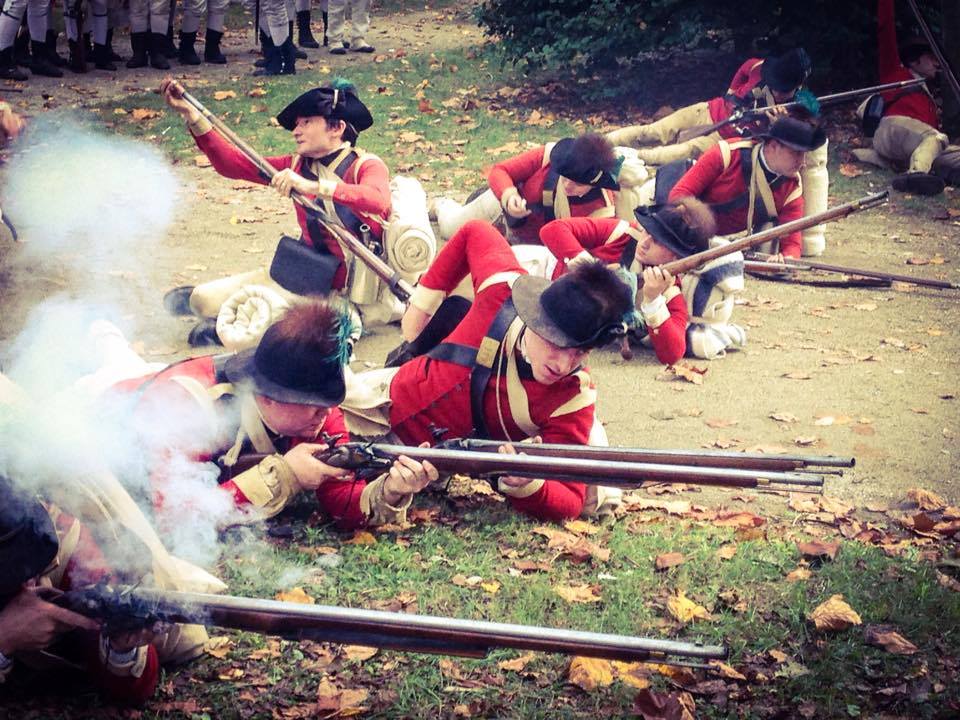
Members of HM 17th Regiment of Infantry engaged in a firefight
Dear Reader,

In the eighteenth century, commanders prized orderly and disciplined fire. The British and Prussian armies were famous for their level of discipline and firepower. These armies particularly valued soldiers who fired by platoons (perhaps 1/8 of the formation firing at a time.) Soldiers and junior officers regularly noted when troops were able to achieve this level of discipline and control on the battlefield. At battlefield as diverse as Mollwitz, Dettingen, Prague, the Sullivan Campaign, and Reichenbach soldiers maintained complicated firings by platoons, divisions, and battalions. [1] We should take these reports seriously: these armies were sometimes able to achieve fire-discipline.

However, it appears from the sources that troops involuntarily used another type of fire: something that in modern English we might call, "firing at will." In the eighteenth century, the English sometimes called this an "irregular," "straggling," or "running fire," the French a, "feu de billebaude" and German sources often refer to it as, "Plackerfeuer" or sometimes "Batalillenfeuer." In practice, this simply meant that troops loaded and fired as quickly as they could, often without orders from officers. It is important to carefully interrogate sources referring to "running fire," as at times this can mean a quick but orderly fire by divisions.  A number of historians have written on this topic, such as Christopher Duffy, David Blackmore, John Houlding, and Matthew Spring.

British Troops firing
I should make it clear: eighteenth-century military theorists often frowned on this type of firing, as it was perhaps less effective than controlled firing by platoons or ranks.  Despite the censure of military theorists, we can observe this type of firing in a number of sources. It was used on eighteenth-century battlefields, across most armies. The British and Prussian armies took steps to mitigate firing at will and it may have occurred less frequently, but sources still report its use in those armies. Perhaps the most famous (and controversial) description of this type of firing comes from Lt. Colonel Russell of the British Guards at the Battle of Dettingen in 1743:
"That the Austrians behaved well also is true; that except one of their battalions which fired only once by platoons, they all fired as irregular as we did; that the English infantry behaved like heroes, and as they were the major part in the action to them the honor of the day is due; that they were under no command by way of Hide Park firing, but that the whole three ranks made a running fire of their own accord, and at the same time with great judgement and skill, stooping all as low as they could, making almost every ball take palce, is true, that the enemy, when expecting our fire, dropped down, which our men perceiving, waited till they got up before they would fire as a confirmation of their coolness as well as bravery, is very certain; that the French fired in the same manner, I mean like running fires, without waiting for words of command, and that Lord Stair did often say he had seen many a battle and never saw the infantry engage in any other manner is as true.[2]
As you might expect, this statement has generated some controversy. David Blackmore has called the eyewitnesses credibility into account and has suggested that Lord Stair's comment may only apply to the French Infantry.[3] The author was two miles away from the battle, but wrote this letter two months after the battle, and would have been able to discuss the events with officers closer to the scene. The statement "Lord Stair did often say," implies that this topic was a matter of conversation, at least among officers, after Dettingen. Even if we assume that Stair's statement only applies to the French, what a statement! Another officer reported on the same battle reported that "the British infantry fired not by platoons but with perpetual volleys from right to left, loading almost as fast as they fired without ceasing so that the French were forced to retreat."[4]


Interpretive Staff representing French Troops at Fort Ticonderoga in 1758

If this practice happened at Dettingen, where else can we observe it in the eighteenth-century? Certainly, this practice was embraced by the French. In the 1750s, the Comte de Chabot argued that allowing soldiers to fire at will was superior to other systems of fire. "The French leave each man the will and power to direct his fire, and all this fire takes good effect... this is the great advantage of French fire."[5] Chabot put forth a number reasons why this type of firing might be effective, including less pressure on officers, less chance of rookie soldiers interfering and disordering the battalion, and many other reasons.[6] Sometimes, the troops would augment firing at will by laying on the ground or on their knees. It seems that the battles of Parma and Guastalla in 1734,  the French and Austrian fought mainly on their knees.[7]   Charles Immanuel de Warnery reports that on this occasion, "the infantry laid on all fours, and fired after the manner of Croats."[8]  Comte Turpin de Crisse, writing in 1770, called the feu de billebaude, "the best of all fires," and advocated that officers facilitate the fire by having men in the rear ranks load, while the men in the front ranks fired.[9] Austrian Veteran Jacob de Cogniazzo discussed the use and disadvantages of an "unregulated fire."[10] Tobias Smollet's military history, published in 1786, refers to straggling and irregular fire in reference to the British and French Infantry in 1758, but since he was not an eyewitness, we should treat these accounts with care.[11] John Knox reports that the French used, "a galling though irregular fire" at Quebec in 1759.[12]

French military author, Jacques, Comte de Guibert, discussed the varieties of infantry fire in his 1772 essay on tactics. He concluded,
Finally, the running fire, [feu de billebaude] is the only one that should take place during a musketry firefight. After two orderly discharges, there is no effort of discipline that can prevent a complicated and regular fire from degenerating into firing at will. This fire is the liveliest and most deadly of all... it is particularly suited to the French way of war. The only thing that is necessary is a signal to cease firing. Formerly, it was thought impossible that this could succeed. During a battle in the last war [the Seven Years' War] I witnessed a regiment execute this fire in a fight with the enemy, by beginning and ending with a drum beat.  This regiment fought everywhere with the same discipline and value.[13]
As I believe the next few sources will show, the Prussians fretted endlessly about their inability to perfect platoon fire, even though they were more successful in achieving this end than other armies. Charles Immanuel de Warnery, writing in 1782, summarizes some of the difficulties in firing with platoons.
"The whole world seems to cry out against our platoon fire, since on the battlefield, we can only seem to do it twice. I agree in part, as I have written elsewhere, and I believe that we could perfect this system with better principles than we have now. The first vice is the size of our platoons: they are much too big, their frontage is too wide. How can we pretend that the officer who commands the platoon, standing on the right can see his command, much less be heard when the [more senior] two officers 50 paces to the rear can barely hear themselves? The noise of the artillery, musketry, and shouts of other platoons officers, the cries of the wounded, blinding and suffocating smoke, the distance from where the [platoon] commander stands to the left of the platoon, all conspires to hide the officer from the platoon. He could not command them even if he had a voice of thunder. These are the primary obstacles which prevent us from firing by platoons, as the system currently exists. It is amazing that noone has tried to fix this. We should also carefully examine initial cause of the disorder which gets into the infantry as soon as it has started to fire. Officers agree that this is quite normal, [once the shooting starts,] they are almost no longer masters of their soldiers."[14]


An image of Scharnhorst later in life, during the Napoleonic Era

 In his 1790 handbook for officers, Prussian General Johann von Scharnhorst, entitles one of his chapter headings: "The Plackerfeuer which must be Avoided."[15] He complains about firing at will for some time, giving detailed descriptions of why it is disadvantageous. "The worst of all these is that a certain order in the battalion has been generally lost during this fire, and that the officers who have lost control of their command can only restore their attention with great difficulty, and often not at all."[16] The extensiveness of his complaints indicate that he was not merely talking from a theoretical standpoint but from first-hand experience. Other Prussian military authorities also addressed the problem of troops involuntarily firing at will.

Berenhorst in 1756
In 1798, Georg Heinrich von Berenhorst reflected on the art of war. He had served on Frederick II of Prussia's staff during the Seven Years' War, and would become an important military figure in the history of the Napoleonic era. When describing infantry firing in battle, he noted,
You begin firing by a salvo, or perhaps firing by platoons for two or three shots. Then a general blazing away follows: the usual rolling fire where everyone fires as quickly as they are loaded. Ranks and files become mixed, those in the first rank could not kneel even if they desired it, and the officers, from the lower ranks to the generals can do nothing more with this mass, until it finally begins moving forwards or backwards.[17] 
This type of firefight is perhaps the kind of combat Ulrich Bräker was referring to when he recalled of the Battle of Lobositz in 1756. A soldier with the Itzenplitz regiment, Bräker recalled that"in great heat and excitement I, I fired away nearly all my sixty rounds. My musket became so warm that I had to carry it by the sling."[18] A Prussian report from the Battle at Soor in 1745 indicates, "In the meantime, our infantry had to endure a strong fire from the small arms [of the enemy.] Our battalions began to fire without orders, the enemy withstood this and continued his fire, which brought disorder into our lines."[19]  Johan Gottfried Hoyer, who would rise to prominence as a Prussian Major-General of the Napoleonic Era, set out to describe military history between 1750 and 1799. In describing infantry fire-tactics, he describes firing by platoons and other various forms of complex firing in the eighteenth-century. Near the end of his description, he comments:
"In fact, all these types of firing were practiced in peacetime on the drill-square, but soldiers hardly used them in serious combat. Once there, everything was abandoned for running fire [plackerfeuer], that is, everyone loaded and shot for himself as fast as he could. This is highly embarrassing, as after one hundred years of practice, we can not bring common soldiers under control, and build an unfeeling shooting-machine. In the heat and confusion of battle, the instrument is only set in motion by the artist's finger. Some exceptions [to the general rule of running fire], which may be found among the Prussian troops, and only with them alone, have been made possible through their ceaseless practice. They can prove nothing against the universality of the idea shared here."[20]
Hessian Troops open fire at Guilford Courthouse

 In North America, there are examples of this type of firefight as well, though during the American War of Independence, the British used bayonet attacks and volley fire. This swift-moving sort of attack sometimes prevented a general breakdown of control. On the other hand, the forces of the young United States appear to have used this tactic frequently.[21] It occasionally happened to the British as well, as British officer Thomas Anburey describes it in his letters from Burgoyne's campaign:
"In this action, I found that all manual exercise is but an ornament, and the only object of importance it can boast of was that of loading, firing, and charging with bayonets: as to the form, the soldiers should be instructed in the best and most expeditious method. Here I cannot help observing to you, whether it proceeded from an idea of self-preservation, or natural instinct, but the soldiers greatly improved the mode they were taught in, as to expedition, for as soon as they primed their pieces, and put the cartridge into the barrel, instead of ramming it down with their rods, they struck the butt end of their piece upon the ground, and bringing it to the present, fired it off. The confusion of a man's ideas during the time of action, brave as he may be, is undoubtedly great..."[22]
This phenomenon, often called, "tap-loading" quickened the rate of fire, but had the potential to
greatly reduced muzzle-velocity. It is possible that the Austrians engaged in this practice at the Battle of Mollwitz in 1741.[23]

2nd Battalion of Light Infantry at Germantown
What does all this mean for wargamers and reenactors? The nature of many wargame rules already simulates this idea, as many rulesets give a bonus for initial firing, and have factors which slowly curtail the effectiveness of extended fire. I would argue that it should be possible for troops who stay stationary and away from the enemy (doing nothing) for a 15 minute period to reclaim this "first fire" bonus, as troops often carried extra flints, and cleaning supplies such as barrel worms, with them on the battlefield. In addition, this represents officers bring the regiment back into a state of order, which was a key part of maintaining fire discipline. In terms of effectiveness, troops who engaged in a running fire should be perhaps marginally more effective in a firefight, but at a severe disadvantage if charged by a swift-moving enemy.

For reenactors, if in a firefight lasting more than 3 volleys, (preferably at longer range) I would suggest that it is perfectly permissible to represent troops engaging in an uncontrolled firing. The unit as a whole should fire as fast as possible until the enemy moves away, or officers manage to restore order. Again, this is perhaps less likely for Prussian and British troops (although still a feature of their experience) and more common for French troops.

If you enjoyed this post, or any of our other posts, please consider liking us on facebook, or following us on twitterConsider checking out our exclusive content on Patreon. Finally, we are dedicated to keeping Kabinettskriege ad-free. In order to assist with this, please consider supporting us via the donate button in the upper right-hand corner of the page. As always:


Thanks for Reading,


Alex Burns

--------------------------------------------------------------------------------------------------------------------------

[1] For examples of these types of reports see: Christopher Duffy, Military Experience in the Age of Reason, 212-213.;  Cook, Journals of the Military Expedition of Major General John Sullivan,  232.; Anonymous, Schreiben eines Hollaendischen Volontairs, 5,; Charles Immanuel de Warnery, Campagnes de Frédéric II, roi de Prusse, de 1756 à 1762, 48.; David Blackmore, Descructive and Formidable, 107.; C. F. Hempel and J. F. Seyfart, Helden- Staats- und Lebens-Geschichte Des Allerdurchlauchtigsten und Grosmächtigsten Fürsten, 260.; Anonymous, Das Treffen bei Reichenbach in Schlesien Zwischen Einem Korps Preussen Unter Den Befehlen Des Herzogs Von Braunschweig-Bevern, 12-13.
[2]Historical Manuscripts Commission,  Report on the manuscripts of Mrs. Franklin-Russell-Astley, of Chequers Court, 278.
[3]Blackmore, Destructive and Formidable, 107.
[4]Lt. Colonel E. A. H. Webb, History of the 12th (The Suffolk) Regiment, 63,
[5] Chabot, Réflexions critiques sur les differens systêmes de tactique de Folard, 9-11.
[6]Ibid, 5-20.
[7] Duffy, Military Experience in the Age of Reason, 213.
[8] Warnery, Des Herrn Generalmajor von Warnery sämtliche Schriften, Vol 2, 211.
[9] Turpin de Crisse, Commentaires sur les memoires de Montecuculi, 179-180
[10] Jacob de Cogniazzo, Geständnisse eines Oesterreichischen Veterans, Vol 1, 169
[11] Tobias Smollet, The History of England from the Revolution to the Death of George the Second, 189, 260.
[12] John Knox, An Historical Journal, vol 2, 128.
[13] Comte de Guibert, Essai général de tactique, 107-108. (He was describing the Royal Deux-Ponts Regiment at Vellinghausen.)
[14] Charles Immanuel de Warnery, Remarques sur plusieurs auteurs militaires et autres, 69-70.
[15] Scharnhorst, Handbook für Officiere, 276.
[16] Ibid, 277.
[17] Georg Berenhorst, Betrachtungen über die Kriegskunst, Vol 1, 255.
[18]Ulrich Bräker, Arme Mann, 150.
[19] Sammlung ungedruckter Nachrichten, Vol 1, 359.
[20] Johann Gottfried Hoyer, Geschichte der Kriegskunst, 102-103
[21] John Simcoe, Simcoe's Military Journal, 45, 146.;  Cook, Journals of the Military Expedition of Major General John Sullivan,  92, 95.
[22] Thomas Anbury, Travels through the Interior Parts of America, 333.
[23] Anonymous, Denckwüdiges Leben und Thaten Beruehmeten Herren Johaan Daniels von Menzel, 80.

Wednesday, January 31, 2018

How Close Ranged were Mid-Eighteenth-Century Firefights?


The British Prepare to Give Fire

Dear Reader,

After the post last week on ammunition expenditure, I noted a number of surprised conversations on social media. If many eighteenth-century battles in Europe, and some in North America, resulted in troops expending their ammunition load (of 30, 40, 60, or 90+ rounds) how could any soldiers be left alive? Or in other words, in battles with such high rates of ammunition expenditure, how could casualties be so low?

The answer to this riddle is not the supposed inaccuracy of muskets, or the failure of soldiers to aim properly, but the ranges at which battles were often fought. When picturing eighteenth-century combat, historians and the public often imagine battle reenactments. In these reenactments, troops often open fire at a very short range, at say 50 or 25 yards. For those unused to picturing such ranges, imagine one half or one-quarter of an American football field. Troops in the eighteenth-century occasionally fired at such close range (such as the Swedish Karoliner of the Great Northern War) but MUCH more frequently, fire-fights developed at a longer range.

Reenactors represent Regiment von Bose at Guilford Courthouse


In the eighteenth-century, the term "musket-shot" usually referred to a distance of around 300 yards. Commanders, concerned about the accuracy of their musketry, often performed tests in peacetime to discover an optimal range.  During the era, such tests were conducted at between 500 yards and 80 yards, 200 yards and 100 yards, and further estimations of 250 yards and 80 yards and 200 yards and 80 yards.[1] I find it strangely compelling that none of these tests felt the need to practice at ranges underneath 80 yards, perhaps implying that combat infrequently reached those close distances.  Leaving aside this theoretical point, let us turn to what the soldiers of the era say in their writings: how close range were eighteenth-century firefights?

Although there is no way to truly measure the surviving descriptions of range scientifically, we can perhaps arrive at a few conclusions regarding the range of eighteenth-century firefights. In the first category, there are skirmishes and premature fires by inexperienced troops. These preliminary skirmishes often occurred at 300 yards, or even a greater distance. As a result, they were not very deadly. During skirmishes in 1759 and 1760, French troops and their native allies opened fire on the British at a range of 300 yards, which seemed quite normal to the participants.[2] During a skirmish on Staten Island in June of 1777, preliminary skirmishing began at about 300 yards.[3] At the Battle of Mollwitz in 1741, the Prussian infantry, inexperienced in real combat, opened fire at the considerable range of 600-800 yards.[4]

A small group of Prussians engaged in a firefight

In Europe during large-scale and determined combat, battle-lines could draw much closer. A good "average" range for combat during the Seven Years' War appears to be between 200 yards and 100 yards. At the Battle of Leuthen in 1757, Ernst von Barsewisch recalled, "As soon as we had cleared the forest, we approached the enemy's second line of battle at a distance of 200 paces [150 yards], which was preparing to march against us. Now... our officers ordered, "Fire! Fire!"[5] Later in the war, Barsewisch recalled being fired on by Croats at a similar distance.[6] The battle lines at Prague in 1757 appear to have been around 150 yards apart.[7] At Hochkirch in 1758,  Johann von Archenholz recalled that the Austrians opened fire at, "a few hundred paces."[8] During a skirmish near Prenzlow in October of 1760, hostile forces approached to within 200 paces [150 yards] of one another.[9]  At the Battle of Vellinghausen in 1761, official reports indicate that battle lines were 150 paces [100 yards] apart, and indicate that this was uncomfortably close.[10] By contrast, when the battle lines closed to 80 yards at the Battle of Minden, the contest was no longer in doubt, and the French began to retreat.[11]

In North America, infantry firefights followed a similar mold. Although the French and Indian War saw few large-scale field battles, a few sources describe infantry firefights. At the Battle of the Plains of Abraham, the French opened fire a very regular European distance, 130 yards.[12] During fighting in the Carribean in 1759, Francis Downman noted that the enemy moved away from the British, "keeping always 200 yards in our front."[13] During the American War of Independence, firefights continued to follow a European pattern, at least with regards to range. During the flank attack at the Battle of Brandywine, both the British and Americans gave fire at 150 yards, and then the British immediately charged at the run with their bayonets.[14] The French attack on St. Lucia in December of 1778 was conducted, "at a distance not less than 280 yards."[15] At the Battle of Camden, John Robert Shaw describes an infantry firefight at 100 yards.[16] At Guilford Courthouse, Roger Lamb reports that the American line opened fire at 140 yards.[17] Berthold Koch, a sergeant with the Von Bose Regiment, recalled receiving fire at 100 yards from the American line.[18]

British Reenactors representing the 2nd Battalion of Light Infantry

Troops were often ordered to hold their fire until very close to the enemy line, but appear to have found it difficult to follow this directive. At the Battle of Germantown in 1777, Joseph Plump Martin describes this in his humorous way:
"Our brigade moved off to the right into the fields. We saw a body of the enemy drawn up behind a rail fence on our right; we immediately formed in line and advanced upon them. Our orders were not to fire till we could see the buttons upon their clothes, but they were so coy that they would not give us an opportunity to be so curious, for they hid their clothes in fire and smoke before we had either time or leisure to examine their buttons."[19]
Here, we find a unit ordered to hold fire until close to the enemy, but because the enemy began returning fire a long range, a longer ranged firefight developed. When troops did approach (or fire) at ranges closer than 100 yards, it was often because a bayonet attack was underway. The Swedish Army in the Great Northern War, and the British Army in the American War of Independence, both made quick moving assaults supported by one close-range volley a standard of their tactical repertoire. Nicholas Creswell describes this type of attack on Staten Island in 1777:
When [the two sides] were about 100 yards from each other, both parties fired, but I did not see any fall. They still advanced to the distance of 40 yards or less and fired again. I then saw a great number fall on both sides. Our people rushed upon them with their Bayonets and the others took to their heels. I heard one of them call out murder lustily, this [would  have been] laughable if the consequence was not serious. A Fresh party immediately fired upon our people but was dispersed and pursued into the woods by a company of the 15th Regmt."[20]
British Troops. The man in front appears to be calling out, murder, lustily.

Here, Nicholas Creswell describes the archetypal bayonet attack as practiced by the British Army in the American War of Independence. If troops moved into 50 yards or closer, it was not to have an extended firefight, but because one or other intended to make an attack with bayonets, or was in the process of doing so.  Some British commanders may have preferred try and close the distance before firing.  Prescriptive source: drill manuals, books offering advice to officers, etc, often instructed soldiers to reserve their fire until at thirty or fifty yards of the enemy.[21] Often, the commanders judged their tactics on a case-by-case basis. At the Prussian 1785 Review, British General Cornwallis criticized Prussians for advancing too close to their mock enemies before opening fire.[22] While a good idea in theory, advancing into such close range under a heavy fire proved difficult to do. Notably, the British seem to have achieved this at the Battle of the Plains of Abraham, but examples of this kind are rare. On average, troops seem to have fired at ranges of 100 yards or longer. 

How might reenactors represent this to the public? Battles should occur at greater ranges. If you are engaged in a standup firefight with other reenactors, and you are much closer than 75 yards away, something is wrong. If the British advance to within 40 yards and fire a volley, they should immediately follow that volley with a bayonet attack and either way, Continental forces should quickly prevail or retreat. Engaging in standup firefights with 20+ rounds expended is acceptable, even laudable. Just make sure that you have a football field or two between you and the opposing forces while doing so.

If you enjoyed this post, or any of our other posts, please consider liking us on facebook, or following us on twitterConsider checking out our exclusive content on Patreon. Finally, we are dedicated to keeping Kabinettskriege ad-free. In order to assist with this, please consider supporting us via the donate button in the upper right-hand corner of the page. As always:


Thanks for Reading,


Alex Burns 


--------------------------------------------------------------------------------------------------------------------------
[1] Duffy, Military Experience in the Age of Reason, 207.; The Army of Frederick the Great, 128.;  Lossow, Denkwürdigkeiten, 260-61, 275.
[2] John Knox, An Historical Journal,  Vol 2, 274.; Vol 1, 305.
[3] Nicholas Creswell, A Man Apart, 170.
[4] Valorie, Quoted in Duffy, Military Experience, 212.
[5] Barsewisch, Meine Kriegs-Erlebnisse, 36.
[6] Ibid, 170.
[7] Johann von Archenholz, Geschischte des Siebenjährige Kriegs , (1911, Leipzig), 52.
[8] Ibid, 187.
[9] Sammlung ungedruckter Nachrichten, Vol 5, 358.
[10] Westfalen, Geschichte der Feldzüge des Herzogs Ferdinand, Vol 5, 623.
[11] Ibid, Vol 3, 486.
[12] Knox, Journal, 70. (The British, it must be said, held their fire until 40 yards on this occasion).
[13] Francis Downman, The Services of Lt. Colonel Francis Downman, 8.
[14] Martin Hunter, Extracts from the Journal of General Sir Martin Hunter, 27.
[15] Downman, The Services, 98.
[16] John Robert Shaw, John Robert Shaw, 31.
[17] Roger Lamb, An Original and Authentic Journal, 350.
[18] Bertold Koch, The Battle of Guilford Courthouse, 7.
[19] Joseph Plumb Martin, Private Yankee Doodle, 72-73.
[20] Creswell, A Man Apart, 170-171
[21] David Blackmore, Destructive and Formidable, 136-137
[22] Charles Cornwallis, Correspondence of Charles, first Marquis Cornwallis, Vol 1, 211.

Thursday, November 30, 2017

How Accurate were Regular Soldiers in the Mid-Eighteenth Century?

A Soldier from the King's Regiment takes aim.

Dear Readers,

Today, I want to touch on a rather controversial subject.* The subject is the infantry fire effectiveness of mid-eighteenth century European and Euro-American armies. At the outset, "shooting at marks" or target practice, was common in many eighteenth-century armies. Specifically, I am examining the accuracy and limitations of firepower regular soldiers from the British and Prussian armies in the 1740-1783 era.  Many people have firm beliefs on this subject and feel that the eighteenth-century musket was a rather poor weapon.

 First of all, by modern standards, the smoothbore musket of the mid-eighteenth century was not a terribly accurate weapon. However, we need to judge it by the standards of its own time, not modern standards. In the eighteenth century, more accurate weapons existed, such as the rifles carried by specialized American troops, and Hessian Jägers. However, those weapons also took a significant time to load.

To see the drawbacks of rifles firsthand, examine this pair of videos. The first shows a musketeer and riflemen loading side by side.  The second video, below, shows how quickly British soldiers could move in order to attack riflemen with bayonets. The rifleman, offscreen, is portrayed by the director of interpretation at Old Fort Niagara, Davis Tierney. Just before the video begins, Davis has fired a shot, incapacitating one soldier. In the remaining 13 seconds, the British troops quickly cross the 100 yards separating the opposing forces.


 When bayonets were not the primary form of attack, how accurate could smoothbore-equipped forces be against one another? The Journal of the American Revolution has featured a number of posts on this topic. The purpose of this post is not to rag on any of the work of these academic, public or amateur historians. In this sense, I use amateur as it is intended to be used: these individuals are interested in the topic for the love of it, and care for it, not simply motivated by the career-orientated goals of a professional historian. As a result of these works, the general public can access information in an easy to digest format suggesting that the soldiers of the eighteenth century fired at marks, and took time to aim. Almost two years ago, living historians at Old Fort Niagara made this video, in order to seriously address this question. Take a few moments to watch the link, or click on the video below.


Firepower was vital to armies of the mid-eighteenth century. A number of authors have amassed evidence regarding the British Army's dedication to accurate fire. In his book, Louisbourg 1758, Hugh Boscawen gives a very detailed description of the British Army honing their accuracy during the Seven Years' War. During the preparations for the attack at Louisbourg, British troops engaged in extensive marksmanship training, mostly consisting of "firing at a marque" or a man sized target. [1]  The 60th of Foot, the Royal American Regiment, was praised for taking good aim during the Seven Years' War in North America.[2] In the course of the American War for Independence, despite their reliance on bayonet tactics British troops frequently practiced shooting at marks, and their Germanic allies followed suit.

British Soldiers take aim near Ft. Niagara
Friedrich Adolf, Freiherr von Riedesel, often called Baron Riedesel by English language historians, left an excellent description of this process.

"General Carleton has decreed that that the army is to practice target shooting or shooting at a goal, I am issuing orders so as to adhere to this as well and as successfully as possible. Each squadron or company is to have some rough boards fastened together, on which a ring of black is to be painted proportionately. The target may be either square or round. Have this target placed at a distance of point blank shot."

"NOW WAIT A MINUTE," you say.  How helpful could target practice be at point blank range? Well, fortunately, we have an exact idea what "point blank" meant in the eighteenth century. It may surprise you. Lewis Lochee, the author of a military treatise in this era, notes that, "the point blank of our firelocks... is known to be about 300 yards." [3] For more on the subject, check out this website. With that in mind, let us return to Baron Riedesel:

"Each man of the company will shoot eight times... a non-commissioned officer standing some distance from the target will mark on the target the location of the shot... the company officers are to gather together to prove to the men how well they can shoot and aim. When each man has shot eight times, the entire target practice will be completed. In the judgement of the captain, the one who has made the best four shots will receive the following prizes..."[4]

Riedesel goes on to list a monetary reward, and also gives instructions that men who are waiting their turn to shoot should be kept at ease, so as not to think of target shooting as a hard duty, but something necessary for military life. If Germans in North America took to target shooting with such alacrity, we should not be surprised to find that German soldiers in Europe also worried about the accuracy of their shots.

Firepower was also a key feature of Prussian infantry tactics, where Frederick II's infantry had won him the province of Silesia in the War of Austrian Succession via their skill at loading the musket.  Wargamers and reenactors debate Frederick's devotion to infantry firepower based on his theoretic military writings, but that his infantry used firepower in both the attack and defense remains clear. Frederick's mind clearly seems to have been made up on the issue by November of 1757, when after witnessing infantry firepower shattering a spontaneous and abortive French assault in columns at the Battle of Rossbach, he famously stated, "If Chevalier Folard had known how it would have turned out, he would have cursed his sacred columns."[5]

Don Troinai's recent interpretation of Freeman's Farm, one of the
few heavy firefights of the American War of Independence

Perhaps unsurprisingly, given their monarch's Enlightenment persuasion, the Prussian's under Frederick undertook a number of studies concerning accuracy of fire during his reign. The first, after the initial battles of the War of Austrian Succession, revealed that Prussian soldiers were firing to low. According to Mauvillon, a military theorist of the time:  "According to my sums, the Prussians fired 650,000 rounds of musketry during their advance at Chotusitz, and the enemy lost scarcely 2,500 dead and as many wounded. If you subtract the men who were killed and wounded by the sword, a great number of rounds must have gone astray!"[6]

Frederick himself was concerned with measuring the accuracy of fire, and as a result his general Winterfeldt had two platoons of Grenadiers fire at a target screen in 1755, scoring between 10 and 13% hits at 300 paces, 16.6% at 200 paces, and 46% at 150 paces.[7] It must be said that this target screen was around 30 feet by 30 feet. Finally, Scharnhorst tested the older musket of Frederick's period in 1813, producing the following results:

(Duffy, Military Experience in the Age of Reason, 207)
However, it is important to realize that none of these tests, no matter how hard they might try, simulated the stress of combat. This prevents these studies from truly helping us understand what occurred on mid-eighteenth century battlefields. For an indication of what that combat might have been like, we can only turn to the documentary evidence. The following two excerpts come from Prussian common soldiers' experiences of the Battle of Lobositz, the first engagement of the European Seven Years' War:
“So the battle began at six o’clock in the morning and dragged on amidst thundering and firing until four in the afternoon, and all the while I stood in such danger that I cannot thank God enough for my health. In the very first cannon shots {my friend} Krumpholtz took a cannonball through his head and the half of it was blown away, he was standing just beside me, and the brains and skull of Krumpholtz sprayed into my face and the gun was blown to pieces from my shoulder, but I, praise God, was uninjured. Now, dear wife, I cannot possibly describe what happened, for the shooting on both sides was so great, that no-one could hear a word of what anyone was saying, and we didn’t see and hear just a thousand bullets, but many thousands. But as we got into the afternoon, the enemy took flight and God gave us the victory. And as we came forward into the field, we saw men lying, not just one, but 3 or 4 lying on top of each other, some dead with their heads gone, others short of both legs, or their arms missing, in short, it was a horrifying sight. Now, dear child, just think of how we must have felt, we who had been led meekly to the slaughterhouse without the faintest inkling of what was to come.” [8]
Prussian Soldiers, from a 1730s painting
Another Prussian soldier recalled:
     “Now an indescribable slaughter took place, before we could drive the Pandurs out from among the trees. Our advance troops suffered severely, but the rear ranks pressed after them at breakneck speed, until at last all had gained the height. There we had to go stumbling over heaps of dead and wounded. Then the Pandurs went helter-skelter down the hill, jumping down over one wall after another, down to the level ground. Our native Prussians and Brandenburgers sprang upon the Pandurs like Furies. I too was quite beside myself with heat and excitement, and conscious of no fear or repugnance I loosed off nearly all my sixty cartridges without stopping, until my flintlock became almost red-hot and I had to carry it by the sling; yet I do not believe that I hurt any living thing, it all went into thin air. “[9]
With these examples in mind, the chaos of eighteenth-century warfare can begin to seem a bit more real. These passages help explain Mauvillon's discrepancy between shots expended and casualties inflicted. Eighteenth-Century battlefields were truly chaotic places, and acheiving accuracy with a smoothbore weapon was difficult at the best of times.   All that the Prussians (or any other European soldier) could hope for was a comparative advantage in firepower which would drive off the enemy force. And, as a result of thorough training, the Prussians and other armies often achieved that comparative advantage.

Infantry firepower decided many of the battles of the eighteenth century, and as a result, helped shape our world. While, "Muzzle-Velocity" military history may be out of favor with academic historians, it remains a portion of lived human experience, and as a result, a topic worthy of historical thought and explanation.

If you enjoyed this post, or any of our other posts, please consider liking us on facebook,  or following us on twitter. Finally, we are dedicated to keeping Kabinettskriege ad-free. In order to assist with this, please consider supporting us via the donate button in the upper right-hand corner of the page. As always:

Thanks for Reading,


Alex Burns


--------------------------------------------------------------------------------------------------------------------------
*This is a largely updated version of an older post.
[1] Hugh Boscawen, Louisbourg 1758, 140.
[2] Alexander Campbell, The Royal American Regiment, 110.
[3] Lewis Lochee. Elements of Field Fortification, 1783,  37
[4] Hessian Documents of the American Revolution, Microform, "Riedesel's Order Book", 21.
[5] Quoted in Duffy, Prussia's Glory, 80.
[6] Translation  by Christopher Duffy, quoted in Military Experience in the Age of Reason, 209: Mauvillon, Histoire de la derniere guerre de Boheme, Vol. 1,  100-101
[7] Duffy, Army of Frederick the Great, 128.
[8] Bleckwenn, Preussische Soldatenbriefe , 13.
[9] Ulrich Bräker, Lebensgeschichte Und Natürliche Abentheuer Eines Armen Mannes Von Tockenburg (Zurich: Hans Heinrich Füssli, 1789), 150.