Showing posts with label Eighteenth Century. Show all posts

Friday, August 14, 2020

Urban Warfare in the Eighteenth Century


Two members of HM 40th Foot / 2nd Battalion LI - "Bloodhounds" take cover
in Cliveden, photo credit Suzanne Shaw
Dear Reader,

Today, we are going to examine an understudied topic in eighteenth-century military history: urban warfare. Although the eighteenth century was an age where generals preferred to fight large field battles and conduct formal sieges, the century did indeed see its share of urban warfare, that is to say, troops fighting house to house in built-up areas. Troops would occasionally find themselves fighting in village houses during large field battles, but addressing that is not the main goal of my post today. Rather, I seek to understand what happened when armies clashed in actual urban environments, towns or cities as they would have been identified in the eighteenth century.

Encounters of this sort are rare, but not unheard of. Principally, in writing this post, I examined the fight at Preston in 1715, the Austrian attack on Velletri in 1744, and the American assault on Quebec in 1775. At Preston, the Hanoverians attacked a unfortified town that a small Jacobite army had hastily attempted to barricade. At Velletri, an Austrian army attempted to capture the entourage of the future King Charles III of Spain. At Quebec, an initially successful assault on a fortified city bogged down in heavy street fighting. These experiences will be supplements by descriptions of village fighting in larger field battles. With these sources of experience in mind, what common experiences can we identify between these actions?

When fighting in an urban environment, soldiers quickly sought out cover, usually by barricading themselves in houses. At Preston in 1715, when the Jacobite commander William  MacIntosh was asked why he chose to defend Preston rather than a nearby ridge, explained, "the body of the town was the security of the army."[1] At Velletri in 1744, civilians, seeing the fire that Austrian troops were spreading in the town, began firing at the troops in the street from barricaded houses. The Austrians soon followed suite, taking cover in whatever houses they could force open.[2] Events followed the same pattern at Quebec in 1775, when French civilians, loyal to the crown, opened fire on rebel troops marching through the lower town. In the words of a junior British officer observing the scene, "some of the French who took to the houses... ke[pt] gauling them so as obliged the rebels also to take to the houses... where they remained and returned our fire."[3] Larger buildings were valued as observation points and firing platforms.[4] At confused fighting at Leuthen and Hochkirch in the Seven Years War, Austrian and Prussian soldiers sought any cover they could find, and used a high churchyard walls in these villages as miniature fortresses.[5] At the Battle of Blenheim/Höchstadt in 1704, the French attempted to use the village of Blenheim (Blindheim) itself as a strongpoint.[6]

Schlacht bei Hochkirch, Carl Röchling
In addition to houses, soldiers constructed street barricades and fighting positions. Searching for cover, soldiers used whatever they could find in order to provide cover for themselves. John Deane helpfully lists the materials used for the construction of street barricades at Blenheim: "trees, planks, coffers, chests, wagons, carts and palisades[.]"[7] At Leuthen in 1757, Austrians troops were told off, in the midst of battle, to construct fighting positions in the village.[8] At Preston in 1715, the Jacobites constructed numerous barricades across the streets, encompassing multiple lines of defense. In a running battle that lasted for days, the Hanoverians followed suit by building trenches and barricades of their own.[9] At Preston, some of these barricades were large enough for hundreds of men to take shelter behind.

In the course of the natural use of houses as cover by soldiers, structures were almost always burned. Fire had important tactical uses in the eighteenth century. Obviously, only immobile and suicidal men would remain in a burning structure during a fight, and many wounded men burned to death in these horrible encounters.[10] Soldiers set buildings on fire intentionally, in order to drive out defenders, at Preston and Velletri.[11] Fire, of course, spread unintentionally from there. Soldiers also believed that the smoke that fires generated could be employed as cover, essentially as a smoke screen. At Blenheim in 1704, and Preston in 1715, fires were intentionally set to give concealment to friendly forces. At Blenheim, John Deane relates that, "The village was sett on fire before we came to it by the enemy whereby they though to have blinded our gunners[.]"[12] At Preston, both the Hanoverians and the Jacobites used the smoke of burning buildings as cover, and may have set fire intentionally for that purpose.[13]

The Battle of Quebec, F. H. Wellington

In this urban setting, artillery played the role of supporting weapons, clearing streets, and demolishing enemy strongpoints.  Thomas Ainslee, a British officer at Quebec in 1775, described the process of taking a large house on a city street with American rebel troops inside:
Capt. Nairn...had by this time run up a ladder and entered a window at the end of the corner house where the enemy were posted, there they killed one and took another prisoner and my detachment in the other street having by my direction enlarged the post of one of the guns... brought it to bear on the house where most of them were. I ordered it to be fired and as it was loaded with canister and grape shott, it killed Capt. Hendrick of the Rifllers, wounded Capt. Lamb... and several others in the room all of these circumstances together... obliged them to lay down their arms and surrender.[14]
At Trenton in 1776, the American continental army used artillery to stop enemy movement on village streets, this tactic was also used by the Austrians at Hochkirch in 1758.[15] At Preston in 1715, cannons were used extensively to sweep streets of enemy forces, as well as fire on and demolish enemy strong points.[16] Henry Knox's suggestion to use artillery on the Cliveden at Germantown in 1777 may fit into this type of tactical thinking.

Heavy fighting in an urban setting usually led to a high number of enemy troops surrendering, when cover and dense terrain meant that flight was impossible. At Preston in 1715, the battle ended when after four days of resistance, the entirety of the Jacobite Army surrendered.[17] At Velletri, the fighting in the town netted the Austrians almost 600 prisoners. [18] At Quebec in 1775, more than one third of Montgomery's initial force, over 400 men, were captured by the British and their Canadian allies.[19]

Finally, the consequences for the urban environment involved in the fighting were usually severe. At Velletri in 1744, civilians were accidentally shot on one occasion, and looting by Austrian Grenzer was widespread.[20] In Preston, the prolonged nature of the fighting caused widespread destruction, and a commission for civilian relief set up after the end of hostilities received 226 requests from the inhabitants of Preston for relief, totalling sums of approximately £6,500, or approximately $850,000 today.[21]

Fighting in an urban environment was provided eighteenth-century soldiers with an odd mix of contradictions. In dense terrain, soldiers were more likely to have an abundance of cover, and use that cover effectively. Fire was used both offensively and defensively, to provide cover from the enemy, and drive the enemy from buildings. Artillery was employed with an impressive degree of tactical flexibility,  to control enemy movement and reduce enemy strong points. Finally, despite the greater cover afforded by urban environments, soldiers were much more likely to be captured by the enemy in large numbers if they lost the engagement. Fighting in urban environments also had the possibility of causing great damage to civilian property.  By and large, eighteenth-century warfare in an urban environment possess more than a passing continuity to the experiences of urban warfare in the modern world.

If you enjoyed this post, or any of our other posts, please consider liking us on facebook, or following us on twitterConsider checking out our exclusive content on Patreon. Finally, we are dedicated to keeping Kabinettskriege ad-free. In order to assist with this, please consider supporting us via the donate button in the upper right-hand corner of the page. As always:

Thanks for Reading, 


Alex Burns


-----------------------------------------------------------------------------------------------

[1] Charles Hardwick, History of the Borough of Preston and Its Environs, 224.
[2] Christopher Duffy, The Wild Goose and the Eagle, (2019 edition), 85-6.
[3] MSS L2019F60, Society of the Cincinnati Library, (Thomas Ainslee's account of the Siege of Quebec)
[4]Charles Hardwick, History of the Borough of Preston and Its Environs, 225-6.
[5] Christopher Duffy, Army of Frederick the Great, (1996 edition) 272, 284.
[6] John Deane, A Journal of Marlborough's Campaigns, 11.
[7] Ibid.
[8]Christopher Duffy, Prussia's Glory, 158.
[9] Charles Hardwick, History of the Borough of Preston and Its Environs, 224-228.
[10] John Deane, A Journal of Marlborough's Campaigns, 11.
[11]Charles Hardwick, History of the Borough of Preston and Its Environs, 229; Duffy, The Wild Goose and the Eagle, 85.
[12] John Deane, A Journal of Marlborough's Campaigns, 11.
[13]Charles Hardwick, History of the Borough of Preston and Its Environs, 229
[14]MSS L2019F60, Society of the Cincinnati Library, (Thomas Ainslee's account of the Siege of Quebec)
[15]Charles Hardwick, History of the Borough of Preston and Its Environs, 225, 227
[16] David Hackett Fisher, Washington's Crossing, 244; Christopher Duffy, Army of Frederick the Great, (1996 edition), 284.
[17] Ibid, 233.
[18]Christopher Duffy, The Wild Goose and the Eagle, (2019 edition), 87.
[19]MSS L2019F60, Society of the Cincinnati Library, (Thomas Ainslee's account of the Siege of Quebec)
[20] Christopher Duffy, The Wild Goose and the Eagle, (2019 edition), 86.
[21]Charles Hardwick, History of the Borough of Preston and Its Environs, 240

Thursday, May 28, 2020

"Tricorne Hat": How Accurate is this Term?

A Gaggle of Hats
Dear Reader,

There is no more iconic symbol and image of the eighteenth century than the three-cornered, or Tricorne, hat. Americans imagine their founding fathers wearing such hats, it is the hat of Frederick and Catherine the Great, George II and III; it is the hat worn in the art of William Hogarth and David Morier. Today, the image of people wearing tricorne hats is utilized by historic sites, media companies, and football teams.

Detail of a portrait of Frederick II of Hesse-Cassel, (DHM)
This post is not an effort to get into the various historic styles and designs of the so-called Tricorne hat. Skilled artisans such as M. Brenckle, Geo. Franks, and Andy Kirk have brought the reproduction of the cocked hat to an art form, and are highly familiar with the intricacies of shaping and cocking these hats. Once again, Matt Keagle's work is perhaps the best place to turn for the military material culture of the eighteenth century. These historians, artisans, and makers have provided many resources for those seeking to better understand this particular type of eighteenth-century hat. Rather, this post is an effort to understand how a term which was not used in the eighteenth century, "tricorne hat" has overwhelmingly dominated our language, obscuring the original English-language term for this hat: "cocked hat."  Should we continue to use this term, if it  was not employed by contemporaries? I'll first offer some reasons why the term could be replaced with more accurate language, and then provide a brief rejoinder in defense of the tricone.

George II by artist David Morier

1) The term "tricone hat" was not used in the eighteenth century. 

The earliest English language usage of the term tricorne hat (and I am open to correction if you can date it earlier) appears to be in the mid-nineteenth century, with many examples from the 1860s and 1870s. In French and German, the term appears as early as the 1830s.[1] So, if people living in the eighteenth century did not call these hats, "tricorne hats" what did they call them?

P. J. de Loutherbourg simply used the term "hat" to describe this headgear


The eighteenth-century three-cornered hat, the "cocked hat", was ubiquitous across Europe. Perhaps not surprisingly, many contemporaries simply called this design a "hat", as it was the most common form of male headwear across much of the eighteenth century. Where more specialized terms existed, they usually described specific hat designs.

Englishmen occasionally used the term, "three-cornered" when describing their hats in contrast to the hats of other cultures, but did not use the term tricorne.[2] Perhaps surprisingly to us, they used the term "three-cornered cap" more frequently than hat. By the end of the eighteenth century, the term, "three cornered hat" became more common, as contemporaries tried to distinguish this garment from other emerging sorts of headwear.[3]

British Military-Style Cocked Hat, 1750s (M. Brenkle)
In English, the term "cocked hat" was used to refer to three pointed hats. This term referred to their method of design: there were multiple ways of "cocking" a hat to produce a variety of different styles. Again, the most common term employed was simply "hat", but "cocked hat" was used when further explanation was required.[4] A dictionary of 1758 gives this entry for "Slouched: As a slouched hat. A Hat not cocked up."[5]

2) The modern term "tricorne hat" brings together a group of hats which contemporaries often viewed as distinct.   

Reproduced Hat of the 8th Regiment of Foot (M. Brenkle)
This hat appears to be tending towards the Ramilies/l'androsmane style
There was a great variety in the types of cocked hats worn in the eighteenth century, and these hats possessed different names across the continent. By the 1780s, for example, the various languages of Europe developed terms for styles of cocked hats. The Austrian military leader Ludwig Andreas von Khevenhüller was associated with a particular style, late in the century the French spoke of a "chapeau à l'androsmane," and the British talked of the Monmouth cock and Ramilies cock.[6] The English referred to the style of hat worn by the French ambassador as, "Nivernois" style, after the name of the ambassador.[7]  A poem from 1756 indicated that "a fierce cock'd hat, and modish ramilie" was the necessary headgear of a young soldier.[8]  Late in the century, a French style-tract commented: "The Englishmen may be represented with the Androsmane style of cock, with a massive black-ribbon cockade worn on the left side."[9]
A variety of hats are on display in the Voelkertaefel, from left:
French, Italian, German, English, and Swedish 
All this points to a wide variety of styles, which evolved across the European continent during the eighteenth century. Lumping these hats together as "tricorne" hats may be a useful shorthand in some cases, but often obscures the rich complexity present across the decades and locales of eighteenth century Europe.

3) The term "tricorne" is used as shorthand for hats between 1700 and 1800, making the eighteenth-century appear static and monolithic to the general public.  

Much of the specialized language for cocked hats before 1780 was designed to differentiate various unique styles and cocks. Only at the end of the eighteenth century did the critics of tricorne hats begin to represent them as monolithic and similar. As it was a symbol of wealth and good standing, the popular mood began to turn against the three-cornered hat in the 1790s. An anonymous author wrote the following in The New-York Weekly Magazine:

Among the many things invented by man for his use, none perhaps is more ridiculous than the three-cornered hat at present used by some persons. That it affords but an inconsiderable shelter to the head, is a truth scarcely to be denied; and that the face of him who wears it remains exposed to the piercing rays of the sun, is equally true. If our ancestors deemed it a conveniency to wear the hats in question, experience teaches us at the present day, their great inutility: And shall we then willing smile on those customs which (tho' formerly practiced) proves at present highly injurious? No; Let us cosult our own feelings, and not the habits of former times.-- Common sense points out their inconsistency, and reason mocks the stupidity of him who madly submits to be ruled by custom, that tyrant of the human mind, to whose government three-fourths of this creation foolishly subscribe their assent. Again, the weight which is comprised in a hat of that size, is a sufficient argument for their abolition. Wherein then can the utility of such an unwieldy machine consist? Is not the round hat more becoming? And does it not finally prove to the head by far the  best covering? The contrary cannot be urged unless through prejudice or selfishness. That it looks respectable and sacred, may be urged in favour of it; to this I reply, that if to be impudent constitutes either of those characters, the three cornered hat has the great good fortune to be superior to the other. It may be further advanced in its favour, that by letting down its brings it will answer the purpose of an umbrella in a hot summer day: ture that for size it may, but where is the person that would not rather make use of the real than the fictitious machine? Why was the pains taken for the invention of an umbrella, if the hat could be made to answer the same views? Was it not because the hat attracting the rays of the sun, was found to be injurious to the eyes, and therefore recourse was had to a machine which proved not only shelter from the sun, but to the eyes far more beneficial. To conclude, nothing but a false pride, and a desire to be conspicuous, could ever induce a person thus inconsistently to use that which will finally prove his folly. -- TRYUNCULUS, New-York, July 7, 1796.[10] 
Just as the revolutionaries toppled the monarchies of Europe, the great push to end social deference finally destroyed the three-cornered hat.

recreated American cocked hats
Proponents of the term tricorne might offer some reasons for the terms continued usage. First of all, it is certainly an iconic term, which immediately connects to a wide audience. This is perhaps the best argument for continued usage of the term. Second, the term tricorne hat is a vivid linguistic descriptor: the meaning is instantly clear. The term "cocked hat" could bring a variety of images into one's mind, tricone, or three-cornered hat brings the meaning clearly into view. This isn't a fire-proof reason for employing the term, after all, it would be more linguistically descriptive to call 20th-century military tanks, "roller-shooters". Regardless, I am confident that the term "tricorne" will be used to refer to these hats for a long time to come.

The cocked hat is an iconic symbol of a fascinating historical era. Regardless of what you choose to call this hat, I hope this post has providing some thoughts on the precision of language when it comes to historical objects, and how terms which are completely ubiquitous today may not reflect the terminology contemporaries used to describe these objects.

If you enjoyed this post, or any of our other posts, please consider liking us on facebook, or following us on twitterConsider checking out our exclusive content on Patreon. Finally, we are dedicated to keeping Kabinettskriege ad-free. In order to assist with this, please consider supporting us via the donate button in the upper right-hand corner of the page. As always:

Thanks for Reading, 


Alex Burns


--------------------------------------------------------------------------------
[1] Anon, Archives historiques et littéraires du Nord de la France (Vol III, 1833) 45. Anon, Das Ausland: Eine Wochenschrift für Kunde, (Vol 6, 1833), 965.
[2]See, Mortimer Harley, The Harleian Miscellany, (1745) 555; Robert Ainsworth, Thesairis Linguae Latinae Compendiarius, (1752), 113; John Henry Grose, A Voyage to the East Indies, (1757), 274; 
[3]See Tobias Smolett, The Critical Review, (1796), 406; Voltaire, The History of Candide, Translated from the French (1796), 42; Anon, "On the Three-Cornered Hat" The New-York Weekly Magazine, (Vol II, Wednesday, July 20th, 1796), 19.  
[4] See, Anon, The Gentleman's Magazine, (Vol XXIII, 1753), 187; Anon, The Batchelor: Or Speculations of Jeoffry Wagstaffe, Esq, (1769). 129.
[5] Anon, A Pocket Dictionary; Or Complete English Expositor, (1758), 361.
[6] See, Anon, The British Magazine, (1746) 309. Anon, The Gentleman's Magazine, (Vol XXVI, 1756) 490, Anon, Magasin des modes noevelles, (1787) 5; Anon, "The Spectator" Harrison's British Classicks, (Vol IV, Thursday, July 26th 1786) 251.
[7]William Hickey, Memoirs, (Vol I) 140.
[8]Anon, "The Spectator" Harrison's British Classicks, (Vol IV, Thursday, July 26th 1786) 251.
[9]Anon, Magasin des modes noevelles, (1787) 5;
[10]Anon, "On the Three-Cornered Hat" The New-York Weekly Magazine, (Vol II, Wednesday, July 20th, 1796), 19.  


Tuesday, March 17, 2020

Scandal in the Guards: Lt. Colonel Dury confesses to his Wife regarding his Second Family


A Detail from George II at Dettingen


Dear Reader,

Today, I want to examine a document I recently examined in the United Kingdom. In it, we find a British officer in a rather awkward situation. Lt. Col. Alexander Dury of the Guards, fearing he might be killed in action, wrote a letter to his wife, Isabella, telling her about his other family. In this letter, we see a fascinating bundle of eighteenth-century ideas regarding marriage, sex, religion, death, and family obligations. Without further adieu, here is the letter:

-------------------------------------------------------------------------------------------

My Dear Bell,
 Before I left London, I took care to make a proper
disposition of my worldly concerns, and in such a manner as
I hope you are satisfied with, but one thing remains which I
cannot now avoid mentioning as I am going upon Service, and
for the concealment of which, I ask pardon of God and of yourself
and indeed my inducement for concealing it from you, was to
avoid giving you uneasiness of any kind, especially as
the case was without Remedy. Indeed at the time I was
solliciting you to marry I ought then to have acquainted you
with it, but my fears of losing you prevailed over reason
and I was also by a friend of both to conceal it,
which I listened to the sooner, as I did not entail any charge
on you having a little income from my Company (which
I never mentioned to you) over and above the 1000 a year
which I declared to you my income consisted of vis. 500
from H.R.H. the Duke, and 500 as a Lt. Colonel to the Regiment
so that the balance of the accounts of my company, amounting
to 70 or 80 pounds I applied for the maintenance of one Mrs.
Barbara Moncrieffe, and her two Children. The said Barbara
goes by the name of Thompson and lives at one Mrs. Walton
two doors beyond the white houses in Marsham Street
Westminister. She was formerly a servant in my Mothers'
Family, and I was so wicked, as by frequently importunity and
opportunity to seduce her, and she was with Child by me.
From that time I thought myself bound, from principle
to take care of her and of her Child, which I did; the Child
died, but continuing to go to her from time to time, she was
delivered of another son, the latter end of December 1746
who was christened Henry, two years after that she lay in of
a Daughter who was christened Barbara, and they both go by
the name of Thompson as well as the mother. I never
gave the least hope of expectation to the mother of her ever
becoming my wife, but as I have great reason to think
she has always been honest to me, and that she has taken
great and proper care of her Children, I cannot help
recommending her and them to your protection, and if
as they grow up, you would be so good as to put them out apprentices to some
business, to prevent their ruin by being idea and destitute,
it will be a great act of charity, and of Regard to me.
The boy, who is now between 11 and 12 years of age, writes a good
hand, has been educated at a school at Stanmore where
he is now, and my design was to procure an Ensigns
Commission for him in a marching Regiment, but I now fear
that cannot be done. I can solemnly assure you my Dear
Bell, since the time of our marriage and from some weeks
before I have not seen her, nor her Children; I have received
Letters from her, and have wrote to her, to direct her in the
management of her family, but never anything more.
I could wish my Dear you would allow her 30 or 40 pounds
a year, viz. 20 for the boy, ten for her self, and ten for the
Girl, till such time as they are able to procure a livelihood
for themselves, and may God reward you for such an Act of
Charity...
Mr. Davies, Surgeon to the
Regiment, knows where she lives, the last time she received
any money from me, she came to him for it. I had never
before paid it to her, and did it then at my Request, He
may (and will very readily, I am persuaded out of regard
for me) carry any message to her...

Once more forgive my deceit, in concealing this circumstance
of my Life from your knowledge, consider the
motive for it, and pardon it not only pardon, but pray
to the almighty for my forgiveness, from this, and many
other Crimes I have been guilty off, both of Omission
and commission and may the same Merciful Father of
us all ever watch over you and our Child, Guard and
protect you both,  Amen.

Alex Dury.

--------------------------------------------------------------------------------------------------

Tragically, Lt. Colonel Dury was killed in action at St. Malo in September of 1758, only months after he had written this letter. No record of what happened to his second family survives. This letter is preserved in the British National Army Museum at Chelsea.

If you enjoyed this post, or any of our other posts, please consider liking us on facebook, or following us on twitterConsider checking out our exclusive content on Patreon. Finally, we are dedicated to keeping Kabinettskriege ad-free. In order to assist with this, please consider supporting us via the donate button in the upper right-hand corner of the page. As always:

Thanks for Reading, 


Alex Burns

Friday, August 30, 2019

Black Soldiers in European Armies during the Eighteenth Century

An excellent reenactor from HM 17th Regiment of Infantry,
Photo Credit: Wilson Freeman /Drifting Focus Photography courtesy of H
M 17th Regiment of Infantry
Dear Reader,

This post is designed to give an overview of the history of African soldiers fighting in Europe during the eighteenth century. It purposely does not include soldiers who fought in all-black regiments, which occurred at the end of this era in the British Army, and American Continental Army. For excellent research into that important topic, see the work of Professsor Norman Roger Buckley, who has written extensively on the West Indian Regiments of the British Army in the 1790s-1810s. Rather, this post examines a smaller number of men of color, often elusive and difficult to track, who served in particular roles in largely white regiments of European Armies.

Writing on the history of slavery and enslaved people, even slavery which is disconnected from how it is traditionally seen in the western hemisphere, requires a great deal of care. I hope this post respectfully explores some of the complexities of the service of these men, who both experienced a lack of freedom, and were sometimes able to use their military service to improve their social and economic status. Black soldiers fighting in European armies during the eighteenth century possessed a wide range of experiences: as human beings, they were often given as gifts, they acquired powerful patrons, were the object of stares on the part of Europeans who had previously not encountered Africans, sometimes earned higher wages than white soldiers, died of diseases contracted while in service, married and had children, and in at least one case, rose to high rank and power as a result of patronage. This post attempts to show the range of possibilities for these men of color, without obscuring the lack of freedom and various difficulties which they faced.

Hessian Drummer painted after the American War of Independence
There has been a great deal of research on Africans and African-Americans in eighteenth century armies, and the work of these historians, particularly Hugh Barnes, Judith L.Van Buskirk, Peter Fryer,  Alan Gilbert, George Fenwick Jones, Rebekka von Mallinckrodt, and John U. Rees has been very helpful in providing a framework for this post.[1] For the assistance I received while researching this post, I would like to thank Jason Doerflein, Dr. Thomasz Karpiński, and Arthur Yushkevich.

In the mid-eighteenth century most European armies included a few black soldiers, who were often employed as musicians, particularly as drummers and fifers. A few of these men also served as laborers, and there is evidence to suggest that in some armies, small numbers were employed in combat roles. These men were not always willingly enlisted into the armed forces they served in: many were purchased in Africa or North America for inclusion as symbols of prestige. The use of these men, particularly their uniforms, was a part of a larger process of emulating the fashion of the Ottoman Empire, a craze which swept through Europe during the early part of the eighteenth century.[2] Having black men as musicians was a mark of pride for regimental commanders, and demonstrated the wealth and power of the colonel-proprietors able to acquire them. Although in some states actually Ottoman Turkish musicians were initially imported, these were swiftly replaced African musicians, whose involvement in European armies pre-dated the Turkish craze, but was greatly increased by it.[3] In an odd moment in European history, Africans (as well as African-Americans born in the American Colonies) became drawn into the European military experience as a result of court fascination with Ottoman Military bands.[4]

These men were often purchased, and thus experienced part of the painful world of slavery. They drew a wage.  Particularly in the Prussian service, data from 1747 indicates that black musicians were paid 4 Thalers per month, double the wage of white musketeers who served alongside them.[5] Where records are available, it appears these men were discharged and free at the end of their service.[6] Some African-Americans, by contrast, used the desire for "exotic" bands on the part of European officers for their own ends: joining European military forces in order to escape from the world of enslavement.  There is a small amount of evidence to suggest that some were even able to draw on the institutions available for the care of former soldiers, such as the Royal Hospital at Chelsea.

An African Musician in Wilkie's "Reading of the Waterloo Dispatch
Although the practice of acquiring African musicians is most famous in American circles as a result of the American War of Independence, the practice long pre-dates this. This post will look at the experience of Africans in the Russian and Prussian military, before turning to the more familiar British and Hessian armies.

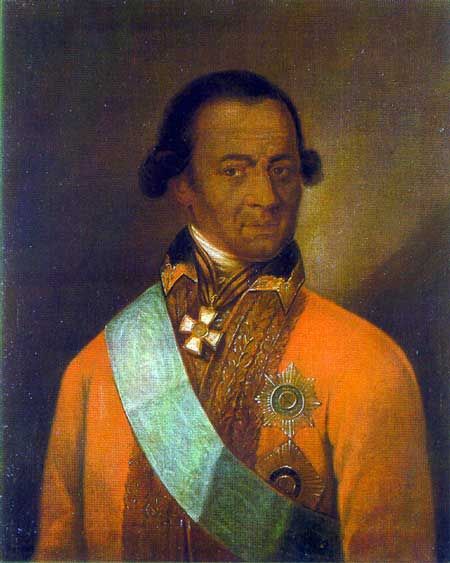
Disputed portrait of Abram Petrovich Gannibal.
Author Hugh Barnes indicates that this may be a portrait of a white officer 
Russian Army: 
Though the Russian court imported an Ottoman military band in 1725, there are few images of African soldiers serving as musicians in the Russian Army. However, a small number of Africans found their way into Russian service as well. The most famous of these is Abram Petrovich Gannibal, a Russian Major General who served in the early-eighteenth century, and is credited with inspiring Alexander Suvorov to become a soldier. Though his exact place of origin in Africa is disputed (both Medri Bahri, in present-day Eritria, as well as Logone-Birni in modern Cameroon have been suggested), Gannibal was brought as an enslaved person to Istanbul, and sent to Russian as a gift to Tsar Peter I in 1704. Likely born in 1696-1698, the Tsar chose to adopt Gannibal as his godson. With this adoption and patronage, Gannibal traveled to France to learn modern military science, and he served in the French Army during the War of the Quadruple Alliance. 

Gannibal was exiled to Siberia after Peter I's death, but continued to demonstrate his excellence by designing fortresses for the Russian state. With the succession of Elizabeth Petrovna to the throne in 1741, Gannibal returned to power, was promoted to Major General, and briefly became the governor of Estonia. His rise to power came with privileges, he became the owner of several estates, and as a result, owned many families of serfs.[7] His power lasted for the lifetime of Elizabeth Petrovna, he was General in Chief of Russian forces in 1762, but retired to his estate after Empress Elizabeth died in January of that year. He lived on his estates until his death in 1781.
Ivan Gannibal, the eldest son of Abram Gannibal
Abram Gannibal married twice, and had ten children with his second wife, a Swedish woman named Christina Regina Siöberg. Their oldest son, pictured above, Ivan Gannibal, also led a distinguished military career. He served as an officer in the Russian Navy, commanding several important naval actions and sieges, but also designed and constructed fortresses, like his father. Also like his father, he achieved the position of General in Chief of the Russian Army.

The fifer is likely an African, based upon his lack
of a queue, and signifying headgear
Prussian Army:
The history of African soldier-musicians in the Prussian Army goes back to seventeenth century, when in 1685, Frederick William, the Elector of Brandenburg, brought a drummer, whose European name was Ludwig Besemann, into his army. In 1737, another African soldier, Josef Sancta Maria, was a drummer in Dragoon Regiment von Moellendorf.[8] It appears that Frederick William I and Frederick II ("the Great") of Prussia maintained a Paukenwagen or a mobile drum platform, for their artillery.[9] You can see a Dutch example of this type of carriage from the era of William III below.


There is a great deal of visual evidence that Prussian armies included African drummers. However, Ottoman emissaries were not impressed by Frederick II's efforts to imitate their bands. After a presentation of a military band, Ottoman Ambassador Achmed Effendi shook his head, and simply commented to the Prussian king, "It is not Turkish."[10] Like in other European states, it seems that African musicians were primarily concentrated in elite regiments, such as Frederick II's Garde, which had a corps of black fifers.

A detail of the image above from the
archival collection of Hans Bleckwenn[11]

However, there were also a number of African Musicians in other regiments, such as the Regiment Markgraf Karl (IR 7).[12] African musicians also served in the Cuirassier Regiment Markgraf Friedrich von Brandenburg (CR 5).[13] Many of these soldiers served in the famous Lange-Kerls of Frederick William I.

An African Drummer from IR 6.
archival collection of Hans Bleckwenn[14]

British Army: 
Historian Peter Fryer provides a clear window into African soldier-musicians in his book: Staying Power: The History of Black People in Britain. He begins his excellent summary of this topic: "The use of black musicians as military bandsmen, a tradition which reached its height toward the end of the eighteenth century, seems to have started in the second half of the seventeenth."[15] As early as 1679, African musicians served in British Regiments, and served as drummers in cavalry regiments as early as 1685.

Despite African soldiers relatively frequent service as musicians in Europeans armies, they still faced surprise from local people. Ensign Hugh Mackay of the 13th Regiment of Foot described the surprise of townspeople in the Netherlands at seeing African musicians:"At 3 O'Clock in the Afternoon Sr. Robt. Riches Dragoons-- enter'd the Town with their black Drummers- at whom the people stared like bewitched, wondering to see Blacks amongst the English Soldiers."[16] This quote gives a window into the sort of reactions which black troops faced as they served in small numbers across Europe.

A Black trumpeter in a detail of a Guard's Officer Painting
Like other European armies, the British regular army acquired black soldiers through the purchase of human beings. The diary of John Peebles on March 4th 1780 indicates: "picked up a little [black child] for a fifer."[17] Peebles' diary later indicates that he attempted to sell a enslaved, it is unclear if it was this same fifer.[18] If that is the case, it would be the sole instance of a black soldier musician being exchange for money which I have encountered. Many of these men were given as gifts, but their being sold individually seems to be a relative rarity. However, it remains a possibility, and would be another similar experience to more traditional slavery encountered by black soldiers and musicians.

The 29th Regiment of Foot, famous in America for their involvement in the Riot on King Street (Boston Massacare), was also famous for the presence of black drummers in the regiment. Regimental Historian Hugh Everard recorded:
"It was while stationed here that the regiment first got its black drummers, which occurred in the following manner. Admiral Boscawen being at the surrender of Guadaloupe, and thinking that blacks would prove very ornamental as drummers, procured eight or ten boys, whom he brought home and gave to his brother, who then commanded the 29th Regiment. Col. Enys, in his MS. Records, states: “His Majesty's permission was obtained to retain them in that capacity, and when I joined the regiment in 1775, there were three, if not more, of the Original blacks in the corps, who were remarkable good drummers.” The custom of having black drummers in the regiment was continued for the better part of 84 years (the last one died on the 15th July, 1843)."[19]
During the eighteenth century, there were also Africans serving in various roles in the Grenadier Guards, Coldstream Guards, 7th Royal Fusiliers, 14th Regiment, 38th Regiment, possibly the 45th Light Company, the Life Guards, 4th Dragoons, and 3rd Hussars.[20]

A Hessian Regiment Circa 1789
Private Archives of Hans Bleckwenn

Hessian Armies:
The longstanding practice of utilizing black musicians followed European armies to North America. In June of 1781, Hesse-Hanauer Captain Georg Pausch reported to his Landgraf that, "Almost all the Hesse-Cassel regiments and grenadier battalions have taken on Negroes as drummers, fifers, and pack-servants[.]"[21] These reports appear rather envious, and Pausch indicates that quickly, "followed this practice at little cost". Interestingly, Pausch mentions the idea of raising an entire regiment of "similar blacks," drawing on experiences of the war in North America. [22] His report to the Landgraf also makes it clear that black soldiers were still a status symbol, human beings who could be given as gifts: "The Brunswick Dragoon Regiment has filled its needs with black drummers, which were however, a present to Major General von Riedesel from Brigadier General Arnold."[23]


As a result of the research of George Fenwick Jones, more is known regarding the Africans who fought alongside the German Subsidientruppen from various states in the American War of Independence.[24] The Hessian muster rolls available at the Hessian State Archives in Marburg list approximately 125 individuals with black skin who served in Hessian forces during the American War of Independence. These roles give an indication that a small number of these soldiers served not only as musicians, but also as combat troops in the Hessian forces. In addition to the large numbers of drummers and fifers, there are a small number of entries for Gemeine, Musketiere, and Fusiliere. Those wishing to make their own notes regarding this particular subset of Africans in Germanic armies should examine the excellent HETRINA database.

These soldiers came from a wide variety of backgrounds in America, including South Carolina, Virginia, both Long Island and upstate New York, New Jersey, Georgia and Florida. Some of the soldiers were not born in America, but originally came from West Africa, and were doubtless transported as slaves before their service with the Subsidentruppen. Still more originally came from the Caribbean. One of these soldiers was born in Lisbon, another is listed as coming from China. 


Of the approximately 125 Black soldiers whose service was recorded, we known approximate dates of service for 56. Of these 56 soldiers, the average term of service was 2 years, some serving as long as six years (and continuing that service after the war) and others serving for as short as 1 month. It seems that some appeared to value their service as an end unto itself, while others simply viewed it as a pit-stop on the journey to freedom.

Of these 56 soldiers, it appears that 16 continued their service past the end of the war, and perhaps returned to the Holy Roman Empire with their regiments. The three images of Black Drummers of the Hessian Garde Regiments come from after the war, possibly confirming that a number of these soldiers returned to Europe. George Fenwick Jones claims that approximately thirty of these drummers serving in Hessian units returned to Europe, but that many of these died of disease in Europe. Others appear to have survived and married in Hessen. The Landgraf even became a god-parent to children of one of these drummers.[25]

I hope that this post has respectfully showed some of the possible life experiences for black soldiers and musicians serving in European military forces during the eighteenth century. They faced incredible challenges, and certainly faced a lack of freedom, but particularly in the case of the Hessian forces, were able to use military service as a way to escape more traditional forms of slavery in North America.

If you enjoyed this post, or any of our other posts, please consider liking us on facebook, or following us on twitterConsider checking out our exclusive content on Patreon. Finally, we are dedicated to keeping Kabinettskriege ad-free. In order to assist with this, please consider supporting us via the donate button in the upper right-hand corner of the page. As always:

Thanks for Reading, 


Alex Burns


------------------------------------------------------------------------------------------------------

[1] Hugh Barnes, Gannibal, Judith L. Van Buskirk, Standing in their Own Light, Peter Fryer, Staying Power: The History of Black People in Britain, Alan Gilbert, Black Patriots and Loyalists: Fighting for Emancipation in the War for Independence, George Fenwick Jones, "The Black Hessians", Rebekka von Mallinckrodt, "There are no slaves in Prussia?" Slavery Hinterland, John U. Rees, ‘They Were Good Soldiers’: African–Americans Serving in the Continental Army, 1775-1783. 
[2]Peter Fryer, Staying Power, 82.
[3] Henry George Farmer, "Turkish Influence in Military Music", Journal of the Society for Army Historical Research, (1946)
[4] Edmund A. Bowles, "The Impact of Turkish Military Bands on European Court Festivals in the 17th and 18th Centuries", Early Music, (2006).
[5]Rebekka von Mallinckrodt, "There are no slaves in Prussia?" Slavery Hinterland, 120.
[6]George Fenwick Jones, "The Black Hessians", The South Carolina Historical Magazine, (1982) 301-302.
[7] Hugh Barnes, Gannibal, 221-224.
[8] Herbert Tobischeck, Die Pauke, 30.
[9] Wolfgang Glauche, Pro Gloria et Patria?,47.
[10] Christian F. Schubart, Ideean zur einer Aesthetik der Tonkunst, 331
[11] P.C. Marten, Die Musik, Der Spielleute.
[12] Theilig, Türken, Mohren, und Tataren, 73-4.
[13] Daniel Hohrath, Uniforms of the Prussian Army, Vol 1, 39.
[14] P.C. Marten, Die Musik, Der Spielleute.
[15]Peter Fryer, Staying Power, 81.
[16] NAM 1997-04-81, pg. 29 (Journal of Ensign Hugh Mackay, 13th Regiment)
[17]John Peebles, John Peebles' American War, 345.
[18] Ibid, 504.
[19] Hugh Everard, History of Thos. Farrington's Regiment, 55.
[20] Peter Fryer, Staying Power, 81-84, Steven Baule, "Drummers in the British Army during the American Revolution, Journal of the Society for Army Historical Research, (2008).
[21] Georg Pausch (Burgoyne tr.), Journals and Reports of the Campaigns in America, 111.
[22] (both quotes) Ibid.
[23]Ibid, 112.
[24] George Fenwick Jones, "The Black Hessians", The South Carolina Historical Magazine, (1982)
[25] Ibid, 302.


Friday, August 2, 2019

Soldiers and Facial Hair in the Kabinettskriege Era

Excellent reenactor Tom Pickerel Portrays a Jaeger 
in 1781 North Carolina
A previous version of this post used a photograph without permission
based on a misunderstanding of its origin. Kabinettskriege sincerely 
apologizes for the confusion.

Dear Reader,

Ahhhh. This topic. Almost nothing I choose to write about will lose me as many friends in so short a span of time, I'll wager. The issue of facial hair among eighteenth-century men is one that sharply divides reenactors of this era, perhaps more than any other issue. So, this post will use period images in an effort to explore the topic in some detail.  In this post, I want to briefly track the course of men's facial hair (with particularly reference to military settings) between the middle of the seventeenth century and near the end of the eighteenth century. There has been a lot of excellent work on this subject by both academic historians, such as Dr. Alun Withey, as well as public historians such as Adam Hodges-LeClaire.

Received wisdom is that during the eighteenth-century, only madmen, beggars, cripples, Catholic Priests, and Jewish people wore beards in the Northern Atlantic World. By and large, I would agree with that assertion. Beards were not common, and should only be worn when portraying one of the groups above. However, in order to fully grapple with this fact, we need to examine the entire era.

Beards were quite common, even among soldiers, during the Thirty Years War. This can be observed in the etchings of French artist Jacques Callot, specifically a series entitled, "Les Grandes Misères de la guerre". The etching below, depicting the enrollment of soldiers, shows the veteran commanders in the right foreground, most of them have beards (even if it is just a goatee.)
Indeed, in the middle of the seventeenth century, it was quite common for monarchs to possess neatly trimmed facial hair. Gustav II. Adolph of Sweden, Karl X. Gustav of Sweden, Charles I of England, Charles II of England, Frederick William, the "great" Elector of Brandenburg, Louis XIII of France, and during the early portion of his life, Louis XIV of France. In 1659, Louis XIV still appears to have a "soul patch" in the tradition of his father, by 1673, he is simply sporting a mustache. However, in almost all of these cases, the beard portion of their facial hair is carefully managed, or even shaved completely. We must thank the monarchs of this era for their popularization of the Soul Patch.


As Dr. Alun Withey has written, razors and the act of shaving came to symbolize the Enlightenment, and control over nature. Dr. Withey has also suggested that shaving came to embody a "cult of youth", and indeed, I would argue that it also resulted from a desire to imitated classical norms. By the early eighteenth-century, these factors had combined to make (clean) shaving a necessity across the Northern Atlantic World. Thus, in paintings across Europe between 1650 and 1700, we see a gradual reduction, but not always a complete elimination of facial hair. 

Soldiers in the second-half of the seventeenth century began to shave more and more, as can be observed in the paintings of Johan Filip Lemke, a Swedish battle painter active in this era. Lemke's art develops a clear trend: in the early part of his career, mustaches were common among infantry soldiers, and goatees were common among the cavalry.

Musketeers in the mid-seventeenth century,
Sketch by Johan Filip Lemke
By the end of Lemke's career, infantrymen were clean-shaven, following the patterns set by late-seventeenth-century monarch Karl XI, and his early-eighteenth-century son, Karl XII.


The situation in the early-eighteenth century can be observed in the paintings of Jean Antoine Watteau, who demonstrates that the fusiliers he encamped with were almost always clean shaven. I have reproduced a number of them below, so that you may have a representative sample. They were executed during the later years of the War of Spanish Succession.


The Portal of Valenciennes, 1709 
These paintings clearly show that like their splendid Sun-King, most French infantry soldiers were clean shaven in the early-eighteenth century. This would remain the norm for both military and civilian fashion for around one hundred years, being challenged by the development of prominent facial hair once again in the middle decades of the nineteenth century. However, unlike beards, mustaches remain a more challenging subject to adequately address in the Kabinettskriege-Era. We cannot simply assert that mustaches were the provenance of the insane, indigent, or specific religious groups. Rather, in both military and civilian settings, mustaches need to be carefully contextualized. 

In military settings, the most famous group consistently possessing mustaches are grenadiers. It has been suggested that these men wore mustaches as a result of a desire to imitate Turkish fashion. John Evelyn, commenting on the development of these troops in 1677, had this to say on the subject:
"Now were brought into service a new sort of soldier called Grenadiers, who were dexterous in flinging hand grenadoes, every one having a pouch full; they had furred caps with coped crowns like Janizaries, which made them look very fierce, and some had long hoods hanging down behind, as we picture fools. Their clothing being likewise piebald, yellow and red."[1]
Clearly, this quote is an indication that these uniforms of these troops were designed to resemble Ottoman military fashion. However, I think there are three primary problems asserting that this applied to their mustaches. First and primarily, Evelyn does not mention grenadier mustaches anywhere in his quote, leaving us to infer that he meant that all aspects of their fashion were imitating the Ottoman borderlands. Second, in 1677, the King of England, Charles II, likely wore a mustache, based on his portraits of 1675 and 1685, so it seems odd that wearing mustaches would need a justification lying in Orientalism for this particular type of soldier. Third, as recently as 1650, Evelyn himself wore a mustache, although he did not have one for his 1689 portrait.

David Morier's depiction of Grenadiers from Regiments:
Stammer, Tunderfeld, and Both

There is no question that grenadiers were the most famous wearers of mustaches, and even grenadiers who normally went clean shaven could occasionally be ordered to wear them. In 1721, British Army grenadiers were ordered to, "let their whiskers grow for the arrival of the King of Prussia," who was then contemplating a visit to Britain, on the occasion of the christening of his God-son, William Augustus, the Duke of Cumberland.[2] As it turns out, the King of Prussia cancelled his visit, and the mustaches were shaved.

However, the idea that only grenadiers wore mustaches as a result of imitating Ottoman fashion also seems odd in the face of overwhelming evidence that between 1670 and 1760, mustaches were quite common among infantry soldiers across German Central Europe and beyond. I've compiled a few period images below to demonstrate my point.


Austrian Fusilier in the 1730s 


Prussian Musketeers, showing both clean shaven and mustaches, 1730s 

Prussian Musketeers 1750s/60s
Prussian Musketeers 1750/60s


Austrian Grenadier and two Fusiliers in the 1750/60s 
French Soldiers at Assietta, Hyacinth de La Pegna
French soldier, Régiment Royal-Suédois, 1760s

Detail from The Siege of Yorktown, Louis Nicholas van Blarenberghe, 1786

These images demonstrate that mustaches were rather common among the infantry troops of the larger armies of German Central Europe and perhaps France as well. Cavalry soldiers wore mustaches with a greater regularity than infantrymen.

 If Grenadiers, Musketeers, Jaeger, Hussars, Dragoons, and Cuirassiers all wore mustaches, it does not seem as though we can assign the development of mustache wearing troops in the eighteenth century to a small number of specialists who were deliberately imitating Ottoman fashion. Imitations of Ottoman fashion occurred, there is no doubt, in the way that Bosniaken lancers were uniformed, the way which African musicians were uniformed, but I am not as confident that mustaches can be placed squarely within this realm. 

In the early portion of the eighteenth century, mustaches were still common among middle-aged men in the highlands of Scotland, but appear to have died out by the time of the 1745 uprising. 


Indeed, in the wonderful Penicuik drawings from the era of the '45 rebellion, the only individuals wearing mustaches are children, "playing at Hessians." Thus, by the 1740s, the mustache had come to be associated with Germanic soldiers in British minds. 


If the paintings of Bernardo Bellotto are any measure, it appears that the mustache may survived in civilian fashion in some parts of the Austrian Empire into the 1750s. The men below are wearing peasant clothing common in German Central Europe at this time, especially in the rural southern portions of the Habsburg State. 

Detail from Bellotto, Schloss Schoenbrunn, 1759
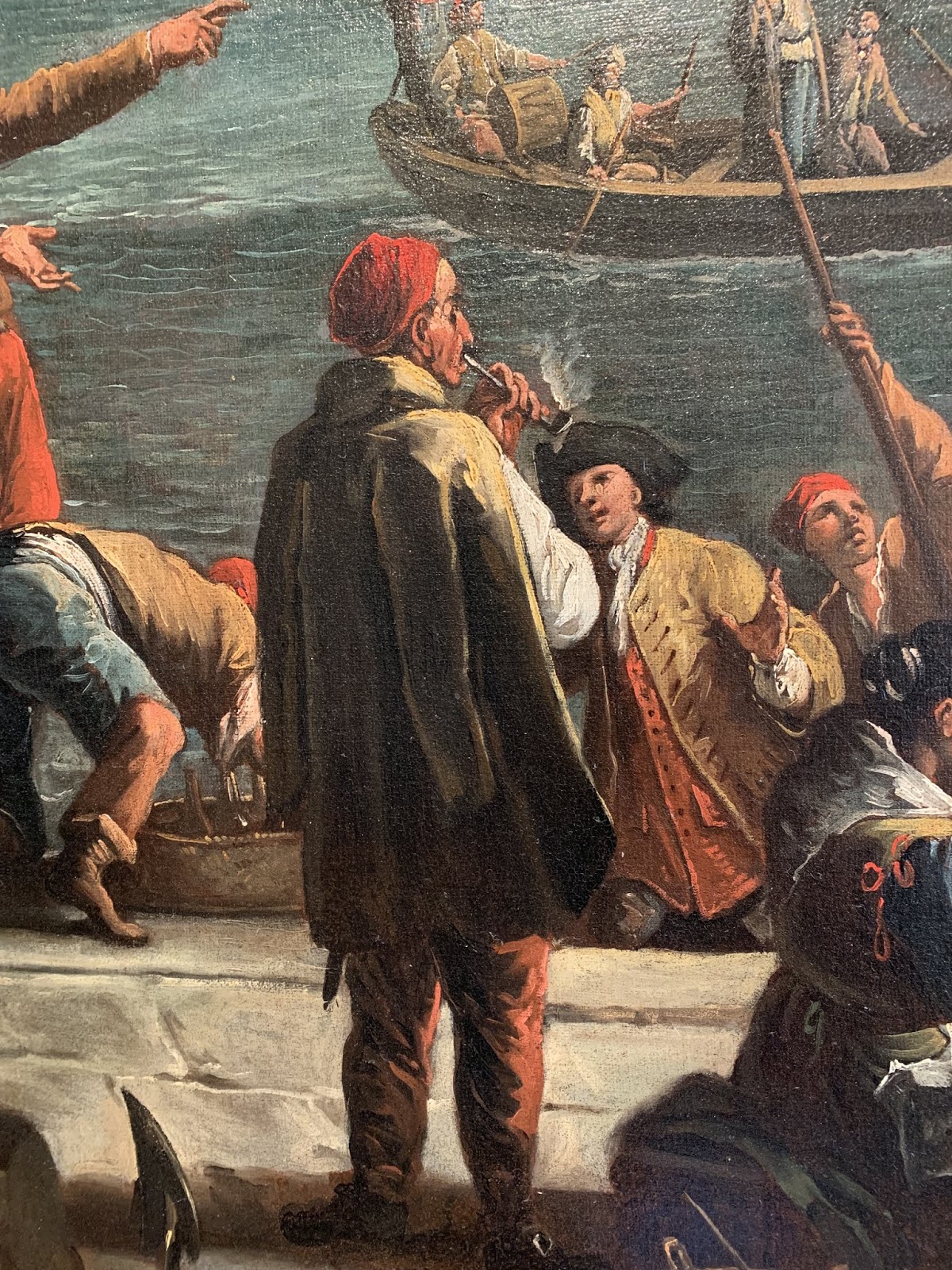
Other groups, of course, continued to wear mustaches as a mark of a specialized trade. Venetian Gondoliers seem to have fit into this mold, at least as depicted by Gaspare Diziani, in the middle of the eighteenth century:

Detail from La Sagra di Santa Marta
Russian civilians as well, appear to have ignored the moratorium on facial hair. Here, Giuseppe Moretti depicts merchants from Russia in Venice in the middle of the eighteenth century:

Detail from Prospettiva con Poritco
And what about Colonial America? Considering the marked aversion which the British Isles had towards mustaches, it is unsurprising that we almost never find them in Colonial America. Continental Army soldiers may not have always been cleanly shaven, but I would be shocked to find more than a week's growth. Even in the harsh winter at Valley Forge, a continental officer noted that Washington advised the men, "The want of uniformity in the soldiers' clothing, and its deficiency in quality, so far from slovenliness and unsoldierly neglect, ought rather to excite the men to compensate for those bleamishes,-- for instance, the soldier may always shave his beard."[3]

What does all this mean for those most interested in it: reenactors of this era? It is vital to tailor your facial hair to the specific time, person, and place you are representing. I see almost no evidence that aside from a few week period in 1721, that the British Army ever wore mustaches (much less beards!) in 1700-1789 era. If your heart's desire is to be a redcoat with facial hair, create a first-rate impression of a British Grenadier waiting for the arrival of the King of Prussia in 1721. Mustaches, while still very uncommon, can be found in a number of military impressions in Europe. If you want to wear a mustache in a military impression, develop of first-rate impression of a French or Spanish soldiers, or Hessian Grenadier or Jaeger from the American War of Independence, or attach yourself to one of a number of units who portray the Seven Years War in Central Europe.

If a full-beard is your desire, I would say that there are a number of impressions in the 1648-1789 era which might allow for it. In addition to being various shades of insane and crippled, you could portray a Russian merchant, or if a military impression is your heart's desire, portray a soldier in 17th Century Colonial America, or the era of the late-Thirty Years War in Europe. I understand that shaving is not convenient, and that beards take a long time to grow. However, if the eighteenth century past is worth recreating, it is worth recreating well.

If you enjoyed this post, or any of our other posts, please consider liking us on facebook, or following us on twitterConsider checking out our exclusive content on Patreon. Finally, we are dedicated to keeping Kabinettskriege ad-free. In order to assist with this, please consider supporting us via the donate button in the upper right-hand corner of the page. As always:

Thanks for Reading, 


Alex Burns


--------------------------------------------------------------------------------------------------------
[1] John Evelyn, The Diary of John Evelyn, 400.
[2] The Weekly Journal, or British Gazetteer, April 29th, 1721.
[3] National Army Museum, 1991-07-117 (Journal of Captain John Davis)