Showing posts with label tactics. Show all posts

Friday, August 14, 2020

Urban Warfare in the Eighteenth Century


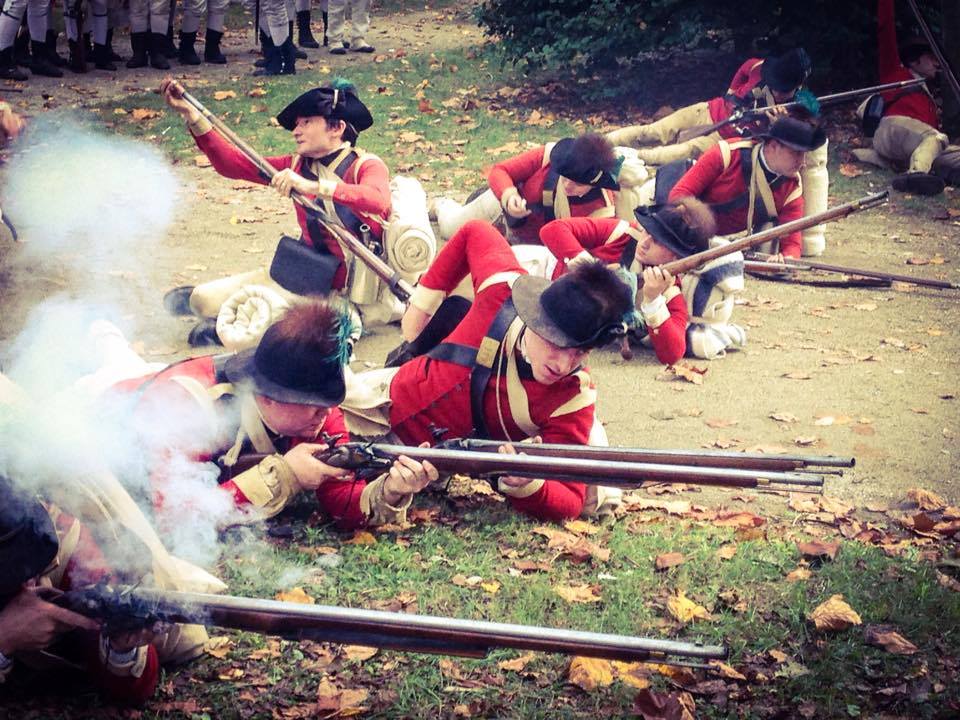
Two members of HM 40th Foot / 2nd Battalion LI - "Bloodhounds" take cover
in Cliveden, photo credit Suzanne Shaw
Dear Reader,

Today, we are going to examine an understudied topic in eighteenth-century military history: urban warfare. Although the eighteenth century was an age where generals preferred to fight large field battles and conduct formal sieges, the century did indeed see its share of urban warfare, that is to say, troops fighting house to house in built-up areas. Troops would occasionally find themselves fighting in village houses during large field battles, but addressing that is not the main goal of my post today. Rather, I seek to understand what happened when armies clashed in actual urban environments, towns or cities as they would have been identified in the eighteenth century.

Encounters of this sort are rare, but not unheard of. Principally, in writing this post, I examined the fight at Preston in 1715, the Austrian attack on Velletri in 1744, and the American assault on Quebec in 1775. At Preston, the Hanoverians attacked a unfortified town that a small Jacobite army had hastily attempted to barricade. At Velletri, an Austrian army attempted to capture the entourage of the future King Charles III of Spain. At Quebec, an initially successful assault on a fortified city bogged down in heavy street fighting. These experiences will be supplements by descriptions of village fighting in larger field battles. With these sources of experience in mind, what common experiences can we identify between these actions?

When fighting in an urban environment, soldiers quickly sought out cover, usually by barricading themselves in houses. At Preston in 1715, when the Jacobite commander William  MacIntosh was asked why he chose to defend Preston rather than a nearby ridge, explained, "the body of the town was the security of the army."[1] At Velletri in 1744, civilians, seeing the fire that Austrian troops were spreading in the town, began firing at the troops in the street from barricaded houses. The Austrians soon followed suite, taking cover in whatever houses they could force open.[2] Events followed the same pattern at Quebec in 1775, when French civilians, loyal to the crown, opened fire on rebel troops marching through the lower town. In the words of a junior British officer observing the scene, "some of the French who took to the houses... ke[pt] gauling them so as obliged the rebels also to take to the houses... where they remained and returned our fire."[3] Larger buildings were valued as observation points and firing platforms.[4] At confused fighting at Leuthen and Hochkirch in the Seven Years War, Austrian and Prussian soldiers sought any cover they could find, and used a high churchyard walls in these villages as miniature fortresses.[5] At the Battle of Blenheim/Höchstadt in 1704, the French attempted to use the village of Blenheim (Blindheim) itself as a strongpoint.[6]

Schlacht bei Hochkirch, Carl Röchling
In addition to houses, soldiers constructed street barricades and fighting positions. Searching for cover, soldiers used whatever they could find in order to provide cover for themselves. John Deane helpfully lists the materials used for the construction of street barricades at Blenheim: "trees, planks, coffers, chests, wagons, carts and palisades[.]"[7] At Leuthen in 1757, Austrians troops were told off, in the midst of battle, to construct fighting positions in the village.[8] At Preston in 1715, the Jacobites constructed numerous barricades across the streets, encompassing multiple lines of defense. In a running battle that lasted for days, the Hanoverians followed suit by building trenches and barricades of their own.[9] At Preston, some of these barricades were large enough for hundreds of men to take shelter behind.

In the course of the natural use of houses as cover by soldiers, structures were almost always burned. Fire had important tactical uses in the eighteenth century. Obviously, only immobile and suicidal men would remain in a burning structure during a fight, and many wounded men burned to death in these horrible encounters.[10] Soldiers set buildings on fire intentionally, in order to drive out defenders, at Preston and Velletri.[11] Fire, of course, spread unintentionally from there. Soldiers also believed that the smoke that fires generated could be employed as cover, essentially as a smoke screen. At Blenheim in 1704, and Preston in 1715, fires were intentionally set to give concealment to friendly forces. At Blenheim, John Deane relates that, "The village was sett on fire before we came to it by the enemy whereby they though to have blinded our gunners[.]"[12] At Preston, both the Hanoverians and the Jacobites used the smoke of burning buildings as cover, and may have set fire intentionally for that purpose.[13]

The Battle of Quebec, F. H. Wellington

In this urban setting, artillery played the role of supporting weapons, clearing streets, and demolishing enemy strongpoints.  Thomas Ainslee, a British officer at Quebec in 1775, described the process of taking a large house on a city street with American rebel troops inside:
Capt. Nairn...had by this time run up a ladder and entered a window at the end of the corner house where the enemy were posted, there they killed one and took another prisoner and my detachment in the other street having by my direction enlarged the post of one of the guns... brought it to bear on the house where most of them were. I ordered it to be fired and as it was loaded with canister and grape shott, it killed Capt. Hendrick of the Rifllers, wounded Capt. Lamb... and several others in the room all of these circumstances together... obliged them to lay down their arms and surrender.[14]
At Trenton in 1776, the American continental army used artillery to stop enemy movement on village streets, this tactic was also used by the Austrians at Hochkirch in 1758.[15] At Preston in 1715, cannons were used extensively to sweep streets of enemy forces, as well as fire on and demolish enemy strong points.[16] Henry Knox's suggestion to use artillery on the Cliveden at Germantown in 1777 may fit into this type of tactical thinking.

Heavy fighting in an urban setting usually led to a high number of enemy troops surrendering, when cover and dense terrain meant that flight was impossible. At Preston in 1715, the battle ended when after four days of resistance, the entirety of the Jacobite Army surrendered.[17] At Velletri, the fighting in the town netted the Austrians almost 600 prisoners. [18] At Quebec in 1775, more than one third of Montgomery's initial force, over 400 men, were captured by the British and their Canadian allies.[19]

Finally, the consequences for the urban environment involved in the fighting were usually severe. At Velletri in 1744, civilians were accidentally shot on one occasion, and looting by Austrian Grenzer was widespread.[20] In Preston, the prolonged nature of the fighting caused widespread destruction, and a commission for civilian relief set up after the end of hostilities received 226 requests from the inhabitants of Preston for relief, totalling sums of approximately £6,500, or approximately $850,000 today.[21]

Fighting in an urban environment was provided eighteenth-century soldiers with an odd mix of contradictions. In dense terrain, soldiers were more likely to have an abundance of cover, and use that cover effectively. Fire was used both offensively and defensively, to provide cover from the enemy, and drive the enemy from buildings. Artillery was employed with an impressive degree of tactical flexibility,  to control enemy movement and reduce enemy strong points. Finally, despite the greater cover afforded by urban environments, soldiers were much more likely to be captured by the enemy in large numbers if they lost the engagement. Fighting in urban environments also had the possibility of causing great damage to civilian property.  By and large, eighteenth-century warfare in an urban environment possess more than a passing continuity to the experiences of urban warfare in the modern world.

If you enjoyed this post, or any of our other posts, please consider liking us on facebook, or following us on twitterConsider checking out our exclusive content on Patreon. Finally, we are dedicated to keeping Kabinettskriege ad-free. In order to assist with this, please consider supporting us via the donate button in the upper right-hand corner of the page. As always:

Thanks for Reading, 


Alex Burns


-----------------------------------------------------------------------------------------------

[1] Charles Hardwick, History of the Borough of Preston and Its Environs, 224.
[2] Christopher Duffy, The Wild Goose and the Eagle, (2019 edition), 85-6.
[3] MSS L2019F60, Society of the Cincinnati Library, (Thomas Ainslee's account of the Siege of Quebec)
[4]Charles Hardwick, History of the Borough of Preston and Its Environs, 225-6.
[5] Christopher Duffy, Army of Frederick the Great, (1996 edition) 272, 284.
[6] John Deane, A Journal of Marlborough's Campaigns, 11.
[7] Ibid.
[8]Christopher Duffy, Prussia's Glory, 158.
[9] Charles Hardwick, History of the Borough of Preston and Its Environs, 224-228.
[10] John Deane, A Journal of Marlborough's Campaigns, 11.
[11]Charles Hardwick, History of the Borough of Preston and Its Environs, 229; Duffy, The Wild Goose and the Eagle, 85.
[12] John Deane, A Journal of Marlborough's Campaigns, 11.
[13]Charles Hardwick, History of the Borough of Preston and Its Environs, 229
[14]MSS L2019F60, Society of the Cincinnati Library, (Thomas Ainslee's account of the Siege of Quebec)
[15]Charles Hardwick, History of the Borough of Preston and Its Environs, 225, 227
[16] David Hackett Fisher, Washington's Crossing, 244; Christopher Duffy, Army of Frederick the Great, (1996 edition), 284.
[17] Ibid, 233.
[18]Christopher Duffy, The Wild Goose and the Eagle, (2019 edition), 87.
[19]MSS L2019F60, Society of the Cincinnati Library, (Thomas Ainslee's account of the Siege of Quebec)
[20] Christopher Duffy, The Wild Goose and the Eagle, (2019 edition), 86.
[21]Charles Hardwick, History of the Borough of Preston and Its Environs, 240

Wednesday, March 14, 2018

Swedish Gå På Tactics During The Great Northern War

Swedish Reenactors 


Dear Reader,

Today we have another excellent guest post focusing on the Karoliner, by historian Mike Glaeser.[1]

--------------------------------------------------------------------------------------------------------------------------

"Never have I seen such a combination of uncontrollable dash and perfectly controlled discipline, such soldiers and such subjects are not to be found the wide world over except in Sweden"[2]
- General Magnus Stenbock after the Battle of Gadebusch, 1712

If students of early modern warfare know one thing about the Swedish Karoliner, it is that they preferred aggressive tactics often executed in the face of overwhelming odds. Their successes in the first half of the Great Northern War bewildered their enemies and endeared the Karoliner to many a historian and wargamer since. Known as Gå På, translated as “go on”, the Swedish tactics emphasized speed over firepower and closing with cold steel.[3] At a time when much of Western European warfare devolved into long and grueling sieges, Gå På allowed the Swedes to play an attacking role and quickly move against a numerically superior foe before excessive firepower could be brought to bear. In this way the Swedes were victorious at Narva (outnumbered 3:1), Klissow (2:1), and Fraustadt (2:1), to name a few. What follows is a brief look at the mindset of the Swedish army, their weapons, and how this combination allowed them to execute Gå På with élan.

Swedish Infantry Formation, Alf Aberg, Karoliner, 156.

Voltaire described the Swedes as “well made, robust, agile and capable of enduring the greatest hardships, hunger and poverty. They are born warriors, full of pride and more brave than industrious” .[4] It is from this stock that the army drew its manpower. Military reforms undertaken by King Charles XI in the 1680s and 90s helped create a strong, unified force that could be sustained in times of peace and quickly mustered for war.[5] The men in each provincial regiment came from the same geographic area which fostered an esprit de corps. Continuous training was a high priority and companies would gather once a month while the full regiment assembled annually for drills under the supervision of the king. They were expected to follow orders without question: “Commands will be carried out soberly and silently without any observation on the part of those whose business it is to obey”.[6] While the men honored their king, they also feared God. Each regiment had an attachment of chaplains who preached the Lutheran creed. Ultimately, God alone decided when and where each soldier would die so it was a moot point to fear death. This religious fatalism allowed the Swedes to march and ride undaunted into enemy fire. Rigorous training, strict discipline, and a shared faith provided the foundations for effective Gå På.

Gå På tactics affected the selection and use of certain weapons. The most notable armament difference between Swedish armies and those of Western Europe was the deployment of the pike. Starting with the Spanish Tercios and Swiss mercenaries of the 1500s, the pike became the queen of the battlefield for much of the following century. It was primarily used as a defensive weapon to help protect matchlock musketeers from cavalry attacks. True to form, the Swedish pike held off a charge of the Polish Crown army at Klissow and then shattered them with two volleys of musket fire. However, the “push of pike” was also a devastating offensive maneuver but one that relied on momentum to see the attack through. With the advent of effective bayonets towards the end of the 17th century, as well as the improvements in gun technology, the pike began to fall out of favor.[7] Nevertheless, the Swedes and Russians tended to make use of the pike throughout the Great Northern War.[8] For the Swedes, the pike suited Gå På tactics perfectly as an offensive shock weapon. Up to one third of each battalion was equipped with the 12-18 foot long weapon with the pikemen taking up the center of the formation. With a typical musket and bayonet amounting to ~6.5 feet, the pike enjoyed a distinct reach advantage. Following the one or two volleys from the musketeers, the entire battalion would charge with pikes leveled.

The Swedes put their faith in the effectiveness of cold steel. While Charles respected firepower, the prevailing belief was that the sword could be more accurate and devastating. At Holowczyn in 1708, “…the king himself went from one battalion to another ordering them above all things, instead of firing, to use their pikes, bayonets and their swords”.[9] All infantry, musketeers and pikemen alike, were equipped with a sword that the king himself had a hand in designing. Once the initial volley was delivered, bayonets would be fixed and swords drawn. The musket with fixed bayonet would be tucked under one arm and the sword leveled in the other. The horse and dragoons had a similar blade and it was used to the same effect. It is worth noting that the blade was straight rather than curved, reinforcing the emphasis on stabbing rather than slashing.

Tent of Augustus the Strong, captured in 1702 by Swedish Karoliner

There is a common perception that Charles had no use for the artillery as it was rarely fielded en masse in his armies. Even the head of the artillery, General Carl Cronstedt, had a similar observation: “At the beginning of the war His Majesty had a sort of contempt for the artillery; but later bitter experience taught him how valuable a weapon it could be”.[10] For Charles and the spirit of Gå På, it was a matter of deployment and speed. Many of Sweden’s victories saw them start the battle as the outnumbered attacker which meant a traditional artillery duel was unsustainable. Deploying cannons could be a time-consuming process and in most cases the Swedes had a tactical disadvantage in terms of terrain. To maintain the initiative, the larger pieces simply had to be kept out.

With morale and discipline established and the appropriate weaponry in place, the Gå På tactic was ready to be unleashed. A provincial infantry regiment consisted of about 1200 Swedes. This was broken down into two battalions and these served as the primary tactical unit. During battle, a battalion would line up four ranks deep with pikes in the center, musketeers on either side, and grenadiers on the flanks. The order to advance would be given by the sound of drums and there are examples of Swedes marching in total silence. At about 40 paces from the enemy, the two front ranks would kneel and the two rear ranks would give fire. The advance would then continue through the cover of the blackpowder smoke to about 20 paces where the two front ranks would fire.[11] General Stenbock’s Instructions stressed holding fire until the foe was within bayonet range.The order was then given to charge and if the enemy unit was not already wavering from being shot at point-blank range, they were now assaulted with sword, bayonet, and pike. At Fraustadt in 1706, some battalions attacked the Saxon lines without firing a single volley. More often than not, the first volley or charge was enough to break a unit and the momentum then carried the Swedes through enemy lines. At the first battle of Narva, the rapidity of the assault allowed the Swedes to close on their opponents with minor casualties and despite being outnumbered three to one, the majority of fighting was over within three hours. The Gå På tactic was devastating against low discipline/ ill-trained units but occasionally proved more problematic against a disciplined foe, especially one that was entrenched like the Russians at Poltava.

Reconstructed Karoliner (Svenska Armeemuseum)

The Swedish cavalry tended to make up around fifty percent of the fighting force. The cavalry was divided between the horse and dragoons although they acted and fought the same way.[12] The tactical unit was the squadron of about 250 men. Deployed on the flanks, the Swedish cavalry tended to move quicker than their enemy counterparts and would charge home at the gallop rather than the trot. The squadron would advance “knee behind knee” with the cornet at the front and each man slightly behind the next to form an arrow. This wedge shape helped punch holes through infantry and cavalry alike. While the horse had pistols and the dragoons their carbines, doctrine decreed that guns should not be fired (unless the attack wasn’t slowed as a result) and the unit should charge home with cold steel.[13] At Klissow in 1702, the Saxon horse surprised the Swedes with a quick deployment through swampy terrain. However, any impetus was lost when the Saxons slowed down and began to caracole .[14] The Swedish cavalry recovered, formed up, and charged with swords. They managed to break the Saxons before turning in on the flank. Here then is a clear example of cold steel having a greater effect than black powder.

If you enjoyed this post, or any of our other posts, please consider liking us on facebook,  or following us on twitter. Finally, we are dedicated to keeping Kabinettskriege ad-free. In order to assist with this, please consider supporting us via the donate button in the upper right-hand corner of the page. As always:

Thanks for Reading,


Mike Glaeser

--------------------------------------------------------------------------------------------------------------------------
[1] Michael Glaeser is an early modern historian specializing in the Great Northern War and the reign of Charles XII of Sweden. He is published in The Great Northern War Compendium and taught history at the University of New Hampshire. He is also an avid reenactor and wargamer. He completed his graduate work at the University of Sheffield, England.
[2]Robert Nisbet Bain, Charles XII and the Collapse of the Swedish Empire, 243.
[3]The “a” has a ring diacritic which gives it a similar pronunciation as “o”. Gå På is therefore pronounced as “go-po”
[4]Voltaire, The History of Charles XII of Sweden, 31.
[5]This was known as the indelningsverk, or allotment system
[6]Charles XI quoted by Alf Aberg, Sweden’s Age of Greatness 1632-1718, 272.
[7]Despite being outdated, Maurice de Saxe still supported use of the pike later in the century.
[8]The Danes, having seen the effectiveness of the pike earlier in the conflict, fielded them when they re-entered the war in 1710.
[9]Robert Frost, The Northern Wars 1558-1721, 274.
[10]Aberg, 284.
[11]David Chandler suggests 40-20 paces whereas Einar Lynth and Lars-Eric Hoglund suggest 70-30.
[12]Dragoons were cheaper to raise and equip but they behaved like cavalry on the battlefield. Their carbines tended to be employed more during foraging missions.
[13]Stenbock, Instructions, Waxjo 1710.
[14]The caracole (Spanish for snail) was a tactic that saw cavalry advance on the enemy at a trot, fire their pistols, and then retreat to the rear to reload while the next rank repeated the same steps.

Wednesday, February 7, 2018

How Often did Eighteenth-Century Soldiers Fire Independently?


Members of HM 17th Regiment of Infantry engaged in a firefight
Dear Reader,

In the eighteenth century, commanders prized orderly and disciplined fire. The British and Prussian armies were famous for their level of discipline and firepower. These armies particularly valued soldiers who fired by platoons (perhaps 1/8 of the formation firing at a time.) Soldiers and junior officers regularly noted when troops were able to achieve this level of discipline and control on the battlefield. At battlefield as diverse as Mollwitz, Dettingen, Prague, the Sullivan Campaign, and Reichenbach soldiers maintained complicated firings by platoons, divisions, and battalions. [1] We should take these reports seriously: these armies were sometimes able to achieve fire-discipline.

However, it appears from the sources that troops involuntarily used another type of fire: something that in modern English we might call, "firing at will." In the eighteenth century, the English sometimes called this an "irregular," "straggling," or "running fire," the French a, "feu de billebaude" and German sources often refer to it as, "Plackerfeuer" or sometimes "Batalillenfeuer." In practice, this simply meant that troops loaded and fired as quickly as they could, often without orders from officers. It is important to carefully interrogate sources referring to "running fire," as at times this can mean a quick but orderly fire by divisions.  A number of historians have written on this topic, such as Christopher Duffy, David Blackmore, John Houlding, and Matthew Spring.

British Troops firing
I should make it clear: eighteenth-century military theorists often frowned on this type of firing, as it was perhaps less effective than controlled firing by platoons or ranks.  Despite the censure of military theorists, we can observe this type of firing in a number of sources. It was used on eighteenth-century battlefields, across most armies. The British and Prussian armies took steps to mitigate firing at will and it may have occurred less frequently, but sources still report its use in those armies. Perhaps the most famous (and controversial) description of this type of firing comes from Lt. Colonel Russell of the British Guards at the Battle of Dettingen in 1743:
"That the Austrians behaved well also is true; that except one of their battalions which fired only once by platoons, they all fired as irregular as we did; that the English infantry behaved like heroes, and as they were the major part in the action to them the honor of the day is due; that they were under no command by way of Hide Park firing, but that the whole three ranks made a running fire of their own accord, and at the same time with great judgement and skill, stooping all as low as they could, making almost every ball take palce, is true, that the enemy, when expecting our fire, dropped down, which our men perceiving, waited till they got up before they would fire as a confirmation of their coolness as well as bravery, is very certain; that the French fired in the same manner, I mean like running fires, without waiting for words of command, and that Lord Stair did often say he had seen many a battle and never saw the infantry engage in any other manner is as true.[2]
As you might expect, this statement has generated some controversy. David Blackmore has called the eyewitnesses credibility into account and has suggested that Lord Stair's comment may only apply to the French Infantry.[3] The author was two miles away from the battle, but wrote this letter two months after the battle, and would have been able to discuss the events with officers closer to the scene. The statement "Lord Stair did often say," implies that this topic was a matter of conversation, at least among officers, after Dettingen. Even if we assume that Stair's statement only applies to the French, what a statement! Another officer reported on the same battle reported that "the British infantry fired not by platoons but with perpetual volleys from right to left, loading almost as fast as they fired without ceasing so that the French were forced to retreat."[4]


Interpretive Staff representing French Troops at Fort Ticonderoga in 1758

If this practice happened at Dettingen, where else can we observe it in the eighteenth-century? Certainly, this practice was embraced by the French. In the 1750s, the Comte de Chabot argued that allowing soldiers to fire at will was superior to other systems of fire. "The French leave each man the will and power to direct his fire, and all this fire takes good effect... this is the great advantage of French fire."[5] Chabot put forth a number reasons why this type of firing might be effective, including less pressure on officers, less chance of rookie soldiers interfering and disordering the battalion, and many other reasons.[6] Sometimes, the troops would augment firing at will by laying on the ground or on their knees. It seems that the battles of Parma and Guastalla in 1734,  the French and Austrian fought mainly on their knees.[7]   Charles Immanuel de Warnery reports that on this occasion, "the infantry laid on all fours, and fired after the manner of Croats."[8]  Comte Turpin de Crisse, writing in 1770, called the feu de billebaude, "the best of all fires," and advocated that officers facilitate the fire by having men in the rear ranks load, while the men in the front ranks fired.[9] Austrian Veteran Jacob de Cogniazzo discussed the use and disadvantages of an "unregulated fire."[10] Tobias Smollet's military history, published in 1786, refers to straggling and irregular fire in reference to the British and French Infantry in 1758, but since he was not an eyewitness, we should treat these accounts with care.[11] John Knox reports that the French used, "a galling though irregular fire" at Quebec in 1759.[12]

French military author, Jacques, Comte de Guibert, discussed the varieties of infantry fire in his 1772 essay on tactics. He concluded,
Finally, the running fire, [feu de billebaude] is the only one that should take place during a musketry firefight. After two orderly discharges, there is no effort of discipline that can prevent a complicated and regular fire from degenerating into firing at will. This fire is the liveliest and most deadly of all... it is particularly suited to the French way of war. The only thing that is necessary is a signal to cease firing. Formerly, it was thought impossible that this could succeed. During a battle in the last war [the Seven Years' War] I witnessed a regiment execute this fire in a fight with the enemy, by beginning and ending with a drum beat.  This regiment fought everywhere with the same discipline and value.[13]
As I believe the next few sources will show, the Prussians fretted endlessly about their inability to perfect platoon fire, even though they were more successful in achieving this end than other armies. Charles Immanuel de Warnery, writing in 1782, summarizes some of the difficulties in firing with platoons.
"The whole world seems to cry out against our platoon fire, since on the battlefield, we can only seem to do it twice. I agree in part, as I have written elsewhere, and I believe that we could perfect this system with better principles than we have now. The first vice is the size of our platoons: they are much too big, their frontage is too wide. How can we pretend that the officer who commands the platoon, standing on the right can see his command, much less be heard when the [more senior] two officers 50 paces to the rear can barely hear themselves? The noise of the artillery, musketry, and shouts of other platoons officers, the cries of the wounded, blinding and suffocating smoke, the distance from where the [platoon] commander stands to the left of the platoon, all conspires to hide the officer from the platoon. He could not command them even if he had a voice of thunder. These are the primary obstacles which prevent us from firing by platoons, as the system currently exists. It is amazing that noone has tried to fix this. We should also carefully examine initial cause of the disorder which gets into the infantry as soon as it has started to fire. Officers agree that this is quite normal, [once the shooting starts,] they are almost no longer masters of their soldiers."[14]


An image of Scharnhorst later in life, during the Napoleonic Era

 In his 1790 handbook for officers, Prussian General Johann von Scharnhorst, entitles one of his chapter headings: "The Plackerfeuer which must be Avoided."[15] He complains about firing at will for some time, giving detailed descriptions of why it is disadvantageous. "The worst of all these is that a certain order in the battalion has been generally lost during this fire, and that the officers who have lost control of their command can only restore their attention with great difficulty, and often not at all."[16] The extensiveness of his complaints indicate that he was not merely talking from a theoretical standpoint but from first-hand experience. Other Prussian military authorities also addressed the problem of troops involuntarily firing at will.

Berenhorst in 1756
In 1798, Georg Heinrich von Berenhorst reflected on the art of war. He had served on Frederick II of Prussia's staff during the Seven Years' War, and would become an important military figure in the history of the Napoleonic era. When describing infantry firing in battle, he noted,
You begin firing by a salvo, or perhaps firing by platoons for two or three shots. Then a general blazing away follows: the usual rolling fire where everyone fires as quickly as they are loaded. Ranks and files become mixed, those in the first rank could not kneel even if they desired it, and the officers, from the lower ranks to the generals can do nothing more with this mass, until it finally begins moving forwards or backwards.[17] 
This type of firefight is perhaps the kind of combat Ulrich Bräker was referring to when he recalled of the Battle of Lobositz in 1756. A soldier with the Itzenplitz regiment, Bräker recalled that"in great heat and excitement I, I fired away nearly all my sixty rounds. My musket became so warm that I had to carry it by the sling."[18] A Prussian report from the Battle at Soor in 1745 indicates, "In the meantime, our infantry had to endure a strong fire from the small arms [of the enemy.] Our battalions began to fire without orders, the enemy withstood this and continued his fire, which brought disorder into our lines."[19]  Johan Gottfried Hoyer, who would rise to prominence as a Prussian Major-General of the Napoleonic Era, set out to describe military history between 1750 and 1799. In describing infantry fire-tactics, he describes firing by platoons and other various forms of complex firing in the eighteenth-century. Near the end of his description, he comments:
"In fact, all these types of firing were practiced in peacetime on the drill-square, but soldiers hardly used them in serious combat. Once there, everything was abandoned for running fire [plackerfeuer], that is, everyone loaded and shot for himself as fast as he could. This is highly embarrassing, as after one hundred years of practice, we can not bring common soldiers under control, and build an unfeeling shooting-machine. In the heat and confusion of battle, the instrument is only set in motion by the artist's finger. Some exceptions [to the general rule of running fire], which may be found among the Prussian troops, and only with them alone, have been made possible through their ceaseless practice. They can prove nothing against the universality of the idea shared here."[20]
Hessian Troops open fire at Guilford Courthouse

 In North America, there are examples of this type of firefight as well, though during the American War of Independence, the British used bayonet attacks and volley fire. This swift-moving sort of attack sometimes prevented a general breakdown of control. On the other hand, the forces of the young United States appear to have used this tactic frequently.[21] It occasionally happened to the British as well, as British officer Thomas Anburey describes it in his letters from Burgoyne's campaign:
"In this action, I found that all manual exercise is but an ornament, and the only object of importance it can boast of was that of loading, firing, and charging with bayonets: as to the form, the soldiers should be instructed in the best and most expeditious method. Here I cannot help observing to you, whether it proceeded from an idea of self-preservation, or natural instinct, but the soldiers greatly improved the mode they were taught in, as to expedition, for as soon as they primed their pieces, and put the cartridge into the barrel, instead of ramming it down with their rods, they struck the butt end of their piece upon the ground, and bringing it to the present, fired it off. The confusion of a man's ideas during the time of action, brave as he may be, is undoubtedly great..."[22]
This phenomenon, often called, "tap-loading" quickened the rate of fire, but had the potential to
greatly reduced muzzle-velocity. It is possible that the Austrians engaged in this practice at the Battle of Mollwitz in 1741.[23]

2nd Battalion of Light Infantry at Germantown
What does all this mean for wargamers and reenactors? The nature of many wargame rules already simulates this idea, as many rulesets give a bonus for initial firing, and have factors which slowly curtail the effectiveness of extended fire. I would argue that it should be possible for troops who stay stationary and away from the enemy (doing nothing) for a 15 minute period to reclaim this "first fire" bonus, as troops often carried extra flints, and cleaning supplies such as barrel worms, with them on the battlefield. In addition, this represents officers bring the regiment back into a state of order, which was a key part of maintaining fire discipline. In terms of effectiveness, troops who engaged in a running fire should be perhaps marginally more effective in a firefight, but at a severe disadvantage if charged by a swift-moving enemy.

For reenactors, if in a firefight lasting more than 3 volleys, (preferably at longer range) I would suggest that it is perfectly permissible to represent troops engaging in an uncontrolled firing. The unit as a whole should fire as fast as possible until the enemy moves away, or officers manage to restore order. Again, this is perhaps less likely for Prussian and British troops (although still a feature of their experience) and more common for French troops.

If you enjoyed this post, or any of our other posts, please consider liking us on facebook, or following us on twitterConsider checking out our exclusive content on Patreon. Finally, we are dedicated to keeping Kabinettskriege ad-free. In order to assist with this, please consider supporting us via the donate button in the upper right-hand corner of the page. As always:


Thanks for Reading,


Alex Burns

--------------------------------------------------------------------------------------------------------------------------

[1] For examples of these types of reports see: Christopher Duffy, Military Experience in the Age of Reason, 212-213.;  Cook, Journals of the Military Expedition of Major General John Sullivan,  232.; Anonymous, Schreiben eines Hollaendischen Volontairs, 5,; Charles Immanuel de Warnery, Campagnes de Frédéric II, roi de Prusse, de 1756 à 1762, 48.; David Blackmore, Descructive and Formidable, 107.; C. F. Hempel and J. F. Seyfart, Helden- Staats- und Lebens-Geschichte Des Allerdurchlauchtigsten und Grosmächtigsten Fürsten, 260.; Anonymous, Das Treffen bei Reichenbach in Schlesien Zwischen Einem Korps Preussen Unter Den Befehlen Des Herzogs Von Braunschweig-Bevern, 12-13.
[2]Historical Manuscripts Commission,  Report on the manuscripts of Mrs. Franklin-Russell-Astley, of Chequers Court, 278.
[3]Blackmore, Destructive and Formidable, 107.
[4]Lt. Colonel E. A. H. Webb, History of the 12th (The Suffolk) Regiment, 63,
[5] Chabot, Réflexions critiques sur les differens systêmes de tactique de Folard, 9-11.
[6]Ibid, 5-20.
[7] Duffy, Military Experience in the Age of Reason, 213.
[8] Warnery, Des Herrn Generalmajor von Warnery sämtliche Schriften, Vol 2, 211.
[9] Turpin de Crisse, Commentaires sur les memoires de Montecuculi, 179-180
[10] Jacob de Cogniazzo, Geständnisse eines Oesterreichischen Veterans, Vol 1, 169
[11] Tobias Smollet, The History of England from the Revolution to the Death of George the Second, 189, 260.
[12] John Knox, An Historical Journal, vol 2, 128.
[13] Comte de Guibert, Essai général de tactique, 107-108. (He was describing the Royal Deux-Ponts Regiment at Vellinghausen.)
[14] Charles Immanuel de Warnery, Remarques sur plusieurs auteurs militaires et autres, 69-70.
[15] Scharnhorst, Handbook für Officiere, 276.
[16] Ibid, 277.
[17] Georg Berenhorst, Betrachtungen über die Kriegskunst, Vol 1, 255.
[18]Ulrich Bräker, Arme Mann, 150.
[19] Sammlung ungedruckter Nachrichten, Vol 1, 359.
[20] Johann Gottfried Hoyer, Geschichte der Kriegskunst, 102-103
[21] John Simcoe, Simcoe's Military Journal, 45, 146.;  Cook, Journals of the Military Expedition of Major General John Sullivan,  92, 95.
[22] Thomas Anbury, Travels through the Interior Parts of America, 333.
[23] Anonymous, Denckwüdiges Leben und Thaten Beruehmeten Herren Johaan Daniels von Menzel, 80.