Showing posts with label platoon fire. Show all posts

Friday, October 18, 2019

French Wargames- Le Camp de Vaussieux 1778

Historians have long debated, proved, or debunked connections between the revolutions of the United States and of France. The societies which emerged from both upheavals created states which would dominate their spheres of influence in the foreseeable future. For our interests, militarily there are obvious connections between the conflicts in the American colonies and across Europe in the late 18th and early 19th centuries. Junior officers of the 1770s and 1780s would go on to become the generals of the early 19th century. In our minds today, the names of two great leaders dominate the conversation about military leadership and development during these two great conflicts, George Washington and Napoleon Boneparte.

The connections to the two are somewhat distant, yet at certain points, in both of their careers people, places, and events line up with for a connection. One which I aim to highlight today is that of the 1778 Camp de Vaussieux. The event in which the French Army prepared to fight alongside George Washington, and ended up forming the basis of the tactics Napoleon would use with the Grande Armée.
Plan du Camp de Vaussieux en Normandie. Aux ordres de M. le Duc de Broglio. Commencé dans les Premiers jours de Septembre et fini dans les Premiers jours d'Octobre 1778. Avec les Grandes Manoeuvres qu'on y a Exécutées pour l'Instruction des Troupes.https://gallica.bnf.fr/ark:/12148/btv1b84919125/f1.item
Located just outside of Bayeux in Normandy, this small farming area would witness forty battalions of infantry, along with cavalry and artillery, totaling close to 20,000 men converge in early September 1778 under the command of Maréchal Victor-François, duc de Broglie, a French hero of the Seven Years War. Broglie had three assignments from the Ministry of War. First, he must defend the Norman coast against British incursions. Second, he must himself prepare the troops under his command to invade Great Britain. Finally, he must conduct training exercises to determine the dominance of one of two main theories of land warfare in 1770s France, l'ordre profond (deep order) and l'ordre mince (thin order).


Le maréchal Victor-François de Broglie. Huile sur toile anonyme, château de Versailles.

Both doctrines had their champions and both had their detractors. l'ordre profond had recently been defended by François-Jean de Mesnil-Durand. To English speakers, l'ordre profond would come to be known as columns or attacking columns. These formations harken back to ancient warfare where thickly packed bodies of men used shock and power to punch through enemy formations. Support was felt by all ranks as masses of comrades could be seen in all directions. However, l'ordre profond faced limitations as it was hard for officers to handle large masses of men, who were large targets to enemy infantry and artillery. The French Army of the Seven Years War had seen large columns of men utilizing these deep order tactics be mowed down and routed by disciplined fire from Prussian and British infantry at Rossbach and Minden. The arguments for the continued development of this theory came from the more conservative and aristocratic side of the French Army. Many argued that l'ordre profond was an innately French skill, which utilized the elan possessed only by the soldiers of King Louis. To deviate from this would be treason to the culture and heritage of French arms, and even worse Germanic or even Prussian in nature.

Opposite l'ordre profond lay l'ordre mince. The experience of the Seven Years War had shown that Prussian lines, drawn three ranks deep, could deliver firepower that outweighed the shock of a French column attack. l'ordre mince called for French infantry to emulate the Prussians by forming the entire battalion into a three rank deep line, able to deliver all of its fire into an opponent. However, if the fire of the line was not controlled efficiently, or a massed attack drew too close, the line risked breaking apart. It was also much harder to command formations in l'ordre mince.

In this debate marched the soldiers of Marshal Broglie. Broglie himself was an ardent defender of l'ordre profond, and expected these exercises to help the Army move on to focus on its preparations for combat with the British. Training commenced early in September as units practiced basic maneuvers and large scale operations. Later in the month, the real tests began.

On one day, a brigade under the command of Marshal Jean-Baptiste Donatien de Vimeur, comte de Rochambeau, opposed an attack by a division. Rochambeau's brigade would utilize the tactics highlighted in the 1776 regulations which leaned heavily on the theories of l'ordre mince. The attacking division would use l'ordre profond. The results were decisive. Rochambeau and his smaller force quickly outmaneuvered and outgunned his opponents. Broglie responded on later days by following the advice of the late Marshal de Saxe, and utilized massive waves of chasseurs deployed as skirmishers to screen the advance. This time the attackers proved successful. Grenadiers and chasseurs were split into separate units to act as shock troops, artillery utilising the new Gribeuval system came into action, and 20,000 men were able to hone their newly introduced skills for the first time. These drills carried on for several days as the troops became drilled in the 1776 regulations, as well as the closed columns demanded by l'ordre profond. 


A Chasseur of the Régiment de Saintonge as they would have appeared during the Yorktown Campaign. The Régiment de Saintonge was present at Vaussieux and its chasseurs would have been separated into independent battalions. (Painting by Don Troiani)

By the time the camp had closed the failures of l'ordre profond had broken through to many. However, the old guard of French officers including Broglie remained convinced in the power of the column. Rochambeau had run circles around them utilising l'ordre mince, and yet the debate continued to rage on. It was not until a third option, thought up by philosophers such as Guibert which mixed both the attacking column, with the firepower of the line (unsurprisingly called l'ordre mixte) was adopted, that a solution came forward. Lines of French infantry advancing with protection on their flank by soldiers in closed columns and lines of skirmishers in front of them would be a hard tactic to master. Yet, this was exactly what the French army adopted. Utilizing l'ordre mixte the French soldier would drive countless enemies before it winning battles across Europe and even the world. Yet these soldiers were not the white-coated infantry of Marshals Broglie or rochambeau, these men wore blue. Their officers were not always aristocrats who had paid their way to high rank, as all had to earn the title. The armies of Revolutionary and later Napoleonic France dominated their battlefields. Yet it was the soldiers of Marshal Broglie, many of them preparing to sail to America to assist George Washington on his campaigns, who were beginning the process to move away from the feudal blocks of infantry, into a changing and thinking army. [1]

If you enjoyed this post, or any of our other posts, please consider liking us on facebook,  or following us on twitter. Finally, we are dedicated to keeping Kabinettskriege ad-free. In order to assist with this, please consider supporting us via the donate button in the upper right-hand corner of the page. As always:

Thanks for Reading,

James Taub

------------------------------------------------------------------------------------------------------

[1] For further reading I highly suggest: Abel, Jonathan. Guibert: Father of Napoleons Grande Armée. Norman: University of Oklahoma Press, 2016.

Wednesday, February 7, 2018

How Often did Eighteenth-Century Soldiers Fire Independently?


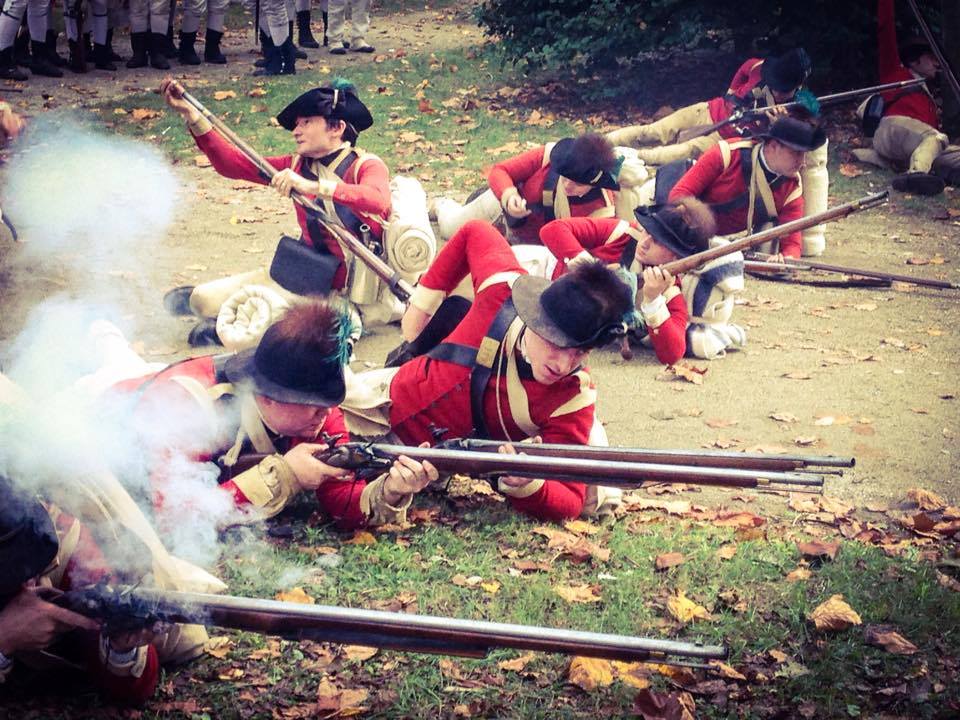
Members of HM 17th Regiment of Infantry engaged in a firefight
Dear Reader,

In the eighteenth century, commanders prized orderly and disciplined fire. The British and Prussian armies were famous for their level of discipline and firepower. These armies particularly valued soldiers who fired by platoons (perhaps 1/8 of the formation firing at a time.) Soldiers and junior officers regularly noted when troops were able to achieve this level of discipline and control on the battlefield. At battlefield as diverse as Mollwitz, Dettingen, Prague, the Sullivan Campaign, and Reichenbach soldiers maintained complicated firings by platoons, divisions, and battalions. [1] We should take these reports seriously: these armies were sometimes able to achieve fire-discipline.

However, it appears from the sources that troops involuntarily used another type of fire: something that in modern English we might call, "firing at will." In the eighteenth century, the English sometimes called this an "irregular," "straggling," or "running fire," the French a, "feu de billebaude" and German sources often refer to it as, "Plackerfeuer" or sometimes "Batalillenfeuer." In practice, this simply meant that troops loaded and fired as quickly as they could, often without orders from officers. It is important to carefully interrogate sources referring to "running fire," as at times this can mean a quick but orderly fire by divisions.  A number of historians have written on this topic, such as Christopher Duffy, David Blackmore, John Houlding, and Matthew Spring.

British Troops firing
I should make it clear: eighteenth-century military theorists often frowned on this type of firing, as it was perhaps less effective than controlled firing by platoons or ranks.  Despite the censure of military theorists, we can observe this type of firing in a number of sources. It was used on eighteenth-century battlefields, across most armies. The British and Prussian armies took steps to mitigate firing at will and it may have occurred less frequently, but sources still report its use in those armies. Perhaps the most famous (and controversial) description of this type of firing comes from Lt. Colonel Russell of the British Guards at the Battle of Dettingen in 1743:
"That the Austrians behaved well also is true; that except one of their battalions which fired only once by platoons, they all fired as irregular as we did; that the English infantry behaved like heroes, and as they were the major part in the action to them the honor of the day is due; that they were under no command by way of Hide Park firing, but that the whole three ranks made a running fire of their own accord, and at the same time with great judgement and skill, stooping all as low as they could, making almost every ball take palce, is true, that the enemy, when expecting our fire, dropped down, which our men perceiving, waited till they got up before they would fire as a confirmation of their coolness as well as bravery, is very certain; that the French fired in the same manner, I mean like running fires, without waiting for words of command, and that Lord Stair did often say he had seen many a battle and never saw the infantry engage in any other manner is as true.[2]
As you might expect, this statement has generated some controversy. David Blackmore has called the eyewitnesses credibility into account and has suggested that Lord Stair's comment may only apply to the French Infantry.[3] The author was two miles away from the battle, but wrote this letter two months after the battle, and would have been able to discuss the events with officers closer to the scene. The statement "Lord Stair did often say," implies that this topic was a matter of conversation, at least among officers, after Dettingen. Even if we assume that Stair's statement only applies to the French, what a statement! Another officer reported on the same battle reported that "the British infantry fired not by platoons but with perpetual volleys from right to left, loading almost as fast as they fired without ceasing so that the French were forced to retreat."[4]


Interpretive Staff representing French Troops at Fort Ticonderoga in 1758

If this practice happened at Dettingen, where else can we observe it in the eighteenth-century? Certainly, this practice was embraced by the French. In the 1750s, the Comte de Chabot argued that allowing soldiers to fire at will was superior to other systems of fire. "The French leave each man the will and power to direct his fire, and all this fire takes good effect... this is the great advantage of French fire."[5] Chabot put forth a number reasons why this type of firing might be effective, including less pressure on officers, less chance of rookie soldiers interfering and disordering the battalion, and many other reasons.[6] Sometimes, the troops would augment firing at will by laying on the ground or on their knees. It seems that the battles of Parma and Guastalla in 1734,  the French and Austrian fought mainly on their knees.[7]   Charles Immanuel de Warnery reports that on this occasion, "the infantry laid on all fours, and fired after the manner of Croats."[8]  Comte Turpin de Crisse, writing in 1770, called the feu de billebaude, "the best of all fires," and advocated that officers facilitate the fire by having men in the rear ranks load, while the men in the front ranks fired.[9] Austrian Veteran Jacob de Cogniazzo discussed the use and disadvantages of an "unregulated fire."[10] Tobias Smollet's military history, published in 1786, refers to straggling and irregular fire in reference to the British and French Infantry in 1758, but since he was not an eyewitness, we should treat these accounts with care.[11] John Knox reports that the French used, "a galling though irregular fire" at Quebec in 1759.[12]

French military author, Jacques, Comte de Guibert, discussed the varieties of infantry fire in his 1772 essay on tactics. He concluded,
Finally, the running fire, [feu de billebaude] is the only one that should take place during a musketry firefight. After two orderly discharges, there is no effort of discipline that can prevent a complicated and regular fire from degenerating into firing at will. This fire is the liveliest and most deadly of all... it is particularly suited to the French way of war. The only thing that is necessary is a signal to cease firing. Formerly, it was thought impossible that this could succeed. During a battle in the last war [the Seven Years' War] I witnessed a regiment execute this fire in a fight with the enemy, by beginning and ending with a drum beat.  This regiment fought everywhere with the same discipline and value.[13]
As I believe the next few sources will show, the Prussians fretted endlessly about their inability to perfect platoon fire, even though they were more successful in achieving this end than other armies. Charles Immanuel de Warnery, writing in 1782, summarizes some of the difficulties in firing with platoons.
"The whole world seems to cry out against our platoon fire, since on the battlefield, we can only seem to do it twice. I agree in part, as I have written elsewhere, and I believe that we could perfect this system with better principles than we have now. The first vice is the size of our platoons: they are much too big, their frontage is too wide. How can we pretend that the officer who commands the platoon, standing on the right can see his command, much less be heard when the [more senior] two officers 50 paces to the rear can barely hear themselves? The noise of the artillery, musketry, and shouts of other platoons officers, the cries of the wounded, blinding and suffocating smoke, the distance from where the [platoon] commander stands to the left of the platoon, all conspires to hide the officer from the platoon. He could not command them even if he had a voice of thunder. These are the primary obstacles which prevent us from firing by platoons, as the system currently exists. It is amazing that noone has tried to fix this. We should also carefully examine initial cause of the disorder which gets into the infantry as soon as it has started to fire. Officers agree that this is quite normal, [once the shooting starts,] they are almost no longer masters of their soldiers."[14]


An image of Scharnhorst later in life, during the Napoleonic Era

 In his 1790 handbook for officers, Prussian General Johann von Scharnhorst, entitles one of his chapter headings: "The Plackerfeuer which must be Avoided."[15] He complains about firing at will for some time, giving detailed descriptions of why it is disadvantageous. "The worst of all these is that a certain order in the battalion has been generally lost during this fire, and that the officers who have lost control of their command can only restore their attention with great difficulty, and often not at all."[16] The extensiveness of his complaints indicate that he was not merely talking from a theoretical standpoint but from first-hand experience. Other Prussian military authorities also addressed the problem of troops involuntarily firing at will.

Berenhorst in 1756
In 1798, Georg Heinrich von Berenhorst reflected on the art of war. He had served on Frederick II of Prussia's staff during the Seven Years' War, and would become an important military figure in the history of the Napoleonic era. When describing infantry firing in battle, he noted,
You begin firing by a salvo, or perhaps firing by platoons for two or three shots. Then a general blazing away follows: the usual rolling fire where everyone fires as quickly as they are loaded. Ranks and files become mixed, those in the first rank could not kneel even if they desired it, and the officers, from the lower ranks to the generals can do nothing more with this mass, until it finally begins moving forwards or backwards.[17] 
This type of firefight is perhaps the kind of combat Ulrich Bräker was referring to when he recalled of the Battle of Lobositz in 1756. A soldier with the Itzenplitz regiment, Bräker recalled that"in great heat and excitement I, I fired away nearly all my sixty rounds. My musket became so warm that I had to carry it by the sling."[18] A Prussian report from the Battle at Soor in 1745 indicates, "In the meantime, our infantry had to endure a strong fire from the small arms [of the enemy.] Our battalions began to fire without orders, the enemy withstood this and continued his fire, which brought disorder into our lines."[19]  Johan Gottfried Hoyer, who would rise to prominence as a Prussian Major-General of the Napoleonic Era, set out to describe military history between 1750 and 1799. In describing infantry fire-tactics, he describes firing by platoons and other various forms of complex firing in the eighteenth-century. Near the end of his description, he comments:
"In fact, all these types of firing were practiced in peacetime on the drill-square, but soldiers hardly used them in serious combat. Once there, everything was abandoned for running fire [plackerfeuer], that is, everyone loaded and shot for himself as fast as he could. This is highly embarrassing, as after one hundred years of practice, we can not bring common soldiers under control, and build an unfeeling shooting-machine. In the heat and confusion of battle, the instrument is only set in motion by the artist's finger. Some exceptions [to the general rule of running fire], which may be found among the Prussian troops, and only with them alone, have been made possible through their ceaseless practice. They can prove nothing against the universality of the idea shared here."[20]
Hessian Troops open fire at Guilford Courthouse

 In North America, there are examples of this type of firefight as well, though during the American War of Independence, the British used bayonet attacks and volley fire. This swift-moving sort of attack sometimes prevented a general breakdown of control. On the other hand, the forces of the young United States appear to have used this tactic frequently.[21] It occasionally happened to the British as well, as British officer Thomas Anburey describes it in his letters from Burgoyne's campaign:
"In this action, I found that all manual exercise is but an ornament, and the only object of importance it can boast of was that of loading, firing, and charging with bayonets: as to the form, the soldiers should be instructed in the best and most expeditious method. Here I cannot help observing to you, whether it proceeded from an idea of self-preservation, or natural instinct, but the soldiers greatly improved the mode they were taught in, as to expedition, for as soon as they primed their pieces, and put the cartridge into the barrel, instead of ramming it down with their rods, they struck the butt end of their piece upon the ground, and bringing it to the present, fired it off. The confusion of a man's ideas during the time of action, brave as he may be, is undoubtedly great..."[22]
This phenomenon, often called, "tap-loading" quickened the rate of fire, but had the potential to
greatly reduced muzzle-velocity. It is possible that the Austrians engaged in this practice at the Battle of Mollwitz in 1741.[23]

2nd Battalion of Light Infantry at Germantown
What does all this mean for wargamers and reenactors? The nature of many wargame rules already simulates this idea, as many rulesets give a bonus for initial firing, and have factors which slowly curtail the effectiveness of extended fire. I would argue that it should be possible for troops who stay stationary and away from the enemy (doing nothing) for a 15 minute period to reclaim this "first fire" bonus, as troops often carried extra flints, and cleaning supplies such as barrel worms, with them on the battlefield. In addition, this represents officers bring the regiment back into a state of order, which was a key part of maintaining fire discipline. In terms of effectiveness, troops who engaged in a running fire should be perhaps marginally more effective in a firefight, but at a severe disadvantage if charged by a swift-moving enemy.

For reenactors, if in a firefight lasting more than 3 volleys, (preferably at longer range) I would suggest that it is perfectly permissible to represent troops engaging in an uncontrolled firing. The unit as a whole should fire as fast as possible until the enemy moves away, or officers manage to restore order. Again, this is perhaps less likely for Prussian and British troops (although still a feature of their experience) and more common for French troops.

If you enjoyed this post, or any of our other posts, please consider liking us on facebook, or following us on twitter. Consider checking out our exclusive content on Patreon. Finally, we are dedicated to keeping Kabinettskriege ad-free. In order to assist with this, please consider supporting us via the donate button in the upper right-hand corner of the page. As always:


Thanks for Reading,


Alex Burns

--------------------------------------------------------------------------------------------------------------------------

[1] For examples of these types of reports see: Christopher Duffy, Military Experience in the Age of Reason, 212-213.;  Cook, Journals of the Military Expedition of Major General John Sullivan,  232.; Anonymous, Schreiben eines Hollaendischen Volontairs, 5,; Charles Immanuel de Warnery, Campagnes de Frédéric II, roi de Prusse, de 1756 à 1762, 48.; David Blackmore, Descructive and Formidable, 107.; C. F. Hempel and J. F. Seyfart, Helden- Staats- und Lebens-Geschichte Des Allerdurchlauchtigsten und Grosmächtigsten Fürsten, 260.; Anonymous, Das Treffen bei Reichenbach in Schlesien Zwischen Einem Korps Preussen Unter Den Befehlen Des Herzogs Von Braunschweig-Bevern, 12-13.
[2]Historical Manuscripts Commission,  Report on the manuscripts of Mrs. Franklin-Russell-Astley, of Chequers Court, 278.
[3]Blackmore, Destructive and Formidable, 107.
[4]Lt. Colonel E. A. H. Webb, History of the 12th (The Suffolk) Regiment, 63,
[5] Chabot, Réflexions critiques sur les differens systêmes de tactique de Folard, 9-11.
[6]Ibid, 5-20.
[7] Duffy, Military Experience in the Age of Reason, 213.
[8] Warnery, Des Herrn Generalmajor von Warnery sämtliche Schriften, Vol 2, 211.
[9] Turpin de Crisse, Commentaires sur les memoires de Montecuculi, 179-180
[10] Jacob de Cogniazzo, Geständnisse eines Oesterreichischen Veterans, Vol 1, 169
[11] Tobias Smollet, The History of England from the Revolution to the Death of George the Second, 189, 260.
[12] John Knox, An Historical Journal, vol 2, 128.
[13] Comte de Guibert, Essai général de tactique, 107-108. (He was describing the Royal Deux-Ponts Regiment at Vellinghausen.)
[14] Charles Immanuel de Warnery, Remarques sur plusieurs auteurs militaires et autres, 69-70.
[15] Scharnhorst, Handbook für Officiere, 276.
[16] Ibid, 277.
[17] Georg Berenhorst, Betrachtungen über die Kriegskunst, Vol 1, 255.
[18]Ulrich Bräker, Arme Mann, 150.
[19] Sammlung ungedruckter Nachrichten, Vol 1, 359.
[20] Johann Gottfried Hoyer, Geschichte der Kriegskunst, 102-103
[21] John Simcoe, Simcoe's Military Journal, 45, 146.;  Cook, Journals of the Military Expedition of Major General John Sullivan,  92, 95.
[22] Thomas Anbury, Travels through the Interior Parts of America, 333.
[23] Anonymous, Denckwüdiges Leben und Thaten Beruehmeten Herren Johaan Daniels von Menzel, 80.

Thursday, June 30, 2016

Bunching, Fire Control, and Command on the Pre-Twentieth-Century Battlefield

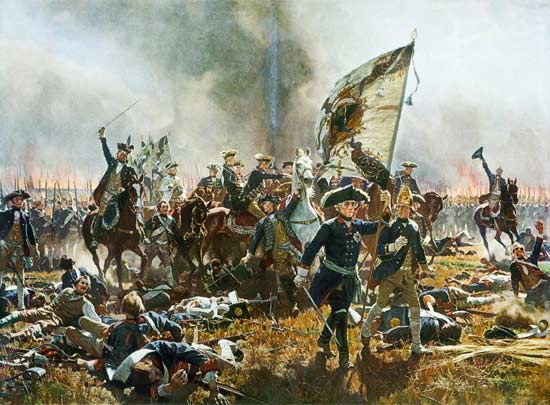
Frederick II at the Battle of Zorndorf


Dear Reader,

This post has been on my mind for a while now, and I hope you will forgive me for my long silence. I am now in the summer between my first and second years of doctoral work, and things are going quite well. One of my articles is being published in the Journal of the Seven Years War Association, so if you are interested in soldierly standards in eighteenth-century North German armies, be sure to check it out! On a related note, I want to examine the issue of bunching and fire control as it applied to eighteenth soldiers.

When I say, "bunching," I am describing the natural instinct to stand closer together in the presence of danger. I began to seriously consider the topic, when a long car-ride conversation with a friend, (and in his own way, military historian), when he expressed incredulity that a professional fighting force such as the Prussians would devolve into an undisciplined mass of men.

The breakdown of command and control on the Kabinettskriege battlefield is well documented. Charles-Joseph, Prince de Ligne, an Austrian officer and military author, recalled, "I cannot recall an action when I did not have to try to break up a multitude of such columns with blows with the flat of my sword, while my corporals were wading in with their canes." (Melanges Militares, vol. 1, 20) "So what," you say- "the Austrians are undisciplined, such things should be expected."  Noted scholars like Christopher Duffy would argue that you are wrong regarding Austrian military capabilities, especially when Ligne would have observed them in the 1770s and 1780s. Rather, this was a European-wide phenomenon.

Frederick II of Prussia's aide in the later stages of the Seven Years' War, Georg H. von Berenhorst, made similar observations regarding Prussian battlefield experience in the Seven Years' War:

"You begin by firing by platoons, and perhaps two or three times get off an ordered volley. But after that follows a general blazing away-- the usual rolling fire when everyone blasted off as soon as he had loaded, when the ranks and files became confused, when the men of first rank could no longer kneel, even if they had wanted to. The commanders, from the lowest officer to the general, could no longer get the mass to perform anything other function: they just had to wait until it finally set itself moving forwards or backwards." (Betractung über die Kriegkunst, vol. 1, 255.)

Berenhorst observations are striking. Even the disciplined Prussian army struggled with command and control. The counter-argument to this is that Berenhorst observed the Prussian army in stages of decline- by 1760, the infantry were of a lesser quality. However, this observation is striking in its similarity to other observers in different armies.

Lt. Colonel Russell, of the British Guards, observed British infantry in action at the Battle of Dettingen, in 1743. Russell wrote in a letter to his wife,

"That the Austrians also behaved well is also true... they all fired as irregular as we did; that the English infantry... were under no command by way of Hide Park firing, but that the whole three ranks made a running fire of their own accord, and at the same time with great judgement and skill, stooping all as low as they could." (Quoted in Blackmore, Destructive and Formidable, 106)

In another letter, Russel indicated, "our men and their regimental officers gained the day; not in the manner of Hyde Park discipline, but our foot almost kneeled down by whole ranks, and so fired upon'em a constant running fire." (Quoted in Blackmore, Destructive and Formidable, 106)

 Ligne, Berenhorst, and Russell all noted the difficulty in translating command and control from peacetime maneuvers to the battlefield. Some may come away thinking that the soldiers of the eighteenth century were not drilled to a high enough standard, but this is the wrong interpretation. Other, non-Kabinettskriege era armies experienced problems in this regard, even those with impeccable credentials.


Peter Connoly's imagining of the Battle of Coronea

To examine this phenomenon at a different level, let us turn to the ancient world. I am sure that many of us are familiar with Thucydides description of the "drift to the right" phenomenon in hoplite battles. According to Strassler's translation, he indicates that, "because fear makes each man do his best to shelter his unarmed side with the shield of the man next to him on the right, thinking that the closer the shields are locked together the better will he be protected."(Strassler, The Landmark Thucydidies, 343.)

But upon closer examination, that doesn't exactly bear out. The second part of that phrase is: καὶ νομίζειν τὴν πυκνότητα τῆς ξυγκλῄσεως εὐσκεπαστότατον εἶναι. (Thuc. 5.71)

Literally, the hoplites "thinking the denser their closeness is, the better protected they are." From a logical standpoint, this is describing bunching. Thucydides language indicates that this phenomenon occurs as a result of fear, and a desire for protection. Thus, even the vaunted Spartiate of the classical age struggled to deal with battlefield bunching. Thucydides shares this anecdote in the context of Spartan King Agis' attempt to minimize the effect of bunching at the Battle of Mantinea in 418.

So, it would seem that keeping soldiers under control on the battlefield was a facet of life in most pre-twentieth century armies, and as some twentieth-century observers, such as Brigadier General Marshall noted in Men against Fire, this problem remains with us today. These problems do not deal dishonor to men from earlier times- command and control had simply not evolved to a sufficient level in order to perfectly manage battle on the scale which it was being waged. Indeed, it must be noted, the highly efficient world of counter-terrorism operations conducted by special forces usually occurs on a small scale. Large armies in battle have been, and continue to be, difficult to manage, and observers should not look for perfection in the military operations.

Thanks for Reading,


Alex Burns

Tuesday, December 17, 2013

Game Review: Empire Total War

Cover Art
Dear Reader,

While most of my readers are likely familiar with the title, Empire Total War, produced by Sega and the Creative Assembly, I thought it might be fun to review it. This game is set between 1700 and 1799, or, roughly, in the second two-thirds of the Kabinettskriege era. 

Here at the outset, it should be noted that I will be reviewing the game on the merits of its historical accuracy, not play-ability or comparison to other strategy titles. In fact, many fans of the series  criticized this title. While many reviews noted that Empire Total War exceed previous games in map size, some reviews criticized the naval battles, and the power AI performance.


However, with that being said, the game is quite historically accurate. The game places you at the head of one of a selection of European powers, such as Great Britain, France, Sweden, Prussia, or Austria. You are in charge of directing your nations development between the years 1700 and 1799. Many random, historically accurate events can occur, such popular revolutions against Absolutist monarchy, or the creation of the United States. One of the good parts about this game is that each play-through is unique, but all retain a measure of historical accuracy.

In the campaign map, one turn is two seasons, meaning the game is split between winter and summer. The research of technology is quite important. You can decide whether you want to focus on military technologies, such as cadenced marching and platoon firing, industrial technologies, such as steam engines and blast furnaces, or Enlightenment technologies, such as citizenship and social contract theory.

There are no different uniforms for soldiers of the same nation, though many modders have created the uniforms for the various regiments of the period. Some of the various downloadable content packs have specific units, such as Prussia's, "Death's Head," Hussars, and other famous units.


One of the most technologies is, "Fire-by-Rank," in which each of the ranks of a particular unit fire in turn. This idea was not actually pioneered during this period, in fact, many of the European nations had discovered the much more effective, "platoon fire," by the 1710s. In the game, platoon fire is actually less effective than fire-by-rank.


The use of battalion squares also presents a problem in terms of historical accuracy. Forming a square took around 5 minutes, much slower than the 30 seconds in the game. This makes square formation much more effective than it was, by ensuring that the cavalry will not reach the infantry before the square is formed.                                                                                                                                                                
Finally, cannons, particularly when using roundshot, are capable of sniping enemy leaders, which is not very historically accurate.  However, despite these problems, this game is definitely the best video game to deal with the Kabinettskriege Era. I have logged an incredible amount of time with this game, and despite its flaws, manages to recreate a passable facsimile of eighteenth century video game.

Let me know what you think of Empire Total War in the comments below!

Thanks for Reading,

Alex Burns