Showing posts with label Black Soldiers. Show all posts

Wednesday, September 25, 2019

Author Interview: John Rees on “They Were Good Soldiers: African Americans Serving in the Continental Army, 1775-1783”


Dear Reader,

Today we have the pleasure of being joined by John Rees, an author and historian of the American War of Independence. Though not a professional historian by training, John has dedicated his life to the study of the American Revolution, and has more detailed knowledge on the life of American common soldiers in this era than any writers I have encountered. I think John's work is an inspiration to all of us, as it shows what can be achieved when people "do history" well. 

His new book, “They Were Good Soldiers: African Americans Serving in the Continental Army, 1775-1783” was published by Helion and Company Press in the United Kingdom earlier this year. John has graciously agreed to answer some questions regarding his book. Without further adieu, let us go to the interview.


Alex Burns: John- you have just published a book regarding the African-American soldiers fighting in the Continental Army. Could you tell us a little about your book? 

John Rees:    ‘They Were Good Soldiers’ examines the subject in some detail, including black soldiers’ personal experiences before, during, and after the war (gleaned largely from nineteenth century pension depositions). The book begins by discussing the treatment of black Americans by Crown commanders and their inclusion in British, Loyalist, and German military units. The narrative then moves into an overview of African American soldiers in the Continental Army, before examining their service state by state. Each state chapter looks first at the Continental regiments in that state’s contingent throughout the war, and then adds interesting black soldiers’ pension narratives or portions thereof. The premise is to introduce the reader to the men’s wartime duties and experiences, within the context of the changing and contracting state lines they served in. The book’s concluding chapters examine veterans’ post-war fortunes in a changing society and the effect of increasing racial bias in the late eighteenth and early nineteenth centuries.
    My intent from the start was to make extensive use of black veterans’ pension narratives. For those unfamiliar with the Revolutionary War pension applications (deemed by one historian, ‘one of the largest oral history projects ever undertaken’), they are the best way to hear the men’s stories in as close to their own words as is possible – to almost hear them speak. Add to that, personal details, available nowhere else, are revealed by the veterans themselves or people close to them. In essence, my wish was to present their experiences as soldiers, as citizens, and as individuals, and pension narratives are the best way to accomplish that.

AB: Although the experiences of these soldiers have not been totally ignored, this is one of the few book-length treatments of African-Americans in the Continental Army in the past fifty years. How has this story been told or neglected by other historians writing before you? 

John Rees portraying a soldier during the
American War of Indepedence

JR:   Funny enough, after being approached to write a book on African American Continental soldiers, but before I submitted my proposal, I received notice of an about-to-be-published book on much the same subject. I’d known my friend Judy Van Buskirk was working on that book, but the matter utterly slipped my mind. After discussing it with my soon-to-be editor and corresponding with Judy, I decided to go ahead with my project. 
    Even now I’ve not read Judy’s book (Standing in Their Own Light: African American Patriots in the American Revolution - University of Oklahoma Press, 2017), the reason being that I did not want to be influenced by or inadvertently plagiarize her work. A friend who has read Standing in Their Own Light tells me that while Judy and I reach many of the same conclusions concerning African Americans’ wartime and post-war experiences, my book more adeptly discusses their service in the context of the Continental army as a military organization, and uses a number of additional primary accounts. I also look further into the veterans’ pension claims, trying to sort facts from faulty memory or deliberate obfuscation. That said, Ms. Van Buskirk is an excellent historian, and I feel confident in recommending her work to anyone interested in the subject. (One of these days I’ll read Standing in Their Own Light myself, and am sure it will educate me, as well as point out the shortfalls in my own work.)
     To get back to the gist of your question, many of the previous accounts of African American Revolutionary soldiers (none, until recently, book-length) have been plagued with misinformation and myths, particularly concerning the “black” 1st Rhode Island Regiment, and have not placed their service within a proper military context. I hope I’ve made some advances in rectifying those deficiencies.     

AB: What first drew you to this particular part of the revolutionary past? It has become very common to focus on the African-Americans serving with British forces during the War of Independence: the Museum of the American Revolution in Philadelphia even has a section dedicated to this story. What caused you to examine the American side of this issue? 

JR:    As a child I knew of Crispus Attucks’ death in the 1770 Boston Massacre, but likely didn’t know of African Americans fighting for American independence until a March 1975 U.S. postal stamp series titled “Contributors to the Cause”; one of those stamps honored Massachusetts soldier Salem Poor.  Two things really piqued my interest. The first was Benjamin Quarles’ book, The Negro in the American Revolution. First published in 1962, I read it in the mid to late 1980s, and was treated to the full scope of African Americans’ roles and experiences during the war. (I still highly recommend Mr. Quarles’ work.) The second was a passage from a post-war memoir by Henry Hallowell, formerly of the 5th Massachusetts Regiment; he wrote, simply, “In my … company [there] was 4 negroes named Jeptha Ward, Job Upton, Douglas Middleton, and Pomp Simmons … part of them called on me after their time was out. They were good soldiers.”
    I began researching the wartime period about 1985, at first focusing on a single Pennsylvania regiment. As I pored through books, and later, manuscripts and microfilm, I began copying and setting aside interesting tidbits that had little or nothing to do with the unit I was studying. That habit continued, and eventually I had miscellaneous information on a number of subjects, including African American soldiers. Over the years I amassed a good store of research, which was added to by my penchant for sharing information, which led to friends and acquaintances sharing their research with me. Around 2005 I decided I had enough material to write a small overview article on black Continentals. That was first published in 2010 in Military Collector & Historian. A few years later I embarked on a monograph focusing on black soldiers in Southern regiments, a project made easier by the discovery of Will Graves’ and C. Leon Harris’s Southern Campaigns Revolutionary War Pension website containing thousands of fully searchable, transcribed pensions. When approached by Helion & Company to do the book, I determined to go further with the subject.
  
AB: What about writing this work surprised you the most? Was there a particular discovery which you were not expecting? 

JR:    Some of the personal details revealed in pension depositions by veterans and those who knew them really floored me. In some cases it was a one-off statement, such as that by a friend of Jacob Francis, a native of Amwell Township, New Jersey, who was taken to Massachusetts as an indentured servant. Francis ended up joining a Massachusetts Continental regiment in late 1775, eventually marched back to New Jersey, and took part in the First Battle of Trenton. In a deposition by one of his old comrades in the New Jersey militia, we learn about an archaic term still used in Massachusetts early in the war, “at that time [1775 and 1776] … Jacob had been out in the New England service among the Yankeys as we then called them. Jacob called his, nap-sack ‘snap-sac’, we told him it was ‘nap sack’ he said that they called it snapsack in the New England troops that he had been with.” A larger story was the number of formerly enslaved men who had several name changes during the lives. For example, former 4th Connecticut soldier David Gardner noted concerning Caesar Clark, “He believes he [Clark] was on the Rolls by the Name of Caesar Negro …” Gardner recalled, too, “There was a Number of Blacks belonging to the [4th] Regiment – most if not all of whom had been Slaves and obtained their Emancipation by Enlistment – Some retained the Names of their former Masters – Some assumed new Names for themselves – and some had Names imposed on them by their Officers …” (Involuntary name change for black men and women was a symbol of servitude or inferiority; for newly-freed African Americans the ability to choose for themselves was a small but overt symbol of liberty.) Several men told origin stories. Cezar Shelton stated, “He was born at sea as he has always been told when his mother was being brought from Africa”; Richard Leet, “a man of Colour … [was] a native of Guinea … brought to the United States when he was about five years old & sold as a slave …” Finally, it was heartbreaking to read a number of veterans tell post-war of their enslaved family members. Philip Savoy, “a man of Collour,” who had served in the 4th Maryland Regiment, noted in his 1818 pension application, “I have a family but they are all slaves. I am myself free and ever have been.” Another former Maryland Continental, Michael Curtis, testified in 1821, “I have no wife and the children born by my wife dec’d. are slaves.”

AB: Although this is your first book, you are not new to researching the American War of Independence. Your various papers on the life of common soldiers are vital reading for anyone attempting to retrace the footsteps of the Continental Army. Was there anything different or challenging about writing a book for the first time? 

JR:   I am used to writing articles, and even large monographs, but a book is another beast altogether. I contracted for the book with Helion in late 2016, with a delivery date at the end of 2017. To say I was daunted and a bit overwhelmed is an understatement. I thought continually about how I would proceed, but procrastinated, trying to advance the manuscript, but instead working on various articles that had nothing to do with the book. By autumn 2017 I had to tell my editor there was no way I would meet deadline and needed an extension. He was very good and told me it was fine, they had other works in the pipeline ready to go and would take the place of my project. Over the next months, into 2018, through a much-needed operation on my back, and during recovery, I continued to work desultorily. About halfway through the year I finally took the leap, tore myself away from other projects and immersed myself in working on “Good Soldiers.”
    I had long thought I would never do a book, realizing I would need to immerse myself in that enterprise, and was concerned I wouldn’t have the time, energy, or discipline. Ultimately, I surprised myself, kept plugging away, and succeeded in finishing the manuscript. Adding to the workload, the Helion series the book was slated for is image intensive, and while busy writing I also had to figure out what illustrations I would to use. As per early discussions and our original agreement, Helion was responsible only for a two-page color painting, part of which would be used for the book’s cover. That left me to provide six more color images, plus a number of black and white pictures. With the kind assistance of Bryant White, who painted three works especially for the book, and the generosity of Don Troiani, the Museum of the American Revolution, and other institutions and individuals, that aspect of the project also came together.
     I do know that, in the end, advancing the submission deadline a year benefitted the final published work product. During the extra time, I gained important additional information and several images not available earlier, and was able to hone the book’s structure.       

AB: John-Can I ask: what might be the next project you take on? Do you think we can expect more books on the revolutionary era? 

JR:    When I completed the book, I really felt as if I’d never do another. Since then I’ve reconsidered and begun to contemplate the possibility. I’ve even mulled over a subject, which, if it ever comes to pass, will likely cover women with the armies of the Revolution, with a focus on the Continental army. 

AB: Thanks so much for agreeing to do this interview!

If you enjoyed this post, or any of our other posts, please consider liking us on facebook,  or following us on twitter. Finally, we are dedicated to keeping Kabinettskriege ad-free. In order to assist with this, please consider supporting us via the donate button in the upper right-hand corner of the page. As always:


Thanks for Reading,


Alex Burns

Friday, August 30, 2019

Black Soldiers in European Armies during the Eighteenth Century

An excellent reenactor from HM 17th Regiment of Infantry,
Photo Credit: Wilson Freeman /Drifting Focus Photography courtesy of H
M 17th Regiment of Infantry
Dear Reader,

This post is designed to give an overview of the history of African soldiers fighting in Europe during the eighteenth century. It purposely does not include soldiers who fought in all-black regiments, which occurred at the end of this era in the British Army, and American Continental Army. For excellent research into that important topic, see the work of Professsor Norman Roger Buckley, who has written extensively on the West Indian Regiments of the British Army in the 1790s-1810s. Rather, this post examines a smaller number of men of color, often elusive and difficult to track, who served in particular roles in largely white regiments of European Armies.

Writing on the history of slavery and enslaved people, even slavery which is disconnected from how it is traditionally seen in the western hemisphere, requires a great deal of care. I hope this post respectfully explores some of the complexities of the service of these men, who both experienced a lack of freedom, and were sometimes able to use their military service to improve their social and economic status. Black soldiers fighting in European armies during the eighteenth century possessed a wide range of experiences: as human beings, they were often given as gifts, they acquired powerful patrons, were the object of stares on the part of Europeans who had previously not encountered Africans, sometimes earned higher wages than white soldiers, died of diseases contracted while in service, married and had children, and in at least one case, rose to high rank and power as a result of patronage. This post attempts to show the range of possibilities for these men of color, without obscuring the lack of freedom and various difficulties which they faced.

Hessian Drummer painted after the American War of Independence
There has been a great deal of research on Africans and African-Americans in eighteenth century armies, and the work of these historians, particularly Hugh Barnes, Judith L.Van Buskirk, Peter Fryer,  Alan Gilbert, George Fenwick Jones, Rebekka von Mallinckrodt, and John U. Rees has been very helpful in providing a framework for this post.[1] For the assistance I received while researching this post, I would like to thank Jason Doerflein, Dr. Thomasz Karpiński, and Arthur Yushkevich.

In the mid-eighteenth century most European armies included a few black soldiers, who were often employed as musicians, particularly as drummers and fifers. A few of these men also served as laborers, and there is evidence to suggest that in some armies, small numbers were employed in combat roles. These men were not always willingly enlisted into the armed forces they served in: many were purchased in Africa or North America for inclusion as symbols of prestige. The use of these men, particularly their uniforms, was a part of a larger process of emulating the fashion of the Ottoman Empire, a craze which swept through Europe during the early part of the eighteenth century.[2] Having black men as musicians was a mark of pride for regimental commanders, and demonstrated the wealth and power of the colonel-proprietors able to acquire them. Although in some states actually Ottoman Turkish musicians were initially imported, these were swiftly replaced African musicians, whose involvement in European armies pre-dated the Turkish craze, but was greatly increased by it.[3] In an odd moment in European history, Africans (as well as African-Americans born in the American Colonies) became drawn into the European military experience as a result of court fascination with Ottoman Military bands.[4]

These men were often purchased, and thus experienced part of the painful world of slavery. They drew a wage.  Particularly in the Prussian service, data from 1747 indicates that black musicians were paid 4 Thalers per month, double the wage of white musketeers who served alongside them.[5] Where records are available, it appears these men were discharged and free at the end of their service.[6] Some African-Americans, by contrast, used the desire for "exotic" bands on the part of European officers for their own ends: joining European military forces in order to escape from the world of enslavement.  There is a small amount of evidence to suggest that some were even able to draw on the institutions available for the care of former soldiers, such as the Royal Hospital at Chelsea.

An African Musician in Wilkie's "Reading of the Waterloo Dispatch
Although the practice of acquiring African musicians is most famous in American circles as a result of the American War of Independence, the practice long pre-dates this. This post will look at the experience of Africans in the Russian and Prussian military, before turning to the more familiar British and Hessian armies.

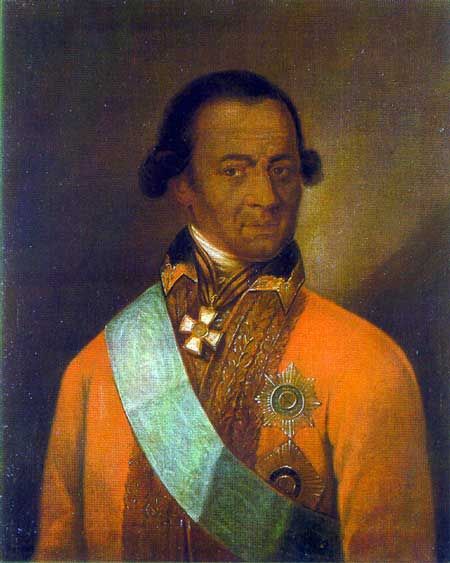
Disputed portrait of Abram Petrovich Gannibal.
Author Hugh Barnes indicates that this may be a portrait of a white officer 
Russian Army: 
Though the Russian court imported an Ottoman military band in 1725, there are few images of African soldiers serving as musicians in the Russian Army. However, a small number of Africans found their way into Russian service as well. The most famous of these is Abram Petrovich Gannibal, a Russian Major General who served in the early-eighteenth century, and is credited with inspiring Alexander Suvorov to become a soldier. Though his exact place of origin in Africa is disputed (both Medri Bahri, in present-day Eritria, as well as Logone-Birni in modern Cameroon have been suggested), Gannibal was brought as an enslaved person to Istanbul, and sent to Russian as a gift to Tsar Peter I in 1704. Likely born in 1696-1698, the Tsar chose to adopt Gannibal as his godson. With this adoption and patronage, Gannibal traveled to France to learn modern military science, and he served in the French Army during the War of the Quadruple Alliance. 

Gannibal was exiled to Siberia after Peter I's death, but continued to demonstrate his excellence by designing fortresses for the Russian state. With the succession of Elizabeth Petrovna to the throne in 1741, Gannibal returned to power, was promoted to Major General, and briefly became the governor of Estonia. His rise to power came with privileges, he became the owner of several estates, and as a result, owned many families of serfs.[7] His power lasted for the lifetime of Elizabeth Petrovna, he was General in Chief of Russian forces in 1762, but retired to his estate after Empress Elizabeth died in January of that year. He lived on his estates until his death in 1781.
Ivan Gannibal, the eldest son of Abram Gannibal
Abram Gannibal married twice, and had ten children with his second wife, a Swedish woman named Christina Regina Siöberg. Their oldest son, pictured above, Ivan Gannibal, also led a distinguished military career. He served as an officer in the Russian Navy, commanding several important naval actions and sieges, but also designed and constructed fortresses, like his father. Also like his father, he achieved the position of General in Chief of the Russian Army.

The fifer is likely an African, based upon his lack
of a queue, and signifying headgear
Prussian Army:
The history of African soldier-musicians in the Prussian Army goes back to seventeenth century, when in 1685, Frederick William, the Elector of Brandenburg, brought a drummer, whose European name was Ludwig Besemann, into his army. In 1737, another African soldier, Josef Sancta Maria, was a drummer in Dragoon Regiment von Moellendorf.[8] It appears that Frederick William I and Frederick II ("the Great") of Prussia maintained a Paukenwagen or a mobile drum platform, for their artillery.[9] You can see a Dutch example of this type of carriage from the era of William III below.


There is a great deal of visual evidence that Prussian armies included African drummers. However, Ottoman emissaries were not impressed by Frederick II's efforts to imitate their bands. After a presentation of a military band, Ottoman Ambassador Achmed Effendi shook his head, and simply commented to the Prussian king, "It is not Turkish."[10] Like in other European states, it seems that African musicians were primarily concentrated in elite regiments, such as Frederick II's Garde, which had a corps of black fifers.

A detail of the image above from the
archival collection of Hans Bleckwenn[11]

However, there were also a number of African Musicians in other regiments, such as the Regiment Markgraf Karl (IR 7).[12] African musicians also served in the Cuirassier Regiment Markgraf Friedrich von Brandenburg (CR 5).[13] Many of these soldiers served in the famous Lange-Kerls of Frederick William I.

An African Drummer from IR 6.
archival collection of Hans Bleckwenn[14]

British Army: 
Historian Peter Fryer provides a clear window into African soldier-musicians in his book: Staying Power: The History of Black People in Britain. He begins his excellent summary of this topic: "The use of black musicians as military bandsmen, a tradition which reached its height toward the end of the eighteenth century, seems to have started in the second half of the seventeenth."[15] As early as 1679, African musicians served in British Regiments, and served as drummers in cavalry regiments as early as 1685.

Despite African soldiers relatively frequent service as musicians in Europeans armies, they still faced surprise from local people. Ensign Hugh Mackay of the 13th Regiment of Foot described the surprise of townspeople in the Netherlands at seeing African musicians:"At 3 O'Clock in the Afternoon Sr. Robt. Riches Dragoons-- enter'd the Town with their black Drummers- at whom the people stared like bewitched, wondering to see Blacks amongst the English Soldiers."[16] This quote gives a window into the sort of reactions which black troops faced as they served in small numbers across Europe.

A Black trumpeter in a detail of a Guard's Officer Painting
Like other European armies, the British regular army acquired black soldiers through the purchase of human beings. The diary of John Peebles on March 4th 1780 indicates: "picked up a little [black child] for a fifer."[17] Peebles' diary later indicates that he attempted to sell a enslaved, it is unclear if it was this same fifer.[18] If that is the case, it would be the sole instance of a black soldier musician being exchange for money which I have encountered. Many of these men were given as gifts, but their being sold individually seems to be a relative rarity. However, it remains a possibility, and would be another similar experience to more traditional slavery encountered by black soldiers and musicians.

The 29th Regiment of Foot, famous in America for their involvement in the Riot on King Street (Boston Massacare), was also famous for the presence of black drummers in the regiment. Regimental Historian Hugh Everard recorded:
"It was while stationed here that the regiment first got its black drummers, which occurred in the following manner. Admiral Boscawen being at the surrender of Guadaloupe, and thinking that blacks would prove very ornamental as drummers, procured eight or ten boys, whom he brought home and gave to his brother, who then commanded the 29th Regiment. Col. Enys, in his MS. Records, states: “His Majesty's permission was obtained to retain them in that capacity, and when I joined the regiment in 1775, there were three, if not more, of the Original blacks in the corps, who were remarkable good drummers.” The custom of having black drummers in the regiment was continued for the better part of 84 years (the last one died on the 15th July, 1843)."[19]
During the eighteenth century, there were also Africans serving in various roles in the Grenadier Guards, Coldstream Guards, 7th Royal Fusiliers, 14th Regiment, 38th Regiment, possibly the 45th Light Company, the Life Guards, 4th Dragoons, and 3rd Hussars.[20]

A Hessian Regiment Circa 1789
Private Archives of Hans Bleckwenn

Hessian Armies:
The longstanding practice of utilizing black musicians followed European armies to North America. In June of 1781, Hesse-Hanauer Captain Georg Pausch reported to his Landgraf that, "Almost all the Hesse-Cassel regiments and grenadier battalions have taken on Negroes as drummers, fifers, and pack-servants[.]"[21] These reports appear rather envious, and Pausch indicates that quickly, "followed this practice at little cost". Interestingly, Pausch mentions the idea of raising an entire regiment of "similar blacks," drawing on experiences of the war in North America. [22] His report to the Landgraf also makes it clear that black soldiers were still a status symbol, human beings who could be given as gifts: "The Brunswick Dragoon Regiment has filled its needs with black drummers, which were however, a present to Major General von Riedesel from Brigadier General Arnold."[23]


As a result of the research of George Fenwick Jones, more is known regarding the Africans who fought alongside the German Subsidientruppen from various states in the American War of Independence.[24] The Hessian muster rolls available at the Hessian State Archives in Marburg list approximately 125 individuals with black skin who served in Hessian forces during the American War of Independence. These roles give an indication that a small number of these soldiers served not only as musicians, but also as combat troops in the Hessian forces. In addition to the large numbers of drummers and fifers, there are a small number of entries for Gemeine, Musketiere, and Fusiliere. Those wishing to make their own notes regarding this particular subset of Africans in Germanic armies should examine the excellent HETRINA database.

These soldiers came from a wide variety of backgrounds in America, including South Carolina, Virginia, both Long Island and upstate New York, New Jersey, Georgia and Florida. Some of the soldiers were not born in America, but originally came from West Africa, and were doubtless transported as slaves before their service with the Subsidentruppen. Still more originally came from the Caribbean. One of these soldiers was born in Lisbon, another is listed as coming from China. 


Of the approximately 125 Black soldiers whose service was recorded, we known approximate dates of service for 56. Of these 56 soldiers, the average term of service was 2 years, some serving as long as six years (and continuing that service after the war) and others serving for as short as 1 month. It seems that some appeared to value their service as an end unto itself, while others simply viewed it as a pit-stop on the journey to freedom.

Of these 56 soldiers, it appears that 16 continued their service past the end of the war, and perhaps returned to the Holy Roman Empire with their regiments. The three images of Black Drummers of the Hessian Garde Regiments come from after the war, possibly confirming that a number of these soldiers returned to Europe. George Fenwick Jones claims that approximately thirty of these drummers serving in Hessian units returned to Europe, but that many of these died of disease in Europe. Others appear to have survived and married in Hessen. The Landgraf even became a god-parent to children of one of these drummers.[25]

I hope that this post has respectfully showed some of the possible life experiences for black soldiers and musicians serving in European military forces during the eighteenth century. They faced incredible challenges, and certainly faced a lack of freedom, but particularly in the case of the Hessian forces, were able to use military service as a way to escape more traditional forms of slavery in North America.

If you enjoyed this post, or any of our other posts, please consider liking us on facebook, or following us on twitterConsider checking out our exclusive content on Patreon. Finally, we are dedicated to keeping Kabinettskriege ad-free. In order to assist with this, please consider supporting us via the donate button in the upper right-hand corner of the page. As always:

Thanks for Reading, 


Alex Burns


------------------------------------------------------------------------------------------------------

[1] Hugh Barnes, Gannibal, Judith L. Van Buskirk, Standing in their Own Light, Peter Fryer, Staying Power: The History of Black People in Britain, Alan Gilbert, Black Patriots and Loyalists: Fighting for Emancipation in the War for Independence, George Fenwick Jones, "The Black Hessians", Rebekka von Mallinckrodt, "There are no slaves in Prussia?" Slavery Hinterland, John U. Rees, ‘They Were Good Soldiers’: African–Americans Serving in the Continental Army, 1775-1783. 
[2]Peter Fryer, Staying Power, 82.
[3] Henry George Farmer, "Turkish Influence in Military Music", Journal of the Society for Army Historical Research, (1946)
[4] Edmund A. Bowles, "The Impact of Turkish Military Bands on European Court Festivals in the 17th and 18th Centuries", Early Music, (2006).
[5]Rebekka von Mallinckrodt, "There are no slaves in Prussia?" Slavery Hinterland, 120.
[6]George Fenwick Jones, "The Black Hessians", The South Carolina Historical Magazine, (1982) 301-302.
[7] Hugh Barnes, Gannibal, 221-224.
[8] Herbert Tobischeck, Die Pauke, 30.
[9] Wolfgang Glauche, Pro Gloria et Patria?,47.
[10] Christian F. Schubart, Ideean zur einer Aesthetik der Tonkunst, 331
[11] P.C. Marten, Die Musik, Der Spielleute.
[12] Theilig, Türken, Mohren, und Tataren, 73-4.
[13] Daniel Hohrath, Uniforms of the Prussian Army, Vol 1, 39.
[14] P.C. Marten, Die Musik, Der Spielleute.
[15]Peter Fryer, Staying Power, 81.
[16] NAM 1997-04-81, pg. 29 (Journal of Ensign Hugh Mackay, 13th Regiment)
[17]John Peebles, John Peebles' American War, 345.
[18] Ibid, 504.
[19] Hugh Everard, History of Thos. Farrington's Regiment, 55.
[20] Peter Fryer, Staying Power, 81-84, Steven Baule, "Drummers in the British Army during the American Revolution, Journal of the Society for Army Historical Research, (2008).
[21] Georg Pausch (Burgoyne tr.), Journals and Reports of the Campaigns in America, 111.
[22] (both quotes) Ibid.
[23]Ibid, 112.
[24] George Fenwick Jones, "The Black Hessians", The South Carolina Historical Magazine, (1982)
[25] Ibid, 302.