Showing posts with label Seven Years' War. Show all posts

Thursday, July 19, 2018

An Odd Battlefield Walk: The Berlin Raids of 1757 and 1760


Dear Readers,

A battlefield walk, or prepared visit to any historic place, is one of the delights of the those who are alive to a sense of the past. Many organizations have their own term for this concept. Militaries call them, "staff rides," American Civil War reenactors have their own, less savory term.  After my work at the archive yesterday, I conducted a battlefield walk in Berlin. It is possible to do many of these walks in Berlin, but rather than focus on the Second World War, I examined the ground marked by Austrian and Russian raids on Berlin during the Seven Years' War.

Battlefield walks in urban environments are the most difficult and least rewarding type of staff ride. The ground has changed and the spaces are often crowded, noisy and distracting. But, if I wanted something easy, I shouldn't have chosen the mid-eighteenth century as a focus for my studies. If you are hazy regarding the Seven Years' War, you can pop over to this website for a quick refresher.  For the purposes of our discussion today, you only need to know that Berlin, the capital city of the Prussian state, was being threatened by the Austrian and Russian armies. Before embarking on the battlefield, let's discuss the city of Berlin in the eighteenth century for a moment. The map above is from 1789, while the map below is from just before the Seven Years' War in 1748.


You can see the outline of the city. The city center contained crumbling defenses that had not been repaired since 1740. A small wall, more for taxation than defense, surrounded the entirety of the city. The only real fortress in the area was outside the city itself, slightly northwest in Spandau. In times of crisis, the royal family would flee to Spandau, rather than stay in the city. The customs wall, as it was called, can be seen outlining the city on both maps. The southern side of the city contained extensive pastures and this open land was also enclosed by the customs wall. You can see that feature on the southern side of the city in both maps. Our story today primarily takes place in that open land, and around three gates on the southern side of the customs wall: the Halle Gate (Hallesches Tor), the Cotbuss Gate (Kotbusser Tor) and the Silesian Gate (Schlesisches Tor). It is possible to (roughly) retrace the line of the customs wall, by following the U1 or U3 Ubahn lines traveling to or from the Warschauer Straße Ubahnhof. While the line does not follow the course of the customs wall exactly, and while the stations are not exactly on the site of the gates, it is possible to quickly move to the approximate locations of these former gates. The map below shows the 1757 raid of the city.

Grosser Generalstab Map
In 1757, Austrian FML Andreas Hadik chose to approach the city from the southeastern side, in order to cover the relatively small size of his force.  Hadik had perhaps 7,000 men with which to confront the Berlin garrison of roughly 4,000. Moreover, many of Hadik's troops had been detached, and he knew that Prussian reinforcements were quickly approaching from various quarters. On 11am on the 16th of October, 1757, Hadik began offensive operations against the city.

Looking southeast towards the initial Austrian positions. 
The commander of the Berlin Garrison, Lt. General Rochow, upon recovering from his initial shock, quickly deployed troops to the southern city gates. Around 500 men of the Leon Fusiliers were in the vicinity of the Silesian Gate when Hadik began his attack. Major Tesmar and six companies of the 7th Garrison regiment were dispatched to the Silesian Gate shortly before Hadik began firing towards the defenses with three-pounders.[1] The Austrian gunner Georg Joseph Thun managed to lower the drawbridge across the Spree, by damaging one of the chains suspending it, which precipitated an attack by two companies of Austrian Grenadiers. The troops rushed from the southwest side of the Spree across the now passable bridge towards the Stralauer Tor on the far side, scattering the opposition.

The modern far side of the Spree, and bridge towards the Stralauer Tor. 
Hadik deployed more artillery, and his six-pounders smashed the Silesian Gate itself, which permitted around 1,400  Austrian troops to make their way inside the city.

Looking northwest towards Berlin. 
Although most of the formerly open land has been built up, there are a few parks which give a better sense of the space confronting Hadik and his troops. Hadik's troops moved inside the wall to the northwest, and began to notice Prussian reinforcements approaching. Major Tesmar and the six companies of Garrison Regiment 7 wheeled to anchor their right flank on the customs wall, and began to move towards the Austrians pouring through the Silesian gate.[2] The situation can be seen below.

A detail showing the combat at this point. 

A modern version of the view from the perspective of the Prussian reinforcements,
under Major von Tesmar
Hadik used the relative openness of the terrain to outflank and charge the Prussian troops. The six companies were charged from the front by 700 hundred cavalry, while attacked in the flank by an indeterminate number of Croats. The Prussians immediately opened a 'heavy fire' on these approaching forces, but numbers and combat experience took their toll, and the Austrians quickly routed the Prussian troops in the ensuing melee.

The view northeast between the Silesian and Cotbuss Gates 
Having failed to stop the Austrians, Lt. General Rochow retreated with the remainder of his forces towards Zitadelle Spandau. Hadik had too little time to effectively disable the Prussian capital and made some minor demands which were granted before he withdrew. The Austrians were on the road southwards by 10pm, having extracted 14 carriages of currency from Berlin. According to legend, Hadik also demanded 20 pairs of gloves for Maria Theresa. 


The interior of Charlottenburg Palace was badly damaged during the 1760 raid
The Prussian capital would come under attack again in 1760, when forces under Austrian FM Lacy and Russian General Chernyshev concentrated on the city in October of 1760. As opposed to the previous raid, major forces were involved, and by the 7th of October, perhaps 15,000 Prussians faced over 30,000 Austro-Russian allies around the city. Prussian General Johann von Hülsen defended the south approaches to the city against the Austrians, while Prinz Eugen von Württemberg guarded northeastern side against Russian troops. Seeing that the allies possessed almost double their numbers, the Prussian commanders decided to avoid a Maxen-like debacle and withdraw their forces. In essence, to Hülsen and Württemberg, the army was more important than the capital. 

Hülsen's view looking south from the Halle Gate
 towards Austrian positions near Tempelhof
Russian General Totleben had been in negotiations with the commandant of Berlin, the venerable Prussian Lt. General Rochow. Among the generals of the eighteenth century, Rochow possesses the infamous distinction of having lost his prince's capital twice. Rochow and Totleben concluded terms without consulting the Austrian commander Lacy, who was furious. Totleben was a man with a reputation for nepotism and kleptomania, and personally profited a great deal from his military career. 

The courtyard behind the Halle Gate, by which Lacy and the Austrians entered.


The Zeughaus, or armory, which now houses the German History Museum,
was heavily damaged.
Lacy, as a result, did little to stop his troops from looting the city, in violation of Totleben's agreement. The Russians targeted their fury on state-owned buildings, while the few Austrians who managed to get into the city before the agreement was ratified destroyed whatever property they could. Eventually, Russian troops ostensibly guarding the city (for their own, sanctioned, looting) fired on Austrian looters to force them to desist. By the 11th of October, word had reached the capital that the Prussian main army was on the move. The Austrian and Russian forces left a badly damaged Prussian capital and rejoined their main armies. 

Both raids on Berlin had the effect of badly slightly weakening the Prussian war economy, and causing Frederick to lose face before an international audience. However, despite the paintings lost and treasure stolen, losing Berlin did not prevent the Prussians from continuing the war effort. Indeed, the raids on Berlin were less strategically significant than losing a Silesian fortress such as Glatz or Schweidnitz. If you seek to walk the Berlin raids, print off a large period map, and bring both a readable secondary account of the action, as well as print-offs of the relevant articles on Kronoskaf. All three are invaluable in orienting you to the actions which occurred. 

If you enjoyed this post, or any of our other posts, please consider liking us on facebook,  or following us on twitter. Finally, we are dedicated to keeping Kabinettskriege ad-free. In order to assist with this, please consider supporting us via the donate button in the upper right-hand corner of the page. As always:

Thanks for Reading,


Alex Burns 


--------------------------------------------------------------------------------------------------------------------------
[1]Duffy, By Force of Arms, 69.
[2] Ibid, 70. Hadik claims that nearly all the Prussians were taken prisoner, and only six colors were captured. 

Monday, July 16, 2018

Seniority and Organisation in the French Infantry of the Mid-Eighteenth Century

Interpretive Staff portray French Troops in North America

Today, we have an excellent guest post by author and historian William Raffle.[1]
--------------------------------------------------------------------------------------------------------------------------


Dear Reader,

In this post I want to bring your attention to the composition of a typical French Battalion and its intricacies and idiosyncrasies. Through translating a number of sources on this period, I have found it interesting to see how rank and seniority was embedded within almost all aspects of the French army even in attempts with attempts to make the army more efficient.

When tensions began to rise between Britain and France in North America precipitating the Seven Years’ War, major efforts to codify the French army of Louis XV were taking place. An ‘ordonnance’ was issued in 1754 which laid out new regulations for French and foreign infantry battalions to bring them into ‘exact conformity’.[3] At this time a French battalion consisted of twelve companies of fusiliers (A ‘fusil’ is the French name for a flintlock musket, ‘mousquet’ is the word for the old matchlocks) and one grenadier company. This might give the impression that a French battalion would be particularly sizeable, but a French company was fairly small - under fifty men at full strength.[3] Indeed, the new ordonnance gave instructions that a battalion’s smallest fighting unit was to be two companies together called a peloton or platoon. Platoons were a permanent fixture and its two companies would camp, march and fight together.[4]

The company then was almost irrelevant to the functioning of a battalion so what was the point of it? The answer to this conundrum reveals a characteristic particular to the French army; there were far more officers than other armies. As with most eighteenth-century armies, Captains commanded companies and were responsible for their costs. A Captain’s pay could not keep up with this expense and so the companies became smaller over the course of the eighteenth century. ‘Already in 1740 the French Army was becoming marked in this respect having one officer for every eleven soldiers, as against the Prussian ratio of one to twenty-nine.’[5]

Interpretive staff portray Compagnies Franches de la Marine at Niagara in 1759

The ordonnance of 1754 reflects the obsession with hierarchy and seniority within the army with minutiae verging on the ludicrous and is best illustrated by the arrangement of the flank companies. There were two flank companies per battalion – the grenadier and piquet company. The grenadiers, as most readers will be familiar, were recruited from the best soldiers of other companies. The captain of grenadiers would pay a fusilier captains for their experienced men who were chosen to be grenadiers. The piquet was not a permanent company but were drawn from good soldiers from the fusilier companies when a battalion assembled for the duration of its current operation. (Piquet or picket literally translates as ‘fence’ and should be thought of as meaning ‘guard’ company rather than light company although they did evolve this way.) Even within the ranks, fusiliers and grenadiers were lined up in order of each soldier’s seniority (length of service rather than age). The first rank was made up of the most senior soldiers, the rear rank the next most senior and the middle ranks were made up of the least experienced, presumably to strengthen their resolve by being surrounded by their comrades without easy means to break out of formation! The forty-eight fusiliers of the piquet were arranged so that they would mirror the order of the companies and platoons from which they came and then within order of seniority.[6]

The need to distinguish seniority continued to the position of the platoons when formed in line. It is a commonly written that British grenadiers were always placed on the right flank and indeed, in the French military the right flank was the highest position of honour in respect to the entire army.[7] If a battalion was deployed on the right side of the line, the grenadier company would be placed on the right side of the battalion and the piquet would take the left. However, if the battalion was on the left-hand side of the battle line, the whole arrangement would flip to a mirror image, the grenadiers would be deployed on the left and the piquet on the right. It wasn’t just the flank companies that were rearranged, all of the fusilier platoons in the centre would also be rearranged.[8]

Interpretive Staff portraying French Soldiers

These concerns were not just borne out in a drill manual. Military seniority clashed with social rank and had real ramifications on campaign. A Duke or a Count would not wish to be ordered around by a mere Baron, or, God forbid, a bourgeoisie! A letter from 1758 reveals the herculean task involved with drawing up an order of battle which satisfied quarrelsome officers,
‘M. de Randan wanted to return to the line… M. d’Armentiéres found that it was disagreeable for him to be in the infantry en second under M. de Contades, and desired to be moved to the cavalry. M. de Poyanne wanted to remain with the Carabiniers, that obliged me to move all the officers of the left and right wings and disrupted my plan to put the infantry officers with the infantry and the cavalry officers with the cavalry.’[9] 
The nobility believed that military command was their own preserve. In these circumstances, military professionalization would take a back seat to the preservation of the social order. There was much resistance to a new rank created by the war ministry, that of the aide-major (as the name suggests the role was as a second to the Major, to assist with the logistical running of the regiment). The reason it was not welcome was that it would provide more opportunities for officiers de fortune, or career soldiers from more humble backgrounds, as noblemen tended not to care too much for finding lodgings for their men or organizing bread rations.[10] As the historian Lee Kennet summarised, the French officer corps of this period had little understanding of modern warfare and were highly resistant to change until the humiliation of the Seven Years War forced a reckoning and self-reflection within the army.[11]

In a follow-up post to this I will explore the background of the French army which went to North America and how they relate to these notions of seniority and the way in which soldiers were used in this conflict.

If you enjoyed this post, or any of our other posts, please consider liking us on facebook,  or following us on twitter. Finally, we are dedicated to keeping Kabinettskriege ad-free. In order to assist with this, please consider supporting us via the donate button in the upper right-hand corner of the page. As always:

Thanks for reading!


Will Raffle

--------------------------------------------------------------------------------------------------------------------------
[1]Will Raffle graduated with an MA in Early Modern History in 2018 from the University of Sheffield. He published a translation of a French aide-major, comte Maures des Malartic’s North American journal in 2017, entitled Glories to Useless Heroism.
[2]Instruction sur l’Exercice du Infanterie, (Paris, 1754), p. 1. It was issued in the name of the King by D’Argenson, Louis XV’s minister of war.
[3] Ibid, 14.
[4] Ibid.
[5] Lee Kennett, The French Armies in the Seven Years’ War, (North Carolina, 1967), p. 66.
[6] Instruction sur l’Exercice du Infanterie, (Paris, 1754) 18.
[7] Le Blonde, ‘Poste d’Honneur á la Guerre’, Encyclopédie, ou dictionnaire raisonné des sciences, des arts et des métiers, etc., eds. Denis Diderot and Jean le Rond d'Alembert. University of Chicago: ARTFL Encyclopédie Project (Autumn 2017 Edition), Robert Morrissey and Glenn Roe (eds), http://encyclopedie.uchicago.edu/. This place would be taken by the most senior regiment although there was an exception in the most senior regiment in France, the Gardes Française, by tradition deployed in the centre of the line.
[8] Instruction sur l’Exercice du Infanterie, (Paris, 1754) 15.
[9] Clermont to Belle-Isle, June 15, 1758, Correspondance militaire (A-1) Vol. 3503, 141. Archives de la Guerre, Vincennes.
[10] Kennett, The French Armies, 60.
[11] Ibid, 68-71.

Monday, March 19, 2018

1770s Prussian Army Uniform Plates


Prussian Hussars circa 1776


Dear Reader,

Over "spring break," I had the distinct pleasure to be able to research for my dissertation in Washington D.C. and New York City. I looked at numerous document collections relating to my dissertation on the cultural views of British and Prussian soldiers, but also took a few moments to photograph this collection.

The official title of this collection in German is: Plan von der Koeniglichen Preussischen Armee worinnen ein Officer und Gemeiner von Jeden Regiment zu Sehen.  Roughly, this means, "plan of the Royal Prussian Army with a officer and private from each regiment pictured." Drawn in 1776, this collection displays an officer and soldier from each regiment of the Prussian Army as it appeared in the 1770s. I had the opportunity to photograph it at the Society of the Cincinnati Library, in the Anderson House Museum.

This image collection is not necessarily a great resource for the Seven Years' War era, some of the regiments post-date that conflict. However, it is a source drawn in Berlin within 15 years of the end of the war. Certainly, for any wargamers interested in the Prussian army in the 2nd half of the eighteenth-century, these images are worth a look.


If you enjoyed this post, or any of our other posts, please consider liking us on facebook,  or following us on twitter. Finally, we are dedicated to keeping Kabinettskriege ad-free. In order to assist with this, please consider supporting us via the donate button in the upper right-hand corner of the page. As always:

Thanks for Reading,


Alex Burns


Wednesday, February 14, 2018

Did Melee Combat Frequently Occur on Eighteenth-Century Battlefields?

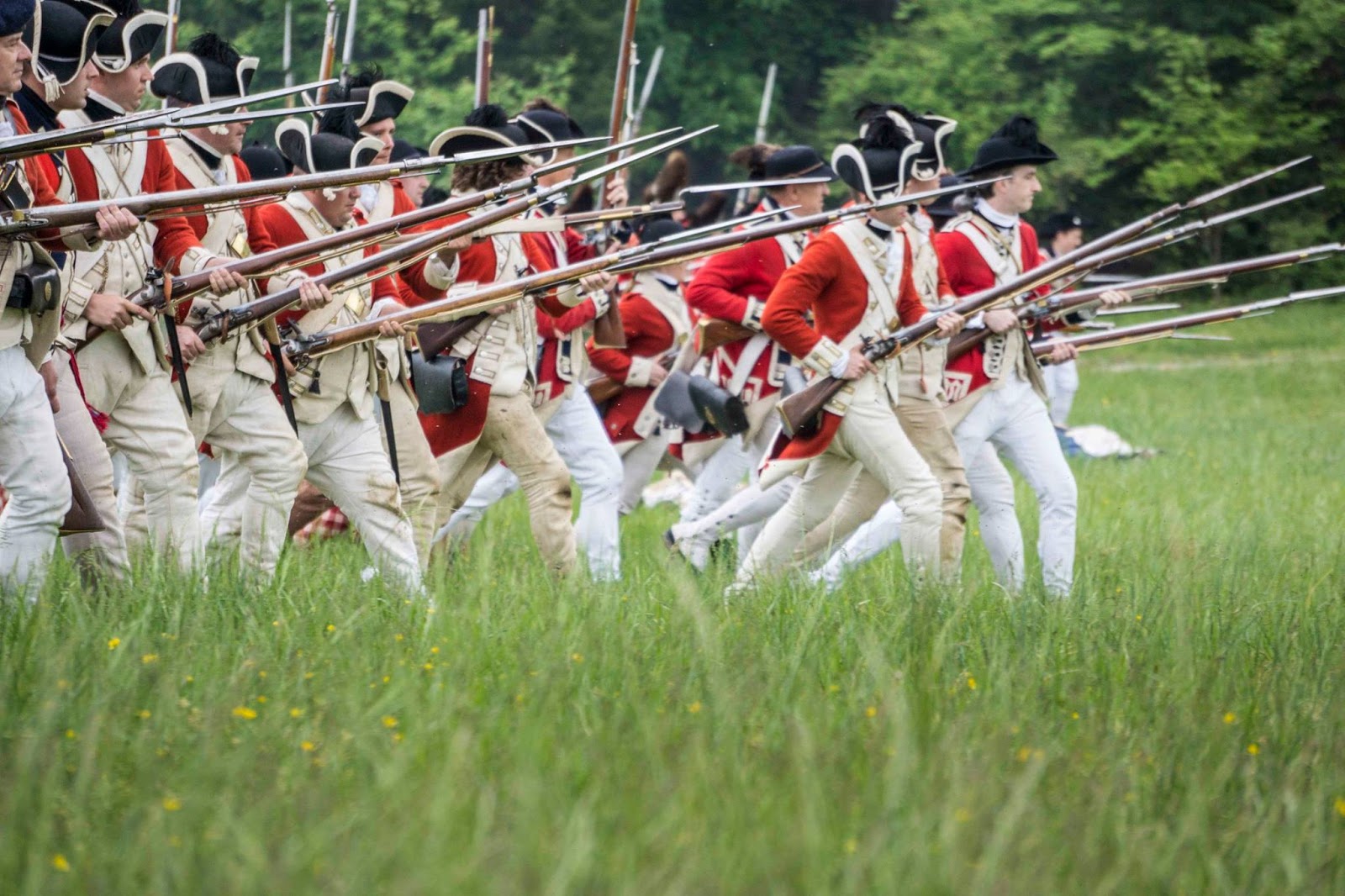
British Troops prepare to charge at Guilford Courthouse
Dear Reader,

We have charted some interesting territory over the past couple of weeks. It seems that mid-eighteenth-century soldiers frequently fired away their entire ammunition load, engaged in firefights at a much greater distance than is usually assumed, and sometimes fired at will, rather than fire by platoon or division. What does all this mean for eighteenth-century combat? If troops fired quickly, it can help to explain the ammunition usage, and the range of combat can help historians make sense of the large numbers of rounds expended vs. small number of casualties.

What does all this mean for melee (hand to hand, close) combat? Did eighteenth-century soldiers engage in melee combat frequently? If the Swedish Army during the Great Northern War and the British Army during the American War of Independence preferred bayonet attacks, surely there was a good deal of hand-to-hand combat?

Melee combat occurred, but it was perhaps less frequent than might be initially imagined. I am sure we can all think of famous examples: Culloden, Bunker Hill, and Guilford Courthouse all seem like important examples. When fighting against the Ottoman Empire, both Russian and Austrian soldiers reported fierce hand-to-hand struggles. Many military commanders, at some point in their careers, seemed to prefer an armes blanche or cold steel attack. Frederick the Great advocated this idea in the early Seven Years' War, Alexander Vasilyevich Suvorov famously stated that, "the bullet is a mad thing, put your trust in the bayonet." With these ideas spreading, surely hand to hand combat was frequent?
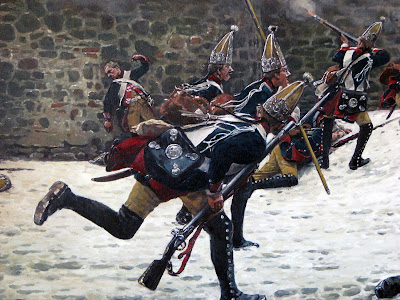
An artist's reimagining of Prussian Troops at the Battle of Leuthen

In reality, hand-to-hand, or melee combat was often limited to a select number of places on the battlefield. When enemy troops appeared to make a serious advance into close range with bayonets, defending troops often melted away. That is why the Swedish Karoliner and British redcoats proved so effective on their respective battlefields. It also helps to explain why, when things went wrong for troops making a charge with cold steel, they went very wrong (such as at Poltava in 1709 and Cowpens in 1781.)Troops did experience hand-to-hand combat, but firepower (at range) was the order of the day. In William Dalrymple's 1782 essay on tactics, he asserted (in the case of infantry):
"There is probably not an instance of modern troops being engaged in close combat... the bayonet can be of little utility by way of impulsion in the field... these defects in modern infantry prove the impracticability of two battalions, opposed to each other, being brough in the open field to close encounter: one body must give way before they get into action."[1]
Though Dalrymple is exaggerating for effect, we would be wise to take his point. In the open field, when flight was a possibility, it was rare for two battalions of infantry to cross bayonets. Nonetheless, other types of melee combat did occur, and are worth discussing. Even in nations where military theorists preferred bayonets, such as the French, soldiers realized that actual bayonet fighting was rare in this era. French military authority Jacques Antoine de Guibert understood the issue in this way:
"Finally, it seems that the entire exercise of the bayonet consists of fixing bayonets, presenting, and unfixing. I do not wish, as is currently the case, that troops should only use bayonets at parades and reviews. I would like them to be placed, as in combat, or rather in simulated motions which represent it. Soldiers have become familiar with bayonets, and view them as an unnecessary arm. They consider it to be a weapon without a use. Soldiers, and French soldiers above all, believed, "Well, I am out of ammunition, so only bayonets are left."... According to the method of the German infantry, our troops always march with fixed bayonets, in a unique way, a weapon that is always ready but never used."[2]
In short, during cavalry action, attacks on defensive works, and surprise attacks, troops often engaged in melee combat. These were the places for bayonets, not in the open field against other infantry.
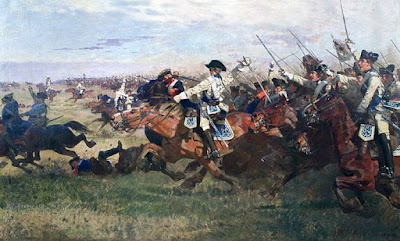
Prussian Cavalry on the Charge
When cavalry troops were involved, melee combat was quite frequent. At Guilford Courthouse, William Washington's light dragoons savaged the British 2nd Guards.[3] One of these light dragoons, Peter Francisco gave us a window in the visceral intensity of this type of combat:
“Colonel Washington, observing their maneuvering, made a charge upon them, in which charge he (Francisco) was wounded in the thigh by a bayonet, from the knee to the socket of the hip, and in the presence of many, he was seen to kill two men, besides making many other panes which were doubtless fatal to others.”[4]
At the Battle of Hohenfriedberg. the Bayreuth Dragooner swept away a large portion of the Austrian army.[5] Lt. Francois de Chasot, a friend of Frederick "the Great" of Prussia, gave his recollection of the attack:
At the start we moved at a walk. We crossed several ditches one rank at a time, and on each occasion I made the leading rank halt of the far side so as to give the reward two ranks time to catch up. Then we broke into a trot, and finally into a full gallop, putting our heads down and running into the Austrian grenadiers. At first they stood bravely, and fired a salvo at twenty paces. After that, they were overthrown and cut down.[6] 

Unlike dragoons and cuirassiers, Prussian Hussars had curved swords 

When fighting other cavalry, it appears that the horses would seek intervals through the enemy formation, leading to brief moments of intense combat followed by maneuvering. In moments of true melee combat, all order was lost, and horses and men swirled around in an individual combat. Even here, however, cavalry melee was perhaps less effective than frequently believed. In the 1780s, military theorists studying the Prussian army recorded, "We heard from some cavalry officers that when troops undertake a charge, almost always, one troop flees before melee is joined, and the other gives pursuit."[7] Georg Tempelhof, a veteran of the Seven Years' War, reported,
"The strength of cavalry consists in its movement: it must have the ability to maneuver with speed. The shock or charge has no effect unless it happens in this way. Forgive me if I do not consider the cavalry's shock to be so decisive as it seems. In 1762 I observed Prussian cavalry charging superior Austrian horsemen. The result was that on both sides there were a few hundred wounded and prisoners. Not a single death was recorded."[8]
It is possible that Tempelhof, as an artillerist, underestimated the potency of cavalry. Horsemen, then, particularly in Europe, preferred to engage in hand to hand combat. Cavalry officers endlessly debated whether or not it was more effective to cut or thrust against the enemy, or whether straight or curved swords were more effective. Frederick II of Prussia was once pressed on this issue:
Speaking one day with his Majesty the King of Prussia, of this diversity of opinions, with regard to the edge or the point, he answered, " Kill your enemy with the one or the other, I will never bring you to an account with which you did it."[9]
Having addressed cavalry, we will now turn to another example of troops in melee combat: combat over defended positions.

Reenactors in the processes of assaulting a Redoubt

When defending soldiers held fortified or prepared positions, melee combat could be fierce. Soldiers attached great pyschological important to their defensive works, and often tangled with enemy troops in melee combat in order to defend them. In discussing this issue, Christopher Duffy presents evidence that soldiers actually had difficulty understanding that they needed to use their bayonets in these type of assaults.[10] Even insignificant defensive positions could motivate defending troops to stand, such as the rail fence which the North Carolina troops sheltered behind at Guilford Courthouse in 1781. An advancing Hessian soldier, recalling the fighting over this obsticale, only commented, "Colonel Du Buy at once ordered, "Fix bayonets! March! Before the enemy could reload, we changed against them with our bayonets. Everyone was bayoneted."[11]

Obviously, this type of melee action includes siege warfare. During the Siege of Schweidnitz in 1762, Austrian 1st Lt. Waldhütter and thirty men of the Erzherzog Carl regiment spearheaded a successful sortie against the besieging Prussian forces. Franz Guasco, the fortress commandant, left this description of the sortie:
"Waldhütter and his troops jumped inside without hesitation and found the Prussians on their guard.Some of the opened fire, while some knelt on the floor and raised their muskets, the bayonets fixed to the muzzles. Our men flung themselves blindly among them, sabre in hand; some of them were skewered on the bayonets, but the rest set about the enemy and hacked them to pieces."[12]
Alexander Hamilton was briefly involved in bayonet fighting during the storming of redoubts 9 and 10 at the siege of Yorktown. Joseph Plumb Martin is silent on the exact nature of the fighting inside the redoubts.[13]  Hamilton reported that men under his command suffered a number of "bayonet wounds," in the course of the fighting.[14]

Xavier della Gatta's impression of the Battle of Paoli
Troops often fought with bayonets during surprise attacks or "massacres." 
The American War of Independence produced a number of famous night-attacks which led to bayonet fighting, both of these, at Paoli in 1777 and Tappan in 1778 were extremely violent affairs, with many soldiers being killed both in and out of combat. At both Paoli and Tappan, British troops bayoneted Americans, and there is indeed evidence that Americans fought back with bayonets. This type of fighting was quite intense from a psychological perspective, and you often find descriptions of men, who like Captain Sir James Baird, killed large numbers of enemy troops singlehandedly. In addition to fighting with bayonets, troops at Paoli and Tappan burned to death, and were killed by firepower. Lt. Martin Hunter described the scene: "the camp was immediately set on fire; the Light Infantry bayonetted every man they came up with... this, with the cries of the wounded, formed altogether the most dreadful scene I ever beheld. Every man that fired was immediately put to death."[15]

The Attack at Hochkirch by Hyacinthe de La Pegna
During the Seven Years' War, the Austrians managed to inflict similar damage on the Prussian army. At the Battle of Hochkirch in 1758, Austrian columns overran the Prussian camp before some Prussians were even awake. Johann Wilhelm von Archenholz, a Prussian veteran, described what it was like the be on the receiving end of such a swift-moving attack:
"It was dark, and confusion reigned supreme. What a sight for these warriors, almost like a night terror. The Austrians seemed to emerge from the earth, in the midst of the Prussian flags at the center of camp! Several hundred men were killed before they could open their eyes, and others ran half-naked to their weapons. Only a few could reach them. Others laid ahold of whatever was closest to hand, and began to fight."[16]
Here we have an example of true melee, with thousands of soldiers fighting and dying in close combat. However, even here, it is important to note the ways in which this melee is unique. The Prussian army was surprised in camp, and fought a battle of desperation because of the impossibility of escape. In the open, troops would have fled long before this point.

British Troops with charged bayonets

So, did troops in the open really not cross bayonets? Outside of the above-mentioned categories, infantry forces actually crossing bayonets when one force had the option to flee seems to have been quite rare. Again, there are instances such as Culloden and Guilford Courthouse, but those remained more the exception than the rule.  According to one French report, 68.8% percent of troops were wounded by small arms fire, 14.7% were wounded by artillery fire, and approximately 15% were wounded by swords and bayonets.[17] When we consider that swords were the cavalry's main form of engaging the enemy, these figures are impressive. J. F. Puysegur argued that,
"firearms are the most desctructive category of weapon, and now more than ever. If you need convinving, just go to the hospital and you will see how few men have been wounded by cold steel as opposed to firearms. My argument is not advanced lightly. It is founded on knowledge.[18]
Because Puysegur was writing in the 1740s, before the Seven Years' War, his experience is even more telling. Other military theorists, such as David Dundas, recalled,  "... infantry seldom mix with bayonets."[19] These eighteenth-century military observations match well with those from the twentieth century:
"The vast majority of soldiers who do approach bayonet range with the enemy use the butt of the weapon or any other available means to incapacitate the enemy rather than skewer him... when the bayonet is used, the close range results in a situation with enormous potential for psychological trauma... The resistance to killing with the bayonet is equal only to the enemy's horro at having this done to him. Thus in bayonet charges one side or the other inveriably flees before the actual crossing of bayonets occurs."[20] 
Reenactors at Guilford Courthouse
 Thus even in desperate circumstances, such as the battle of the third line at Guilford Courthouse, we see infantry attempting to load and fire while in melee combat. Captain John Smith of the 1st Maryland Regiment found himself in heavy melee combat against the British guards, but was shot in the head at extremely close range (non-fatally by buckshot, as it turns out) by a soldier who had just loaded.[21] Therefore, there may be some truth psychological prejudice against using bayonets, even in the eighteenth-century. Lt. Colonel John Graves Simcoe described realistic small unit training which kept this principle in mind:
"they were, particularly, trained to attack a supposed enemy, posted behind railing, the common position of the rebels; they were instructed not to fire, but to charge their bayonets with their muskets loaded, and, upon their arrival at the fence, each soldier to take his aim at their opponents, who were then supposed to have been driven from it; they were taught that, in the position of running, their bodies afforded a less and more uncertain mark to their antagonists, whose minds also must be perturbed by the rapidity of their approach..."[22]
Here, we can see that when driving enemy from a position, infantry were trained to fire at fleeing men, rather than attempt to chase them down with bayonets. Obviously, melee occurred in the eighteenth century. However, it was not a common occurence, and seems to have become less prevelant over the course of the era.

If you enjoyed this post, or any of our other posts, please consider liking us on facebook, or following us on twitterConsider checking out our exclusive content on Patreon. Finally, we are dedicated to keeping Kabinettskriege ad-free. In order to assist with this, please consider supporting us via the donate button in the upper right-hand corner of the page. As always:

Thanks for reading,


Alex Burns

--------------------------------------------------------------------------------------------------------------------------
[1] William Dalrymple, Tacticks, 113.
[2] Guibert, Essai général de tactique, 81.
[3] Lawrence Babits and Joshua Howard, Long Obstinate and Bloody, 160.
[4]Letter of Peter Francisco, William and Mary College Quarterly, (1905) Vol 10, 219.
[5] Christopher Duffy, Military Life of Frederick the Great, 64.
[6] Matthias Kröger, Friedrich der Große und General Chasot, 38.
[7] Mirabeau and Mauvillon, Systeme militaire de Prusse, 104.
[8] Georg F. Tempelhof, Geschichte des Siebenjährigen Krieges in Deutschland, 68.
[9] Charles Immanuel de Warnery, Remarks on Cavalry, 17.
[10] Christopher Duffy, Military Experience in the Age of Reason, 204-5.
[11] Bertold Koch, The Battle of Guilford Courthouse, 7.
[12] Kriegs Archiv, Vienna, HKR Memoires 1762  880/12, Guasco, Relation du Siege de Schweidnitz, 31 October, 1762.
[13] Joseph Plumb Martin, Private Yankee Doodle, 237.
[14] Alexander Hamilton, The Works of Alexander Hamilton, Vol 8, 47.
[15] Martin Hunter, Journal, 31.
[16] Johann Wilhelm von Archenholz, Geschichte des Siebenjährigen Krieges, Vol 2, 279.
[17] Andre Corvisier, L'Armee Francaise, 64.
[18] Puysegur, Art de guerre par pricipes et par regles, Vol 1, 227. (Translation is Christopher Duffy's.)
[19] David Dundas, Principles of Military Movement, 51.
[20] David Grossman, On Killing, 120.
[21] Babits and Howard, Long Obstinate and Bloody, 159.
[22] John Simcoe, Simcoe's Military Journal, 98.