Showing posts with label hussars. Show all posts

Thursday, May 14, 2020

Deep Dive on Uniform Research: The Pelisse Trim of the "Death's Head" Hussars

Accurate Vorstellung der sämtlich Koeniglichen Preusischen Armee
(Society of the Cincinnati Library, Washington, DC)

Dear Reader,

Today, I want to examine a topic near and dear to many of our hearts: researching the details of uniforms from the eighteenth century. Although this post follows one uniform detail and my search for answers regarding it, my hope is that it will provide enthusiasts and amateur historians of material culture with a step-by-step processes for evaluating and answering their own questions regarding uniforms and material culture from the eighteenth century.

Obviously, this is not a comprehensive guide on how to research material culture, nor is it is a comprehensive guide to eighteenth-century uniforms. For further advice on these matters, I highly recommend contacting archaeologists and specialists from your particular field of interest. For all eighteenth-century uniformology questions, Dr. Matthew Keagle at Fort Ticonderoga is an excellent place to begin. When his dissertation, 'An Uniform is Granted by all to be Absolutely Necessary’: A Cultural History of Military Dress in the Revolutionary Atlantic, is widely available, it will be a necessary starting point for understanding military dress. If you are new to this process, my first piece of advice is find someone who (regardless of their profession or credentials) has spent serious time doing primary research in your field of interest. If you need advice on who to contact for your specific question, feel free to reach out to me. I have many friends digging deep into the world of eighteenth-century uniforms.

Step 1: Formulate a Question. 

Several months ago, I became interested in the uniforms of one of the most iconic mid-eighteenth-century military units: The Reusch Hussars, or Hussar Regiment 5 of the Prussian Army. Colloquially, this regiment has received the "Death's Head" or Totenkopf, nickname as a result of the skull and crossbones which featured prominently on their mirlitons. As I looked more into this regiment's uniform, it became apparent that there was some disagreement regarding the color of the trim on the outer coat (or Pelisse) worn by the hussars. Some believed that the trim was black, the same color as the body of the Pelisse, others believed that it was white, contrasting sharply with the body of the coat. I had arrived at my question: During the reign of Frederick II,what color was the trim on the Pelisse of this hussar regiment?

Various examples of secondary sources 
Step 2:  Examine Multiple Secondary Sources to see if your question has been answered. 

For those not versed in the lingo of historians, a secondary source is distilled historical knowledge easily accessed by the public: a website, book, journal article, or dictionary could all be examples of secondary sources. When beginning research, it is extremely helpful to survey secondary sources, to see what others have written regarding your question. You may, in select cases, find that there is sufficient evidence in a secondary source to answer your question, ending the process. This step alone may satisfy your curiosity. As it often happens, however, secondary sources do not always agree. Casting about for more information regarding the trim of Hussar Regiment 5, I examined the secondary sources that I possessed around the house (Hans Bleckwenn, Dorn/Engelmann, and Hohrath) as well as looking for resources online, (such as Kronoskaf). In my case, the secondary sources disagreed. Hans Bleckwenn, the father of modern old Prussian army uniformology, indicated that the Pelisse of the hussars possessed a black trim. Likewise, Günter Dorn and Joachim Engelmann's book portrayed these hussars with a black trim. Kronoskaf, a Seven Years War themed wikipedia, indicated that the trim was black, but that certain visual primary sources indicated that was white. Finally, Daniel Hohrath indicated that the Pelisse was black, trimmed with white sheepskin, but provided no source for this assertion, except the period images already described by Kronoskaf.

Having looked at four secondary sources, I had not yet reached a definitive conclusion regarding my question. The source that I trusted the most as a result of its recent publication and depth of research (Hohrath), indicated one thing, while most of the older secondary sources asserted a different answer to the question. In the face of such disagreement, I concluded that my question had not been answered to my satisfaction. I did not simply choose to agree with the sources that I preferred, instead, I decided that it was time to proceed with my own evaluation of primary sources.

Plan von der Koeniglichen Preussischen Armee worinnen ein Officer und Gemeiner von Jeden Regiment zu Sehen
(Society of the Cincinnati Library, Washington, DC)

Step 3: View Multiple Primary Sources and evaluate their authority to answer your question.

Being unaware of any surviving examples of Pelisse from Hussar Regiment 5, I proceeded to the next most likely source: images of Hussar Regiment 5 drawn during the reign of Frederick II.  I found nine depictions of the Pelisse of Hussar Regiment 5. I have had the good fortunate to examine two of these groups of images in person at the Society of the Cincinnati Library, the rest were made available by the generosity of the institutions currently holding them. Of these depictions, 6 depicted the Hussars with white trim, 2 depicted them with black trim, and 1 depicted them with grey trim.


Using MS excel as a place to chart my progress, I evaluated the sources with reference to when and where they were created, their provenance in 2020, their accuracy in answering other questions, and their usage by secondary sources. By weight of numbers, white trim seemed to be the likely answer. One of the images which showed black trim, the Wellner Manuscript, had been discredited by previous usage when compared other agreeing sources. In some cases, my research would have ended here, but I still possessed lingering doubts, and so I proceeded to step 4.

Step 4: Do not rush to conclusions, assertions, or dissemination of your research. 

In the internet age, this is perhaps the most important and difficult step. Sharing research with interested friends is always a happy experience, but it is important to distance yourself from your project sufficiently to understand if you have reached a balanced conclusion. The careers of historians are often ruined by judgement calls made in error. Christopher Duffy's Ph.D mentor, Hugh-Trevor Roper, was (unfairly, perhaps) discredited as a historian when he authenticated the supposedly legitimate diaries of Adolf Hitler, and these diaries were later proven to be a careful forgery. It is better to sit on a project that you are unsure about, than rush to a conclusion which might be inaccurate. While sitting on such a project, it is possible to continue light research into it, leading us to step 5.


Step 5: Always keep your eyes open for new information, whether it agrees with your conclusion or not. 

Photograph of the Pelisse of a Prussian Hussar Regiment, Swedish Marine Museum
Over 2 months after first thinking about this question and evaluating the available primary sources, I was laying in bed, reading about the Battle of the Lagoon of Stettin in 1759. I was on the website of the Swedish Marine Museum, searching for objects using Swedish language search terms.  As I did, an object jumped out at me. It was the Pelisse of a Prussian Hussar, likely dating from the Swedish naval descent on Brandenburg in 1759. Despite the lateness of the hour, I was immediately awake. This is the type of connection that historians live for. I immediately returned to Step 3, and began to evaluate the relevance of this object for answering my research question.

The Pelisse in its display case at the Swedish Marine Museum
The Hussar Pelisse had clearly been through a lot in the intervening two hundred years. It is possible that the coat had been modified, reconstructed by conservationists, and altered by its Swedish captors. Lace loops, ordinarily present in large numbers on the Pelisse, had been stripped off, likely by Swedish enlisted men looking to make a profit. The white sheepskin trim was matted, in some spots by what looked like blood, in other cases it was missing entirely. However, on the right cuff of the Pelisse, there was what appeared to be relatively intact white sheepskin wool trim.

Prussian Mirliton in the Swedish Marine Museum

There were no guarantees that this was a Pelisse from Hussar Regiment 5, at least initially. Hussar Regiment 8/9 also wore black Pelisse with white trim, although that regiment wore green braid loops on the breast of their Pelisse, and this coat, though most had been stripped, still possessed four white braid loops. Supporting evidence for the coat belonging to the Death's Head Hussars included the fact that the Swedish Marine Museum also possessed a Black Death's Head mirliton, with the same provenance of the Pelisse. The combination of the white braid loops, and Hussar Regiment 5 mirliton, lead me to believe that tentatively, we should attribute this Pelisse to Hussar Regiment 5. Now, for step 6: what does it all mean? 

Step 6: Formulate an answer to your question. 

Based upon the existing evidence, both from visual sources and from existing material objects, it now seemed more likely to me that during the reign of Frederick II, Prussian Hussar Regiment 5 possessed white fur trim on their Pelisse. The combination of quality and quantity in terms of visual primary sources, combined a likely surviving example of the object under study leads me to assert that the Pelisse of the Reusch Hussars possessed white trim during at least a portion of the reign of Frederick II, and likely did so during the Seven Years War. 

Uniformes Prussien et Saxonne
(1750s)
Step 7: Share the answer to your question. 

In public history, answering your questions is only useful if  you share your findings with others. This step is easy, I have just done it above.

I hope this has been a helpful guide, which will enable you to answer your own questions regarding uniforms in the eighteenth century. Research into material culture is extremely rewarding, as a result of the wide array of primary sources that can be utilized in the course of answering questions.


If you enjoyed this post, or any of our other posts, please consider liking us on facebook, or following us on twitterConsider checking out our exclusive content on Patreon. Finally, we are dedicated to keeping Kabinettskriege ad-free. In order to assist with this, please consider supporting us via the donate button in the upper right-hand corner of the page. As always:

Thanks for Reading, 


Alex Burns


Wednesday, February 14, 2018

Did Melee Combat Frequently Occur on Eighteenth-Century Battlefields?

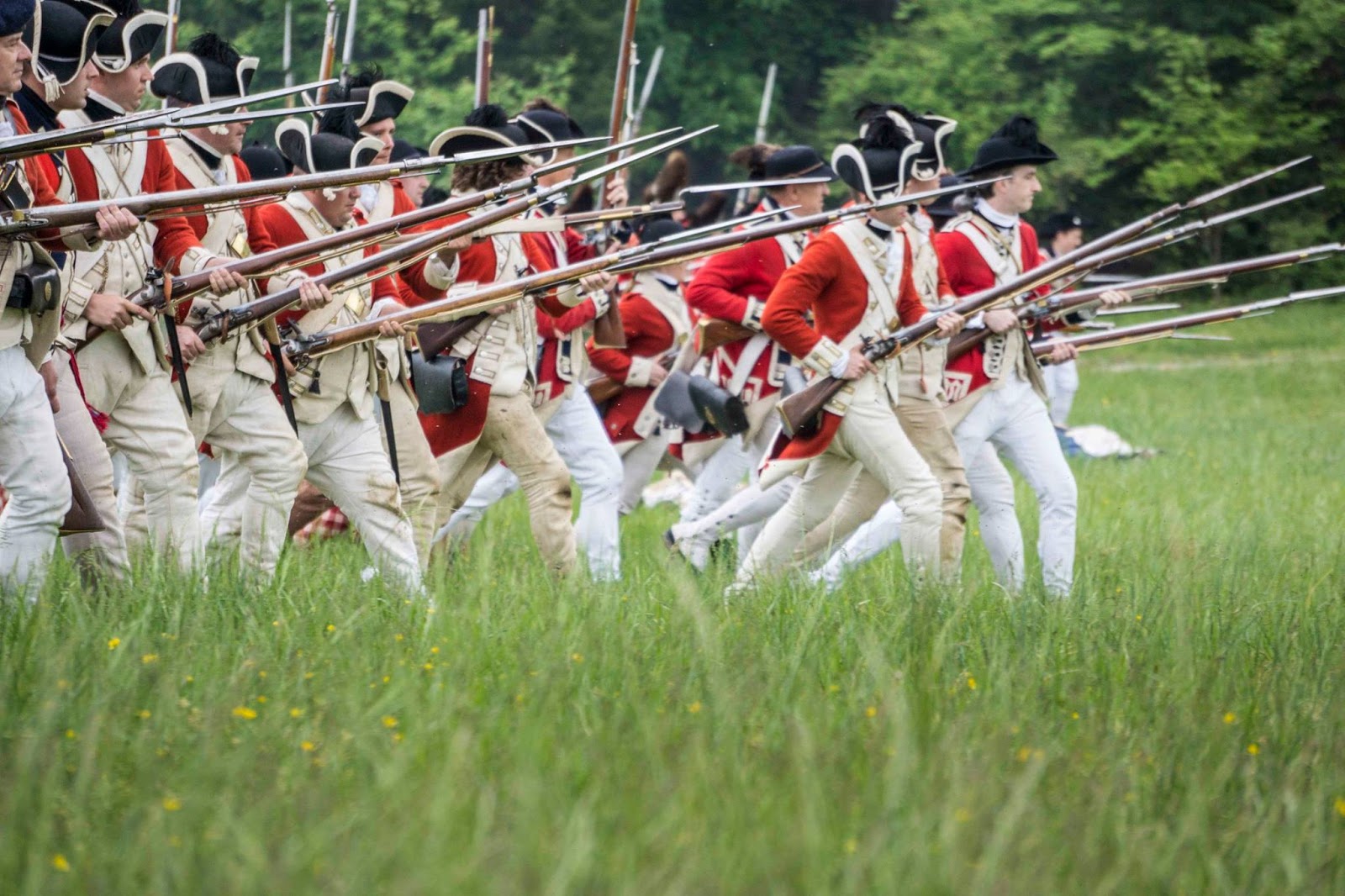
British Troops prepare to charge at Guilford Courthouse
Dear Reader,

We have charted some interesting territory over the past couple of weeks. It seems that mid-eighteenth-century soldiers frequently fired away their entire ammunition load, engaged in firefights at a much greater distance than is usually assumed, and sometimes fired at will, rather than fire by platoon or division. What does all this mean for eighteenth-century combat? If troops fired quickly, it can help to explain the ammunition usage, and the range of combat can help historians make sense of the large numbers of rounds expended vs. small number of casualties.

What does all this mean for melee (hand to hand, close) combat? Did eighteenth-century soldiers engage in melee combat frequently? If the Swedish Army during the Great Northern War and the British Army during the American War of Independence preferred bayonet attacks, surely there was a good deal of hand-to-hand combat?

Melee combat occurred, but it was perhaps less frequent than might be initially imagined. I am sure we can all think of famous examples: Culloden, Bunker Hill, and Guilford Courthouse all seem like important examples. When fighting against the Ottoman Empire, both Russian and Austrian soldiers reported fierce hand-to-hand struggles. Many military commanders, at some point in their careers, seemed to prefer an armes blanche or cold steel attack. Frederick the Great advocated this idea in the early Seven Years' War, Alexander Vasilyevich Suvorov famously stated that, "the bullet is a mad thing, put your trust in the bayonet." With these ideas spreading, surely hand to hand combat was frequent?

An artist's reimagining of Prussian Troops at the Battle of Leuthen

In reality, hand-to-hand, or melee combat was often limited to a select number of places on the battlefield. When enemy troops appeared to make a serious advance into close range with bayonets, defending troops often melted away. That is why the Swedish Karoliner and British redcoats proved so effective on their respective battlefields. It also helps to explain why, when things went wrong for troops making a charge with cold steel, they went very wrong (such as at Poltava in 1709 and Cowpens in 1781.)Troops did experience hand-to-hand combat, but firepower (at range) was the order of the day. In William Dalrymple's 1782 essay on tactics, he asserted (in the case of infantry):
"There is probably not an instance of modern troops being engaged in close combat... the bayonet can be of little utility by way of impulsion in the field... these defects in modern infantry prove the impracticability of two battalions, opposed to each other, being brough in the open field to close encounter: one body must give way before they get into action."[1]
Though Dalrymple is exaggerating for effect, we would be wise to take his point. In the open field, when flight was a possibility, it was rare for two battalions of infantry to cross bayonets. Nonetheless, other types of melee combat did occur, and are worth discussing. Even in nations where military theorists preferred bayonets, such as the French, soldiers realized that actual bayonet fighting was rare in this era. French military authority Jacques Antoine de Guibert understood the issue in this way:
"Finally, it seems that the entire exercise of the bayonet consists of fixing bayonets, presenting, and unfixing. I do not wish, as is currently the case, that troops should only use bayonets at parades and reviews. I would like them to be placed, as in combat, or rather in simulated motions which represent it. Soldiers have become familiar with bayonets, and view them as an unnecessary arm. They consider it to be a weapon without a use. Soldiers, and French soldiers above all, believed, "Well, I am out of ammunition, so only bayonets are left."... According to the method of the German infantry, our troops always march with fixed bayonets, in a unique way, a weapon that is always ready but never used."[2]
In short, during cavalry action, attacks on defensive works, and surprise attacks, troops often engaged in melee combat. These were the places for bayonets, not in the open field against other infantry.

Prussian Cavalry on the Charge
When cavalry troops were involved, melee combat was quite frequent. At Guilford Courthouse, William Washington's light dragoons savaged the British 2nd Guards.[3] One of these light dragoons, Peter Francisco gave us a window in the visceral intensity of this type of combat:
“Colonel Washington, observing their maneuvering, made a charge upon them, in which charge he (Francisco) was wounded in the thigh by a bayonet, from the knee to the socket of the hip, and in the presence of many, he was seen to kill two men, besides making many other panes which were doubtless fatal to others.”[4]
At the Battle of Hohenfriedberg. the Bayreuth Dragooner swept away a large portion of the Austrian army.[5] Lt. Francois de Chasot, a friend of Frederick "the Great" of Prussia, gave his recollection of the attack:
At the start we moved at a walk. We crossed several ditches one rank at a time, and on each occasion I made the leading rank halt of the far side so as to give the reward two ranks time to catch up. Then we broke into a trot, and finally into a full gallop, putting our heads down and running into the Austrian grenadiers. At first they stood bravely, and fired a salvo at twenty paces. After that, they were overthrown and cut down.[6] 

Unlike dragoons and cuirassiers, Prussian Hussars had curved swords 

When fighting other cavalry, it appears that the horses would seek intervals through the enemy formation, leading to brief moments of intense combat followed by maneuvering. In moments of true melee combat, all order was lost, and horses and men swirled around in an individual combat. Even here, however, cavalry melee was perhaps less effective than frequently believed. In the 1780s, military theorists studying the Prussian army recorded, "We heard from some cavalry officers that when troops undertake a charge, almost always, one troop flees before melee is joined, and the other gives pursuit."[7] Georg Tempelhof, a veteran of the Seven Years' War, reported,
"The strength of cavalry consists in its movement: it must have the ability to maneuver with speed. The shock or charge has no effect unless it happens in this way. Forgive me if I do not consider the cavalry's shock to be so decisive as it seems. In 1762 I observed Prussian cavalry charging superior Austrian horsemen. The result was that on both sides there were a few hundred wounded and prisoners. Not a single death was recorded."[8]
It is possible that Tempelhof, as an artillerist, underestimated the potency of cavalry. Horsemen, then, particularly in Europe, preferred to engage in hand to hand combat. Cavalry officers endlessly debated whether or not it was more effective to cut or thrust against the enemy, or whether straight or curved swords were more effective. Frederick II of Prussia was once pressed on this issue:
Speaking one day with his Majesty the King of Prussia, of this diversity of opinions, with regard to the edge or the point, he answered, " Kill your enemy with the one or the other, I will never bring you to an account with which you did it."[9]
Having addressed cavalry, we will now turn to another example of troops in melee combat: combat over defended positions.

Reenactors in the processes of assaulting a Redoubt

When defending soldiers held fortified or prepared positions, melee combat could be fierce. Soldiers attached great pyschological important to their defensive works, and often tangled with enemy troops in melee combat in order to defend them. In discussing this issue, Christopher Duffy presents evidence that soldiers actually had difficulty understanding that they needed to use their bayonets in these type of assaults.[10] Even insignificant defensive positions could motivate defending troops to stand, such as the rail fence which the North Carolina troops sheltered behind at Guilford Courthouse in 1781. An advancing Hessian soldier, recalling the fighting over this obsticale, only commented, "Colonel Du Buy at once ordered, "Fix bayonets! March! Before the enemy could reload, we changed against them with our bayonets. Everyone was bayoneted."[11]

Obviously, this type of melee action includes siege warfare. During the Siege of Schweidnitz in 1762, Austrian 1st Lt. Waldhütter and thirty men of the Erzherzog Carl regiment spearheaded a successful sortie against the besieging Prussian forces. Franz Guasco, the fortress commandant, left this description of the sortie:
"Waldhütter and his troops jumped inside without hesitation and found the Prussians on their guard.Some of the opened fire, while some knelt on the floor and raised their muskets, the bayonets fixed to the muzzles. Our men flung themselves blindly among them, sabre in hand; some of them were skewered on the bayonets, but the rest set about the enemy and hacked them to pieces."[12]
Alexander Hamilton was briefly involved in bayonet fighting during the storming of redoubts 9 and 10 at the siege of Yorktown. Joseph Plumb Martin is silent on the exact nature of the fighting inside the redoubts.[13]  Hamilton reported that men under his command suffered a number of "bayonet wounds," in the course of the fighting.[14]

Xavier della Gatta's impression of the Battle of Paoli
Troops often fought with bayonets during surprise attacks or "massacres." 
The American War of Independence produced a number of famous night-attacks which led to bayonet fighting, both of these, at Paoli in 1777 and Tappan in 1778 were extremely violent affairs, with many soldiers being killed both in and out of combat. At both Paoli and Tappan, British troops bayoneted Americans, and there is indeed evidence that Americans fought back with bayonets. This type of fighting was quite intense from a psychological perspective, and you often find descriptions of men, who like Captain Sir James Baird, killed large numbers of enemy troops singlehandedly. In addition to fighting with bayonets, troops at Paoli and Tappan burned to death, and were killed by firepower. Lt. Martin Hunter described the scene: "the camp was immediately set on fire; the Light Infantry bayonetted every man they came up with... this, with the cries of the wounded, formed altogether the most dreadful scene I ever beheld. Every man that fired was immediately put to death."[15]

The Attack at Hochkirch by Hyacinthe de La Pegna
During the Seven Years' War, the Austrians managed to inflict similar damage on the Prussian army. At the Battle of Hochkirch in 1758, Austrian columns overran the Prussian camp before some Prussians were even awake. Johann Wilhelm von Archenholz, a Prussian veteran, described what it was like the be on the receiving end of such a swift-moving attack:
"It was dark, and confusion reigned supreme. What a sight for these warriors, almost like a night terror. The Austrians seemed to emerge from the earth, in the midst of the Prussian flags at the center of camp! Several hundred men were killed before they could open their eyes, and others ran half-naked to their weapons. Only a few could reach them. Others laid ahold of whatever was closest to hand, and began to fight."[16]
Here we have an example of true melee, with thousands of soldiers fighting and dying in close combat. However, even here, it is important to note the ways in which this melee is unique. The Prussian army was surprised in camp, and fought a battle of desperation because of the impossibility of escape. In the open, troops would have fled long before this point.

British Troops with charged bayonets

So, did troops in the open really not cross bayonets? Outside of the above-mentioned categories, infantry forces actually crossing bayonets when one force had the option to flee seems to have been quite rare. Again, there are instances such as Culloden and Guilford Courthouse, but those remained more the exception than the rule.  According to one French report, 68.8% percent of troops were wounded by small arms fire, 14.7% were wounded by artillery fire, and approximately 15% were wounded by swords and bayonets.[17] When we consider that swords were the cavalry's main form of engaging the enemy, these figures are impressive. J. F. Puysegur argued that,
"firearms are the most desctructive category of weapon, and now more than ever. If you need convinving, just go to the hospital and you will see how few men have been wounded by cold steel as opposed to firearms. My argument is not advanced lightly. It is founded on knowledge.[18]
Because Puysegur was writing in the 1740s, before the Seven Years' War, his experience is even more telling. Other military theorists, such as David Dundas, recalled,  "... infantry seldom mix with bayonets."[19] These eighteenth-century military observations match well with those from the twentieth century:
"The vast majority of soldiers who do approach bayonet range with the enemy use the butt of the weapon or any other available means to incapacitate the enemy rather than skewer him... when the bayonet is used, the close range results in a situation with enormous potential for psychological trauma... The resistance to killing with the bayonet is equal only to the enemy's horro at having this done to him. Thus in bayonet charges one side or the other inveriably flees before the actual crossing of bayonets occurs."[20] 
Reenactors at Guilford Courthouse
 Thus even in desperate circumstances, such as the battle of the third line at Guilford Courthouse, we see infantry attempting to load and fire while in melee combat. Captain John Smith of the 1st Maryland Regiment found himself in heavy melee combat against the British guards, but was shot in the head at extremely close range (non-fatally by buckshot, as it turns out) by a soldier who had just loaded.[21] Therefore, there may be some truth psychological prejudice against using bayonets, even in the eighteenth-century. Lt. Colonel John Graves Simcoe described realistic small unit training which kept this principle in mind:
"they were, particularly, trained to attack a supposed enemy, posted behind railing, the common position of the rebels; they were instructed not to fire, but to charge their bayonets with their muskets loaded, and, upon their arrival at the fence, each soldier to take his aim at their opponents, who were then supposed to have been driven from it; they were taught that, in the position of running, their bodies afforded a less and more uncertain mark to their antagonists, whose minds also must be perturbed by the rapidity of their approach..."[22]
Here, we can see that when driving enemy from a position, infantry were trained to fire at fleeing men, rather than attempt to chase them down with bayonets. Obviously, melee occurred in the eighteenth century. However, it was not a common occurence, and seems to have become less prevelant over the course of the era.

If you enjoyed this post, or any of our other posts, please consider liking us on facebook, or following us on twitterConsider checking out our exclusive content on Patreon. Finally, we are dedicated to keeping Kabinettskriege ad-free. In order to assist with this, please consider supporting us via the donate button in the upper right-hand corner of the page. As always:

Thanks for reading,


Alex Burns

--------------------------------------------------------------------------------------------------------------------------
[1] William Dalrymple, Tacticks, 113.
[2] Guibert, Essai général de tactique, 81.
[3] Lawrence Babits and Joshua Howard, Long Obstinate and Bloody, 160.
[4]Letter of Peter Francisco, William and Mary College Quarterly, (1905) Vol 10, 219.
[5] Christopher Duffy, Military Life of Frederick the Great, 64.
[6] Matthias Kröger, Friedrich der Große und General Chasot, 38.
[7] Mirabeau and Mauvillon, Systeme militaire de Prusse, 104.
[8] Georg F. Tempelhof, Geschichte des Siebenjährigen Krieges in Deutschland, 68.
[9] Charles Immanuel de Warnery, Remarks on Cavalry, 17.
[10] Christopher Duffy, Military Experience in the Age of Reason, 204-5.
[11] Bertold Koch, The Battle of Guilford Courthouse, 7.
[12] Kriegs Archiv, Vienna, HKR Memoires 1762  880/12, Guasco, Relation du Siege de Schweidnitz, 31 October, 1762.
[13] Joseph Plumb Martin, Private Yankee Doodle, 237.
[14] Alexander Hamilton, The Works of Alexander Hamilton, Vol 8, 47.
[15] Martin Hunter, Journal, 31.
[16] Johann Wilhelm von Archenholz, Geschichte des Siebenjährigen Krieges, Vol 2, 279.
[17] Andre Corvisier, L'Armee Francaise, 64.
[18] Puysegur, Art de guerre par pricipes et par regles, Vol 1, 227. (Translation is Christopher Duffy's.)
[19] David Dundas, Principles of Military Movement, 51.
[20] David Grossman, On Killing, 120.
[21] Babits and Howard, Long Obstinate and Bloody, 159.
[22] John Simcoe, Simcoe's Military Journal, 98.

Sunday, June 11, 2017

Kabinettskriege Cavalry in Europe and America: How Important was it?


Reenactors portraying Austrian Cuirassiers at Terezin in 2011


Dear Reader,

There is a narrative that touches all levels of interest in our period. Academically, as the result of figures such as Victor Davis Hanson, this narrative asserts that western militaries, from the Greeks to the present day, have traditionally relied on infantry forces, with a brief hiccup in the middle ages.[1] In reenacting, it is a simple function of cost. How many reenactors, the fine gentlemen in the picture above excluded, can afford to maintain and feed a powerful warhorse, in addition to all of the other expenses of the hobby? Finally, in wargaming, there is a powerful belief that cavalry played a much less important role in the Kabinettskriege era than the later Napoleonic Wars. After being chased by a dragoon through the Virginia wilderness in outside Yorktown in 2014, I had to ask:  are these views supportable? That is the question that bears consideration today. Let us first look at Europe, before turning to North America.

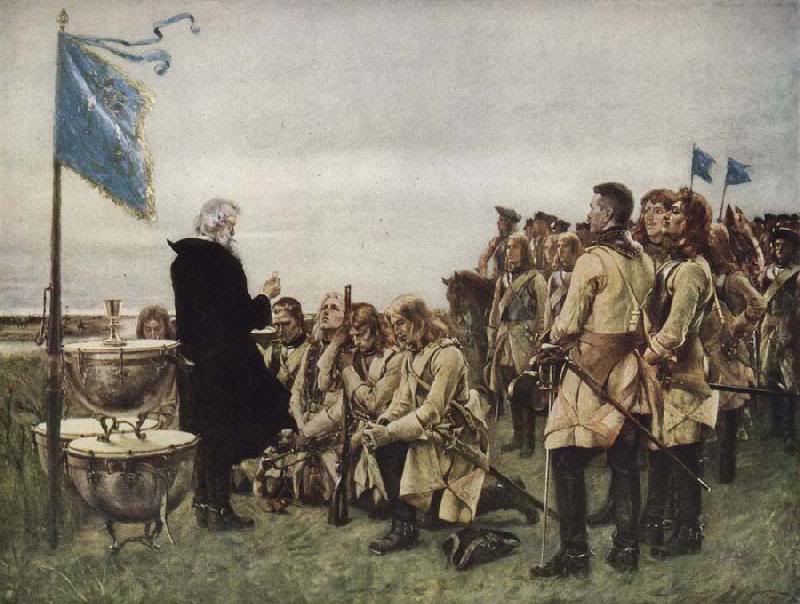
A Swedish Regiment of Horse receives communion after battle, by Gustav Cederstrom

In conflicts in Europe between 1648 and 1783, cavalry played a vitally important role. Cavalry made up varying proportions of European armies in this period, from around 1/3rd (or even over 1/2!) of Swedish armies in the Great Northern War, to a much more common figure of 1/5 to 1/7 of most armies during the middle of the eighteenth century.

 Even if the confines of the period forbid us from examining the cavalry of Gustav II Adolph, we can still look at the Swedish cavalry of kings Karl X Gustav, and Karl XII. For both of these monarchs, cavalry played a pivotal role in their military success at battles such as Fraustadt in 1706.  Importantly, they did not view cavalry as a way to deliver firepower via the caracole (as had been common in the 1500s), but as a way to deliver a mass of mounted men towards the enemy at the trot or the canter. Charging at the gallop was not unknown, but relatively rare until the last few hundred paces before contact with the enemy.

Polish Winged Hussars 
Throughout the eighteenth century, cavalry took on an even more important role for powers facing the Ottoman Empire. Polish Winged Hussars were able to sweep Turkish forces away during the relief of the Siege of Vienna in 1683, and Russian Cossacks were able to negate the advantage held by the swarms of Ottoman Sipahi. Christopher Duffy has described the process of readying for war against the Ottoman Empire, and how Austrian cavalrymen were issued extra armor at the prospect of extensive hand-to-hand fighting against the Turks.[2]

Richard Knoetel's re-imagining of the Bayreuth Dragoons at Hohenfriedberg 

On the European battlefields of the mid-eighteenth century, cavalry played a decisive role time and again. Indeed, if we look at the battles of the War of Austrian Succession and the Seven Years' War, cavalry played a decisive role on numerous occasions, such as Hohenfriedberg, Rossbach, Zorndorf, Kunersdorf, Maxen, and Reichenbach.  Although most useful as a weapon for chasing down a defeated enemy, cavalry could deliver smashing blows, ending a battle in their own right. Rossbach itself was a victory of Prussian cavalry almost by itself, the Prussian infantry played a secondary shaping role. At Hohenfriedberg and Kunersdorf, cavalry was able to seize upon the decisive moment, sweeping the enemy army from the field at the climax of the battle. In a lecture given at the meeting of the Seven Years' War association in 2016, Christopher Duffy suggested that a cavalry wing commander was one of the few individuals with almost absolute autonomy on an eighteenth-century battlefield.  

The charge of Prussian Cuirassiers at Zorndorf 
Indeed, one of the reasons for Prussia's survival and victory in the Seven Years' War was the high quality of Prussian cavalry, thanks to the reforms of Frederick II and the input of Hans Karl von Winterfeldt. Under the control of men like Friedrich Wilhelm von Seydlitz, and Hans Joachim von Ziethen, the Prussian cavalry became a battle-winning weapon. The charge of the Bayreuth Dragoons at Hohenfriedberg certainly wormed its way into the canon of Prussian mythology. Even after Frederick the Great complained that his infantry soldiers consisted of "weakly boys" the Prussian cavalry proved its effectiveness time and again late in the Seven Years' War. 

But what about warfare in North America? 

Some Continental Dragoons run into trouble at the Battle of Eutaw Springs
Well, first of all, cavalry obviously did not play an equally important role in North America. Among other problems, horses in North America were less readily available for military use. Aside from the Corps du Cavalry, horsemen played almost no role in the French and Indian War. Throughout the American War of Independence, cavalry forces often operated at the fringes of the larger combats, playing an important role in the war of outposts. Historian Matthew H, Spring has gone as far to suggest that the lack of cavalry played an important role in the development of quick-moving, shallow, open order tactics utilized by the British throughout the war.[3] 

Recreated dragoons at the Battle of Guilford Courthouse (Photo Credit: Dan Routh Photography)


However, particularly in the southern campaign, cavalry began to take on a new-found importance towards the end of the war. Daniel Murphy has written a couple of very good posts on this subject over at The Journal of the American Revolution.  Especially in the southern campaign, cavalry played an important, if not always decisive role at battles such as the Waxhaws, Blackstock's Farm, Cowpens, Guilford Court House, Hobkirk's Hill, and Eutaw Springs. 

What does all this mean for historians, reenactors, and wargamers? Although large models, (such as Hanson's western way of war thesis) may be convenient to teach undergraduate courses, they need to be carefully qualified in serious study of the past. In the eighteenth century, cavalry was not simply waiting to be pushed off the stage by the advent of smokeless powder and repeating rifles: it still played a vital role in warfare. 

For reenactors, using horses can be indimitating, expensive, and dangerous. I have personally been at a reenactment and witnessed horse-related injuries occur (to a person, the horse was fine.) However, having proficient mounted reenactors adds a layer of realism (not talking about the injury, here) to reenactments. There is nothing more frightening than seeing a line of horses barreling towards you. 

For wargamers, taking eighteenth-century cavalry seriously is a vital step in modeling the conflict of this era. I have heard many wargamers refer to players assigned to cavalry commands as "General Kill-Cavalry," the idea being that cavalry have no purpose other than to kill one another. While such actions did indeed occur, cavalry also swept infantry from the field at Kolin, Rossbach, and Kunersdorf. I have never seen anything like the charge of the Bayreuth dragooner on the tabletop, and in most rulesets, such an occurrence would be impossible.  Should spectacular equestrian phenomenon like this be allowed? Even designed for?  

Although not as decisive in North America as in Europe, it is foolish to ignore the role played by cavalry during the Kabinettskriege era. Infantry may well have been the queen of battle, but cavalry played a vital role on the battlefield and certainly possessed the ability to decide the course of an action if managed correctly. This ability was recognized by competent commanders on both sides of the Atlantic, such as Friedrich II of Prussia, Leopold Joseph von Daun, Charles Cornwallis, Daniel Morgan, and Nathaniel Greene. Infantry provided stability and firepower, but cavalry gave commanders flexibility and striking power. 

Feel free to share this post if you know individuals who would find it intriguing. 

Thanks for Reading, 


Alex Burns 

[1] Hanson, Western Way of War, 9-10. For its widespread acceptance among academic military historians, see: Parker eds, The Cambridge History of Warfare,  2-3. 
[2] Duffy, Military Experience in the Age of Reason, 279-80.
[3]Spring, With Zeal and With Bayonets Only, 161.