Showing posts with label musket. Show all posts

Tuesday, May 1, 2018

How Rapidly Could Soldiers Load in the Mid-Eighteenth Century?

Just how quickly could these soldiers reload?
Dear Reader,


How many rounds could eighteenth-century soldiers fire a minute? This is a question which has long preoccupied military enthusiasts of the era, and many feel quite strongly on this question. From the sequence in the (in?)famous Sharpe series depicting the training of the South Essex Regiment, to many reenactors demonstrating their own skills, the desire to show that musket-armed troops could fire quickly dominates media produced regarding the era. Of course, as we might expect, such depictions are sometimes rather fanciful.

My favorite line from the Sharpe sequence is, "The trick is, to keep the muzzle up to stop the bloody bullet falling out. Of course, the muzzle needs to point up anyway, the frog coming towards you is high up on a horse." Because, as everyone knows, the French only sent cavalry to fight in the Peninsula. Somewhat ironically, many historical officers (correctly) encouraged their soldiers to aim low, at the knees of enemy troops, or the ground directly in front of the enemy. These officers believed that this compensated for the kick of the musket. Oh well.

But can ya stand?
This post attempts to examine how quickly soldiers could fire their muskets across mid-eighteenth-century European armies. It will address the importance of firepower, the abilities of troops to fire quickly in a drill square environment, speed of fire in combat, the disadvantages of "quick-fire mania", and how officers attempted to mitigate those disadvantages. Despite other parade ground or theoretical results, an average of approximately 2 rounds a minute was quite normal in combat conditions, when soldiers did not engage in "tap-loading". This is significant, as it helps explain the length of eighteenth-century battles, and the length of time needed for troops to run low on ammunition. 

A number of excellent historians have addressed this question, and once again, I am standing on the shoulders of giants. This list includes David Blackmore, Hugh Boscawen, Alexander Campbell, Christopher Duffy, John Houlding, Richard Holmes, and Matthew Spring. Usually, these authors are writing about the forces of an individual state, such as Austria, Britain, or Prussia. For more detailed information on specific national practices, I encourage you to read these historians' works.

An Austrian Fires with a conical touch-hole and cylindrical ram rod

Erik Lund, writing in an assessment of the Austrian officer corps in the Kabinettskriege era, argues that historians have, by and large, purchased into a myth regarding the importance of a high tactical rate of fire. Here, I disagree with Lund. Tactical rate of fire, and the superiority it granted in combat, was no myth.

 Oddly enough, Frederick II, "the Great" of Prussia, early in his career, seems to have ignored the importance of firepower. In 1748, he encouraged his infantry to attack without firing, and he knew generals would complain, "that I never employ my small arms."[1] Frederick, it seems, had taken the wrong lessons from the War of Austrian Succession. Shock tactics, not firepower, seemed to be the way forward. It was a much more experienced, seasoned, and defeated Frederick who wrote in 1768:
"The cannon does everything, and the infantry cannot get to grips with cold steel... battles are decided by the superiority of fire. Except in the attack of defended positions, a force of infantry which loads speedily will always get the better of a force which loads more slowly."[2]
Let those words sink in. Firepower and speed of loading decided eighteenth-century contests between infantry. Most generals understood this idea, and soldiers were relentlessly taught to fire quickly. Firepower, and sometimes the psychological threat of cold steel, not cold steel itself, won eighteenth-century combats.
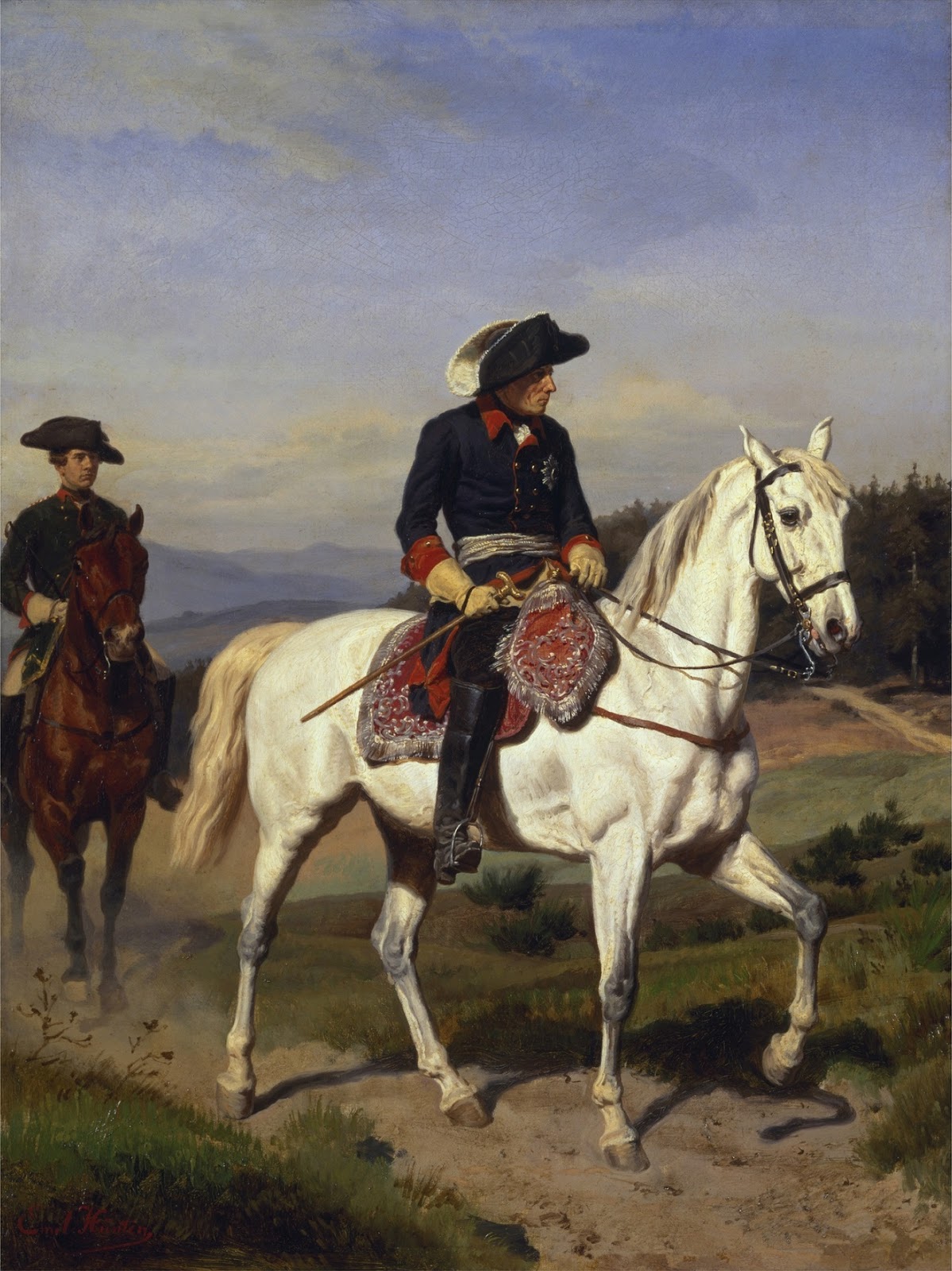
Friedrich II von Preussen
First, we need to examine how quickly a soldier could fire on the drill square in peacetime. Across most European nations, 4-5 rounds seems to have been quite normal.  By 1750, most European armies were fascinated with the speed of fire demonstrated by the Prussian troops in the War of Austrian Succession. Austrian military veterans and theorists saw that their troops could fire 4-5 rounds a minute on the drill square, basically matching the Prussian drill square ideal.[3] Prussian troops were capable of firing six rounds a minute, but could not maintain that pace for any length of time. Lossow comments, "Altogether, it would be too much to expect troops to maintain six rounds a minute for an extended time."[4]  The British achieved a similar level of drill-square proficiency in this regard, with veteran troops being able to fire four rounds a minute.[5] The Russians, too, used Prussian emphasis speed of fire when training their troops in the 1750s.[6]  Some sources think even this too ambitious. Prussian General Ludwig von Lossow argued that, "in ... European armies only the most practiced parts of them can fire four times in a minute's time. Usually, only three shots come are fired: watch and see!"[7] Regardless, by the 1780s, the cylindrical ramrod and the conical touch-hole (technological assists to loading) had increased the drill-square rate of fire to six rounds fired with a seventh-round loaded.
o
British Soldiers in front of Ft. Niagara
However, as in almost all aspects of military life, there was a severe disparity between what soldiers could accomplish on the peacetime drill square and the battlefield. It seems that troops in combat fired more slowly. Two rounds a minute is a very believable figure for well-trained, veteran troops in combat.  Austrian army officer Jakob Cogniazzo gives us a window into this idea:
Now, how many rounds of rapid fire do you think he can loose off in a minute when he is in a minute when he is in this condition? At least five a minute? That is certainly the norm for fire on the drill square, which conjures up visions of enemy corpses by the thousand. But, when we consider all the encumbering burden of the soldier... taking everything into due account, it would be optimistic to suppose that he fires as many as one or at the most two rounds a minute [in combat].[8]
One of the differences between drill square "minute firing" and real combat was its duration. The real test was how long soldiers could keep firing at a high rate. It seems British troops could fire between 2-3 rounds a minute for a sustained amount of time.[9] Likewise, it seems that during combat the Prussians could fire three rounds per minute, and they could keep up this pace extended periods of time.[10] The Russians loaded slower, perhaps 1-2 shots a minute, as a result of the additional time it took to load their buckshot rounds.[11] With this in mind, it seems that troops carrying 30 rounds would run low on ammunition after 10-20 minutes, while troops carrying 60 rounds of ammunition would run low after 30-45 minutes. 

Reenactors portraying the 3rd New Jersey Regiment
More important than the actual number of shots was the ability to confer a comparative advantage to troops who could load and fire more quickly than their opponents. An Austrian officer noted that the Prussians had, "the important and extraordinarily, significant advantage of being able to get off three rounds to every one of the Austrian infantry. This is conceded by all impartial and well-informed men who have seen it with their own eyes."[12] Prussian officer Ernst von Barsewisch recalled of the Battle of Leignitz:
"Now I commanded, "platoon: ready!  present!  fire!" Then the remaining part of the battalion followed, whereupon we blasted away for a length of time. The enemy, however, did not withdraw, but also fired vigorously. But we loaded more speedily and had devastated the enemy with our first volley."[13]
The author prepares to fire
Instilling troops with the need to fire quickly at the expense of all other factors had a number of downsides. Again, General von Lossow comments that officers, "forget that the musket barrel becomes too hot to hold after two minutes... the soldiers inevitably acquired bad habits when they were put through the rapid-fire drill every day, like failing to ram the loads firmly home, neglecting to aim, raising the barrel too rapidly after they had loosed off, and so on."[14] It seems there might have been a downside to this "quick-fire mania."

In addition to these bad qualities, soldiers might begin to "cheat" in other ways. Of these, the most infamous was the so-called, "tap-loading." In 1726, General Hawley complained that, "the German and Dutch foot might be brought to ram their cartridge every time on service, for ought I know, but by the nature of our men I believe it impossible to bring them to it."[15] The Austrians engaged in tap-loading at Mollwitz in 1741, where it robbed their musket discharges of lethal force, the French used tap-loading at Lauffeld in 1747,  and the British engaged in the practice at Hubbardton in 1777.[16]'

Reenactors representing HM 17th Regiment of Infantry in North America

Military authorities from various nations were aware of these problems and attempted to ensure that soldiers fired with speed AND accuracy on the day of battle. Soldiers in almost all European nations practiced firing at targets to ensure accuracy. Troops in Central European armies were carefully taught to aim their muskets with reference to their distance from the target.[17] British General Wolfe argued that, "[t]here is no necessity for firing very fast; a cool and well-leveled fire, with the pieces, carefully loaded, is much more destructive and formidable than the quickest fire in confusion."[18] Despite this, numerous military theorist believed that though disadvantageous, there were times when quick-fire and tap-loading outweighed these concerns.[19] Officers and military theorists attempted to carefully weigh and balance speed of fire with accuracy.

So, what can we assert regarding the rate of fire among regular troops in the mid-eighteenth century? These troops could fire at prodigious rates on the drill square but often fell short of this ideal on the battlefield. Sometimes, this led to the disadvantages associated with "quick-fire mania" or the dangerous of tap-loading. As a result, officers attempted to find a happy medium: soldiers who would fire at speed but retain accuracy.

If you enjoyed this post, or any of our other posts, please consider liking us on facebook,  or following us on twitter. Finally, we are dedicated to keeping Kabinettskriege ad-free. In order to assist with this, please consider supporting us via the donate button in the upper right-hand corner of the page. As always:

Thanks for Reading,


Alex Burns


--------------------------------------------------------------------------------------------------------------------------

[1] Jay Luvaas, Frederick the Great on the Art of War, 143-145.; Vincent Rospond, Frederick's Orders, 112.
[2] Frederick II, Testament Politique, (1768) 146-148.
[3] Christopher Duffy, Instrument of War, 408.; Duffy, Army of Frederick the Great, 128.
[4]Ludwig von Lossow, Denkwürdigkeiten zur Charakteristik der preussischen Armee, 265.
[5] Richard Holmes, Redcoat, 199.
[6] Christopher Duffy, Russia's Military Way to the West, 62.
[7] Ludwig von Lossow, Denkwürdigkeiten zur Charakteristik der preussischen Armee, 264.
[8] Jakob Cogniazzo, Freymuethige Beytrag zur Geschichte, (1779), 147.
[9] John Houlding, Fit for Service, 194.
[10] Duffy, Army of Frederick the Great, 128.
[11] Anon, Besondere Merkwürdigkeiten und Anekdoten aus Neudam in der Neumark, 29.
[12] Vienna Kriegsarchiv, CA 1758 III 1, Lieutenant-Colonel Rebain, 10 May 1758.
[13] Ernst von Barsewisch, Meine Kriegs-Erlebnisse, 113.
[14] Ludwig von Lossow, Denkwürdigkeiten zur Charakteristik der preussischen Armee, 266.
[15] Quoted in Journal of the Society for Army Historical Research, Volume 32 (1953), 88-89.
[16] Anonymous, Denckwüdiges Leben und Thaten Beruehmeten Herren Johaan Daniels von Menzel, 80.; David Blackmore, Destructive and Formidable, 104.; Thomas Anbury, Travels through the Interior Parts of America, 333.
[17] Christopher Duffy, Instrument of War, 409.; Duffy, Army of Frederick the Great, 129.
[18] Wolfe, Instructions to Young Officers, 49.
[19] David Blackmore, Destructive and Formidable, 104-105

Wednesday, January 31, 2018

How Close Ranged were Mid-Eighteenth-Century Firefights?


The British Prepare to Give Fire

Dear Reader,

After the post last week on ammunition expenditure, I noted a number of surprised conversations on social media. If many eighteenth-century battles in Europe, and some in North America, resulted in troops expending their ammunition load (of 30, 40, 60, or 90+ rounds) how could any soldiers be left alive? Or in other words, in battles with such high rates of ammunition expenditure, how could casualties be so low?

The answer to this riddle is not the supposed inaccuracy of muskets, or the failure of soldiers to aim properly, but the ranges at which battles were often fought. When picturing eighteenth-century combat, historians and the public often imagine battle reenactments. In these reenactments, troops often open fire at a very short range, at say 50 or 25 yards. For those unused to picturing such ranges, imagine one half or one-quarter of an American football field. Troops in the eighteenth-century occasionally fired at such close range (such as the Swedish Karoliner of the Great Northern War) but MUCH more frequently, fire-fights developed at a longer range.

Reenactors represent Regiment von Bose at Guilford Courthouse


In the eighteenth-century, the term "musket-shot" usually referred to a distance of around 300 yards. Commanders, concerned about the accuracy of their musketry, often performed tests in peacetime to discover an optimal range.  During the era, such tests were conducted at between 500 yards and 80 yards, 200 yards and 100 yards, and further estimations of 250 yards and 80 yards and 200 yards and 80 yards.[1] I find it strangely compelling that none of these tests felt the need to practice at ranges underneath 80 yards, perhaps implying that combat infrequently reached those close distances.  Leaving aside this theoretical point, let us turn to what the soldiers of the era say in their writings: how close range were eighteenth-century firefights?

Although there is no way to truly measure the surviving descriptions of range scientifically, we can perhaps arrive at a few conclusions regarding the range of eighteenth-century firefights. In the first category, there are skirmishes and premature fires by inexperienced troops. These preliminary skirmishes often occurred at 300 yards, or even a greater distance. As a result, they were not very deadly. During skirmishes in 1759 and 1760, French troops and their native allies opened fire on the British at a range of 300 yards, which seemed quite normal to the participants.[2] During a skirmish on Staten Island in June of 1777, preliminary skirmishing began at about 300 yards.[3] At the Battle of Mollwitz in 1741, the Prussian infantry, inexperienced in real combat, opened fire at the considerable range of 600-800 yards.[4]

A small group of Prussians engaged in a firefight

In Europe during large-scale and determined combat, battle-lines could draw much closer. A good "average" range for combat during the Seven Years' War appears to be between 200 yards and 100 yards. At the Battle of Leuthen in 1757, Ernst von Barsewisch recalled, "As soon as we had cleared the forest, we approached the enemy's second line of battle at a distance of 200 paces [150 yards], which was preparing to march against us. Now... our officers ordered, "Fire! Fire!"[5] Later in the war, Barsewisch recalled being fired on by Croats at a similar distance.[6] The battle lines at Prague in 1757 appear to have been around 150 yards apart.[7] At Hochkirch in 1758,  Johann von Archenholz recalled that the Austrians opened fire at, "a few hundred paces."[8] During a skirmish near Prenzlow in October of 1760, hostile forces approached to within 200 paces [150 yards] of one another.[9]  At the Battle of Vellinghausen in 1761, official reports indicate that battle lines were 150 paces [100 yards] apart, and indicate that this was uncomfortably close.[10] By contrast, when the battle lines closed to 80 yards at the Battle of Minden, the contest was no longer in doubt, and the French began to retreat.[11]

In North America, infantry firefights followed a similar mold. Although the French and Indian War saw few large-scale field battles, a few sources describe infantry firefights. At the Battle of the Plains of Abraham, the French opened fire a very regular European distance, 130 yards.[12] During fighting in the Carribean in 1759, Francis Downman noted that the enemy moved away from the British, "keeping always 200 yards in our front."[13] During the American War of Independence, firefights continued to follow a European pattern, at least with regards to range. During the flank attack at the Battle of Brandywine, both the British and Americans gave fire at 150 yards, and then the British immediately charged at the run with their bayonets.[14] The French attack on St. Lucia in December of 1778 was conducted, "at a distance not less than 280 yards."[15] At the Battle of Camden, John Robert Shaw describes an infantry firefight at 100 yards.[16] At Guilford Courthouse, Roger Lamb reports that the American line opened fire at 140 yards.[17] Berthold Koch, a sergeant with the Von Bose Regiment, recalled receiving fire at 100 yards from the American line.[18]

British Reenactors representing the 2nd Battalion of Light Infantry

Troops were often ordered to hold their fire until very close to the enemy line, but appear to have found it difficult to follow this directive. At the Battle of Germantown in 1777, Joseph Plump Martin describes this in his humorous way:
"Our brigade moved off to the right into the fields. We saw a body of the enemy drawn up behind a rail fence on our right; we immediately formed in line and advanced upon them. Our orders were not to fire till we could see the buttons upon their clothes, but they were so coy that they would not give us an opportunity to be so curious, for they hid their clothes in fire and smoke before we had either time or leisure to examine their buttons."[19]
Here, we find a unit ordered to hold fire until close to the enemy, but because the enemy began returning fire a long range, a longer ranged firefight developed. When troops did approach (or fire) at ranges closer than 100 yards, it was often because a bayonet attack was underway. The Swedish Army in the Great Northern War, and the British Army in the American War of Independence, both made quick moving assaults supported by one close-range volley a standard of their tactical repertoire. Nicholas Creswell describes this type of attack on Staten Island in 1777:
When [the two sides] were about 100 yards from each other, both parties fired, but I did not see any fall. They still advanced to the distance of 40 yards or less and fired again. I then saw a great number fall on both sides. Our people rushed upon them with their Bayonets and the others took to their heels. I heard one of them call out murder lustily, this [would  have been] laughable if the consequence was not serious. A Fresh party immediately fired upon our people but was dispersed and pursued into the woods by a company of the 15th Regmt."[20]
British Troops. The man in front appears to be calling out, murder, lustily.

Here, Nicholas Creswell describes the archetypal bayonet attack as practiced by the British Army in the American War of Independence. If troops moved into 50 yards or closer, it was not to have an extended firefight, but because one or other intended to make an attack with bayonets, or was in the process of doing so.  Some British commanders may have preferred try and close the distance before firing.  Prescriptive source: drill manuals, books offering advice to officers, etc, often instructed soldiers to reserve their fire until at thirty or fifty yards of the enemy.[21] Often, the commanders judged their tactics on a case-by-case basis. At the Prussian 1785 Review, British General Cornwallis criticized Prussians for advancing too close to their mock enemies before opening fire.[22] While a good idea in theory, advancing into such close range under a heavy fire proved difficult to do. Notably, the British seem to have achieved this at the Battle of the Plains of Abraham, but examples of this kind are rare. On average, troops seem to have fired at ranges of 100 yards or longer. 

How might reenactors represent this to the public? Battles should occur at greater ranges. If you are engaged in a standup firefight with other reenactors, and you are much closer than 75 yards away, something is wrong. If the British advance to within 40 yards and fire a volley, they should immediately follow that volley with a bayonet attack and either way, Continental forces should quickly prevail or retreat. Engaging in standup firefights with 20+ rounds expended is acceptable, even laudable. Just make sure that you have a football field or two between you and the opposing forces while doing so.

If you enjoyed this post, or any of our other posts, please consider liking us on facebook, or following us on twitter. Consider checking out our exclusive content on Patreon. Finally, we are dedicated to keeping Kabinettskriege ad-free. In order to assist with this, please consider supporting us via the donate button in the upper right-hand corner of the page. As always:


Thanks for Reading,


Alex Burns 


--------------------------------------------------------------------------------------------------------------------------
[1] Duffy, Military Experience in the Age of Reason, 207.; The Army of Frederick the Great, 128.;  Lossow, Denkwürdigkeiten, 260-61, 275.
[2] John Knox, An Historical Journal,  Vol 2, 274.; Vol 1, 305.
[3] Nicholas Creswell, A Man Apart, 170.
[4] Valorie, Quoted in Duffy, Military Experience, 212.
[5] Barsewisch, Meine Kriegs-Erlebnisse, 36.
[6] Ibid, 170.
[7] Johann von Archenholz, Geschischte des Siebenjährige Kriegs , (1911, Leipzig), 52.
[8] Ibid, 187.
[9] Sammlung ungedruckter Nachrichten, Vol 5, 358.
[10] Westfalen, Geschichte der Feldzüge des Herzogs Ferdinand, Vol 5, 623.
[11] Ibid, Vol 3, 486.
[12] Knox, Journal, 70. (The British, it must be said, held their fire until 40 yards on this occasion).
[13] Francis Downman, The Services of Lt. Colonel Francis Downman, 8.
[14] Martin Hunter, Extracts from the Journal of General Sir Martin Hunter, 27.
[15] Downman, The Services, 98.
[16] John Robert Shaw, John Robert Shaw, 31.
[17] Roger Lamb, An Original and Authentic Journal, 350.
[18] Bertold Koch, The Battle of Guilford Courthouse, 7.
[19] Joseph Plumb Martin, Private Yankee Doodle, 72-73.
[20] Creswell, A Man Apart, 170-171
[21] David Blackmore, Destructive and Formidable, 136-137
[22] Charles Cornwallis, Correspondence of Charles, first Marquis Cornwallis, Vol 1, 211.