Showing posts with label soldier. Show all posts

Tuesday, May 1, 2018

How Rapidly Could Soldiers Load in the Mid-Eighteenth Century?

Just how quickly could these soldiers reload?
Dear Reader,


How many rounds could eighteenth-century soldiers fire a minute? This is a question which has long preoccupied military enthusiasts of the era, and many feel quite strongly on this question. From the sequence in the (in?)famous Sharpe series depicting the training of the South Essex Regiment, to many reenactors demonstrating their own skills, the desire to show that musket-armed troops could fire quickly dominates media produced regarding the era. Of course, as we might expect, such depictions are sometimes rather fanciful.

My favorite line from the Sharpe sequence is, "The trick is, to keep the muzzle up to stop the bloody bullet falling out. Of course, the muzzle needs to point up anyway, the frog coming towards you is high up on a horse." Because, as everyone knows, the French only sent cavalry to fight in the Peninsula. Somewhat ironically, many historical officers (correctly) encouraged their soldiers to aim low, at the knees of enemy troops, or the ground directly in front of the enemy. These officers believed that this compensated for the kick of the musket. Oh well.

But can ya stand?
This post attempts to examine how quickly soldiers could fire their muskets across mid-eighteenth-century European armies. It will address the importance of firepower, the abilities of troops to fire quickly in a drill square environment, speed of fire in combat, the disadvantages of "quick-fire mania", and how officers attempted to mitigate those disadvantages. Despite other parade ground or theoretical results, an average of approximately 2 rounds a minute was quite normal in combat conditions, when soldiers did not engage in "tap-loading". This is significant, as it helps explain the length of eighteenth-century battles, and the length of time needed for troops to run low on ammunition. 

A number of excellent historians have addressed this question, and once again, I am standing on the shoulders of giants. This list includes David Blackmore, Hugh Boscawen, Alexander Campbell, Christopher Duffy, John Houlding, Richard Holmes, and Matthew Spring. Usually, these authors are writing about the forces of an individual state, such as Austria, Britain, or Prussia. For more detailed information on specific national practices, I encourage you to read these historians' works.

An Austrian Fires with a conical touch-hole and cylindrical ram rod

Erik Lund, writing in an assessment of the Austrian officer corps in the Kabinettskriege era, argues that historians have, by and large, purchased into a myth regarding the importance of a high tactical rate of fire. Here, I disagree with Lund. Tactical rate of fire, and the superiority it granted in combat, was no myth.

 Oddly enough, Frederick II, "the Great" of Prussia, early in his career, seems to have ignored the importance of firepower. In 1748, he encouraged his infantry to attack without firing, and he knew generals would complain, "that I never employ my small arms."[1] Frederick, it seems, had taken the wrong lessons from the War of Austrian Succession. Shock tactics, not firepower, seemed to be the way forward. It was a much more experienced, seasoned, and defeated Frederick who wrote in 1768:
"The cannon does everything, and the infantry cannot get to grips with cold steel... battles are decided by the superiority of fire. Except in the attack of defended positions, a force of infantry which loads speedily will always get the better of a force which loads more slowly."[2]
Let those words sink in. Firepower and speed of loading decided eighteenth-century contests between infantry. Most generals understood this idea, and soldiers were relentlessly taught to fire quickly. Firepower, and sometimes the psychological threat of cold steel, not cold steel itself, won eighteenth-century combats.
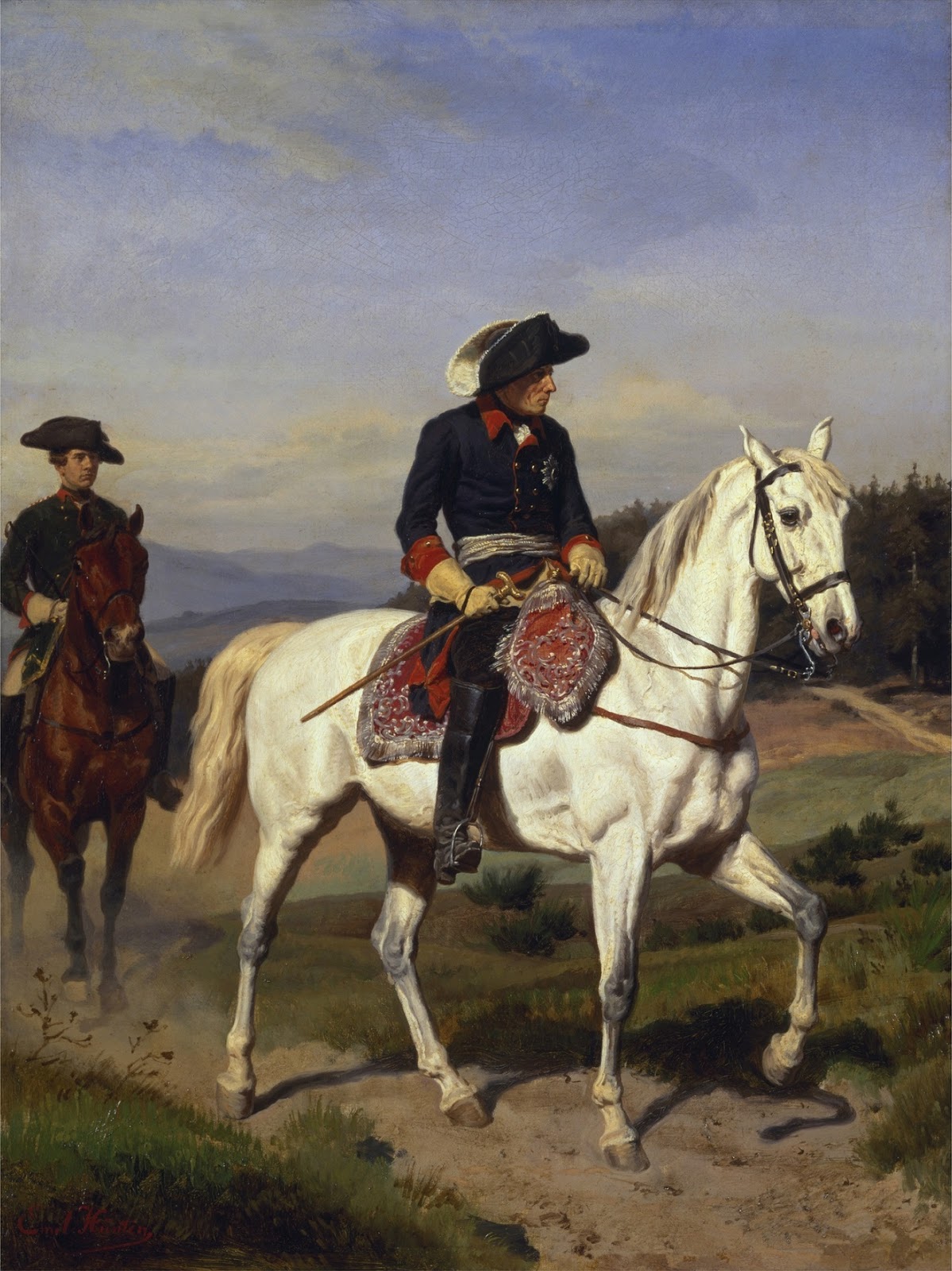
Friedrich II von Preussen
First, we need to examine how quickly a soldier could fire on the drill square in peacetime. Across most European nations, 4-5 rounds seems to have been quite normal.  By 1750, most European armies were fascinated with the speed of fire demonstrated by the Prussian troops in the War of Austrian Succession. Austrian military veterans and theorists saw that their troops could fire 4-5 rounds a minute on the drill square, basically matching the Prussian drill square ideal.[3] Prussian troops were capable of firing six rounds a minute, but could not maintain that pace for any length of time. Lossow comments, "Altogether, it would be too much to expect troops to maintain six rounds a minute for an extended time."[4]  The British achieved a similar level of drill-square proficiency in this regard, with veteran troops being able to fire four rounds a minute.[5] The Russians, too, used Prussian emphasis speed of fire when training their troops in the 1750s.[6]  Some sources think even this too ambitious. Prussian General Ludwig von Lossow argued that, "in ... European armies only the most practiced parts of them can fire four times in a minute's time. Usually, only three shots come are fired: watch and see!"[7] Regardless, by the 1780s, the cylindrical ramrod and the conical touch-hole (technological assists to loading) had increased the drill-square rate of fire to six rounds fired with a seventh-round loaded.
o
British Soldiers in front of Ft. Niagara
However, as in almost all aspects of military life, there was a severe disparity between what soldiers could accomplish on the peacetime drill square and the battlefield. It seems that troops in combat fired more slowly. Two rounds a minute is a very believable figure for well-trained, veteran troops in combat.  Austrian army officer Jakob Cogniazzo gives us a window into this idea:
Now, how many rounds of rapid fire do you think he can loose off in a minute when he is in a minute when he is in this condition? At least five a minute? That is certainly the norm for fire on the drill square, which conjures up visions of enemy corpses by the thousand. But, when we consider all the encumbering burden of the soldier... taking everything into due account, it would be optimistic to suppose that he fires as many as one or at the most two rounds a minute [in combat].[8]
One of the differences between drill square "minute firing" and real combat was its duration. The real test was how long soldiers could keep firing at a high rate. It seems British troops could fire between 2-3 rounds a minute for a sustained amount of time.[9] Likewise, it seems that during combat the Prussians could fire three rounds per minute, and they could keep up this pace extended periods of time.[10] The Russians loaded slower, perhaps 1-2 shots a minute, as a result of the additional time it took to load their buckshot rounds.[11] With this in mind, it seems that troops carrying 30 rounds would run low on ammunition after 10-20 minutes, while troops carrying 60 rounds of ammunition would run low after 30-45 minutes. 

Reenactors portraying the 3rd New Jersey Regiment
More important than the actual number of shots was the ability to confer a comparative advantage to troops who could load and fire more quickly than their opponents. An Austrian officer noted that the Prussians had, "the important and extraordinarily, significant advantage of being able to get off three rounds to every one of the Austrian infantry. This is conceded by all impartial and well-informed men who have seen it with their own eyes."[12] Prussian officer Ernst von Barsewisch recalled of the Battle of Leignitz:
"Now I commanded, "platoon: ready!  present!  fire!" Then the remaining part of the battalion followed, whereupon we blasted away for a length of time. The enemy, however, did not withdraw, but also fired vigorously. But we loaded more speedily and had devastated the enemy with our first volley."[13]
The author prepares to fire
Instilling troops with the need to fire quickly at the expense of all other factors had a number of downsides. Again, General von Lossow comments that officers, "forget that the musket barrel becomes too hot to hold after two minutes... the soldiers inevitably acquired bad habits when they were put through the rapid-fire drill every day, like failing to ram the loads firmly home, neglecting to aim, raising the barrel too rapidly after they had loosed off, and so on."[14] It seems there might have been a downside to this "quick-fire mania."

In addition to these bad qualities, soldiers might begin to "cheat" in other ways. Of these, the most infamous was the so-called, "tap-loading." In 1726, General Hawley complained that, "the German and Dutch foot might be brought to ram their cartridge every time on service, for ought I know, but by the nature of our men I believe it impossible to bring them to it."[15] The Austrians engaged in tap-loading at Mollwitz in 1741, where it robbed their musket discharges of lethal force, the French used tap-loading at Lauffeld in 1747,  and the British engaged in the practice at Hubbardton in 1777.[16]'

Reenactors representing HM 17th Regiment of Infantry in North America

Military authorities from various nations were aware of these problems and attempted to ensure that soldiers fired with speed AND accuracy on the day of battle. Soldiers in almost all European nations practiced firing at targets to ensure accuracy. Troops in Central European armies were carefully taught to aim their muskets with reference to their distance from the target.[17] British General Wolfe argued that, "[t]here is no necessity for firing very fast; a cool and well-leveled fire, with the pieces, carefully loaded, is much more destructive and formidable than the quickest fire in confusion."[18] Despite this, numerous military theorist believed that though disadvantageous, there were times when quick-fire and tap-loading outweighed these concerns.[19] Officers and military theorists attempted to carefully weigh and balance speed of fire with accuracy.

So, what can we assert regarding the rate of fire among regular troops in the mid-eighteenth century? These troops could fire at prodigious rates on the drill square but often fell short of this ideal on the battlefield. Sometimes, this led to the disadvantages associated with "quick-fire mania" or the dangerous of tap-loading. As a result, officers attempted to find a happy medium: soldiers who would fire at speed but retain accuracy.

If you enjoyed this post, or any of our other posts, please consider liking us on facebook,  or following us on twitter. Finally, we are dedicated to keeping Kabinettskriege ad-free. In order to assist with this, please consider supporting us via the donate button in the upper right-hand corner of the page. As always:

Thanks for Reading,


Alex Burns


--------------------------------------------------------------------------------------------------------------------------

[1] Jay Luvaas, Frederick the Great on the Art of War, 143-145.; Vincent Rospond, Frederick's Orders, 112.
[2] Frederick II, Testament Politique, (1768) 146-148.
[3] Christopher Duffy, Instrument of War, 408.; Duffy, Army of Frederick the Great, 128.
[4]Ludwig von Lossow, Denkwürdigkeiten zur Charakteristik der preussischen Armee, 265.
[5] Richard Holmes, Redcoat, 199.
[6] Christopher Duffy, Russia's Military Way to the West, 62.
[7] Ludwig von Lossow, Denkwürdigkeiten zur Charakteristik der preussischen Armee, 264.
[8] Jakob Cogniazzo, Freymuethige Beytrag zur Geschichte, (1779), 147.
[9] John Houlding, Fit for Service, 194.
[10] Duffy, Army of Frederick the Great, 128.
[11] Anon, Besondere Merkwürdigkeiten und Anekdoten aus Neudam in der Neumark, 29.
[12] Vienna Kriegsarchiv, CA 1758 III 1, Lieutenant-Colonel Rebain, 10 May 1758.
[13] Ernst von Barsewisch, Meine Kriegs-Erlebnisse, 113.
[14] Ludwig von Lossow, Denkwürdigkeiten zur Charakteristik der preussischen Armee, 266.
[15] Quoted in Journal of the Society for Army Historical Research, Volume 32 (1953), 88-89.
[16] Anonymous, Denckwüdiges Leben und Thaten Beruehmeten Herren Johaan Daniels von Menzel, 80.; David Blackmore, Destructive and Formidable, 104.; Thomas Anbury, Travels through the Interior Parts of America, 333.
[17] Christopher Duffy, Instrument of War, 409.; Duffy, Army of Frederick the Great, 129.
[18] Wolfe, Instructions to Young Officers, 49.
[19] David Blackmore, Destructive and Formidable, 104-105

Thursday, July 13, 2017

The "average" Mid-Eighteenth-Century Soldier

Photo Credit: Lee Charles Gugino

Dear Reader,

This post is meant as a summary of the various datasets which I have been compiling over the past few weeks. By adding all the data together, we can both confirm and complicate our understanding of the "average" eighteenth-century soldier. So, over the past few weeks, what have we discovered about the mid-eighteenth-century soldier?

A Hessian in North America 

A picture of the "average" eighteenth-century soldier begins to take shape from the fog of history.  More than likely, he had been a day-laborer or apprenticed weaver before enlisting in the service. He had first enlisted in his early twenties, and after seven or eight years of service was around thirty years of age. He was unmarried. The soldier was tall compared with many civilians, likely around 5 feet 8 inches (approx 172 cm). When on the march with his regiment, the soldier was capable of covering an average of 14 miles per day, although that could easily be increased in times of extreme need, such as when 10th Regiment of Foot dashed 70 miles in a 24 hour period in the Seven Years' War.[1] His daily calorie intake ranged from roughly 2200-3000, and mainly consisted of meat and bread of some type.

Even when not marching or fighting, his daily life was quite rigorous, as he and the men around him were often engaged in strenuous physical labor. He would likely take part in between 3 and 4 major battles, which lasted roughly 4 hours apiece. In the course of his career, he also fought in innumerable sieges, skirmishes, and smaller actions. His chance of being wounded in an individual battle was quite small, but rose to almost 60% over the course of his career. He was far more likely to die from disease than enemy action. Talk of his propensity for desertion has perhaps been overblown. 

A British Soldier on campaign 

This snapshot may not fully conform to all armies in all places, but it provides a good baseline for historians, reenactors, and wargamers to understand, portray, complicate and challenge. I hope you have enjoyed these posts as much as I have enjoyed working on them. I hope to meet you at an academic conference, reenactment, or across the wargame table in the future, so we can discuss these ideas a bit more. Feel free to contact me via the "about the author" page with concerns and questions, or leave a comment below.

If you enjoyed this post, or any of our other posts, please consider liking us on facebook,  or following us on twitter. Finally, we are dedicated to keeping Kabinettskriege ad-free. In order to assist with this, please consider supporting us via the donate button in the upper right-hand corner of the page. As always:

Thanks for reading,


Alex Burns


[1] Duffy, Military Experience in the Age of Reason, 160.

Thursday, June 29, 2017

What did an Average Eighteenth-Century Soldier Eat?

Reenactors portraying a number of British Regiments work on at camp kitchen  (Photo credit: Tommy Tringale)
Dear Reader,

Today, we are going to briefly touch an issue which has received much attention in recent years from progressive eighteenth-century reenactors: the issues of food and rationing. What soldiers' ate was a vital part of life in the army, and deserves a post in this series.

First of all, I highly encourage you to look at the work of John U. Rees, Todd Post, Gregory Theberge, and Christopher Duffy, if you are interested in more in-depth coverage of soldiers' rations during the mid-eighteenth century. These authors have brought together a wealth of information regarding period soldiers' food, and their work deserves to be read. What was common, or shared between many eighteenth-century armies, in terms of feeding the men?

Most mid-eighteenth century armies arrived upon a common scheme for delivering food to their soldiers. Soldiers were divided into sub-groupings, which each group referred to as a "mess," or Kameradschaft in German-language armies. These men were responsible for cooking together. The mess ranged from between 5-7 soldiers, depending on the army, conflict, and year. An NCO of some rank was responsible for each mess, with a corporal being the most common in the larger Germanic armies. So, on average,  what might soldiers eat?


Brunswickers at Fort Ticonderoga (Photo Credit: Ron Videau)

For a good daily ration, something like 1 and a half pounds of bread/flour 3/4 of a pound of meat, 3-4 oz of rice, and 5oz of peas was quite common. This likely ran in the neighborhood of 2200-3000 calories per day.[1] However, this ranged widely enough and was varied enough that any type of true, "average" may be impossible.

Exactly what the soldiers were issued to cook depended greatly on the army and campaign in question. All armies of the era desperately tried to give their soldiers carbohydrates and protein every day. Usually, this took the form of a daily bread or flour issue, and a daily or weekly meat issue.

Between 1-2 pounds of bread or flour per day was average. In the Continental Army, one pound of bread or flour per day was a normal official issue, potentially dropping to a half-pound of flour during hardships of 1777-1778. The British army attempted to issue it's soldiers slightly more, around 1.5 pounds of bread or flour per day.[2]

The Prussian service gave the most bread, at the rate of 2 pounds per day in both war and peace. Frederick's army stopped the pay of its soldiers in peacetime for bread, but issued it free of charge during wartime.[3] The Austrian Army issued their soldiers 1.75 lbs of bread per day, free of charge.[4] On the other hand, the Prussians gave out the least protein to its soldiers: at the measly rate of 2lbs per soldier per week. Again, this issue was free of charge during wartime alone. The Austrians followed the practice of other Western European armies, providing one pound of meat per day to the soldier. However, unlike most armies, Austrian soldiers had to purchase their meat from regimental butchers.[5]

The Continental Army, at least officially, gave out a comparatively large portion, at 1 pound of meat (mixed beef and pork) per day, although this dropped to 3/4 of a pound as the war progressed. The British army on campaign attempted to give its soldiers 1.5 pounds of beef per day.[6] In the British service, both the bread and meat ration would occur on a weekly basis, which led to it being referred to as, "Sevens."[7]

Soldiers in both Europe and North America would frequently supplement their food issue through both forage and purchases. Soldiers bought and requisitioned vegetables, fruit, and other food not issued to them by the military supply system. British soldiers would also [very] occasionally be issued other substances, such as sugar or cocoa.

Soldiers became quite accustomed to their particular army's way of issuing rations. The diaries of the German troops who came to North America are full of complaints. These complaints are manifold and can be found in a variety of sources, but I will share my favorite, from a Brunswicker with Burgoyne:

The banks of the lake are covered with the thickest woods, and every time a camp had to be pitched, trees had to be cut down and the place cleared. In spite of the hard work, no other provisions were furnished than salt meat and flour. As each soldier had to bake his own bread, and no ovens for baking the same were there, he had to either bake it in hot ashes or on hot stones. This bread was, of course, very hard and heavy, and required good teeth. Furthermore there was neither whisky nor tobacco, which the German soldiers were accustomed to have. I consider these last indispensible for soldiers. According to ar rangements of the English Commissary, the troops are never supplied with bread. Only flour is furnished and the men have to bake their own bread. We were not accustomed to this and did not know how to do it...It is not my intention to pity the soldier. He cannot always find things as he is accustomed to having them. He must know how to endure the hardships of his profession without murmuring. However, it would be better to prepare him rather than have him come upon these hardships unexpectedly.[8]
(Photo Credit: Wilson Freeman/Drifting Focus Photography)
Reenactors giving an excellent portrayal of Brunswick Regiment Prinz Friedrich.
In this passage, the Brunswicker refers to the Germanic practice of having large mobile ovens following the army in Europe. German troops did not have a frame of reference for baking their own bread, because they were accustomed to a slightly more developed military supply system. In North America, these expectations were shattered by a more hearty method of campaigning.

Soldiers in the eighteenth-century, by and large, depended on their armies to feed them. If this food and logistical support was not forthcoming, armies would quickly cease to exist as a credible fighting force. Frederick II of Prussia found this particular lesson had this particular lesson driven home during the lean months of the 1778 campaign in Bohemia. However, if all remained well, a soldier could count on his army to supply he and his mess comrades with a daily allotment of bread, meat, and maybe even a little something extra.


Please feel free to share if you know anyone who might be interested.


Thanks for Reading,


Alex Burns


[1] Anderson, A People's Army, 84.
[2] Post, "Victualling the Army," 8.
[3]Duffy, Army of Frederick the Great, 198-201.
[4] Duffy, Instrument of War, 324.
[5] Ibid.
[6] Theberge, To Nourish the Troops, 122.
[7] Ibid, 160.
[8] Du Roi, Journal of Du Roi the Elder, 90-91.

Wednesday, June 21, 2017

How Tall was the Average Eighteenth-Century Soldier?

Photo Credit: Tom George Davison Photography


Dear Reader,


One of the most pernicious and hard to eradicate myths about the eighteenth-century is that people were quite short, roughly 3/4ths the size of Americans today.  Visitors to historic sites and reenactments frequently offer it as an example of their knowledge of the period, or inquire regarding soldiers' height.

 In response to statement from a historic site employee: "soldiers often slept 4-6 men to a tent," or "in barracks, men slept 2-3 to a bunk," there is often a liturgical response of: "yes, but people were short back then...". How true, if at all, is this rumor? Or, put another way, what was the average height of soldiers in the eighteenth century?

They might have been small, or they might have slept like this:
An artists' impression of French soldiers in a tent circa 1760

Once again, I am standing on the shoulders of scholarly giants as I write this post. The painstaking work of John Komlos, Willfred Fann, Kenneth L. Sokoloff, Georgia E. Villaflor, and to a lesser extent, Matthew Spring, has allowed us to obtain a rather large sample size with which to arrive at an average.[1] When taken together, this data includes measured heights from over 13,000 soldiers between 1754 and 1783. These soldiers came from the American (Continental and Provincial), British, and Prussian armies during this era. Without further adieu: how tall was the average eighteenth-century soldier?

This individual, Jean Antoine Cüva, stood 5' 11" when he was painted in 1738.


When averaged, the height for these 13,000 men comes to 67.9 inches (roughly 5 feet 8 inches), or 172.6 cm. Although I was not able to examine the documentation for his average, the respected French historian Andre Corvisier asserts that in 1716, the average French soldiers was 5 feet 7 inches tall, rather close to the average my own research has collated.[2]The average height for Americans today is 5 feet 9 inches, so while soldiers might have been slightly shorter, they were not exponentially shorter. Let us examine the data by army and continent:

By Army:

British Regulars in the American War of Independence (sample size 1462): 65.77 inches

It should be noted that a large part of this sample (roughly 2/3rds) comes from the Royal Marines, which did not prioritize enlistment based on height to the same degree that the British army did. Therefore, this sample should not be taken as a definitive measurement of British soldiers' heights. The average for only army soldiers is 68 inches.

American Provincials in the French and Indian War (sample size 3057): 67.55 inches
Sample contains mostly men from New York.

American Continentals in the American War of Independence (sample size 5608): 68.1 inches
Sample contains mostly men from Virginia and Massachusetts.

Prussian Infantry in 1783 (sample size 3749): 69 inches


This grenadier, Samuel Meissmer von Alstaedt, was 5 feet 9.5 inches in 1738


By Continent: 

Soldiers from North American Armies (sample size: 8149): 67.89 inches

Soldiers from European Armies (sample size 5211):  68.09 inches
Despite the relative similarity in heights of fighting men, individuals in North America possessed greater height when looking at the population as a whole, thanks to the better nutrition (read protein consumption) available there.[3]

A Lange Kerl, painted in 1737
Soldiers should not be taken as a representative sample of the population as a whole , as they were often selected for their height. Taller soldiers were consistently sought in all armies of the eighteenth century, although Prussia is often cited as a particularly extreme case. During the early eighteenth-century, Frederick William I (the father of Frederick "the Great"), sought out tall men for his army. The tallest were grouped into one of his grenadier regiments, often called "the giant grenadiers" in English language descriptions, or the "Lange Kerls," colloquially in German. It is often bandied about that these men were mentally disabled as a result of the giant stature, but that comes from a few descriptions of individuals, and the unit performed very well in combat during the eighteenth century.

Would these veritable giants have stood out in the eighteenth century?
Let's be real, they might have.

In the British service, on average, the largest men went to the grenadiers, while the smallest and youngest men were placed in the light infantry. Former officer John Williamson complained about this method, saying it was impracticable for "real service."[4] Thus, when sailing for America in 1774, the 4th Regiment of Foot's tallest grenadier measured 6 feet 2 inches, while the tallest light infantrymen measured 5 feet 8.5 inches.[5]

So, based on these averages, it would seem that the height of eighteenth-century soldiers was not radically different from our own average height today. However, over the course of the eighteenth-century, average height was on the decrease, likely as a result of a rise in population without a commensurate increase in agricultural productivity.[6] So, while the myth that eighteenth-century soldiers were quite small is untrue, they were getting shorter, if ever so slightly.  In conclusion, even if modern Americans have on average, myself included, become somewhat more girthy than individuals in the eighteenth-century, they are not much taller than eighteenth-century soldiers.

So, the next time you are at a historic site, reenactment, or museum, and someone invariably points to an object and says, "wow, look at that, were people shorter back then", you now have the equipment to firmly say: "No. they might have been a couple of inches shorter, but they were not tiny people."

You could even refer them to my blog, if you like.

If you enjoyed this post, or any of our other posts, please consider liking us on facebook, or following us on twitterConsider checking out our exclusive content on Patreon. Finally, we are dedicated to keeping Kabinettskriege ad-free. In order to assist with this, please consider supporting us via the donate button in the upper right-hand corner of the page. As always:

Thanks for Reading, 


Alex Burns

---------------------------------------------------------------------------------------------------------

[1] Komlos, "On the Biological Standard of Living of Eighteenth-Century Americans," Fann,  "Foreigners in the Prussian Army 1713-1783," Sokoloff and Villaflor, "The Early Achievement of Modern Stature in America," and Spring, With Zeal and With Bayonets Only, 60.
[2] André  Corvisier, L'armée française, de la fin du XVIIe siècle au ministère de Choiseul, le soldat, Vol 2, 640-641.
[3] Komlos, "On the Biological Standard of Living of Eighteenth-Century Americans."
[4] Williamson, Elements of Military Discipline, 5-6, note on page 6.
[5] Spring, With Zeal and With Bayonets Only, 60.
[6] Duffy, Military Experience in the Age of Reason, 5.

Monday, June 19, 2017

How Far did the Average Mid-Eighteenth-Century Soldier March in a Day?

A reenacted British Soldier from the American War of Independence
(Photo Credit: Lee Charles Gugino)

Dear Reader,


Historians of other eras often assert that: ""In general, an ancien regime [eighteenth-century] army was a slow and unwieldy mass of disgruntled and terrorized soldiers led by untrained and unimaginative officers."[1] By doing so, they prepare the way to discuss how armies in the era of Napoleon were fast moving, lithe, killing machines led by professional soldiers promoted on merit alone. Leaving aside the fact the Ilya Berkovich as destroyed the notion that eighteenth-century soldiers were "disgruntled and terrified," we should turn our attention to the question of whether an eighteenth-century army was a "slow and unwieldy mass." 

It has now been almost thirty-five years since Christopher Duffy first began to contemplate the marching speed of armies in the eighteenth-century. He noted that,
"I must say that I am impressed, almost disconcerted by the very high level of mobility of the monarchical armies. The invention of the sheet-copper pontoon enabled these old warriors to take a river barrier in their stride, as Frederick rightly claimed; they pushed and hacked their way through gloomy forests; they and their guns passed over the merest hillside tracks; they were halted by nothing short of genuine mountains, of the kind which have their peaks capped with snow for most of the year. In other words, before the advent of the railway and the internal combustion engine, the physical improvements in mobility were ones of degree rather than kind."[2]
A mixed war-party with men from the King's Regiment in North America
(Photo Credit: Tommy Tringale)
Duffy also addressed this issue in some detail in his book Military Experience in the Age of Reason. He asserted that an eighteenth-century soldier could perhaps move as fast as 12 miles a day during "urgent phases of a campaign" and that this speed was sustainable for two weeks.[3] It is at least clear that eighteenth-century armies gave nothing in terms of speed to their Napoleonic counterparts:

It would appear mistaken to claim that recent wars [the Napoleonic Wars] are the only ones which have demanded great physical exertion, or that these exertions were greater than those of our ancestors. We would be just as wrong to suppose that the soldiers of those times, most of whom were probably aged between thirty and forty, could not have been a match for our present soldiers, the majority of whom are between twenty and thirty.[4]
This point is also taken up by Carl von Clausewitz in On War. Clausewitz did not believe that the Napoleonic era represented a watershed in speed of movement, but rather that:
"[T]he Seven Years War produced marches that have still not been surpassed: Lacy's for instance, in 1760, in support of the Russian diversion toward Berlin. He covered the 220 miles from Schweidnitz through Lusatia to Berlin in ten days-- a rate of 22 miles a day, which would be astounding even nowadays for a corps of 15,000 men... Bonaparte, when pursuing the Prussians and trying to cut off their retreat in 1806 and Blücher, intending to do the same to the French in 1813, both required ten days to cover only 150 miles or so. That was a rate which Frederick the Great achieved, baggage and all, when marching from Saxony to Silesia and back."[5]

Clausewitz comments, further, arguing that the reduction of baggage in the Napoleonic era did little to increase the speed of marching. He comments on the fact that reducing the amount of baggage in an army rarely accelerated movement.
"Once tents had gone out of use and troops began to be supplied by requisitioning food on the spot, an army's baggage shrank considerably. One would expect the most important result to be an acceleration of mobility, and as a consequence, an increase in the range of a day's march. But this will only occur under certain circumstances. The change did little to accelerate marches in the theater of operations. The reason is the well-known fact that whenever in earlier times the situation called for an exceptional amount of marching, the baggage had always been left behind or sent ahead, and in general, separated from the troops for as long as movements of this kind were still in progress. Baggage, in point of fact, rarely had any influence on movements[.]"[6]
So, how far did soldiers march in eighteenth-century campaigns? To answer this question, I have drawn together data on marching from a number of armies between 1755 and 1781. For this project, I looked at around 420 individual days of marching, and the distances of covered by soldiers on those days. Of those days, around 249 represent troops marching without impediment, and 170 of them represent troops cutting a trail through wooded terrain. For now, just looking at the 250-odd days of marching, how far did the average soldier march in the mid-eighteenth century? 

According to the data which I gathered, the average mid-eighteenth-century soldier marched around 15.51 Miles, or 24.96 km per day.[7] While Duffy's figure may be more accurate for the entirety of the eighteenth century, I argue that my sample size is large enough to push for a slight revision upwards for the era between 1755 and 1781. At the very least, this difference is worth further investigation. 

With that in mind, let us look at the averages by army, from lowest to highest: 


A (not completely accurate) depiction of Prussian soldiers on the march, by Carl Roechling.
 The Seven Years' War Average: 15.9 Miles per day (25.5km) 

The French Army in the Seven Years' War: 11.7 Miles per day (18.9km) 
(14-day average) 

The Russian Army in the Seven Years' War: 12.9 Miles per day (20.85km) 
(7-day average) 

The British Army in the Seven Years' War: 14.1 Miles per day (22.7km) 
(35-day average) 

The Austrian Army in the Seven Years' War: 17.48 Miles per day (28.1km)
(36-day average) 

The Prussian Army in the Seven Years' War: 17.74 Miles per day (28.6km) 
(44-day average) 

These numbers are interesting in their consistency. None of the armies fall within Duffy's proscribed 6-8 mile estimate, and most even go beyond his assertion of 12 miles per day during intense campaigning. 


Reenactors portraying North Carolina militia working on Forbes Road in 1758
Cutting Trail during the French and Indian War: 2.75 Miles per day (4.42km) 
(170-day average) This total comes from work on Braddock's and Forbes' roads during the French and Indian War. Braddock moved much faster than Forbes, who steadily approached his target (Ft. Duquense) at a crawling pace of 2 miles per day. On the other hand, Braddock's army was annihilated as a cohesive fighting force. 


Reenactors portraying American forces during the War of Independence

The American War of Independence Average: 16.15 Miles per day (26.01km) 

The American Army in the American War of Independence: 14.77 Miles per day (23.77km) 
(84-day average)

The British Army in the American War of Independence: 19.6 Miles per day (31.5km) 
(29-day average) 

Much of this data comes from the experiences of the Delaware Regiment of the Continental Army. During 1777, the Delaware Regiment covered 796 miles in 57 marches, or roughly 14 miles per day. Once again, these totals are surprisingly higher than Duffy's estimate of 6-8 miles per day, and even if they represent a particularly intense phase of the campaign, it is a phase worth considering.


Reenactors portraying men of the 8th Regiment of Foot on the march
Obviously, this is a very small sample size compared to all distance/days marched by soldiers in the eighteenth century. Soldiers did not march this far every day, as armies took occasional rest days after moving long distances. It seems, then, that we should update our evaluation of how fast eighteenth-century armies could move. Or, at the very least, call for more detailed and thorough research on the subject. The myth that eighteenth-century armies were slow and unwieldy is simply untenable. Napoleonic armies were certainly capable of moving quickly; the 70-mile march to action at Austerlitz comes to mind. However, when the armies of the eighteenth-century were capable of moving 145km (approx 90 miles) in 3 days, as Prinz Henri's army did in the Seven Years' War,  does the Napoleonic era truly represent a watershed in army movement?


Please feel free to share if you know individuals who might be intrigued by this post.

If you enjoyed this post, or any of our other posts, please consider liking us on facebook,  or following us on twitter. Finally, we are dedicated to keeping Kabinettskriege ad-free. In order to assist with this, please consider supporting us via the donate button in the upper right-hand corner of the page. As always:


Thanks for Reading,


Alex Burns


------------------------------------------------------------------------------------------------------------------
[1]Andrew R. Wilson, "Master's of War: History's Great Strategic Thinkers" (lecture, The Great Courses, Naval War College, Newport, Rhode Island).
[2] Duffy, The Fortress in the Age of Vauban and Frederick the Great, 291-2.
[3] Duffy, Military Experience in the Age of Reason, 160.
[4] Lossow, Denkwürdigkeiten zur Charakteristik der preussischen Armee, 10-11.
[5] Clausewitz, On War, (Michael Howard and Peter Paret edition), 320.
[6] Ibid.
[7] While I am not going to provide an itemized list of where this information comes from (I hope to publish it in paper format someday), many of the totals come from commentaries by authors such as Clausewitz and Jomini, primary sources cited in the works of Christopher Duffy (the majority come from By Force of Arms), The Journal and Order Book of Captain Robert Kirkwood, the Papers of George Washington, in addition to manuscript sources.