Showing posts with label Hyacinth de La Pegna. Show all posts

Monday, January 6, 2020

Following the Armies: Contemporary Images of Military Women and Children in German Central Europe

A reenactor portraying a Prussian Soldatenfrau
late in the Seven Years War

Dear Reader,

Today, I would like to present several contemporary images of women who followed Germanic Armies during the Eighteenth Century. These women, often the wives of soldiers, traveled alongside the armies of Frederick the Great and Maria Theresa. The first four images come from the collection produced by Johann Christian Becher, Wahrhaftige Nachricht derer Begebenheiten drawn during the Seven Years War.


A Franconian Sutleress, Becher
The first woman, a sutler of some means, wears a red sleeved waistcoat and dark blue jacket and petticoat. Her shoes are obscured, but she wears a round, shallow-crowned felt hat with a red ribbon. Her cart/wheelbarrow contains a cask, bags, and she is pictured with a "Coffee Machine" according to a different version of the same image.  The cookware is not blackened. 

An Austrian Sutleress and her family 
There are some similar elements of dress in this image, showing a black felt round hat, likewise tied with a red ribbon (both are knotted on the right of the wearers' crown). This woman has three children, two walk barefoot, and the third is kept tied around the woman's body. Like the Franconian woman above, this woman wears a dark colored jacket with a bit of red at the sleeves. She appears to have a patterned apron and light colored petticoat with red striping. Her daughter carries a walking stick, bottle, and wine skin or draw-string bag, and has a pink sleeveless top over her shift, a green petticoat, and blue apron. Her son wears a round felt hat, worn knee breeches, and a cream woolen waistcoat. 

A Wuertemberger Soldier's Wife
This woman carries a small child on her head, tied to a basket. She has a straw hat, a long cream-colored woolen or linen frock coat, a black waistcoat, and a white cloth around her neck. Her apron is white with blue floral patterning, and she wears a blue petticoat. She has something strapped to her back and a small keg with a strap. 

A Grenadier's Wife from Mainz, her family and equipment 
This women wears a blue jacket and petticoat, her head is tied in a scarf, and she wears no hat. Her eldest daughter cares for a smaller child on the back of a donkey, in a grey top and petticoat with a light colored neck-cloth and straw hat. The woman appears to have light brown shoes, the daughter wears red shoes. The women leads the donkey and has a walking stick, and what appears to be a linen wallet on her back. 

A French Sutleress and a Hungarian Hussar's wife
The French sutleress (left) wears a brown brunswick or long jacket, what might be a military canteen or a glass bottle, a pink cap, a blue apron and green striped petticoat. The Hungarian woman wears a sleeveless green top, no discernible shirt, a loose head covering underneath a military-style laced cocked hat, a blue hussar's jacket, and a white striped petticoat. Somewhat memorably, she carries a strand of garlic in her right hand, and a chicken or some sort of fowl in her right hand. 

The next few images come from details of the military art of Hyacinth de La Pegna, an  artist who commemorated the Hapsburg victories of the Seven Years War. 


This image shows a Prussian soldier's wife with a blue jacket, red petticoat, and white cap. Her baby, on her back, is swaddled in green cloth. 
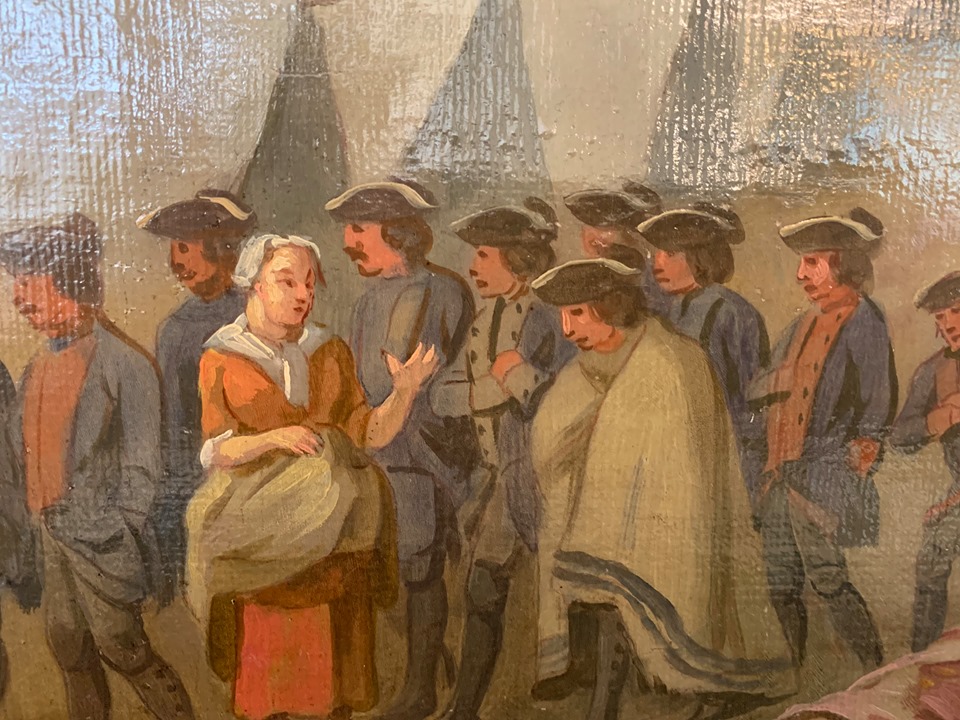

This woman, with an orange jacket, white shawl/neck cloth, and white cap wears a red petticoat and has her shirt sleeves tucked into the arms of her jacket. She appears to have some sort of wallet/blanket around her middle, held in her right hand. 
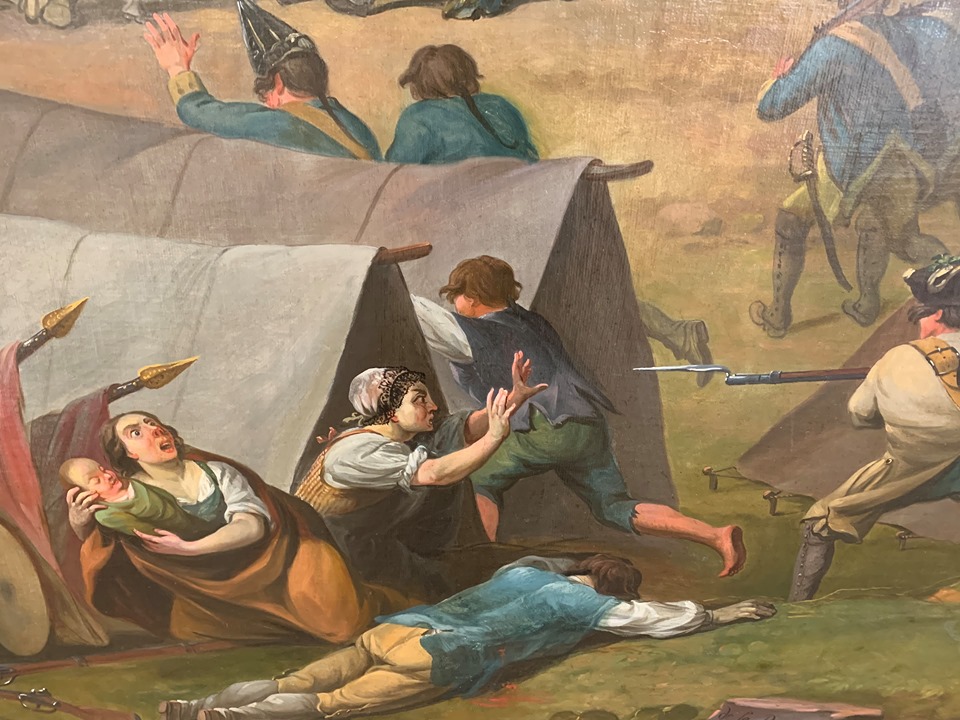

This painting shows Prussian women in states of relative undress as a result of the early morning surprise attack at Hochkirch in 1758. The woman on the right appears to have a white/rose colored cap, and she has her sleeves rolled up, and wears her stays. On the left, a women holds a child in while wearing similar clothing, but appears to have a brown/orange blanket of some sort draped around her. 


This scene, also from the downfall at Hochkirch, appears to show a woman in matching sleeveless top and petticoat fleeing from a tent with a blanket around her middle.  She wears a white cap, and sleeves rolled to above the elbow. 
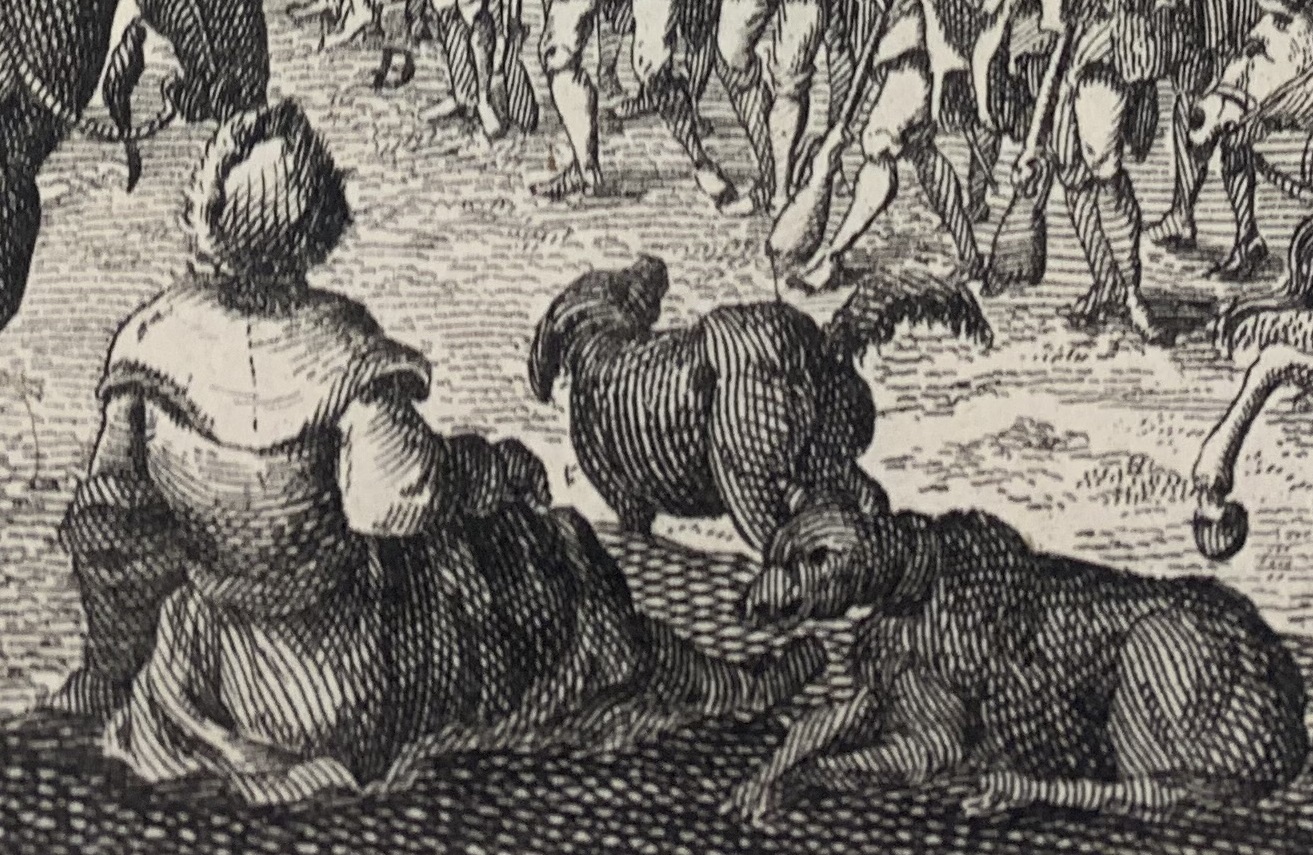
Pro-Prussian Silesian Woman, surrender of Breslau
This image, taken from a commemorative print of the surrender of Breslau, shows a pro-Prussian Silesian woman, with a dark colored petticoat, light-colored jacket with a light-colored shawl and cap. 
The Begging Soldier's Wife, Daniel Chodowiekci

This image, by Prussian painter Chodowiecki, shows a women with a jacket, two military style cocked hats, a market wallet, some type of leather or linen bag, and a light colored petticoat. As a result of her market wallet, it is difficult to definitively address some of her clothing. 

From the above sources, it is clear that some women wore old or unused cocked hats, and occasionally wore military style coats/jackets. Patterned aprons and blue aprons appear in multiple images, as do petticoats with stripes near the bottom. 

If you enjoyed this post, or any of our other posts, please consider liking us on facebook, or following us on twitterConsider checking out our exclusive content on Patreon. Finally, we are dedicated to keeping Kabinettskriege ad-free. In order to assist with this, please consider supporting us via the donate button in the upper right-hand corner of the page. As always:

Thanks for Reading, 


Alex Burns


Monday, July 29, 2019

Prussian Infantry Blankets from the Paintings of Hyacinth de La Pegna


Detail from La Pegna, Maxen, HGM
Dear Reader,

Today, we are going to look at examples of Prussian infantry enlisted-men's blankets as drawn in the paintings of artist Hyacinth de La Pegna. La Pegna is famous for his many excellent eighteenth century battle scenes, ranging from the Battle of Assietta to fighting in the Austrian Netherlands, to his most famous painting in the English-speaking world: The Ambush at Hochkirch.

La Pegna's Surrender at Maxen, HGM
The subject of Prussian soldiers' blankets is mentioned in contemporary sources A special thanks to Christoph Koester for sending me Musketier Dominicus' comment on blankets: "Then the Prince of Zweibruecken stopped by, and said that since the men had on an old clothing issue, it was getting cold, they should take the tent blankets. We were happy, and they issued them to us. Those who had no blankets carved up old tents, and took pieces of them."[1] An anonymous letter from an Unteroffizier in Regiment Nr. 3 (Anhalt) described the situation on the night of September 30th, 1756: "Our Tornisters were our pillows, the earth was our bed, and the heavens were our blanket." He had failed to retrieve blankets from the supply train for his Leutnant, as a result of a skirmish between the outposts of the army and enemy Grenzer. [2] We know that at least according to the infantry regulations, each Prussian tent squad was supposed to be issued with two blankets.[3]


La Pegna's Battle of Hochkirch, HGM


I had the opportunity to examine two of La Pegna's paintings up close  at the Heeresgeschichtliches Museum in Vienna a few weeks ago. In that museum, there are two paintings, both by La Pegna, which depict Prussian blankets. Both of these paintings, the Attack at Hochkirch, and the Surrender at Maxen, were completed during the later years of the Seven Years War. The first painting, rather well known, is the detail below from La Pegna's depiction of the Battle of Hochkirch. The detail shows an Austrian grenadier and two fusiliers chasing a woman from a Prussian tent, with a camp bed and blanket prominently depicted in the tent itself.


Detail from La Pegna, Hochkirch, 

The remaining images, as well as the image at the topic of the post, come from a second painting by La Pegna: the surrender of Finck at Maxen. Here, Prussian troops are shown grounding their weapons and surrendering to Austrian forces, in cold weather. The temperature is apparent from a number of factors including the fact that many Prussian soldiers have their hands thrust inside their coats. I'll continue the textual narrative below, after having allowed you to examine the images.


Detail from La Pegna, Maxen, HGM

Detail from La Pegna, Maxen, HGM

Detail from La Pegna's Maxen, HGM
Detail from La Pegna, Maxen, HGM
With the following images, I believe that it might be proper to conclude the following: La Pegna believed that in Prussian camps, and on surrender marches, the Prussian army was equipped with rectangular blankets, white or off white in color, surrounded by two blue stripes (one blanket appears to have three, but that it is an isolated example.) The images above seem to indicated that the blankets were available to Prussian soldiers, not just officers, as the officer in the first of the four images does not have a blanket. It does not appear, at least to me, as though the soldiers depict in this image have formally turned their blankets into blanket coats, but I am open to those with contrary evidence on that point. However, the blankets have been made to a size where it was quite easy to wear them while walking in cold weather.

Obviously, this has been a rather cursory investigation of blankets in the Prussian army during the Seven Years War-era. If you have more information regarding Prussian army blankets in the middle of the eighteenth century, please let us know via the comments below, or via email, found on the about the author page.

If you enjoyed this post, or any of our other posts, please consider liking us on facebook,  or following us on twitter. Finally, we are dedicated to keeping Kabinettskriege ad-free. In order to assist with this, please consider supporting us via the donate button in the upper right-hand corner of the page. As always:


Thanks for Reading,


Alex Burns


--------------------------------------------------------------------------------------------------------------------
[1] Tagebuch von Musketier Dominicus, s. 77
[1]Curt Jany, Urkundliche Beitraege und Forschungen zur Geschichte des Preussischen Heeres, section 2, pg. 2. 1901.
[2] Reglement vor die königl. preussische Infanterie, 1750, pg. 297.