Monday, July 16, 2018

Seniority and Organisation in the French Infantry of the Mid-Eighteenth Century

Interpretive Staff portray French Troops in North America

Today, we have an excellent guest post by author and historian William Raffle.[1]
--------------------------------------------------------------------------------------------------------------------------


Dear Reader,

In this post I want to bring your attention to the composition of a typical French Battalion and its intricacies and idiosyncrasies. Through translating a number of sources on this period, I have found it interesting to see how rank and seniority was embedded within almost all aspects of the French army even in attempts with attempts to make the army more efficient.

When tensions began to rise between Britain and France in North America precipitating the Seven Years’ War, major efforts to codify the French army of Louis XV were taking place. An ‘ordonnance’ was issued in 1754 which laid out new regulations for French and foreign infantry battalions to bring them into ‘exact conformity’.[3] At this time a French battalion consisted of twelve companies of fusiliers (A ‘fusil’ is the French name for a flintlock musket, ‘mousquet’ is the word for the old matchlocks) and one grenadier company. This might give the impression that a French battalion would be particularly sizeable, but a French company was fairly small - under fifty men at full strength.[3] Indeed, the new ordonnance gave instructions that a battalion’s smallest fighting unit was to be two companies together called a peloton or platoon. Platoons were a permanent fixture and its two companies would camp, march and fight together.[4]

The company then was almost irrelevant to the functioning of a battalion so what was the point of it? The answer to this conundrum reveals a characteristic particular to the French army; there were far more officers than other armies. As with most eighteenth-century armies, Captains commanded companies and were responsible for their costs. A Captain’s pay could not keep up with this expense and so the companies became smaller over the course of the eighteenth century. ‘Already in 1740 the French Army was becoming marked in this respect having one officer for every eleven soldiers, as against the Prussian ratio of one to twenty-nine.’[5]

Interpretive staff portray Compagnies Franches de la Marine at Niagara in 1759

The ordonnance of 1754 reflects the obsession with hierarchy and seniority within the army with minutiae verging on the ludicrous and is best illustrated by the arrangement of the flank companies. There were two flank companies per battalion – the grenadier and piquet company. The grenadiers, as most readers will be familiar, were recruited from the best soldiers of other companies. The captain of grenadiers would pay a fusilier captains for their experienced men who were chosen to be grenadiers. The piquet was not a permanent company but were drawn from good soldiers from the fusilier companies when a battalion assembled for the duration of its current operation. (Piquet or picket literally translates as ‘fence’ and should be thought of as meaning ‘guard’ company rather than light company although they did evolve this way.) Even within the ranks, fusiliers and grenadiers were lined up in order of each soldier’s seniority (length of service rather than age). The first rank was made up of the most senior soldiers, the rear rank the next most senior and the middle ranks were made up of the least experienced, presumably to strengthen their resolve by being surrounded by their comrades without easy means to break out of formation! The forty-eight fusiliers of the piquet were arranged so that they would mirror the order of the companies and platoons from which they came and then within order of seniority.[6]

The need to distinguish seniority continued to the position of the platoons when formed in line. It is a commonly written that British grenadiers were always placed on the right flank and indeed, in the French military the right flank was the highest position of honour in respect to the entire army.[7] If a battalion was deployed on the right side of the line, the grenadier company would be placed on the right side of the battalion and the piquet would take the left. However, if the battalion was on the left-hand side of the battle line, the whole arrangement would flip to a mirror image, the grenadiers would be deployed on the left and the piquet on the right. It wasn’t just the flank companies that were rearranged, all of the fusilier platoons in the centre would also be rearranged.[8]

Interpretive Staff portraying French Soldiers

These concerns were not just borne out in a drill manual. Military seniority clashed with social rank and had real ramifications on campaign. A Duke or a Count would not wish to be ordered around by a mere Baron, or, God forbid, a bourgeoisie! A letter from 1758 reveals the herculean task involved with drawing up an order of battle which satisfied quarrelsome officers,
‘M. de Randan wanted to return to the line… M. d’Armentiéres found that it was disagreeable for him to be in the infantry en second under M. de Contades, and desired to be moved to the cavalry. M. de Poyanne wanted to remain with the Carabiniers, that obliged me to move all the officers of the left and right wings and disrupted my plan to put the infantry officers with the infantry and the cavalry officers with the cavalry.’[9] 
The nobility believed that military command was their own preserve. In these circumstances, military professionalization would take a back seat to the preservation of the social order. There was much resistance to a new rank created by the war ministry, that of the aide-major (as the name suggests the role was as a second to the Major, to assist with the logistical running of the regiment). The reason it was not welcome was that it would provide more opportunities for officiers de fortune, or career soldiers from more humble backgrounds, as noblemen tended not to care too much for finding lodgings for their men or organizing bread rations.[10] As the historian Lee Kennet summarised, the French officer corps of this period had little understanding of modern warfare and were highly resistant to change until the humiliation of the Seven Years War forced a reckoning and self-reflection within the army.[11]

In a follow-up post to this I will explore the background of the French army which went to North America and how they relate to these notions of seniority and the way in which soldiers were used in this conflict.

If you enjoyed this post, or any of our other posts, please consider liking us on facebook,  or following us on twitter. Finally, we are dedicated to keeping Kabinettskriege ad-free. In order to assist with this, please consider supporting us via the donate button in the upper right-hand corner of the page. As always:

Thanks for reading!


Will Raffle

--------------------------------------------------------------------------------------------------------------------------
[1]Will Raffle graduated with an MA in Early Modern History in 2018 from the University of Sheffield. He published a translation of a French aide-major, comte Maures des Malartic’s North American journal in 2017, entitled Glories to Useless Heroism.
[2]Instruction sur l’Exercice du Infanterie, (Paris, 1754), p. 1. It was issued in the name of the King by D’Argenson, Louis XV’s minister of war.
[3] Ibid, 14.
[4] Ibid.
[5] Lee Kennett, The French Armies in the Seven Years’ War, (North Carolina, 1967), p. 66.
[6] Instruction sur l’Exercice du Infanterie, (Paris, 1754) 18.
[7] Le Blonde, ‘Poste d’Honneur á la Guerre’, Encyclopédie, ou dictionnaire raisonné des sciences, des arts et des métiers, etc., eds. Denis Diderot and Jean le Rond d'Alembert. University of Chicago: ARTFL Encyclopédie Project (Autumn 2017 Edition), Robert Morrissey and Glenn Roe (eds), http://encyclopedie.uchicago.edu/. This place would be taken by the most senior regiment although there was an exception in the most senior regiment in France, the Gardes Française, by tradition deployed in the centre of the line.
[8] Instruction sur l’Exercice du Infanterie, (Paris, 1754) 15.
[9] Clermont to Belle-Isle, June 15, 1758, Correspondance militaire (A-1) Vol. 3503, 141. Archives de la Guerre, Vincennes.
[10] Kennett, The French Armies, 60.
[11] Ibid, 68-71.

Thursday, July 5, 2018

Lt. Colonel George Stanhope describes the Battle of Culloden

British reenactors represent troops from the '45.

The following is an account of the Battle of Culloden from British Lt. Colonel George Stanhope, as written in a letter to his brother shortly following the battle. This comes from my research this week in Kent.

--------------------------------------------------------------------------------------------------------------------------

Dear Brother                                                    Camp Near Inverness, April 21st, 1746

I return many thanks for the favour of yours of the 10th instant which I received last night, as well as of the 1st instant that I received at Aberdeen the 8th of this month, and should have answered sooner but have been upon the march ever since. At present writing my fingers are almost froze being as cold in camp as in winter. I shall not trouble you with our particular marches, but ours and the Rebel army about 9,000 strong, and they fired the first cannon shot at us about two in the afternoon, which we answered with great success.[1] The army was drawn up in two lines and a reserve, with horse and dragoons on the flanks. The small arms began about a quarter of an hour after the first cannon shot, and for the time it lasted it was the hottest I ever saw. The rebels after having flung away their fire attacked with sword in hand most furiously, and bent their chief effort after Barrel's [Regiment] that was on the left of the front line, who received them warmly and stood as well as men could do till overpowered and were obliged to give ground...[.] The Rebels pursuing them intermixed with sword in hand upon which our being Regiment next to Wolfe's on the left of the second line and both Regiments outflanking Barrel's of the front line had the finest opportunity imaginable which we did not let slip off.

[Our troops] giving the column of Rebels that was about twenty deep and not forty yards distant from our regiment's right the most infernal flanking fire and saved Barrel's by it, and contributed a great deal to the turn of the whole for the rebels were soon after put to flight. When we marched on to pursue them I never saw such dreadful slaughter we had made. [The Jacobites] lying thick as they had grounded their arms and our men gave no quarter to them. I reckon two thousand of them killed in the field [and by] besides in the pursuit by the horse and dragoons with a great many of their chiefs and upward of a thousand prisoners...

It was a glorious victory and I believe the cheapest that was ever gained our whole loss being under three hundred, chiefly Barrel's with upwards of a hundred killed or wounded, with Robert Kerr, a Captain killed, and their Lt. Colonel Rich much cut in the head, his left hand cut off with one stroke, and his other arm so cut that it is doubtful they can save it, some other [junior] officers killed or wounded. The whole army behaved with the utmost resolution, and our regiment with little loss as well as any.

--------------------------------------------------------------------------------------------------------------------------

If you enjoyed this post, or any of our other posts, please consider liking us on facebook,  or following us on twitter. Finally, we are dedicated to keeping Kabinettskriege ad-free. In order to assist with this, please consider supporting us via the donate button in the upper right-hand corner of the page. As always:

Thanks for Reading,


Alex Burns


[1] Modern estimates place the Jacobites closer to between 7,000 and 8,000 men, and indicate that the battle began around 12:30 to 12:45pm. It is possible that Stanhope's pocket watch was running behind.

Sunday, July 1, 2018

Eighteenth-Century Items in Irish Museums

Detail from "The Dublin Volunteers on College Green", 1779

Dear Reader,

As many of you are aware, I am traveling for archival research this summer, in order to write my dissertation. Along the way, I've seen a few items which might interest you all. These are some of the interesting eighteenth-century military items in Dublin. The artwork is from the National Gallery of Ireland, while the material items come from the National Museum of Ireland, Collins Barracks.

Detail from, "Mrs Congreve with her Children," 1782
Majority of "Captain William Congreve..." 1782
Detail from, "Captain William Congreve..." 1782

Detail from, "The Dublin Volunteers on College Green", 1779
Detail from, "A view of Dublin from Chapelizod," 1796
(Shows the still extant but badly dilapidated "Magazine Fort")

Detail from, "Captain William Congreve," 1782
Detail from, "A view of Dublin from Chapelizod," 1796

Officer's Coat, 101st Regiment of Foot, 1780s

Officer's Coat, 101st Regiment of Foot, 1780s

Coat of the Dublin Volunteers, 1770s

Officer's Coat of the Armagh Militia, 1798

Flag of the Dillon Regiment carried at Fontenoy, 1745
French Ship's Boat lost in Ireland, 18th century

If you enjoyed this post, or any of our other posts, please consider liking us on facebook,  or following us on twitter. Finally, we are dedicated to keeping Kabinettskriege ad-free. In order to assist with this, please consider supporting us via the donate button in the upper right-hand corner of the page. As always:

Thanks for Reading,


Alex Burns

Tuesday, June 19, 2018

Eighteenth-Century Items in British Museums

Officer's coat, 49th Regiment of Foot, 1770s, NAM
Dear Readers,

I am posting these images to give you a brief snapshot into some of the eighteenth-century collections in British Museums. Kabinettskriege will return, but for much of the summer, I will be overseas. I hope you are all doing well!

Foot Guard's Enlisted Coat, 1770s (?), NAM
Drummer's Coat, 1770s (?) NAM
Dragoon Officer's coat, 1750s, NAM
George II at Dettingen, NAM
Militia Grenadier's Cap, 1760s, NAM
Royal Horse Guards coat and waistcoat, 1790s

Guards Officer's coat, 1760s
Grenadier's Cap, 1770s
Foot Guards Enlisted coat, late 1780s
Miniature of a grenadier, 1760s, British Museum

Drum of the 6th Regiment of Foot, associated with the Jacobite Rebellions

Wall gun, Warwick Castle
Medal worn by David Dundas, Warwick Fusiliers Museum
Cavalry leather coat associated with the Battle of Blenheim, date unclear
Royal Armories, Leeds
Battle of Culloden, copy of work by Morier, targets associated with the Jacobite risings
Royal Armories, Leeds
Prussian (middle) and Austrian (bottom) muskets, 1770s
Royal Armories, Leeds
Various Shenanigans, early-to-mid 1700s
Royal Armories, Leeds
I still have roughly two and a half weeks in Britain, before I head to Northern Central Europe. Expect more pictures, and if you would like to write for the blog this summer, please contact me via the about the author page.

If you enjoyed this post, or any of our other posts, please consider liking us on facebook,  or following us on twitter. Finally, we are dedicated to keeping Kabinettskriege ad-free. In order to assist with this, please consider supporting us via the donate button in the upper right-hand corner of the page. As always:

Thanks for Reading,


Alex Burns

Wednesday, May 9, 2018

Military Buckshot in the Mid-Eighteenth Century

Reenactors portray Maryland troops

Dear Reader,


Today, we are going to examine a particular type of ammunition used by eighteenth-century soldiers: buckshot. For those unfamiliar with the term, buckshot consists of smaller projectiles, which spread out after leaving the barrel of the weapon. It is often used in a shotgun today. In the eighteenth-century, German language speakers called this specialty ammunition Cartatschen-Patronen, which gives us the modern German term, Kartätschen-Patronen, a catch-all term for submunitions including grape-shot (Traubhagel).

It appears that while this type of ammunition was common amongst American, British, and French irregular forces, and it was utilized by American, Austrian, British, French and Russian regular troops as well. In the eighteenth-century, buckshot was used to help compensate for the smoothbore weapons in common use at the time. By firing more projectiles at the target, troops generated a larger wall of lead with which to damage enemy forces. Far from being an exclusively American innovation, this weapon was employed by multiple European regular armies. This post will examine the use of buckshot in the mid-eighteenth century. I want to thank Dr. Grzegorz  Podruczny for his advice and help with source material.


Most troops discussed in this post were not firing only buckshot, but rather a combination of both buckshot and musket ball ammunition. In English, this is called "buck and ball", (sometimes, "buck 'n' ball") ammunition.[1] Usually, this consisted of a regular cartridge with 2-3 buckshot attached to it. This would provide the best of both worlds: the larger ball could be effective at long ranges, while at 100 yards or less, the buckshot would begin to wound and mangle enemy soldiers. If you are wondering what one of these cartridges might look like, check out the artistic reconstruction below. With the round itself examined, let us look first at the use of buckshot in the Seven Years' War, and then during the American War of Independence.

A Provincial in Winter

This type of specialist round was employed by both sides in the French and Indian War. British officers believed that their French and Native Americans enemies exclusively used this type of ammunition. In October of 1757, a British officer recalled, "The enemy never fire a single ball, for they always load with six or seven smaller ones (which are called buck-shot) besides their usual musket-ball."[2] The same officer referred to being under buckshot fire as, "a dreadful shower."[3] By 1760, both the British and their provincial allies had followed suit. Describing a small engagement in Canada, John Knox reported that New England provincials, "advanced, very spiritedly, to the enemy, who were endeavoring to steal upon them; gave them a regular discharge of a brace of balls, besides buckshot from each piece, and sent them flying."[4] By the end of the war, it seems that both the British and Americans had begun to employ buckshot with increasing regularity. 

Austrian Reenactors 

At the start of the Seven Years' War Austrian infantrymen carried a total of 48 rounds of ammunition. Of those, twelve were buckshot rounds. It is unclear if these twelve rounds were buck and ball rounds (as pictured above) or specialized buckshot rounds designed to be loaded in addition to the regular round, as in the Russian practice (described below). Regardless, the Austrian army formalized ideas on use buckshot in their 1759 field manual. The Militär Feld-Regulament of 1759 indicated when facing enemy infantry, Austrian troops should use their buckshot rounds beginning at 100 yards, should definitely use them if enemy infantry attempted a bayonet attack. When facing enemy cavalry, the manual instructs the soldiers to reserve their buckshot fire until the charging horsemen have closed to 10 yards.[5]

Russian Infantrymen/Artillerymen of the Seven Years' War

In his 2008 book, Kiril Tatarnikov shows the Russian military issued buckshot cartridges to soldiers as standard relatively early. In 1715, Russian troops were issued 50 cartridges total, 30 will ball ammunition, and 20 with buckshot ammunition. [6] The Russian army of the Seven Years' War used buckshot to terrible effect at battles such as Zorndorf, Paltzig, and Kunersdorf. Indeed, the use of buckshot may help explain the incredible high casualties at battles like Zorndorf.  A Prussian recalled the battle of Zorndorf:
On our side, therefore, there were relatively little dead, but a great number of wounded. However, most of the wounded were able to convalesce with their regiments...every Russian infantryman loads a musket ball and an equal pack of buckshot. There are between 7-9 of these in a linen packet in the form of grapeshot. As a result of this, the Russians load quite slowly, as a Jäger loads his rifle. In the time it takes the Russians to load their weapons, the Prussians have fired three times. I address this only in passing. We have found signs of this buckshot in many of the wounded, because they bled freely, almost to death. I cannot say whether their balls are poisoned, but you have observed that the Russians even use heated shot to harm their enemies.[7]
Buckshot from archeology on the Kunersdorf battlefield. (Many thanks to Dr.
Grzegorz Podruczny for the image!)

Clearly, then, the Russians used a different sort of buck and ball ammunition, one where two distinct cartridges were loaded into the weapon. It is interesting that the Prussian soldier compares the additional time loading this ammunition to that of a Jägers' rifled weapon. After the Seven Years' War, Russian army would continue to use buckshot ammunition until the end of the Napoleonic Wars.[8] The British and fledgling American army would use this type of ammunition in the American War of Independence.

Reenactors portray American soldiers in the War of Independence
This ammunition was widely used by militiamen in the American War of Independence. When not using rifled weapons, militia troops increased their firepower and effectiveness through buck and ball ammunition.[9] Both Continental and militia troops used buck and ball ammunition at the Battle of Camden.[10] George Washington, possibly as a result of his experience in the French and Indian War, was a proponent of buck and ball ammunition. On October 6th, 1777, Washington circulated general orders that mandated, "Buckshot are to be put into all the cartridges that shall hereafter be made."[11] This decision came directly after the Battle of Germantown. Archaeology and documentary sources indicate that this order was indeed followed. The American predilection for buckshot continued into the War of 1812 era.

Soldier's Musket recovered from British shipwreck in St. Augustine, FL. 

The British, too, used buck and ball cartridges during the American War of Independence.[12] The musket above was photographed in a shipwreck near St. Augustine, Florida. Multiple American sources report suffering buckshot wounds when engaged with British regulars, particularly in the Southern Campaign of 1781. At the Battle of Guilford Courthouse, it is possible that both the Brigade of Guards and the 33rd Regiment were using this type of ammunition.[13] Although the British army never employed buck and ball as the standard ammunition, it appears that by the late war its use was quite common.

Thus, it would seem that buckshot was commonly used on many of the battlefields of the mid-eighteenth century. Rather than being a distinct practice unique to American backwoodsmen, the ammunition was used French troops in colonial Canada, and Austrian and Russians troops in Europe during the Seven Years' War. The American contribution to the use of buckshot ammunition was mandating its use, something that the British failed to do. It is an interesting coincidence that the two superpowers of the twentieth century, Russia and America, heavily employed buckshot during the eighteenth and early nineteenth-centuries. 

If you enjoyed this post, or any of our other posts, please consider liking us on facebook,  or following us on twitter. Finally, we are dedicated to keeping Kabinettskriege ad-free. In order to assist with this, please consider supporting us via the donate button in the upper right-hand corner of the page. As always:

Thanks for Reading,


Alex Burns


---------------------------------------------------------------------------------------------------------------------

[1] Babits, Brenckle, and Howard, "Rifle Shot and Buck'n'Ball in the 1781 Southern Campaign," Paper presented to the 2005 Nathanial Greene Symposium.
[2] Knox, An Historical Journal, Vol 1, 54.
[3] Ibid, 91.
[4] Ibid, Vol 2, 280.
[5]Anon, Militär Feld-Regulament, articles 15, 18, and 19. (Manuscript is unpaginated).
[6] Kiril Tatarnikov, Русская полевая армия 1700-1730, (Moscow, 2008), 58. 
[7]Anon, Besondere Merkwürdigkeiten und Anekdoten aus Neudam in der Neumark, 29.
[8] Leo Bockeria, et al, "Russian war surgery in 1812," International Journal of Surgery, Vol 10, Issue, 10, 2012.
[9] Lawrence Babits, Devil of a Whipping, 13.
[10] Legg, et al, "Understanding Camden: The Revolutionary War Battle of Camden As Revealed Through Historical, Archaeological, and Private Collections Analysis," University of South Carolina Scholarly Commons, 2005.
[11] John Fitzpatrick (Eds), The Writings of George Washington, Vol 9, 313.
[12] Lawrence Babits, Devil of Whipping, 165n8.
[13] Lawrence Babits, Long, Obstinate, and Bloody, 166.


Tuesday, May 1, 2018

How Rapidly Could Soldiers Load in the Mid-Eighteenth Century?

Just how quickly could these soldiers reload?
Dear Reader,


How many rounds could eighteenth-century soldiers fire a minute? This is a question which has long preoccupied military enthusiasts of the era, and many feel quite strongly on this question. From the sequence in the (in?)famous Sharpe series depicting the training of the South Essex Regiment, to many reenactors demonstrating their own skills, the desire to show that musket-armed troops could fire quickly dominates media produced regarding the era. Of course, as we might expect, such depictions are sometimes rather fanciful.

My favorite line from the Sharpe sequence is, "The trick is, to keep the muzzle up to stop the bloody bullet falling out. Of course, the muzzle needs to point up anyway, the frog coming towards you is high up on a horse." Because, as everyone knows, the French only sent cavalry to fight in the Peninsula. Somewhat ironically, many historical officers (correctly) encouraged their soldiers to aim low, at the knees of enemy troops, or the ground directly in front of the enemy. These officers believed that this compensated for the kick of the musket. Oh well.

But can ya stand?
This post attempts to examine how quickly soldiers could fire their muskets across mid-eighteenth-century European armies. It will address the importance of firepower, the abilities of troops to fire quickly in a drill square environment, speed of fire in combat, the disadvantages of "quick-fire mania", and how officers attempted to mitigate those disadvantages. Despite other parade ground or theoretical results, an average of approximately 2 rounds a minute was quite normal in combat conditions, when soldiers did not engage in "tap-loading". This is significant, as it helps explain the length of eighteenth-century battles, and the length of time needed for troops to run low on ammunition. 

A number of excellent historians have addressed this question, and once again, I am standing on the shoulders of giants. This list includes David Blackmore, Hugh Boscawen, Alexander Campbell, Christopher Duffy, John Houlding, Richard Holmes, and Matthew Spring. Usually, these authors are writing about the forces of an individual state, such as Austria, Britain, or Prussia. For more detailed information on specific national practices, I encourage you to read these historians' works.

An Austrian Fires with a conical touch-hole and cylindrical ram rod

Erik Lund, writing in an assessment of the Austrian officer corps in the Kabinettskriege era, argues that historians have, by and large, purchased into a myth regarding the importance of a high tactical rate of fire. Here, I disagree with Lund. Tactical rate of fire, and the superiority it granted in combat, was no myth.

 Oddly enough, Frederick II, "the Great" of Prussia, early in his career, seems to have ignored the importance of firepower. In 1748, he encouraged his infantry to attack without firing, and he knew generals would complain, "that I never employ my small arms."[1] Frederick, it seems, had taken the wrong lessons from the War of Austrian Succession. Shock tactics, not firepower, seemed to be the way forward. It was a much more experienced, seasoned, and defeated Frederick who wrote in 1768:
"The cannon does everything, and the infantry cannot get to grips with cold steel... battles are decided by the superiority of fire. Except in the attack of defended positions, a force of infantry which loads speedily will always get the better of a force which loads more slowly."[2]
Let those words sink in. Firepower and speed of loading decided eighteenth-century contests between infantry. Most generals understood this idea, and soldiers were relentlessly taught to fire quickly. Firepower, and sometimes the psychological threat of cold steel, not cold steel itself, won eighteenth-century combats.

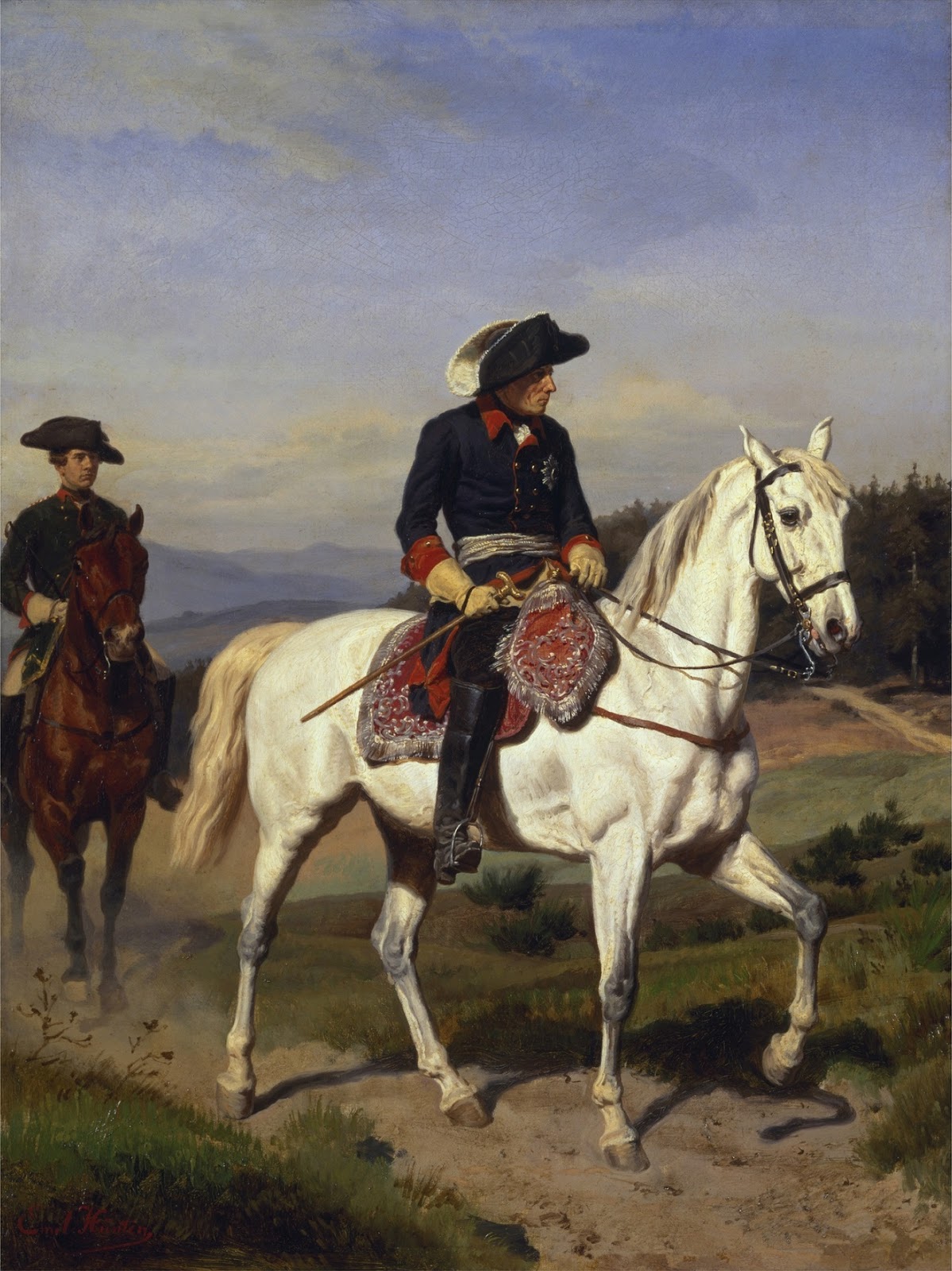
Friedrich II von Preussen
First, we need to examine how quickly a soldier could fire on the drill square in peacetime. Across most European nations, 4-5 rounds seems to have been quite normal.  By 1750, most European armies were fascinated with the speed of fire demonstrated by the Prussian troops in the War of Austrian Succession. Austrian military veterans and theorists saw that their troops could fire 4-5 rounds a minute on the drill square, basically matching the Prussian drill square ideal.[3] Prussian troops were capable of firing six rounds a minute, but could not maintain that pace for any length of time. Lossow comments, "Altogether, it would be too much to expect troops to maintain six rounds a minute for an extended time."[4]  The British achieved a similar level of drill-square proficiency in this regard, with veteran troops being able to fire four rounds a minute.[5] The Russians, too, used Prussian emphasis speed of fire when training their troops in the 1750s.[6]  Some sources think even this too ambitious. Prussian General Ludwig von Lossow argued that, "in ... European armies only the most practiced parts of them can fire four times in a minute's time. Usually, only three shots come are fired: watch and see!"[7] Regardless, by the 1780s, the cylindrical ramrod and the conical touch-hole (technological assists to loading) had increased the drill-square rate of fire to six rounds fired with a seventh-round loaded.
o
British Soldiers in front of Ft. Niagara
However, as in almost all aspects of military life, there was a severe disparity between what soldiers could accomplish on the peacetime drill square and the battlefield. It seems that troops in combat fired more slowly. Two rounds a minute is a very believable figure for well-trained, veteran troops in combat.  Austrian army officer Jakob Cogniazzo gives us a window into this idea:
Now, how many rounds of rapid fire do you think he can loose off in a minute when he is in a minute when he is in this condition? At least five a minute? That is certainly the norm for fire on the drill square, which conjures up visions of enemy corpses by the thousand. But, when we consider all the encumbering burden of the soldier... taking everything into due account, it would be optimistic to suppose that he fires as many as one or at the most two rounds a minute [in combat].[8]
One of the differences between drill square "minute firing" and real combat was its duration. The real test was how long soldiers could keep firing at a high rate. It seems British troops could fire between 2-3 rounds a minute for a sustained amount of time.[9] Likewise, it seems that during combat the Prussians could fire three rounds per minute, and they could keep up this pace extended periods of time.[10] The Russians loaded slower, perhaps 1-2 shots a minute, as a result of the additional time it took to load their buckshot rounds.[11] With this in mind, it seems that troops carrying 30 rounds would run low on ammunition after 10-20 minutes, while troops carrying 60 rounds of ammunition would run low after 30-45 minutes. 

Reenactors portraying the 3rd New Jersey Regiment
More important than the actual number of shots was the ability to confer a comparative advantage to troops who could load and fire more quickly than their opponents. An Austrian officer noted that the Prussians had, "the important and extraordinarily, significant advantage of being able to get off three rounds to every one of the Austrian infantry. This is conceded by all impartial and well-informed men who have seen it with their own eyes."[12] Prussian officer Ernst von Barsewisch recalled of the Battle of Leignitz:
"Now I commanded, "platoon: ready!  present!  fire!" Then the remaining part of the battalion followed, whereupon we blasted away for a length of time. The enemy, however, did not withdraw, but also fired vigorously. But we loaded more speedily and had devastated the enemy with our first volley."[13]
The author prepares to fire
Instilling troops with the need to fire quickly at the expense of all other factors had a number of downsides. Again, General von Lossow comments that officers, "forget that the musket barrel becomes too hot to hold after two minutes... the soldiers inevitably acquired bad habits when they were put through the rapid-fire drill every day, like failing to ram the loads firmly home, neglecting to aim, raising the barrel too rapidly after they had loosed off, and so on."[14] It seems there might have been a downside to this "quick-fire mania."

In addition to these bad qualities, soldiers might begin to "cheat" in other ways. Of these, the most infamous was the so-called, "tap-loading." In 1726, General Hawley complained that, "the German and Dutch foot might be brought to ram their cartridge every time on service, for ought I know, but by the nature of our men I believe it impossible to bring them to it."[15] The Austrians engaged in tap-loading at Mollwitz in 1741, where it robbed their musket discharges of lethal force, the French used tap-loading at Lauffeld in 1747,  and the British engaged in the practice at Hubbardton in 1777.[16]'

Reenactors representing HM 17th Regiment of Infantry in North America

Military authorities from various nations were aware of these problems and attempted to ensure that soldiers fired with speed AND accuracy on the day of battle. Soldiers in almost all European nations practiced firing at targets to ensure accuracy. Troops in Central European armies were carefully taught to aim their muskets with reference to their distance from the target.[17] British General Wolfe argued that, "[t]here is no necessity for firing very fast; a cool and well-leveled fire, with the pieces, carefully loaded, is much more destructive and formidable than the quickest fire in confusion."[18] Despite this, numerous military theorist believed that though disadvantageous, there were times when quick-fire and tap-loading outweighed these concerns.[19] Officers and military theorists attempted to carefully weigh and balance speed of fire with accuracy.

So, what can we assert regarding the rate of fire among regular troops in the mid-eighteenth century? These troops could fire at prodigious rates on the drill square but often fell short of this ideal on the battlefield. Sometimes, this led to the disadvantages associated with "quick-fire mania" or the dangerous of tap-loading. As a result, officers attempted to find a happy medium: soldiers who would fire at speed but retain accuracy.

If you enjoyed this post, or any of our other posts, please consider liking us on facebook,  or following us on twitter. Finally, we are dedicated to keeping Kabinettskriege ad-free. In order to assist with this, please consider supporting us via the donate button in the upper right-hand corner of the page. As always:

Thanks for Reading,


Alex Burns


--------------------------------------------------------------------------------------------------------------------------

[1] Jay Luvaas, Frederick the Great on the Art of War, 143-145.; Vincent Rospond, Frederick's Orders, 112.
[2] Frederick II, Testament Politique, (1768) 146-148.
[3] Christopher Duffy, Instrument of War, 408.; Duffy, Army of Frederick the Great, 128.
[4]Ludwig von Lossow, Denkwürdigkeiten zur Charakteristik der preussischen Armee, 265.
[5] Richard Holmes, Redcoat, 199.
[6] Christopher Duffy, Russia's Military Way to the West, 62.
[7] Ludwig von Lossow, Denkwürdigkeiten zur Charakteristik der preussischen Armee, 264.
[8] Jakob Cogniazzo, Freymuethige Beytrag zur Geschichte, (1779), 147.
[9] John Houlding, Fit for Service, 194.
[10] Duffy, Army of Frederick the Great, 128.
[11] Anon, Besondere Merkwürdigkeiten und Anekdoten aus Neudam in der Neumark, 29.
[12] Vienna Kriegsarchiv, CA 1758 III 1, Lieutenant-Colonel Rebain, 10 May 1758.
[13] Ernst von Barsewisch, Meine Kriegs-Erlebnisse, 113.
[14] Ludwig von Lossow, Denkwürdigkeiten zur Charakteristik der preussischen Armee, 266.
[15] Quoted in Journal of the Society for Army Historical Research, Volume 32 (1953), 88-89.
[16] Anonymous, Denckwüdiges Leben und Thaten Beruehmeten Herren Johaan Daniels von Menzel, 80.; David Blackmore, Destructive and Formidable, 104.; Thomas Anbury, Travels through the Interior Parts of America, 333.
[17] Christopher Duffy, Instrument of War, 409.; Duffy, Army of Frederick the Great, 129.
[18] Wolfe, Instructions to Young Officers, 49.
[19] David Blackmore, Destructive and Formidable, 104-105