Showing posts with label Russia. Show all posts

Wednesday, March 17, 2021

Did Soldiers use Grenades in the Mid-Eighteenth Century?


Plate from, The Grenadiers exercise of the Granado...
published December 4th, 1744

Dear Reader,


I sincerely apologize for the long silence. It has been too long since I've created any content on this site. I promised someone very dear to me that I would not write any more posts until after I had defended my dissertation, and I am delighted to report that I passed my dissertation defense on March 1st. Although I am still hard at work on revisions, I decided to take a bit of time out of that schedule to provide a short write-up on grenades. 

The use of hand grenades is commonly associated with the period just before the Seven Years War: the grenadiers of the 1690s employed grenades in siege combat, and no-one would dispute this.  Likewise, it is common knowledge that grenades continued to be employed by naval forces during the eighteenth century. On land, however, it is commonly asserted, that grenades fell out of fashion after the War of Spanish Succession, and played little part in warfare during the Seven Years War or American War of Independence. Evidence shows that this is incorrect. Grenades continued to play an important part in siege warfare throughout this period, and both European and American officers concurred that armies needed to be supplied and equipped with grenades. 

During this entire period, the hand grenade was a hollow ball of metal (glass grenades were also employed by the Austrian military, but may be from an earlier period) filled with gunpowder and ignited by means of a short fuse. A military author defined grenades in 1783: 

The hand-grenade, which is a hollow ball or shell, generally of iron, but sometimes of tin... of about 2 1/2 inches in diameter; was first used in 1594... it is filled with a very fine powder, and set on fire by means of a small fuze driven into the fuze hole.[1]


A pile of early modern grenades and musket balls,
Forchtenstein Castle

Evidence for the continued use of grenades by European armies is substantial. In 1747, two (probably drunk) Prussian cantonists disrupted a engagement party by exploding hand grenades nearby, until the minister had them chased off (no mean feat).[2] When the Austrians captured Schweidnitz in 1757, they inherited a store of almost 81,000 hand grenades from their former Prussian owners.[3] In 1779, Gaston de Commines, a soldier formerly in Austrian service, writing from the United Provinces, attempted to convince Benjamin Franklin of the efficacy of his new grenade launcher, which he envisioned mounted troops employing.[4] Lewis Lochée, a naturalized British military writer from the Austrian Netherlands, wrote on hand grenades in his 1783 treatise on field fortification, arguing that camps should have, "palisades fixed at a certain distances from the parapet.. to obtain the additional security against hand grenades." Lochee continued, "the distance that hand-grenades can be thrown is from 25 to 30 yards."[5] Thus, Prussian cantonists had access to grenades in peacetime, and set a considerable store of them aside. Authors and inventors with Austrian, Dutch, and British connections likewise considered the use of hand grenades, and developed new weapons for their employ. However, were they used in actual combat? 

It seems that, much like their use during the Nine Years War and War of Spanish Succession, hand grenades were most commonly deployed around fortresses. British troops utilized hand grenades in colonial conflict, such as against the Native Americans who took part in Pontiac's War in 1763. Simeon Ecuyer, the officer commanding at Fort Pitt, noted that the Indians, "continued firing at the fort all night, [we] threw some hand grenades into the ditch where we imagined some of the enemy were."[6] Captain Dalrympe of the Loyal Irish Volunteers wrote Lord Germain in 1779, describing the attack on the fortress at Porto Omoa, asserting that his troops, "were formed into four columns in line, four men advanced in each column, with guides at the head... followed [by] eight men with carrying the ladders, who were followed by a few hand grenade men."[7] Although the Loyal Irish took part in this assault, seamen and marines also formed part of the attack. 

Grenades were also captured, acquired and employed by American troops during the War of Independence. At the capture of Fort Chambly in October of 1775, part of the stores which fell into American hands were, "500 hand grenades."[8] American Colonel Richard Gridley estimated that American troops would need, "2000 hand grenades" in order to successfully besiege Boston.[9] Captain Thomas Antoine Mauduit du Plessis, a French engineer working with the American troops, wrote to Washington in 1777 that Fort Red Bank could better defended if, "we can with mines [and] hands grenades... secure him."[10] Like most European armies, then, the North American rebels primarily used grenades in the context of sieges and defending positions. 

Russian Troops experimenting with mortars, 1750s[11]

The Russians, in contrast with most armies in Military Europe, stood out for their great love of hand grenades during the eighteenth century. Russian grenadiers and fusiliers carried grenades throughout the Seven Years War, carrying two grenades in a special bandoleer.[12] Grenadiers were instructed to throw these grenades whenever the enemy was close enough.[13] This was also done by the dragoon regiments in the Russian Army, who like the infantry had special ammunition carts for the transport of grenades. Perhaps uniquely among eighteenth-century armies, Russian troops planned for the use of grenades outside siege warfare. In skirmishes with East Prussian militia forces, Russian dragoons were instructed to dismount and throw their grenades whenever the enemy took cover or used buildings as a strongpoint.[14] The Russian army employed grenades in a variety of settings, and even equipped their mounted troops with grenades.

Thus, although there were some regional differences, troops all across Europe and North America continued to employ hand grenades in specific settings during the middle decades of the eighteenth-century. These weapons did not disappear with the end of the War of Spanish Succession, and continue to be employed throughout the period. 

If you enjoyed this post, or any of our other posts, please consider liking us on facebook, or following us on twitterConsider checking out our exclusive content on Patreon. Finally, we are dedicated to keeping Kabinettskriege ad-free. In order to assist with this, please consider supporting us via the donate button in the upper right-hand corner of the page. As always:

Thanks for Reading, 


Alex Burns

--------------------------------------------------------------------------------------------------------------  

[1] Lewis Lochée, Elements of Field Fortification, 22.
[2] William W. Hagen, Ordinary Prussians, 155, 472.
[3] George Grey Butler (editor) and Horace St. Paul, A Journal of the First Two Campaigns of the Seven Years War, (Cambridge: 1914), 380.
[4] Barbara B. Oberg, The Papers of Benjamin Franklin, November 1, 1779, through February 29, 1780, Volume 31, 48–54.
[5] Lewis Lochée, Elements of Field Fortification, 22.
[6] Mary C. Darlington, Fort Pitt and Letters from the Frontier, 105.
[7] The Universal Magazine of Knowledge and Pleasure, Volume 65, 319.
[8] The Scots Magazine, Volume 37 (1775), 651.
[9] Philander D. Chase, The Papers of George Washington, Revolutionary War Series, Volume 2, 210.
[10]Philander D. Chase, The Papers of George Washington, Revolutionary War Series, Volume 12, 287.
[11] For this and more excellent images of the Russian Army, see: Tomasz Karpinski, "Unknown Iconographic Sources for the History of the Russian Army: The Russian garrison in Elblag during the Seven Years War though the Observation of Eyewitnesses," Milihist Info. Link
[12] Groβen Generalstabe, Die Krieges Friedrichs des Groβen, Teil 3, Der Siebenjaehrige Krieg, Volume 4 (Berlin, E. Mittler und Sohn, 1914) 5,29.
[13] Ibid.
[14]Christopher Duffy, Russia's Military Way to the West, 64.

Tuesday, January 21, 2020

On this Day in History (1720): The Treaty of Stockholm

The Town of Anklam, drawn in 1758


Dear Readers,

On this day in the 1720s, Prussia made peace with Sweden. The Prussian portion of the treaty of Stockholm, which ended this portion of the larger Great Northern War, gave territory to Prussia, and badly needed cash to Sweden, which was still struggling against Russia and Denmark. King Charles XII of Sweden died at the Siege of Fredricksten in 1718, and the new Swedish King, Frederick I, and government sought to rapidly end the war. As a Hessian prince, Frederick I was only too willing to negotiate with Prussia and Hanover, seeking to draw them out of the war via territorial concessions, and use them as leverage against Russian occupation of large portions of Swedish territory in Estonia and Livonia.  

In reality, only the area south of the red line was given to Prussia
Stettin (Szczecin), a large and important city on the river Oder, was given over to Prussia. Prussia also gained Pomeranian territory south of the river Peene. Frederick William I, the King of Prussia, had significantly expanded for very little expense. Smaller towns, such as Damm, Gollnow and Anklam were also ceded to the Prussians. This area would be contested by Sweden again in the course of the Seven Years War, but remained in Prussian hands. 

A plan of the city of Stettin around 1720
For their part, the Swedes gained 2000 Riksdaler for the loss of these territories. This cash was desperately needed by the Swedish government, which had been at war for approximately twenty years. Unfortunately for the Swedish, the removal of Prussia (as well as Hanover and Denmark by July 1720) from their coalition of enemies did little to influence Russia.[1] Swedish power was decisively broken at the Treaty of Nystad in the following year. 

The Berlin Gate at Stettin, erected in the
era of Frederick William I
Three hundred years ago today was a surprisingly important moment in the history of central and eastern Europe. It helped to confirm what was already apparent, that Sweden, which for a generation had dominated the Baltic world, was beginning to give way to Russian power. It was not apparent to observers at the time, however, that Prussia was consolidating its power in ways which would have profound consequences for the history of Europe over the next three hundred years.

(And yes, I realize that as a result of the change in calendars in the 1750s, the "real" anniversary for this event is February 1st.)

If you enjoyed this post, or any of our other posts, please consider liking us on facebook, or following us on twitterConsider checking out our exclusive content on Patreon. Finally, we are dedicated to keeping Kabinettskriege ad-free. In order to assist with this, please consider supporting us via the donate button in the upper right-hand corner of the page. As always:

Thanks for Reading, 


Alex Burns

---------------------------------------------------------------------------------


[1]Robert I. Frost, The Northern Wars, 296.  


Friday, November 15, 2019

What HBO's "Catherine the Great" gets Wrong: Paul I

Joseph Quinn as Paul I of Russia, and Kevin McNally as Alexei Orlov

Dear Readers,

Today we are continuing the series of posts discussing "Catherine the Great": HBO's recent period drama on that most excellent of monarchs in eighteenth-century Russia. Our first post discussed the role of Peter III in Russian, history, describing some of the ways that he has been misunderstood by historians. This post discusses a main character in the series, and Catherine's son, Tsar Paul I of Russia.

In the closing scene of the HBO miniseries, Clive Russell, playing the court fool, sings a song which opens: "...History is written by crooks and fools...". The implication is that Paul I controlled the narrative of Catherine's reign, preventing the nature of her love with Prince Potemkin from being common knowledge. This belief both crooked and foolish, as in Russian history, Catherine and Prince Potemkin have always been more beloved than Paul I and his father, Peter III, who are viewed as being traitors to the "Russian soul." In claiming to have unearthed a secret narrative of Catherine's life, the HBO miniseries is really just championing the same nationalist view of the Russian past which was common in 19th and 20th centuries. How then, does the series treat Tsar Paul?

Joseph Quinn's Paul I is a fairly-stock villain for Catherine to square off against. When the series begins, most elements suggest that it is pre-1768 (the Russo-Turkish War has yet to break out, Potemkin is referred to as "Lt. Potemkin", Grigory Orlov is responsible for artillery), but Paul is not portrayed as a 8-12 year-old boy he would have at that point. Rather, he is turning age 19, and obsessed with challenging his mother's power. In the first scene where he has major lines, his attitude towards his mother is encapsulated in the line: "my God, how I hate her." Catherine, on the other hand, develops the antagonism between them through well-crafted lines such as: "Why is my son so unattractive?"

Paul I was eight years old in 1762, when his father was died in suspicious circumstances after his mother's coup d'etat. As boy, Paul was in a difficult position, as an unwanted heir to the Russian throne, and a daily reminder for Catherine of Peter III's existence. During the first ten years of her reign (from 1762-1771) Catherine and Paul had a very difficult relationship, and foreign diplomats commented on the lack of affection the Tsarina seemed to have for her son.[1] Following a serious illness in 1771, Paul and his mother reconciled, to such an extent that Catherine complained regarding the amount of time he was in her presence: "my son no longer wants to be a step away from me and ... I have the honor of amusing so well that he sometimes changes his place at table in order to sit beside me."[2]  This aspect of Paul and Catherine's relationship is left relatively unexplored in the HBO miniseries, as it portray's Paul as scheming to replace his mother for most of the series.


Rory Kinnear's excellent minister Panin,
struggles through a difficult conversation regarding the succession

This reconciliation was cut short by Catherine II's resistance to having Paul II as a co-ruler, and the dismissal and exile of Paul's advocate at court, Caspar von Saldern.  Catherine II initially indicated a willingness to be co-ruler with Paul when he reached the age of 18. Maria Theresa and Joseph II of Austria reached a similar arrangement in 1765. In Paul's case, Catherine was unwilling to share power, and despite the efforts of Nikita Panin to shield Saldern, he was exiled when his support for the idea came to light.[3] The HBO miniseries portrays this rather accurately, although Panin, rather than Saldern, is the character who supports the young Tsar.

After Catherine's ascension to the throne, Paul possessed an unenviable position: his mother viewed him as a remainder of a her hated husband, Peter III. She referred to her son and his wife as, "that difficult baggage".[4] She insinuated that Paul was not Peter III's son in her memoirs, but the fact of the matter is that Sergei Saltykov, her lover in 1752-1754, was not present with her during the timeframe of Paul's conception. Likewise, Peter III wrote to foreign courts that he was pleased at the birth of his son, but acknowledged that Catherine's daughter, Anna, was an illegitimate child of another man.

Paul grew up in an environment where it was common knowledge that his parents hated one another, his mother overthrew and contributed to the death of his father, and then had a series of relationships with other men, who frequently disliked and sometimes humiliated Paul.  Prince Potemkin intercepted mail between two of Paul's supporters, Pavel Bubikov and Alexandr Kurakin, which insinuated that if Prince Potemkin were to be killed, Russia would be better off. Taking this note to Catherine, Potemkin moved against Paul, excluding him from influence at court for the rest of Catherine's reign.[5]

Joseph Quinn as Paul, with his 2nd wife, Sophea Dorothea of Württemberg,
played by Antonia Clarke
The figure of his father, as well as Frederick II of Prussia, remained a powerful force in Paul's life. He admired Frederick, and likely viewed him as a surrogate father figure. Frederick took up a correspondence with the young man, and even went as far as arranging his second marriage. In January of 1774, Paul wrote to Frederick:
"You have been so good to me on different occasions, you express your mark of friendship to me, and you have striven to make me happy by all you have written me and said to others. I unquestionably attribute to you a large part of what makes me happy in life... I could not learn without the greatest sensitivity what part you have taken, Sire, in what my mother-in-law has done to improve the union between my mother and me. Allow me to express my gratitude for this goodness, I will make myself worthy of it by the attachment I devote to you."[6] 
Frederick replied that he would be, "very happy if I contributed in any way to your contentment and satisfaction."[7] After the death of Paul's first wife, Wilhelmina Louisa of Hessen-Darmstadt, Frederick essentially matched Paul with Sophia Dorothea of Württemberg.  Writing to Paul after hearing of his first wife's death, and with the news that he would meet his second while in Berlin Frederick wrote Paul:
"My dear brother, be persuaded that I felt sincere grief at the loss you have suffered. It will be a great satisfaction to me if I can help to repair it. You may count on me to go with all with all zeal and activity. Among the feelings of pain that your situation brought me, I confess that I felt a very great delight in learning that I would have the opportunity of enjoying your presence here."[8]

Christopher Duffy writes this time in Berlin, meeting both his second wife and Frederick the Great, was the most formative experience in Paul's life.[9] Sophia and Paul had a happy marriage, at least in its early years, and had ten children together. The firstborn, Tsar Alexander, figures briefly in the HBO series, as Catherine attempts to separate Alexander from his parents, and turn him against his father by leaving the Russian throne directly to him. Catherine certainly had plans to place Paul's son, Alexander, on the Russian throne, but those plans were not fully realized by the time of her death. If she had lived another few months, Paul I likely would have been entirely excluded from the succession.  She viewed Alexander as her natural heir, and saw Paul as the heir of her hated husband, Peter III.

The HBO series portrays Catherine's death in a horrifying fashion, suffering a stroke, and Helen Mirren is literally left on the floor to die, moaning and attempting to speak, as Paul steps over her and destroys paperwork which would have placed his son, Alexander, on the throne. Largely, this scene is staged to show that the "German"-influenced Paul has no humanity, leading the view to root for his young son Alexander, who witnesses this horrifying spectacle.

In reality, Catherine suffered a massive stroke, on November 5th, 1796, and never regained consciousness. Her attendants moved her to her bedroom where she was ministered to by both doctors and priests. Paul I arrived at the Winter Palace on November 6th, was told that nothing could medically be done for his mother, and ordered her to be given the last rites. He then waited for her death, which came at 9:45pm on November 6th.[10]

Paul I as Emperor by Vladimir Borovikovsky

After his mother's death, Paul did indeed hold an embarrassing funeral procession, where Peter III's body was reburied next to Catherine II. As the last scene of the HBO series depicts, Paul ordered the final member of the cabal which killed his father, Alexei Orlov, to carry his father's crown in the procession. The HBO ends the miniseries on the note that Paul ruled Russia, "unsuccessfully." How true is that claim?

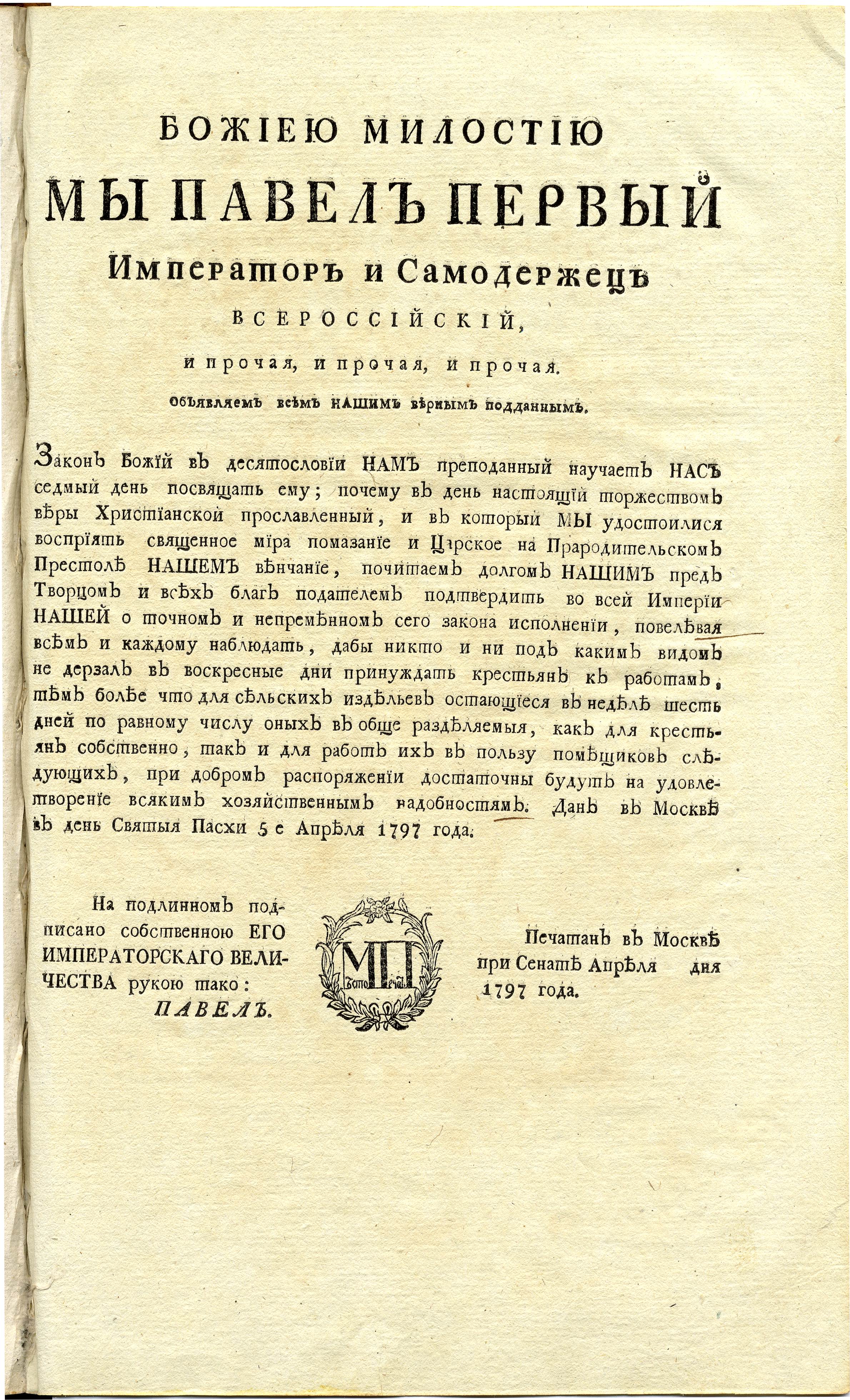
Certainly, Paul's reign was short compared with that of his mother, and he made many enemies among the nobility  as a result of his ambitious reforms.  Tsar Paul, far from being a bitter man obsessed with personal power, followed both his father and Frederick II of Prussia in improving the quality of life for ordinary people in his domain, at the expense of the nobility. Paul I, much like his father, discussed below, firmly believed in using enlightenment principles in order to improve the lives of Russian serfs. Paul I placed limits on the amount of labor landowners could extract from peasants: preventing them from working Sunday, and allowing peasants to work for three days of the week for their own interests/profit.[11] Russian serfs now had Sunday's as a day of religious observance, and could pursued their own labor for an equal amount of time as they work for landlords.  Furthermore, he modified the laws concerning the sale of serfs, mandating that serfs could only be sold with their land. This step ensured that families of serfs in Ukraine could no longer be separated when they were sold by their landowners.[12]  However, for all his enlightenment principles, Paul could not bring himself to liberate the serfs, as he was afraid of the consequences to his power.

In the course of his military reforms, Paul made enemies, and on three occasions, he got into a dispute with army officers heated enough that he beat them with a cane. Christopher Duffy notes that Paul eventually apologized on each occasion, and further states that, "there is much evidence to show that Paul was a man of idealism, honesty, and (we  have to say) sweetness and courtesy."[13] Paul's military reforms likewise showed a humane streak, and wrote in his Tactical Rules of 1797, "The soldier must always be regarded as a human being, for almost anything can be obtained through friendly dealings. Soldiers will do more for an officer who treats them well, and receives their trust, than for one whom they merely fear."[14]

The final note in the HBO series deals with the end of Paul's reign, claiming that he was murdered on the orders of his son, Alexander. It does this to make Tsar Alexander appear as Catherine the Great's avenger. In reality, Alexander was unconnected to the coup which murdered his father. Paul I had alienated large portions of the Russian nobility by means of his liberal reforms, and a group of these noblemen burst into his bedroom March 23rd, 1801. They first attempted to force his abdication, and then brutally murdered him when he resisted. Count Christoph Lieven described the seen in the aftermath of the murder. The former Tsar's younger son, Grand Prince Constantine was, "bathed in tears", while the noblemen around him rejoiced, while the new Tsar, asked for Lieven, and "fell on his shoulder, and sobbed, "My father, my poor father."[15]

Paul I's murder at the hands of drunken noblemen was not a triumph for Catherine the Great, it simply continued a generational story of murder in the Russian Court, and the pain of loss that young Tsars felt at the murder of their fathers.

If you enjoyed this post, or any of our other posts, please consider liking us on facebook, or following us on twitter. Finally, we are dedicated to keeping Kabinettskriege ad-free. In order to assist with this, please consider supporting us via the donate button in the upper right-hand corner of the page. As always: 


Thanks for Reading,


Alex Burns


-------------------------------------------------------------------------------------------------------
[1] Simon Dixon, Catherine the Great, 218.
[2] Sbornik Imperatorskago Russkago Istoricheskago Obshchestava, Vol 13, 265-6. (Translation is Simon Dixon's.)
[3] Dixon, Catherine the Great, 219.
[4] Sbornik Imperatorskago Russkago Istoricheskago Obshchestava, Vol 23, 621.
[5] Sebag Montefoire, Prince of Princes, 240-241.
[6] Politische Correspondenz Friedrich's des Großen, Vol 35, pg. 122
[7] Ibid, 123.
[8] Ibid, Vol. 38, 138.
[9] Christopher Duffy, Russia's Military Way to the West 1700-1800, 200.
[10] Dixon, Catherine the Great, 315.
[11] This manifesto was widely printed, the text can be read here.
[12] See Paul's Decree of October 16th [27th], 1798.
[13] Duffy, Russia's Military Way, 207.
[14] Quoted in Duffy, Ibid
[15] Quoted in Duffy, Ibid, 232. 

Wednesday, November 13, 2019

HBO's "Catherine the Great": The Role of Peter III


Tsar Paul with the remains of Peter III
Dear Readers,

It should come as no surprise that I've been watching HBO's new drama regarding the reign of eighteenth-century Russia's enlightened monarch: Catherine the Great. Catherine was an exceptional woman who led Russia successfully for over thirty years. The length of her reign was nothing short of astounding for eighteenth-century Russia, over 4 times the average length of a Tsar(ina)'s rule after Peter the Great.  This alone is an incredible accomplishment, one which vaulted her rule into the (now defunct) category of "enlightened absolutist" monarchs in the eighteenth century. Though English language historians have often focused on her various sexual affairs and "favorites", Catherine deserves to be recognized as a powerful monarch for her achievements, not her scandals.

After seizing the throne, Catherine waged a number of successful campaigns against the Ottoman Empire, reformed the education system of the Russian Empire, making education to a greater (though still small) number of her subjects. Furthermore, as the HBO briefly mentions, her development of the Smolny Institute allowed select women to receive higher education for the first time in Russian history. She was a patron of the arts, and like Frederick II of Prussia a generation before, had graduated to the position of senior stateswoman of Europe by the time of her death in 1796.

Image result for HBO Catherine the Great
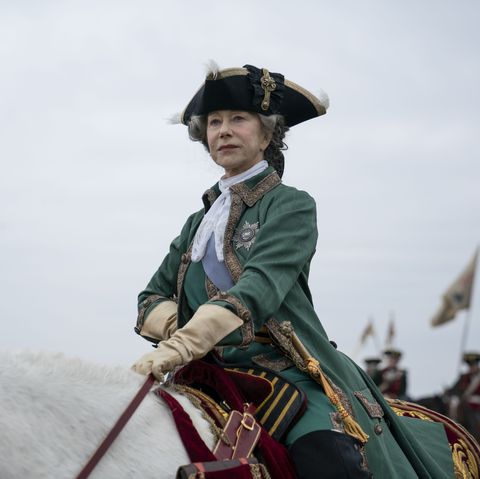
Helen Mirren in her portrayal of Catherine II

The point of this post is not to review the HBO miniseries, but to delve into a specific aspect of it. For all its successes, the HBO miniseries falls dangerously short of the mark when portraying both Peter III of Russia (Catherine's husband) and Paul I of Russia (Catherine's son). Despite portraying Catherine as a complex and challenging historical figure, the miniseries leaves Peter and Paul to fulfill the role of fairly one-dimensional villains. Peter III ruled Russia for barely six months in 1762, before the coup which took him from the throne and his death a week later. Paul I ruled for a bit longer, four and a half years between November of 1796 and March of 1801. Like his father, he was deposed by army officers in favor of another ruler.

Both of these men, but particularly Peter III, have had few friends, both historiographically, and during their lifetimes. Largely, this is a result of their decision to rule as distinctly Germanic enlightenment-era monarchs in Russia. The Napoleonic era, and, of course, the experience of the twentieth century convinced Soviet historians that Peter and Paul were Germanic traitors, besotted with Prussia, who essentially got what they deserved. This language is repeated, largely verbatim, in the HBO miniseries. Catherine is portrayed as a woman who hates "Germany", Germans, and the German language.  This first post will discuss how the HBO series portray's Peter III, who is present in the series, in skeletal form. Grizzly. Subsequent posts will examine the life of Paul I, and other aspects of the show.


Emperor Peter III,, 1762, by Fyodor Rokotov

Over the last forty years, historians have significantly revised our understanding of both Peter III. An older generation of historiography, as well as Franz Szabo's recent English language survey of the Seven Years War, portrays Peter as a, "boorish, obnoxious, obstinate, and capricious young man of arrested development and limited intelligence."[1] These characterizations of  Peter III struggle to mesh with his policy record, which even Szabo notes involved the reduction of taxes, releasing the nobility from permanent military service, and forbidding the sale of serfs to large industries .[2] A further examination of Peter III's reign demonstrates that he was an advocate for religious toleration, allowing for the toleration of the Old Believers in Russia.[3] Peter III promoted educational institutions in Russia, and as noted above his wife would continue this policy during her reign.[4] As an enlightened monarch, Peter III decreed that it was a crime for landlords to kill their serfs, and those who did so would be exiled for life, (small steps, to be sure.)[5]

How can we account for this discrepancy between Peter III the mentally disabled (Szabo implies but fails to use this term) and Peter III the reformer?  

If Peter III was a reformer, and relatively effective ruler, why was he deposed? The answer to this riddle lies in his position as a monarch from German Central Europe who was also the ruler of a larger empire. Historian Peter Wilson has suggested that rather than focusing on Peter III's supposed obsession with Prussia, understanding his role as dual monarch who cared more about his position as Duke of Holstein-Gottorp than his position as Tsar of Russia. [6] Peter III of Russia, like George I of Britain, preferred the familiar politics of the small German state of his birth over the imperial politics of his inherited and adopted empire. George I disliked England, likewise, Peter III of Russia disliked Russia. As such, he ended a relatively successful war with Frederick of Prussia (the Seven Years War) in order to pursue aggressive foreign policy against Denmark. Again, his goals were that of a minor German prince, not the Tsar of Russia. In hindsight, this failure to embrace his role as the Tsar of Russia, rather than mental instability or "weakness" brought down his regime. Catherine II embraced her role as a Russian ruler to the exclusion of her former German identity, and as a result ruled a massive empire quite successfully for over thirty years. In order to achieve this, Catherine deposed and murdered in her husband, and her views on Peter III have dominated the historical memory of Peter's reign.

Both Peter III and his son Paul I allowed Prussian military thinking to dominate their regimes, both conducted drills of their own battalions of soldiers. In this way, they followed the example of Peter I "the Great" of Russia as well. Peter the Great had drilled a small, "toy" army of soldiers during the rule of his half-sister Sophia, and eventually used these soldiers to overthrow her. Like Peter III and Paul I, this earlier "toy army" was drilled by German-speaking instructors.[7] Both Peter III and Paul I were afflicted with a especially bad case of Prussomania, and for Peter, his decision to end the war with Prussia quite literally led to his downfall and death.

Another point of contention between historians: was Peter III murdered? Although there is a possibility that his death was natural, brought about by the stress of Catherine's coup d'état, it is much more likely that Peter III was murdered. At the end of the day, this issue is officially unresolvable, but it begs a question. Which seems more likely: that a 34 year-old man would die of complications from hemorrhoids (the official cause of death), or that a politically inconvenient former ruler would be murdered 8 days after his government was overthrown in a military coup?  In a conversation during the first episode in the HBO series, Paul I and Nikita Panin discuss the likehood of this event. As the HBO series clearly depicts Catherine II also ordered the murder of imprisoned former child-Tsar Ivan VI, when it appeared that he would be freed by disloyal army officers.

Peter's legacy remained contested even in his own time, with the appearance of perhaps as many as 40 "false" Peter III's.[8] Of these, the most famous was the Cossack leader Pugachev, but he was far from alone using Peter III's legacy with the common people of Russia.The greatest legacy of Peter III, however, is the way he was remembered by his son, the future Tsar Paul. Paul attempted to fulfill many of his father's ambitions, particularly in his reforms of serfdom, the nobility, and the military in Russia. Paul also receives much more attention in HBO's miniseries, and will be the subject of the next post on this miniseries.

If you enjoyed this post, or any of our other posts, please consider liking us on facebook, or following us on twitter. Finally, we are dedicated to keeping Kabinettskriege ad-free. In order to assist with this, please consider supporting us via the donate button in the upper right-hand corner of the page. As always: 


Thanks for Reading,


Alex Burns


------------------------------------------------------------------------------------------------------------------
[1] Franz Szabo, The Seven Years War in Europe, 381. 
[2] Ibid, 382. 
[3]Carol S. Leonard, Reform and Regicide, 20. 
[4]Ibid, 21.
[5]Aleksandr Sergeevich Myl'nikov, "Peter III" in The Emperors and Empresses of Russia: Reconsidering the Romanovs, 121-122.  
[6] Peter H. Wilson, German Armies: War and German Politics, 279.
[7]Duffy, Russia's Military Way13-14, 200-201.
[8]нтонова И.В., Ярыкина И.Г. Интегрированный урок по курсу истории России и литературы в 8-м классе "Емельян Пугачёв: кровавый убийца или народный герой" (Chapter 6)


Wednesday, May 9, 2018

Military Buckshot in the Mid-Eighteenth Century

Reenactors portray Maryland troops

Dear Reader,


Today, we are going to examine a particular type of ammunition used by eighteenth-century soldiers: buckshot. For those unfamiliar with the term, buckshot consists of smaller projectiles, which spread out after leaving the barrel of the weapon. It is often used in a shotgun today. In the eighteenth-century, German language speakers called this specialty ammunition Cartatschen-Patronen, which gives us the modern German term, Kartätschen-Patronen, a catch-all term for submunitions including grape-shot (Traubhagel).

It appears that while this type of ammunition was common amongst American, British, and French irregular forces, and it was utilized by American, Austrian, British, French and Russian regular troops as well. In the eighteenth-century, buckshot was used to help compensate for the smoothbore weapons in common use at the time. By firing more projectiles at the target, troops generated a larger wall of lead with which to damage enemy forces. Far from being an exclusively American innovation, this weapon was employed by multiple European regular armies. This post will examine the use of buckshot in the mid-eighteenth century. I want to thank Dr. Grzegorz  Podruczny for his advice and help with source material.


Most troops discussed in this post were not firing only buckshot, but rather a combination of both buckshot and musket ball ammunition. In English, this is called "buck and ball", (sometimes, "buck 'n' ball") ammunition.[1] Usually, this consisted of a regular cartridge with 2-3 buckshot attached to it. This would provide the best of both worlds: the larger ball could be effective at long ranges, while at 100 yards or less, the buckshot would begin to wound and mangle enemy soldiers. If you are wondering what one of these cartridges might look like, check out the artistic reconstruction below. With the round itself examined, let us look first at the use of buckshot in the Seven Years' War, and then during the American War of Independence.

A Provincial in Winter

This type of specialist round was employed by both sides in the French and Indian War. British officers believed that their French and Native Americans enemies exclusively used this type of ammunition. In October of 1757, a British officer recalled, "The enemy never fire a single ball, for they always load with six or seven smaller ones (which are called buck-shot) besides their usual musket-ball."[2] The same officer referred to being under buckshot fire as, "a dreadful shower."[3] By 1760, both the British and their provincial allies had followed suit. Describing a small engagement in Canada, John Knox reported that New England provincials, "advanced, very spiritedly, to the enemy, who were endeavoring to steal upon them; gave them a regular discharge of a brace of balls, besides buckshot from each piece, and sent them flying."[4] By the end of the war, it seems that both the British and Americans had begun to employ buckshot with increasing regularity. 

Austrian Reenactors 

At the start of the Seven Years' War Austrian infantrymen carried a total of 48 rounds of ammunition. Of those, twelve were buckshot rounds. It is unclear if these twelve rounds were buck and ball rounds (as pictured above) or specialized buckshot rounds designed to be loaded in addition to the regular round, as in the Russian practice (described below). Regardless, the Austrian army formalized ideas on use buckshot in their 1759 field manual. The Militär Feld-Regulament of 1759 indicated when facing enemy infantry, Austrian troops should use their buckshot rounds beginning at 100 yards, should definitely use them if enemy infantry attempted a bayonet attack. When facing enemy cavalry, the manual instructs the soldiers to reserve their buckshot fire until the charging horsemen have closed to 10 yards.[5]

Russian Infantrymen/Artillerymen of the Seven Years' War

In his 2008 book, Kiril Tatarnikov shows the Russian military issued buckshot cartridges to soldiers as standard relatively early. In 1715, Russian troops were issued 50 cartridges total, 30 will ball ammunition, and 20 with buckshot ammunition. [6] The Russian army of the Seven Years' War used buckshot to terrible effect at battles such as Zorndorf, Paltzig, and Kunersdorf. Indeed, the use of buckshot may help explain the incredible high casualties at battles like Zorndorf.  A Prussian recalled the battle of Zorndorf:
On our side, therefore, there were relatively little dead, but a great number of wounded. However, most of the wounded were able to convalesce with their regiments...every Russian infantryman loads a musket ball and an equal pack of buckshot. There are between 7-9 of these in a linen packet in the form of grapeshot. As a result of this, the Russians load quite slowly, as a Jäger loads his rifle. In the time it takes the Russians to load their weapons, the Prussians have fired three times. I address this only in passing. We have found signs of this buckshot in many of the wounded, because they bled freely, almost to death. I cannot say whether their balls are poisoned, but you have observed that the Russians even use heated shot to harm their enemies.[7]
Buckshot from archeology on the Kunersdorf battlefield. (Many thanks to Dr.
Grzegorz Podruczny for the image!)

Clearly, then, the Russians used a different sort of buck and ball ammunition, one where two distinct cartridges were loaded into the weapon. It is interesting that the Prussian soldier compares the additional time loading this ammunition to that of a Jägers' rifled weapon. After the Seven Years' War, Russian army would continue to use buckshot ammunition until the end of the Napoleonic Wars.[8] The British and fledgling American army would use this type of ammunition in the American War of Independence.

Reenactors portray American soldiers in the War of Independence
This ammunition was widely used by militiamen in the American War of Independence. When not using rifled weapons, militia troops increased their firepower and effectiveness through buck and ball ammunition.[9] Both Continental and militia troops used buck and ball ammunition at the Battle of Camden.[10] George Washington, possibly as a result of his experience in the French and Indian War, was a proponent of buck and ball ammunition. On October 6th, 1777, Washington circulated general orders that mandated, "Buckshot are to be put into all the cartridges that shall hereafter be made."[11] This decision came directly after the Battle of Germantown. Archaeology and documentary sources indicate that this order was indeed followed. The American predilection for buckshot continued into the War of 1812 era.

Soldier's Musket recovered from British shipwreck in St. Augustine, FL. 

The British, too, used buck and ball cartridges during the American War of Independence.[12] The musket above was photographed in a shipwreck near St. Augustine, Florida. Multiple American sources report suffering buckshot wounds when engaged with British regulars, particularly in the Southern Campaign of 1781. At the Battle of Guilford Courthouse, it is possible that both the Brigade of Guards and the 33rd Regiment were using this type of ammunition.[13] Although the British army never employed buck and ball as the standard ammunition, it appears that by the late war its use was quite common.

Thus, it would seem that buckshot was commonly used on many of the battlefields of the mid-eighteenth century. Rather than being a distinct practice unique to American backwoodsmen, the ammunition was used French troops in colonial Canada, and Austrian and Russians troops in Europe during the Seven Years' War. The American contribution to the use of buckshot ammunition was mandating its use, something that the British failed to do. It is an interesting coincidence that the two superpowers of the twentieth century, Russia and America, heavily employed buckshot during the eighteenth and early nineteenth-centuries. 

If you enjoyed this post, or any of our other posts, please consider liking us on facebook,  or following us on twitter. Finally, we are dedicated to keeping Kabinettskriege ad-free. In order to assist with this, please consider supporting us via the donate button in the upper right-hand corner of the page. As always:

Thanks for Reading,


Alex Burns


---------------------------------------------------------------------------------------------------------------------

[1] Babits, Brenckle, and Howard, "Rifle Shot and Buck'n'Ball in the 1781 Southern Campaign," Paper presented to the 2005 Nathanial Greene Symposium.
[2] Knox, An Historical Journal, Vol 1, 54.
[3] Ibid, 91.
[4] Ibid, Vol 2, 280.
[5]Anon, Militär Feld-Regulament, articles 15, 18, and 19. (Manuscript is unpaginated).
[6] Kiril Tatarnikov, Русская полевая армия 1700-1730, (Moscow, 2008), 58. 
[7]Anon, Besondere Merkwürdigkeiten und Anekdoten aus Neudam in der Neumark, 29.
[8] Leo Bockeria, et al, "Russian war surgery in 1812," International Journal of Surgery, Vol 10, Issue, 10, 2012.
[9] Lawrence Babits, Devil of a Whipping, 13.
[10] Legg, et al, "Understanding Camden: The Revolutionary War Battle of Camden As Revealed Through Historical, Archaeological, and Private Collections Analysis," University of South Carolina Scholarly Commons, 2005.
[11] John Fitzpatrick (Eds), The Writings of George Washington, Vol 9, 313.
[12] Lawrence Babits, Devil of Whipping, 165n8.
[13] Lawrence Babits, Long, Obstinate, and Bloody, 166.


Wednesday, March 19, 2014

Russian Expansion in the Kabinettskriege Era

Putin as Peter the Great

Russia has a long and complicated history with her eastern European neighbors. At the beginning of the Kabinettskriege era, in 1648, there was no reason to suspect that Russia would rise to the status of a European power. Indeed, in those days, there was no Russia, only the small state of Muscovy. All eyes were on Sweden. Her powerful army, and exceptional leadership, gave the Swedes control and domination of much of eastern Europe, particularly in the Baltic region. By the end of the Kabinettskriege era, Russia had displaced Sweden as the dominant power in eastern Europe, and was able to do this through a complex mix of factors.


Eastern Europe in the late 17th Century

Situation in 1648

Russia (Teal/Green) had a impressive territorial empire, but lacked strategic positions and resources. Russia also had a number of powerful enemies. The greatest of these, until 1721, was the Baltic empire of Sweden (pink). Another power opponent of Russian interests was the Ottoman empire (brown), and the Ottoman empire's client state, the Crimean Khanate (bright green). Directly to Muscovy's west, the Poland-Lithuanian commonwealth possessed much territory, but was showing signs of decline.

Muscovy itself had a number of problems. Muscovy had recent emerged from the time of troubles, a disastrous  period in Russian history, which saw much instability. The Russians had also managed to survive a series of long wars against the Mongols, but the army which defeated the Mongols was now outdated. In order make Russia into a great power state, the Russians needed: 1). A stronger army 2). powerful, skillful leadership, 3) and divided and weakened states in the rest of eastern Europe. By 1789, the end of the Kabinettskriege period, Russia would achieve all of these goals, and join the ranks of the European great powers.

Figurines of 17th Century Russian Streltsy

1). Reforming the Military
Until the turn of the eighteenth century, Russian military life was dominated by the type of soldier you see above, Streltsy. These soldiers were state of the art in 1550s, but by the 1650s, had begun to show their age. In order to join the ranks of European great powers, the Russians needed to reform their military along European lines.

They adopted the flintlock musket, as opposed to the primitive matchlock used by the Streltsy, and began to dress in French and German military fashion. For most of the Kabienttskriege era, the Russian military was one of the best in the world. By 1709, the time of the cataclysmic Battle of Poltava, the Russian army began to look a bit more like this:

Early 18th Century Russian Soldiers


Peter I of Russia, "the Great"
 2). Effective Leadership

The Russian army was modernized by a man who was not a masterful tactician, but a great leader: Peter I of Russia. He lost battles in the Great Northern War, but kept Russia in the fight when his allies deserted him. He was often a brutal leader, but his methods produced results. It was his influence, more than any other factor, which led Russia to embrace a distinctly European way of life and thinking.

He had other, very effective rulers follow him as well. Both Elizabeth Petranova, his daughter, and Katherine the Great of Russia followed in his mold of making Russia a first rate European power. Under Elizabeth, the Russians defeated Frederick the Great's Prussia in the Seven Years' War, and Prussia only survived this disastrous war by tenaciously hanging in the fight until Elizabeth's death in 1762.


Katherine the Great in military dress

 3). Weakened Neighbors in Eastern Europe

The Russians were able to achieve spectacular success, because of their great army and leadership, but also because of their diplomatic choices and options. Throughout the eighteenth century, Russia was able to isolate specific enemies, and destroy them in detail. This began with the Great Northern War in 1700, and would continue throughout the eighteenth century. In the Great Northern War, Russia was able to isolate Sweden, and attack it, in an alliance with Denmark and Poland.  This war was successful and Sweden's empire was dismantled. However, this achieved a dual purpose. In the course of the war, Poland was also weakened, both economically and militarily. This would lead to the partitions of Poland, later in the eighteenth century, where Russia, Prussia, and Austria would claim large swaths of Polish territory.

Another example of this is the Russian conflict with the Ottoman empire. The Russians used their common Christianity with the Austrians to gain powerful allies, and force the Ottomans to fight a two-front war. Many of the smaller states in eastern Europe, such as Courland or the Crimean Khanate, were snapped up in times of crisis, when larger powers were too busy to intervene.

 Practical Application Today

At first glance, it might seem as though Putin is a "new" Peter the Great, as the picture at the top implies. However, there are a number of historical differences which actually work in favor of the EU and their allies. First- in the twenty-first century, it is much more noticeable when large countries annex smaller ones, thanks to instantaneous communications, social networks, etc.

Second, Putin may be a charismatic strongman, and a capable strategic leader. His diplomatic maneuvering shows some skill, and his handling of the 2008 South Ossestia war show that he has the potential to force opponents to make mistakes, and back down. With that being said, he is no Peter the Great. While he may be attempting to revitalize the Russian armed forces, those forces are still years away from matching and exceeding first world armies, such as the United States, or even France and Germany. The fact that the dispute is happening in Russia's back yard, Ukraine, indicates that despite the saber rattling, NATO and their allies have Moscow on the back foot.

Third,  the Russian army, unlike the Russian army of the eighteenth century, is badly in need of reform. However, the Ukrainian forces they would be fighting are not much better off. With that being said, Russia should worry about more than just Ukraine, should it choose to invade. While the United States might not intervene, other powers, such as Poland, Lithuania, and the Baltic States, will certainly not take Ukrainian annexation lying down.

This brings us to the fourth and final point: Europe is not divided. This is not 1914. This is not 1938. The entire continent of Europe condemns what Moscow is doing, and should Moscow attempt the total annexation of Ukraine, will act to protect European interests. The Poles, particularly, will fight to keep independence.


Thanks for Reading,


Alex Burns