Showing posts with label Frederick the Great. Show all posts

Thursday, August 12, 2021

Frederick the Great and Washington: Truths, Myths, and Propaganda


Dear Readers,


Yesterday, a popular facebook page which commemorates the Revolutionary War in the United States shared an anecdote regarding George Washington and Frederick the Great. Quoting Frank Moore's 1860 publication, Diary of the American Revolution from Newspapers, volume 2, the post related how Frederick II of Prussia presented George Washington with a picture of himself, inscribed, "From the oldest General in Europe, to the greatest general on earth."[1] The anecdote continues at some length, with another Prussian general questioning Frederick's assessment, and Frederick giving a full explanation of why Washington was the greatest general on earth. The source of this anecdote is the August 9th, 1780 issue of the New Jersey Journal.  

The trouble is, this anecdote is not true. It never occurred. There are variations of it, sometimes a sword is the present, sometimes it is a portrait.  And the worrying part is, historians have known it wasn't true for over one hundred and twenty years. Paul Leland Haworth, writing an article entitled Frederick the Great and the American Revolution in the American Historical Review in 1904, noted: 

At one time a story was widely current, and it is still believed by many, to the effect that he [Frederick] entertained a great admiration for Washington, and that he even went so far as to send him a sword[.] This is one of those historical myths that have been eagerly accepted by a willing and credulous public, and it has been completed exploded.[] 

Haworth cites the work of writer Moncure D. Conway, who, writing in 1891, examines the stories of the sword and/or portrait in detail. Conway corresponded with surviving relatives to see if the portrait survived, and notes that other monarchs did send portraiture to Washington, and the records of those transactions (and the portraits themselves) survive to the present day. Conway also describes the way in which Washington carefully gave the provenance of items in his will, and no gifts from Frederick the Great are described in his will.[3] Likewise, Conway notes that Washington's will carefully preserved a sword from Theophilus Alte of Solingen, and passed the sword onto Washington's nephew, George Steptoe Washington. 

Conway concludes: "We may feel tolerably certain that no gift was ever sent by Frederick the Great to Washington, and that he never recognized in any remark the greatness of Washington."[4] Now, Washington as a figure was certainly known to Frederick. Indeed, in Frederick memoirs, he notes, "General Washington, who was called at London the chief of the rebels, gained, at the commencement of hostilities, some advantages over the royalists who were assembled near Boston."[5] So, while clearly noting the progress of the American War of Independence, Frederick did not sent Washington fan mail. 

If historians have known that this anecdote is false for over one hundred years, why does it get shared 150 times on facebook in the course of a day? This is because like many eighteenth-century anecdotes, true or false, the story of Frederick's portrait/sword is designed to communicate truths to the reader. These truths, that Washington was a inspirational leader who fought from a disadvantageous position, and that he had, "surmounted untold difficulties," were as accurate in 1780 as they remain today.[6] This does not obscure the fact that this newspaper report was a sort of propaganda: in 1780, Frederick II of Prussia was recognized as an authority on warfare. Having him write respectful letters of admiration to Washington would have been an immense public relations victory. As a result, the New Jersey Journal, together with the Providence Gazette, told a story that communicated truths about Washington's skills as a general. 

The May 20th story referenced in the Providence Gazette is relatively brief:  it simply provides the inscription. The August 9th New Jersey Journal provides more embellishment, and begins to raise questions in the mind of the reader. How would the author have been privy to the conversation of the King of Prussia and one of his generals regarding Washington's military qualities? These doubts, together with the lack of physical evidence, point to the fact that these stories are myths designed to impart truths, rather than factual occurrences. As a result, they are often more compelling than factual history. Thus, over a hundred years after Frederick's factual statement regarding Washington was disproved, the legend of Frederick's admiration for Washington continues unabated.  

You can read three more articles on these myths over on the Boston 1775 blog by J.L. Bell. 

If you enjoyed this post, or any of our other posts, please consider liking us on facebook, or following us on twitterConsider checking out our exclusive content on Patreon. Finally, we are dedicated to keeping Kabinettskriege ad-free. In order to assist with this, please consider supporting us via the donate button in the upper right-hand corner of the page. As always:

Thanks for Reading, 


Alex Burns

--------------------------------------------------------------------------------------------------------------
[1] Frank Moore, Diary of the American Revolution: From Newspapers..., Volume 2, (1860), 309-310.
[2] Paul Leland Haworth, "Frederick the Great and the American Revolution", American Historical Review, (1904) Vol. 9 No. 3, 460-478. 
[3] Ibid.  
[4] Moncure D. Conway, The Century Illustrated Monthly Magazine, Volume 41 (1891) 945-948. 
[5] Ibid, 947.  
[6] Frederick, translated by Thomas Holcroft, Posthumous Works of Frederich II: King of Prussia, Volume 4 (1789), 175. 

Saturday, July 17, 2021

Statue Removal and Frederick the Great: A Story of Three Statues


The Unter den Linden statue being replaced, 1980
Bundesarchiv, Bild 183-W1127-030

The post looks at statue/commemoration removal, an idea that dates back to at least the Eighteenth Dynasty of ancient Egypt, and likely before. Over the past few years, citizens of the United States have confronted the issue of the removal of statues of historic figures from prominent places in public life. In the United States today, opinions towards statue removal are often split along party lines, exacerbating the tension of an already charged issue. I will attempt to tread carefully, and my point is certainly not to advocate for the removal or maintenance of statues.  Rather, I hope to provide some comparisons that will allow for reflection regarding statue removal debates as a whole. King Frederick II of Prussia, a figure that few Americans could pick out of a lineup, also has a contentious legacy of statue removal, destruction, and replacement. 

Without becoming enmeshed in the politics of the debate in the United States, I seek to examine the story of three statues of Frederick, their removal, and fate (to the present). In doing so, I hope to demonstrate a few things: First, statue removal and replacement is a struggle that is located in specific, often politically charged, moments in time. Second, when statues are removed, destroyed, or replaced, the decision is not always final. Debates over historical commemoration of specific individuals will continue, regardless of statuary. Finally, knowledge of historical figures, and even debates over their merits, are rarely impacted in the long-term by the removal and destruction of statues. I've been to see all of these statues in person, and that is part of how I know their stories. Two of them are in Germany, one is in the United States. All have been removed, one was destroyed, and two have been replaced. 


The Kloster Zinna Frederick

The drive between Dresden and Berlin can take many different routes, such as Autobahn 13, part of Germany’s famous interstate highway system. If you stick to the path less traveled, however, you might find yourself driving down small rural route 101, a two-lane highway broken up by turns and stoplights. On this scenic drive, which could easily be mistaken by Americans for the rural Midwest, you will pass by small industrial city of Jüteborg, a “city of the reformation,” as the town slogans remind you. Just north of Jüteborg, an hour away from Berlin Mitte, sits the small village of Kloster Zinna. Originally an abbey in the medieval era, the Prussian King Frederick II founded a small community of weavers on this site in the year 1764. The memory of Frederick, the father of the city, is all over Kloster Zinna. Walking through the central square and park, you see the local eatery, “Curry-Fritz,” an amalgamation of the King’s nickname “Alte Fritz” and the popular twenty-first century dish “Currywurst”: a spicy sausage plate. The centerpiece of Frederick’s historical memory in Kloster Zinna, however, is the Denkmal, or commemorative statute, which stands proudly next to rural route 101, reminding all the visitors to Kloster Zinna that this was a city founded by Frederick the Great.

I have had the great good fortune to stop by Kloster Zinna twice in the course of my dissertation research. During my first visit, in 2018, I had never heard of the place before, and it was only the statute of Frederick which caused me to pull my micro-sized rental car to the side of the road for a closer look. The second time in the summer of 2019, I returned with a bit more reverence, and snapped a selfie with the Kloster Zinna Denkmal. Secondary research and discussions with the gruff but friendly townspeople of Kloster Zinna revealed that much like the memory of Frederick across all of Germany, the Kloster Zinna Denkmal, too, had a turbulent and contested meaning. Like so many monuments, the statute of Frederick was built on an anniversary, in 1864 during the centennial of the founding of the city. The Denkmal became a site of congregation for local school events. During the twentieth century, with the image of Fritz used so widely in the National Socialist era, the Denkmal became a symbol of the Nazi legacy in Germany. With the fall of the Nazi Regime in 1945, the legacy and memory of Frederick the Great took a radically different turn. As denazification proceeded in both East and West Germany, the memory of Frederick was tarnished by its association with the Nazi Regime. The former eastern lands of the German state (East Prussia, Pomerania, and Silesia) were given over to new Polish and Soviet leaders. On February 25, 1947, Prussia which had existed as a state in the German federal system, was now replaced with Brandenburg and the very name of Prussia was erased from the maps of Europe. After the Second World War, a communist youth organization was set up nearby, and during a village outing which took most people out of Kloster Zinna, a group of communist party youth destroyed the statute with sledgehammers. 

The blindfolded statue in 2016. 

The memory of Frederick, however, endured. On the 8th of April, 1994, a group of citizens who had collected the pieces of the old, smashed Denkmal, fused them into a new monument, with an inscription proudly stating: “Frederick the Great: Founder of the City in the year 1764. This thanksgiving monument erected in 1864.” A plaque on the reverse side of the monument reads: “This monument was destroyed in 1949. It was renewed on April 8th 1994 thanks to the funds from the citizens and friends of the city.” The contested nature of the statue has continued since that time: when I visited in 2019, there was graffiti, and in 2016, the stature, and many other statues across Germany, were blindfolded in order to demonstrate their historical figure's blindness to the problems of hostility to Jewish communities. The Kloster Zinna monument, a local story, demonstrates the ways that Germans have engaged with and contested the memory of Frederick the Great.

The Washington D.C. statue in its original location

The Washington D.C./Carlisle Frederick   

In 1904, Kaiser Wilhelm II of Germany presented a statue of Frederick II to the United States as a symbol of goodwill. That stature was originally placed on a military base in southern Washington D.C., Fort McNair. It remained in that location between 1904 and 1918. Almost immediately, there was trouble. In January of 1905, Gessler Rousseau, attempted to destroy the statue with an "infernal machine" (bomb). The Saint Louis Republic reported on January 16th that Rousseau was a "patriotic fanatic" with a history of bombing attempts. 

During a surge in anti-German hostility during the First World War, there were calls to remove and destroy the statue. Ralph Block, for the New York Tribune, reported on February 9th, 1918: 

The deadly statue of Frederick the Great, the statue of the man who was termed by Dr. R. M. McElroy of Princeton university, "the head devil of the whole Prussian philosophy," still lurks in front of the War college. Doctor McElroy announced at a luncheon in New York he was gong to start of movement to tear down Frederick and turn him into bullets. But Washington so far has manifested an alarming apathy to the patriotic project.

On August 25th of the same year, the Richmond Times-Dispatch reported that statue had been melted down, but this was premature. Many newspapers, including the The Herald, out of New Orleans, ran this cartoon accompanying the story. 

The statue was removed to a cellar after popular demand grew for removal. In 1927, Dwight F. Davis, the secretary of war, returned the statue to its original location, asserting, "Frederick lived many years before the World War and was not identified in any way with that conflict."[1] Concerns about the statue returned again during the Second World War, and it was removed again. 

The Carlisle Frederick in 2018


With the end of the war, desiring to move Frederick to a "relatively inconspicuous site," he was moved from Washington to Army War College at Carlisle, Pennsylvania.[2] The statue remains at Carlisle to the present day, and civilians can indeed gain entrance to the base in order to visit the statue (as of 2018). 


Unter den Linden  Frederick, 2018

The Unter den Linden Frederick

In 1851, perhaps the most famous statue of Frederick, sculpted by Christian Daniel Rauch, was unveiled and displayed on the Berlin boulevard Unter den Linden. It remained their in relatively the same way until the Second World War, when it was encased in cement for preservation from allied bombing. 

Frederick being removed from carbonite, 1950

As we have already seen above at Kloster Zinna, statues of Frederick were torn down and demolished in Soviet-controlled East Germany. The Unter den Linden statue was removed by the East German government, and nearly melted down. Prussia, and by extension, Frederick, were blamed for the disaster at the end of the war, or leading to militarism and the rise of National Socialism, and a host of other problems. 

The statue being moved in the 1980s, from Christopher 
Clark's Frederick the Great and the Enigma of Prussia


After being nearly melted, and saved by chance, the statue was sent to the Charlottenhof palace in Potsdam for twenty years. By the 1980s, however, the East German government had officially softened its position on Frederick, and Erich Honecker, the East German head of state, personally ordered the restoration of the Rauch’s equestrian statue of Frederick the Great on Unter den Linden. In the later stages of the Cold War, Frederick was remembered in East Germany for his progressive social and legal policies. By emphasizing Frederick’s progressivism, rather than his military feats, the East German government found a way to rehabilitate his historical memory. The equestrian statue remained in place after the reunification of Germany, and it continues to inspire visitors to the Berlin State Library.[3]


Final Thoughts 
What do the stories of these statues tell us? Very little about Frederick himself. Instead, they tell us about the changing nature of historical commemoration across time, regimes, and national boundaries. 
These three statues display the variety of experience in contested historical commemoration. The story of historical commemoration is not a tale of permanence. Statues are built, they are celebrated, they become controversial, they are protested, they are removed, they are destroyed, they live in obscurity, they are rebuilt. Every generation must decide how to commemorate its own past. What is certain, however, is that future generations will continue to contest this legacy: changing, revising, and rediscovering how the past is remembered. What we believe about historical figures and their commemoration is important to us today. It is almost guaranteed that the next generation will remember the same set of historical figures with a different lens of significance. 

If you enjoyed this post, or any of our other posts, please consider liking us on facebook, or following us on twitterConsider checking out our exclusive content on Patreon. Finally, we are dedicated to keeping Kabinettskriege ad-free. In order to assist with this, please consider supporting us via the donate button in the upper right-hand corner of the page. As always:

Thanks for Reading, 


Alex Burns

----------------------------------------------------------------------------------------
[1]Evening star. [volume] (Washington, D.C.), 08 Nov. 1927. Chronicling America: Historic American Newspapers. Library of Congress. <https://chroniclingamerica.loc.gov/lccn/sn83045462/1927-11-08/ed-1/seq-15/>
[2] Historical Marker with the assistance of the U.S. Army Heritage and Education Center, Carlisle. 
[3] Helmut Engel and Wolfgang Ribbe, Via triumphais: Geschichtslandschaft, “Unter den Linden” zwischen Friedrich-Denkmal und Schlossbrücke, (Berlin: Akadmie Verlag, 1997), 52.

Friday, April 10, 2020

Jung Fritz vs. Alte Fritz: Change over Time in Frederick the Great's Style

Frederick the Great, painted during the Seven Years War


Dear Reader,

Today, the image of Frederick the Great of Prussia has been indelibly burned into our collective consciousness as "Old Fritz", a wizened skinny old man on a small horse, directing the troops with flourishes of his cane. This image of Frederick stays with us for a number of reasons: it is the last one present in living memory, it is the image of Frederick immortalized in the Nazi-era films starring actor Otto Gebuhr, and it is the face of Frederick we see in his death mask. This view of Frederick has even led to fame for prominent reenactors who capture this version of the King. Importantly, this is not the only version of Frederick the Great, nor the style that the King seems to have been wearing during the Seven Years War. Before 1763, Frederick II was almost always painted in his dress uniform for the 1st Battalion of Guards. After 1763, Frederick seems to have preferred his undress uniform, and this is the image of Frederick that has come down to us. 

This post will examine the preferred clothing of Frederick the Great throughout this life: first examining the surviving uniforms of Frederick II, and then examining period artwork from two phases in Frederick's life. Obviously, for researching the martial material culture of this period, there is no substitute for the two volume study of Daniel Hohrath, and the many volume studies of Hans Bleckwenn. For this project, though, I was inspired my the recent dissertation of Adam Storring, and his suggestion that especially early in his life, Frederick was fond of flashy uniforms and baroque finery.

What Remains: Surviving Uniforms of Frederick II

There are a number of surviving uniforms worn by Frederick II. The Deutsches Historisches Museum in Berlin contains both the dress and undress uniforms of Frederick the Great. The undress uniform dates from 1786, the dress uniform is undated. Burg Hohenzollern in Baden-Württemberg likewise contains an undress uniform dating from the later portion of the reign.  Below, I have included three images of coats attributed to Frederick the Great, and one which is not attributed to him, for comparison.

(Undress) Uniform of Frederick the Great (DHM) 

(Undress) Uniform of Frederick II of Prussia (Burg Hohenzollern)
Velvet dress uniform of Frederick II (faded, no date)
1st Battalion of Guards Officer's dress coat, unfaded (1786, not attributed
to Frederick)

The Devil We Know: Old Fritz
Old Fritz. This is the image of Frederick that we are most comfortable with. This version of Frederick spawned innumerable paintings in the nineteenth century, where a thin, hook-nosed Frederick stares at us with a wizened and wrinkled face. This image of Frederick the Great was immortalized in the paintings of Daniel Chodowiecki, who drew the king in the 1780s, at the end of his life.

A painting after Chodowiecki's famous woodcut
 This image of Frederick is a useful one, and the iconic one: the plain, buttoned over coat, the simple ornamentation of his order of the Black Eagle, the cane and unlaced cocked hat. This is also the Frederick we see in the portraits of J.H.C. Franke, who was certainly working after the Seven Years War, possibly as early as 1763.

Franke's portrait.
Young Fritz: The Frederick the Seven Years War and earlier
This older, wizened, plain Frederick is not the Frederick who fought in the War of Austrian Succession, or the Seven Years War. For that Frederick, we must turn to an earlier series of paintings. This Frederick is younger, his uniform is more ostentatious, he wears the orange sash of the Order of the Black Eagle, in addition to the star of that order. The orange color symbolizes the familial connection between Frederick's grandfather (King Frederick I of Prussia) and the leader of Protestant Europe: William of Orange. Frederick's hat in these images is not unlaced, it is decked with fine silvered lace which complements the white hat feathers that continue into his later reign.

Antoine Pense, (pre-1740) The Royal Brood: Frederick the Great and his brothers

Antoine Pense, Frederick the Great as King (1740-1745)
Antoine Pense, Frederick the Great as Commanding General, (1745)


Antoine Pense, Painting of Frederick II, Neues Palais 


Antione Pense, Frederick about 1750 

Fischer, portrait of Frederick the Great drawn during the Seven Years War (1758)
Frederick II of Prussia, by David Morier circa 1763

Somewhat frustratingly for wargamers, this Frederick, the orange sashed, hat laced, silver brandenbourged, Frederick, is the man who entered the Seven Years War. We can discern this from the fact that 1) all of the portraits from the early portion of Frederick's reign display him like this, and 2) that the only portrait of Frederick which comes specifically from the years of the Seven Years War (the second to last image above), shows Frederick in this uniform.

What does this mean for Wargamers and Reenactors? 

As you set out to portray Frederick in the setting of living history or wargaming , and you wish your portrayal to be accurate, it is vital to tailor your depiction of the king to the year/era you seek to portray. If you wish to portray Frederick in the later portions of his reign, many wargaming figures will work, as most manufacturers portray Frederick in this portion of his reign in undress uniform, no sash, and with an unlaced hat. This is perfect for Frederick during the 1770s and 1780s maneuvers, the War of Bavarian Succession, and perhaps even the last year of the Seven Years War.


"Old Fritz" in 15mm from Old Glory 15s


If you wish you portray Frederick during most of the Seven Years War, as well as the War of Austrian Succession, painting the King in a dress uniform, with the sash of the order of the Black Eagle, and silvered lace on his cocked hat is perhaps more appropriate for this period.

A 15mm Prussian officer miniature from Essex, promoted to Young Frederick


Reenactors who portray such as the excellent Rolf Zahren, seem to focus on the last years of his reign. Zahren perfectly captured the essence of "Old Frederick" and he will be missed.

Rolf Zahren, dearly departed reenactor

Likewise, the Berlin tour guide Dr. Olaf Kappelt, who I had the great good fortune to meet by chance in 2004, portrays an older Frederick: perhaps from the late 1760s or 1770s. When a fourteen-year-old me addressed Dr. Kappelt as "Great Frederick", he gently reminded me, "Berliners say Old Frederick." For good or ill, the image of "der Alte Fritz" has triumphed in historical imagery and memory.


Dr. Olaf Kappelt as Frederick
I am unaware of anyone who has an impression of younger Frederick from the War of Austrian Succession or the Seven Years War. Perhaps some of my dedicated readers can point one out?

If you enjoyed this post, or any of our other posts, please consider liking us on facebook, or following us on twitterConsider checking out our exclusive content on Patreon. Finally, we are dedicated to keeping Kabinettskriege ad-free. In order to assist with this, please consider supporting us via the donate button in the upper right-hand corner of the page. As always:

Thanks for Reading, 


Alex Burns

Friday, November 15, 2019

What HBO's "Catherine the Great" gets Wrong: Paul I

Joseph Quinn as Paul I of Russia, and Kevin McNally as Alexei Orlov

Dear Readers,

Today we are continuing the series of posts discussing "Catherine the Great": HBO's recent period drama on that most excellent of monarchs in eighteenth-century Russia. Our first post discussed the role of Peter III in Russian, history, describing some of the ways that he has been misunderstood by historians. This post discusses a main character in the series, and Catherine's son, Tsar Paul I of Russia.

In the closing scene of the HBO miniseries, Clive Russell, playing the court fool, sings a song which opens: "...History is written by crooks and fools...". The implication is that Paul I controlled the narrative of Catherine's reign, preventing the nature of her love with Prince Potemkin from being common knowledge. This belief both crooked and foolish, as in Russian history, Catherine and Prince Potemkin have always been more beloved than Paul I and his father, Peter III, who are viewed as being traitors to the "Russian soul." In claiming to have unearthed a secret narrative of Catherine's life, the HBO miniseries is really just championing the same nationalist view of the Russian past which was common in 19th and 20th centuries. How then, does the series treat Tsar Paul?

Joseph Quinn's Paul I is a fairly-stock villain for Catherine to square off against. When the series begins, most elements suggest that it is pre-1768 (the Russo-Turkish War has yet to break out, Potemkin is referred to as "Lt. Potemkin", Grigory Orlov is responsible for artillery), but Paul is not portrayed as a 8-12 year-old boy he would have at that point. Rather, he is turning age 19, and obsessed with challenging his mother's power. In the first scene where he has major lines, his attitude towards his mother is encapsulated in the line: "my God, how I hate her." Catherine, on the other hand, develops the antagonism between them through well-crafted lines such as: "Why is my son so unattractive?"

Paul I was eight years old in 1762, when his father was died in suspicious circumstances after his mother's coup d'etat. As boy, Paul was in a difficult position, as an unwanted heir to the Russian throne, and a daily reminder for Catherine of Peter III's existence. During the first ten years of her reign (from 1762-1771) Catherine and Paul had a very difficult relationship, and foreign diplomats commented on the lack of affection the Tsarina seemed to have for her son.[1] Following a serious illness in 1771, Paul and his mother reconciled, to such an extent that Catherine complained regarding the amount of time he was in her presence: "my son no longer wants to be a step away from me and ... I have the honor of amusing so well that he sometimes changes his place at table in order to sit beside me."[2]  This aspect of Paul and Catherine's relationship is left relatively unexplored in the HBO miniseries, as it portray's Paul as scheming to replace his mother for most of the series.


Rory Kinnear's excellent minister Panin,
struggles through a difficult conversation regarding the succession

This reconciliation was cut short by Catherine II's resistance to having Paul II as a co-ruler, and the dismissal and exile of Paul's advocate at court, Caspar von Saldern.  Catherine II initially indicated a willingness to be co-ruler with Paul when he reached the age of 18. Maria Theresa and Joseph II of Austria reached a similar arrangement in 1765. In Paul's case, Catherine was unwilling to share power, and despite the efforts of Nikita Panin to shield Saldern, he was exiled when his support for the idea came to light.[3] The HBO miniseries portrays this rather accurately, although Panin, rather than Saldern, is the character who supports the young Tsar.

After Catherine's ascension to the throne, Paul possessed an unenviable position: his mother viewed him as a remainder of a her hated husband, Peter III. She referred to her son and his wife as, "that difficult baggage".[4] She insinuated that Paul was not Peter III's son in her memoirs, but the fact of the matter is that Sergei Saltykov, her lover in 1752-1754, was not present with her during the timeframe of Paul's conception. Likewise, Peter III wrote to foreign courts that he was pleased at the birth of his son, but acknowledged that Catherine's daughter, Anna, was an illegitimate child of another man.

Paul grew up in an environment where it was common knowledge that his parents hated one another, his mother overthrew and contributed to the death of his father, and then had a series of relationships with other men, who frequently disliked and sometimes humiliated Paul.  Prince Potemkin intercepted mail between two of Paul's supporters, Pavel Bubikov and Alexandr Kurakin, which insinuated that if Prince Potemkin were to be killed, Russia would be better off. Taking this note to Catherine, Potemkin moved against Paul, excluding him from influence at court for the rest of Catherine's reign.[5]

Joseph Quinn as Paul, with his 2nd wife, Sophea Dorothea of Württemberg,
played by Antonia Clarke
The figure of his father, as well as Frederick II of Prussia, remained a powerful force in Paul's life. He admired Frederick, and likely viewed him as a surrogate father figure. Frederick took up a correspondence with the young man, and even went as far as arranging his second marriage. In January of 1774, Paul wrote to Frederick:
"You have been so good to me on different occasions, you express your mark of friendship to me, and you have striven to make me happy by all you have written me and said to others. I unquestionably attribute to you a large part of what makes me happy in life... I could not learn without the greatest sensitivity what part you have taken, Sire, in what my mother-in-law has done to improve the union between my mother and me. Allow me to express my gratitude for this goodness, I will make myself worthy of it by the attachment I devote to you."[6] 
Frederick replied that he would be, "very happy if I contributed in any way to your contentment and satisfaction."[7] After the death of Paul's first wife, Wilhelmina Louisa of Hessen-Darmstadt, Frederick essentially matched Paul with Sophia Dorothea of Württemberg.  Writing to Paul after hearing of his first wife's death, and with the news that he would meet his second while in Berlin Frederick wrote Paul:
"My dear brother, be persuaded that I felt sincere grief at the loss you have suffered. It will be a great satisfaction to me if I can help to repair it. You may count on me to go with all with all zeal and activity. Among the feelings of pain that your situation brought me, I confess that I felt a very great delight in learning that I would have the opportunity of enjoying your presence here."[8]

Christopher Duffy writes this time in Berlin, meeting both his second wife and Frederick the Great, was the most formative experience in Paul's life.[9] Sophia and Paul had a happy marriage, at least in its early years, and had ten children together. The firstborn, Tsar Alexander, figures briefly in the HBO series, as Catherine attempts to separate Alexander from his parents, and turn him against his father by leaving the Russian throne directly to him. Catherine certainly had plans to place Paul's son, Alexander, on the Russian throne, but those plans were not fully realized by the time of her death. If she had lived another few months, Paul I likely would have been entirely excluded from the succession.  She viewed Alexander as her natural heir, and saw Paul as the heir of her hated husband, Peter III.

The HBO series portrays Catherine's death in a horrifying fashion, suffering a stroke, and Helen Mirren is literally left on the floor to die, moaning and attempting to speak, as Paul steps over her and destroys paperwork which would have placed his son, Alexander, on the throne. Largely, this scene is staged to show that the "German"-influenced Paul has no humanity, leading the view to root for his young son Alexander, who witnesses this horrifying spectacle.

In reality, Catherine suffered a massive stroke, on November 5th, 1796, and never regained consciousness. Her attendants moved her to her bedroom where she was ministered to by both doctors and priests. Paul I arrived at the Winter Palace on November 6th, was told that nothing could medically be done for his mother, and ordered her to be given the last rites. He then waited for her death, which came at 9:45pm on November 6th.[10]

Paul I as Emperor by Vladimir Borovikovsky

After his mother's death, Paul did indeed hold an embarrassing funeral procession, where Peter III's body was reburied next to Catherine II. As the last scene of the HBO series depicts, Paul ordered the final member of the cabal which killed his father, Alexei Orlov, to carry his father's crown in the procession. The HBO ends the miniseries on the note that Paul ruled Russia, "unsuccessfully." How true is that claim?

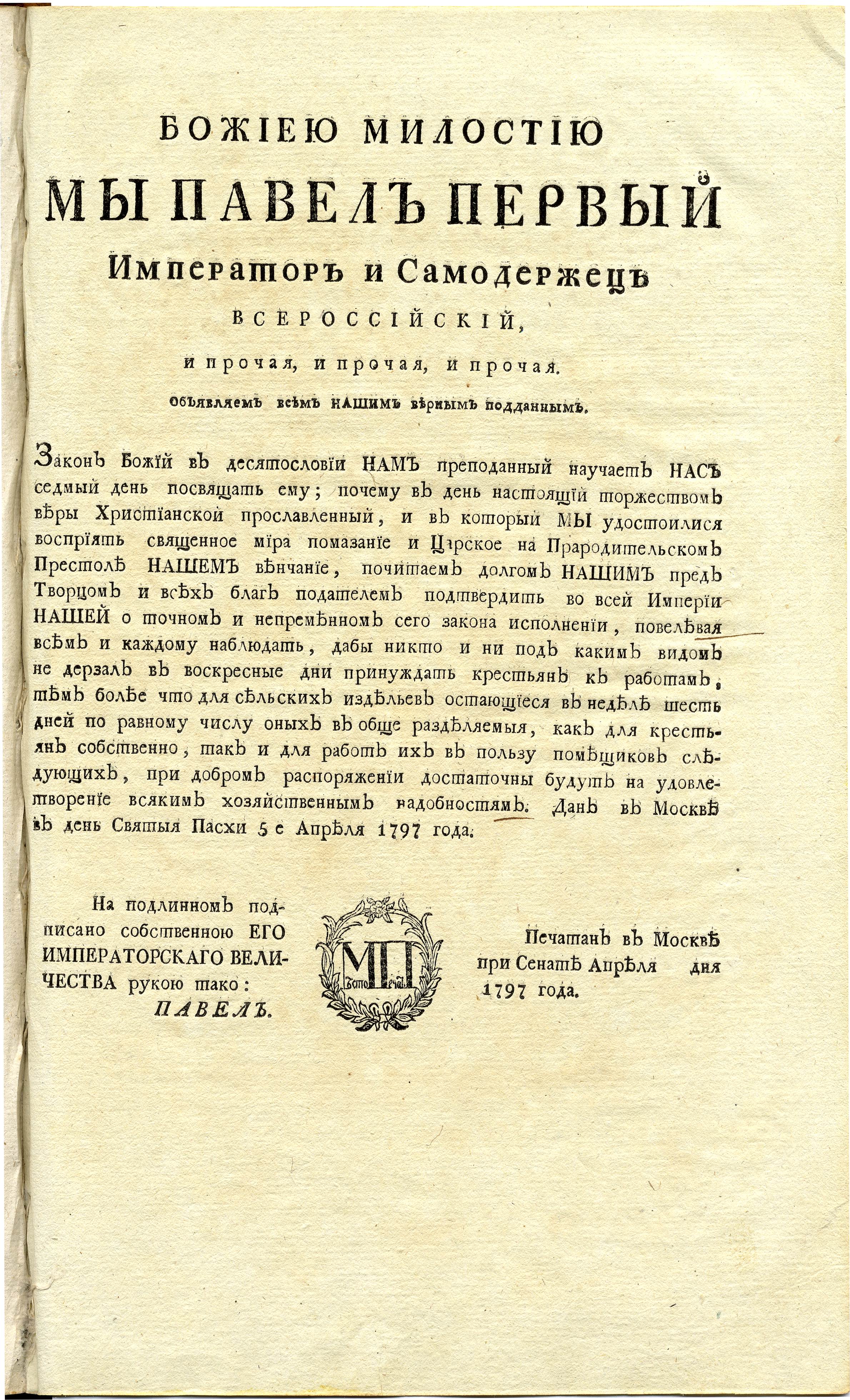
Certainly, Paul's reign was short compared with that of his mother, and he made many enemies among the nobility  as a result of his ambitious reforms.  Tsar Paul, far from being a bitter man obsessed with personal power, followed both his father and Frederick II of Prussia in improving the quality of life for ordinary people in his domain, at the expense of the nobility. Paul I, much like his father, discussed below, firmly believed in using enlightenment principles in order to improve the lives of Russian serfs. Paul I placed limits on the amount of labor landowners could extract from peasants: preventing them from working Sunday, and allowing peasants to work for three days of the week for their own interests/profit.[11] Russian serfs now had Sunday's as a day of religious observance, and could pursued their own labor for an equal amount of time as they work for landlords.  Furthermore, he modified the laws concerning the sale of serfs, mandating that serfs could only be sold with their land. This step ensured that families of serfs in Ukraine could no longer be separated when they were sold by their landowners.[12]  However, for all his enlightenment principles, Paul could not bring himself to liberate the serfs, as he was afraid of the consequences to his power.

In the course of his military reforms, Paul made enemies, and on three occasions, he got into a dispute with army officers heated enough that he beat them with a cane. Christopher Duffy notes that Paul eventually apologized on each occasion, and further states that, "there is much evidence to show that Paul was a man of idealism, honesty, and (we  have to say) sweetness and courtesy."[13] Paul's military reforms likewise showed a humane streak, and wrote in his Tactical Rules of 1797, "The soldier must always be regarded as a human being, for almost anything can be obtained through friendly dealings. Soldiers will do more for an officer who treats them well, and receives their trust, than for one whom they merely fear."[14]

The final note in the HBO series deals with the end of Paul's reign, claiming that he was murdered on the orders of his son, Alexander. It does this to make Tsar Alexander appear as Catherine the Great's avenger. In reality, Alexander was unconnected to the coup which murdered his father. Paul I had alienated large portions of the Russian nobility by means of his liberal reforms, and a group of these noblemen burst into his bedroom March 23rd, 1801. They first attempted to force his abdication, and then brutally murdered him when he resisted. Count Christoph Lieven described the seen in the aftermath of the murder. The former Tsar's younger son, Grand Prince Constantine was, "bathed in tears", while the noblemen around him rejoiced, while the new Tsar, asked for Lieven, and "fell on his shoulder, and sobbed, "My father, my poor father."[15]

Paul I's murder at the hands of drunken noblemen was not a triumph for Catherine the Great, it simply continued a generational story of murder in the Russian Court, and the pain of loss that young Tsars felt at the murder of their fathers.

If you enjoyed this post, or any of our other posts, please consider liking us on facebook, or following us on twitter. Finally, we are dedicated to keeping Kabinettskriege ad-free. In order to assist with this, please consider supporting us via the donate button in the upper right-hand corner of the page. As always: 


Thanks for Reading,


Alex Burns


-------------------------------------------------------------------------------------------------------
[1] Simon Dixon, Catherine the Great, 218.
[2] Sbornik Imperatorskago Russkago Istoricheskago Obshchestava, Vol 13, 265-6. (Translation is Simon Dixon's.)
[3] Dixon, Catherine the Great, 219.
[4] Sbornik Imperatorskago Russkago Istoricheskago Obshchestava, Vol 23, 621.
[5] Sebag Montefoire, Prince of Princes, 240-241.
[6] Politische Correspondenz Friedrich's des Großen, Vol 35, pg. 122
[7] Ibid, 123.
[8] Ibid, Vol. 38, 138.
[9] Christopher Duffy, Russia's Military Way to the West 1700-1800, 200.
[10] Dixon, Catherine the Great, 315.
[11] This manifesto was widely printed, the text can be read here.
[12] See Paul's Decree of October 16th [27th], 1798.
[13] Duffy, Russia's Military Way, 207.
[14] Quoted in Duffy, Ibid
[15] Quoted in Duffy, Ibid, 232. 

Friday, July 26, 2019

Is the Military History of Frederick the Great and George Washington still relevant in the 21st Century?

The excellent reenactors of Prussian IR12, Erbprinz Hessen-Darmstadt

Dear Reader,


In the course of completing my Ph.D, I have the distinct pleasure of teaching the Modern Military History course at West Virginia University. Students always sign up for the class in large numbers, expecting to hear primarily about the Second World War, or even the Vietnam War. They are almost always disappointed to hear that to historians, "Modern" Military History includes much of Military History after 1500.

As I believe that students learn better when their instructor is passionate about the subject under study, I spend approximately two and a half weeks (of a sixteen week course) covering the Kabinettskriege era, with particular reference to the era between the War of Austrian Succession to the American War of Independence. Every semester, I ask students to write a paper, comparing two of the great military leaders of the eighteenth century. (It's not Frederick II and Washington every semester, in fact, I prefer reading essays about Charles XII and Maurice de Saxe). However, students are always surprised that I spend so much time on an era of limited war, where (at least in their mind) tactics and technology were relatively static. As a result, I am writing this post, attempting to defend what I see as an incredibly relevant period in military history for our own time. So, why is the era of Frederick II and George Washington still relevant in the 21st Century?

Washington by Peale, 1779
1. The conflicts of Frederick II and Washington form part of the "canon" of modern military thought, and the Military-Civil relationship in our own time. In order to understand that, we need to understand them. 

If you read On War, you will be astonished by the easy familiarity which Clausewitz possesses with the campaigns of Frederick II. To understand the mind which produced On War, we need to understand the conflicts of Frederick II as he did. The debates about the relationship between armies and societies which continue into our own time were happening albeit in a slightly different form, during the eighteenth century. In my observation, there is a gulf today in the United States between many soldiers and many civilians, and neither seem to understand the other, or even have a desire to do so. A reading of Charles Royster's A Revolutionary People at War, will reveal that the exact same debates were occurring in the fledgling United States during the American War of Independence. The army and the society became disconnected from one another during the course of the conflict, and began to actively dislike each other in cases.  In essence, an understanding of eighteenth-century warfare allows for a greater understanding of our own world.

2. Studying Eighteenth-Century Warfare demonstrates that while technology is important, adaptability is more important. 

There were a number of military technological improvements during the Kabinettskriege era,  including the French development of cooper-bottomed pontoon-bridges in the 1670s, the refinement of mortars, the artillery systems of Shuvalov and Gribeauval, the rifles of Isaac de la Chaumette and Patrick Ferguson, to name but a few. However, with the possible exception of the pontoon bridges, none of these technological inventions fundamentally changed the shape of warfare.

In the Seven Years War, Frederick II was faced by enemies with vastly superior artillery systems. The British, not the Americans, experimented with breechloading rifles under Ferguson. Indeed, technological experimentation does not always lead to decisive results. In the 1749, John Muller wrote to the Duke of Cumberland, arguing that
"The French, who are continually aiming at improvements [in their small arms] have succeeded no better than others; One should be surprised to find in their last establishments several things changed which were better before, and Mr. Belidor who takes great pains in making experiments has been very much mistaken in his account of the Chambers in Mortars[.]"[1]
Napoleonic Prussian Generals made much the same observation, after seeing the results of tests which showed that the older Frederician musket was more accurate than their modern replacement.
Though Frederick II was in many ways technologically inferior to his opponents, his willingness to adapt and learn from them proved one of his strengths, as the result of the Battle of Burkersdorf shows. Technology is not always the silver bullet, especially in an era of limited warfare. As the development of light troops shows us during this era, innovation was often more important than invention.

Frederick II, later 18th century, by J.H.C. Franke


3. In both the case of Frederick II and George Washington, greater material and manpower did not necessarily equate victory. 


Both the allies arrayed against Frederick II in the Seven Years War, and the British forces confronting George Washington the early American War of Independence put many more soldiers into the field, and had greater supporting and logistical forces at their disposal. This did not prevent both Frederick and Washington from achieving their political goals in the final outcome of the conflict (though Frederick's success is much more qualified than Washington's.) Both generals marched quickly, unexpectedly took the offensive and initiative from their opponents, knew when to dig in, and when to retreat, and learned from their many mistakes.

This is not a lesson that the American Civil War, or the First and Second World Wars teach particularly well. In these wars, powers with more resources had time to learn from their mistakes and eventually crush their opposition. Obviously, none of this was achieved superior resources alone. Russian operational maneuvering on the Eastern Front was quite good, particularly in the later stages of the Second World War, while the victories achieve by the Union army in the middle-western theater of the American Civil War were fairly consistent throughout the conflict.

Superior resources mattered in the eighteenth century as well, of course, but the successes of George Washington and other American leaders brought powerful allies (the French, Spanish, and Dutch), into the war, not the other way around. Likewise, successes which Frederick II achieved early in the Seven Years War allowed him breathing space to continue the fight as long as he did, until eventually, as a result of chance, the enemy alliance collapsed.


4. Studying an era where the "rules of engagement" were limited compared to the 20th Century encourages thought about the nature of warfare. 


We live in an age where compared with the mid-twentieth century, violence against civilians by regular forces is frowned upon, and at least officially discouraged. Civilians still suffer in war today, obviously, as they did in the eighteenth century, but compared with the mass blood letting of World Wars 1 and 2, and even Vietnam, modern standing armies attempt to cause less civilian casualties, or at the very least, claim that they attempt to cause less casualties. In that way, the eighteenth century may offer a window into our own time.

This point always causes controversy when brought up in the classroom, as many students prefer the thinking of William Tecumseh Sherman ("You cannot qualify war in harsher terms than I will. War is cruelty, and you cannot refine it") and Bomber Harris to the more seemingly more gentle nature of eighteenth-century war. Indeed, compare Sherman's statement above to Austrian Marshall Daun's: "The purpose of war is to push back the unrighteous enemy, not to exterminate the human race."

Frederick II of Prussia, a truly prickly and acidic man at times, delighted in the ransacking of Saxon noblemen's homes during the Seven Years War. Wars with British could turn particularly ugly when rebellion was involved, whether that rebellion was in Scotland in 1745 or in North America in 1775. However, none of the atrocities of the eighteenth century approach the sustained scale and magnitude of the Thirty Years War or the Napoleonic Wars, to say nothing of the industrialized death of the twentieth century.

 In recent years, as a result of the excellent work of historians such as John Childs, John Lynn, Erica Charters, Hannah Smith, Eva Rosenhaft, and others, there has been a vigorous debate about the exact nature of this "limitation" (if it can even be called that), but I would argue that the numbers tell a clear story. Fewer civilians died from conflict related causes during the 150 odd years of the Kabinettskriege era than died in the 50 odd years of the Thirty Years War and Napoleonic Wars. I don't think that we necessarily have a specific answer as to why that was the case. 

Reenactors portray British Forces in the American War of Independence


5. Studying the Eighteenth-Century Warfare is relevant, because, in a popular sense, it is still very badly understood. 


 6. In many ways, the conflicts of the Kabinettskriege era decisively shaped the course of modern history, the history of the era in which we live. 


It is impossible to understand the course of nineteenth and twentieth-century European History without understanding the wars of the eighteenth century. The Kabinettskriege era saw the beginning of so many stories which continued into our own time, or at the very least, continued into the twentieth century. It is impossible to understand the power of Napoleon's Empire without the stories of Vauban and Louis XVI, and the foreign policy disasters which caused the French Revolution.  It is impossible to understand the creation of the nineteenth-century nations of Germany and Italy without the success which Prussia and Savoy enjoyed in the eighteenth century. It is impossible to understand the rise of the British Empire as a global phenomenon without understanding the Seven Years War. It is impossible to understand the modern United States as a global power without the American War of Independence, and equally impossible to understand the story of the Soviet Union and Russian Federation without the reforms of Peter the Great, to say nothing of the generalship of Suvorov. It is impossible to understand the tragic history of Poland and the Polish people in the nineteenth and twentieth centuries without understanding the partitions of the late-eighteenth century. All of these are only reasons related to military history, to say nothing of the enlightenment and industrial revolution.

To some extent, this is true of every era. It is impossible to fully understand the eighteenth century without understanding the seventeenth century, etc. But, I must say, I am prejudiced and conceited enough towards my own field of study to argue that the eighteenth century deserves more of a share of attention than it currently enjoys in the public consciousness as we move into the third decade of the 21st century.

If you enjoyed this post, or any of our other posts, please consider liking us on facebook,  or following us on twitter. Finally, we are dedicated to keeping Kabinettskriege ad-free. In order to assist with this, please consider supporting us via the donate button in the upper right-hand corner of the page. As always:


Thanks for Reading,


Alex Burns


-------------------------------------------------------------------------------------------

[1] Letter from John Muller at Woolrich to His Royal Highness the Duke of Cumberland, June 28th 1749.