Showing posts with label George Washington. Show all posts

Thursday, August 12, 2021

Frederick the Great and Washington: Truths, Myths, and Propaganda


Dear Readers,


Yesterday, a popular facebook page which commemorates the Revolutionary War in the United States shared an anecdote regarding George Washington and Frederick the Great. Quoting Frank Moore's 1860 publication, Diary of the American Revolution from Newspapers, volume 2, the post related how Frederick II of Prussia presented George Washington with a picture of himself, inscribed, "From the oldest General in Europe, to the greatest general on earth."[1] The anecdote continues at some length, with another Prussian general questioning Frederick's assessment, and Frederick giving a full explanation of why Washington was the greatest general on earth. The source of this anecdote is the August 9th, 1780 issue of the New Jersey Journal.  

The trouble is, this anecdote is not true. It never occurred. There are variations of it, sometimes a sword is the present, sometimes it is a portrait.  And the worrying part is, historians have known it wasn't true for over one hundred and twenty years. Paul Leland Haworth, writing an article entitled Frederick the Great and the American Revolution in the American Historical Review in 1904, noted: 

At one time a story was widely current, and it is still believed by many, to the effect that he [Frederick] entertained a great admiration for Washington, and that he even went so far as to send him a sword[.] This is one of those historical myths that have been eagerly accepted by a willing and credulous public, and it has been completed exploded.[] 

Haworth cites the work of writer Moncure D. Conway, who, writing in 1891, examines the stories of the sword and/or portrait in detail. Conway corresponded with surviving relatives to see if the portrait survived, and notes that other monarchs did send portraiture to Washington, and the records of those transactions (and the portraits themselves) survive to the present day. Conway also describes the way in which Washington carefully gave the provenance of items in his will, and no gifts from Frederick the Great are described in his will.[3] Likewise, Conway notes that Washington's will carefully preserved a sword from Theophilus Alte of Solingen, and passed the sword onto Washington's nephew, George Steptoe Washington. 

Conway concludes: "We may feel tolerably certain that no gift was ever sent by Frederick the Great to Washington, and that he never recognized in any remark the greatness of Washington."[4] Now, Washington as a figure was certainly known to Frederick. Indeed, in Frederick memoirs, he notes, "General Washington, who was called at London the chief of the rebels, gained, at the commencement of hostilities, some advantages over the royalists who were assembled near Boston."[5] So, while clearly noting the progress of the American War of Independence, Frederick did not sent Washington fan mail. 

If historians have known that this anecdote is false for over one hundred years, why does it get shared 150 times on facebook in the course of a day? This is because like many eighteenth-century anecdotes, true or false, the story of Frederick's portrait/sword is designed to communicate truths to the reader. These truths, that Washington was a inspirational leader who fought from a disadvantageous position, and that he had, "surmounted untold difficulties," were as accurate in 1780 as they remain today.[6] This does not obscure the fact that this newspaper report was a sort of propaganda: in 1780, Frederick II of Prussia was recognized as an authority on warfare. Having him write respectful letters of admiration to Washington would have been an immense public relations victory. As a result, the New Jersey Journal, together with the Providence Gazette, told a story that communicated truths about Washington's skills as a general. 

The May 20th story referenced in the Providence Gazette is relatively brief:  it simply provides the inscription. The August 9th New Jersey Journal provides more embellishment, and begins to raise questions in the mind of the reader. How would the author have been privy to the conversation of the King of Prussia and one of his generals regarding Washington's military qualities? These doubts, together with the lack of physical evidence, point to the fact that these stories are myths designed to impart truths, rather than factual occurrences. As a result, they are often more compelling than factual history. Thus, over a hundred years after Frederick's factual statement regarding Washington was disproved, the legend of Frederick's admiration for Washington continues unabated.  

You can read three more articles on these myths over on the Boston 1775 blog by J.L. Bell. 

If you enjoyed this post, or any of our other posts, please consider liking us on facebook, or following us on twitter. Consider checking out our exclusive content on Patreon. Finally, we are dedicated to keeping Kabinettskriege ad-free. In order to assist with this, please consider supporting us via the donate button in the upper right-hand corner of the page. As always:

Thanks for Reading, 


Alex Burns

--------------------------------------------------------------------------------------------------------------
[1] Frank Moore, Diary of the American Revolution: From Newspapers..., Volume 2, (1860), 309-310.
[2] Paul Leland Haworth, "Frederick the Great and the American Revolution", American Historical Review, (1904) Vol. 9 No. 3, 460-478. 
[3] Ibid.  
[4] Moncure D. Conway, The Century Illustrated Monthly Magazine, Volume 41 (1891) 945-948. 
[5] Ibid, 947.  
[6] Frederick, translated by Thomas Holcroft, Posthumous Works of Frederich II: King of Prussia, Volume 4 (1789), 175. 

Friday, February 21, 2020

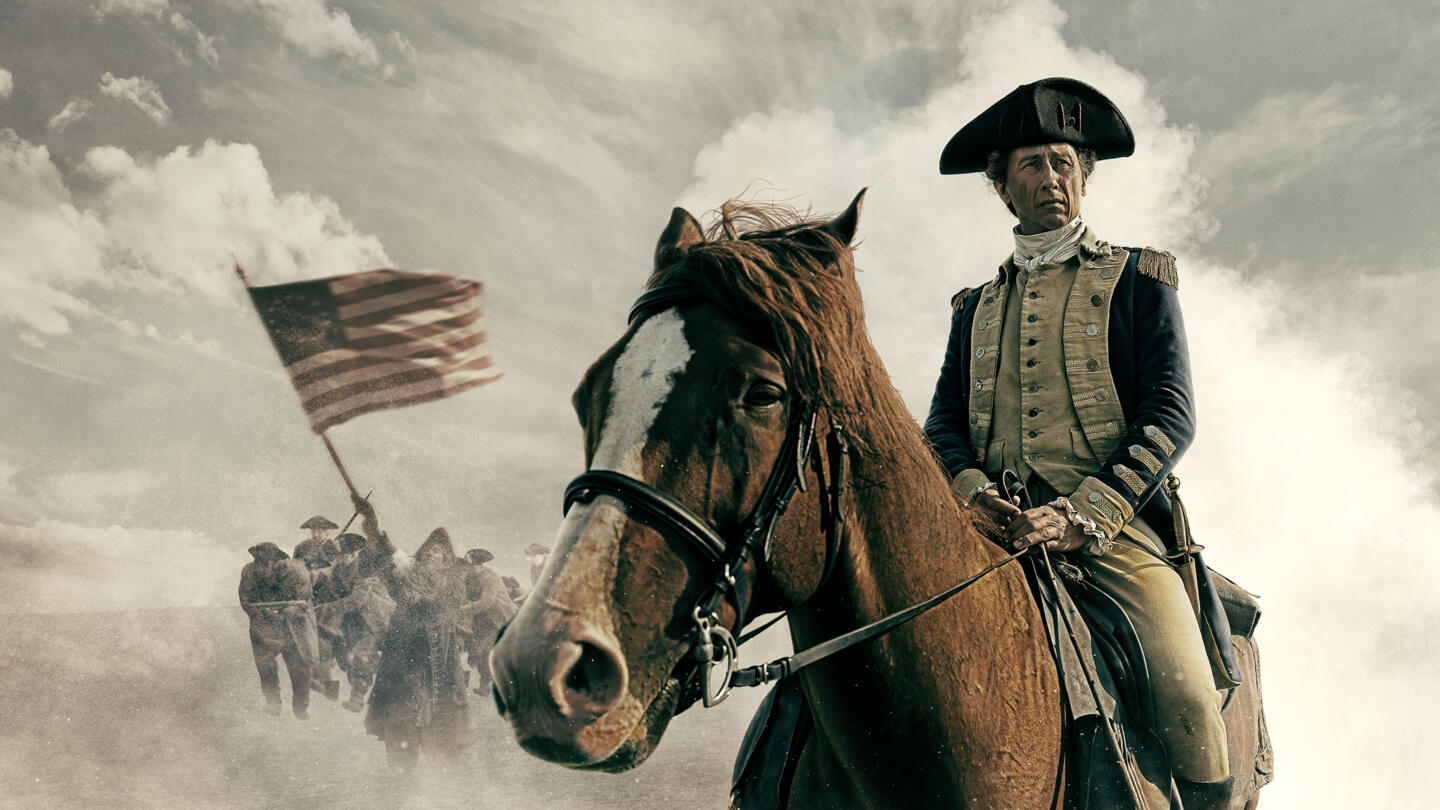
Kabinettskriege Live Reacts to the History Channel's "Washington"

Image result for washington history channel
Here we go

Dear Reader,

I'm starting to watch the Washington Miniseries put out by the History Channel. The timestamp is on the left, followed by my reaction. I'll be updating this as I watch more of the series. Check back for more.

[1:30] Surprised to see Bill Clinton

[1:55] "Washington is the one man who made this country possible." That's possibly true, I guess? Historically unhelpful, too?

[2:30] "Washington was not born great, he took a journey towards greatness." Skips directly to French and Indian War.

[2:46] Washington appears to be about 40 years old here, (22 IRL) I am disappointed. So far costuming is so-so.

[4:03] I'm really happy to see Colin Calloway as a talking head- one of the leading scholars working on 18th century Native Americans.

[4:45] Costuming really isn't wowing me, now that I see it up close.

[6:40] Ok, so now we are going back to the 1740s.  Good to see Washington's lack of formal education discussed, if briefly.

[7:45] Joseph Ellis, like Colin Colloway, is an eminently respected historian- good to see him in this lineup.

[8:00] Hecking Heck, is this supposed to be Jumonville's Glen? Have they ever even been to Western PA?

[8:27] The French uniforms look nothing like what French troops were wearing in 1754.

[8:45] Alan Taylor! Nice.

[9:00-10:00] Clearly Doris Kearns Goodwin has not been reading Kabinettskriege's articles on the nature of 18th century combat. Jumonville's Glen= charging into close combat with no bayonets fixed. Ouch, Jumonville shot through the body.

[10:23] "This is the moment that causes the French and Indian War, this is the war that causes the American Revolution." Where the Hecking Heck is Fred Anderson when you need him? The French and Indian War is worth studying as an end unto itself, as a vitally important event.

[11:09] Series deliberately obscures the fact that Washington does not read French.

[13:17] Joseph Ellis clearing up the "Washington never lied" myth. Good stuff.

[14:32] Wow Colin Powell!

[15:30] Whew these uniforms are bad. It is like someone designed a uniform for a British soldier using only late nineteenth century woodcuts.

[16:19] "Washington is reinforced by 100 British regulars [at Fort Necessity]". Ya? From which Regiment of Foot?

[16:47] Realistic appraisal of Fort Necessity.

[17:46] So the British uniforms aren't just bad, they are bad Revolutionary War-era uniforms. Cause people who have researched material culture really don't add anything to our understanding of history, right? Heck.

[17:50] There are a lot of headshots in this show, and we aren't even 20 minutes in.

[19:03] Why are all the muskets banded?

[19:38] Ed Lengel needs to read Ilya Berkovich.

[20:10] Why are the French parleying in their goal was to kill Washington? Needs more internal consistency.

[21:08] Washington's lack of French acknowledged.

[22:10] Has this man never worn a cartridge box? Does no one look at period images?

[24:40] Nice use of primary sources guys, do more of that.

[26:27] Now this looks like Appalachia

[27:00] Beard on British soldier

[27:22] Importance of European warfare downplayed in American context, nice.

[27:35] "The British didn't know how to fight in the forest conditions"

[28:15] This clothing is laughably bad.

[28:45] Cannon stuck in mud despite fact that dry roads surround it on every side.

[29:30] Braddock is pretty stereotypical.

[29:45] Series feeds into idea that British people are tools.

[30:00] Oh boy, here we go.

[31:00] Charging without bayonets again. They do know what bayonets are, right?

[31:39] Native warriors are just SLAUGHTERING people in close combat, and the people they are slaughtering don't even have their bayonets fixed. Connection? Possibly.

[31:47] There are people running through this shot in what I can only assume are continental army uniforms.

[33:03] Even while upside-down, Native American warriors are wreaking havoc in close combat.

[33:23] Native Americans are slaughtering an artillery crew while the members of the crew who are not being attacked impassively stand with their backs to the Natives. This is possibly the least realistic depiction of combat that I have ever seen.

[34:30] "I mean this is destruction of human life on a colossal scale." I'm not trying to be flippant here, but Braddock's defeat isn't a watershed in loss of life, even in an eighteenth-century context. Look at Zorndorf, or Kunersdorf, or  Brandywine or Long Island or Guilford Courthouse.

[36:03] Ed Lengel makes it appear as though most Americans were thinking teleological in opposition to Britain in 1755.

[39:36] Despite the fact that the nearest tree is 3/4s of a mile a way, and there is no where to hide (I mean, have these people ever been to Appalachia?) a colonist is smoked by a Native American with a smoothbore musket.

[39:40-40:00] Native Americans killing people montage. Not even bad, just a bit weird. 

[40:23] Literal bodies on fire. Yikes.

[40:45] Jeff Daniels, the narrator, is apparently doing a Ron Swanson impression for this.

[41:06] Literally the shortest ramrod anyone has ever seen

[41:34] Bayonet: Exists. Alex: Weeps with joy. More tiny ramrods on display.

[42:20] These are some amazing 1790s-1800s collars on these uniforms. Well fitted tan gaiters, though.
\
[44:37] Literally doing target practice at targets 5 feet away. What even is this?

[45:32] Stab that dummy in the face Washington, stab him.

[48:10] Man, the British are so evil, they won't even talk to George.

[49:34] The British are sooo foppish, no wonder they lost.

[51:45] Washington played an important role in the 1758 campaign to take Fort Duquesne, but did he really deserve all the credit? Also, what even are these uniforms?

[53:30] "We can date from that moment (December 1758) the birth of the rebel George Washington. Which is why he chooses to be depicted in British uniform as a soldier in 1772?

[57:51] George and Martha are really trying, but not exceptional actors.

[1:01:03] Really enjoy the painting of Washington's older brother, Lawrence, on the wall in this scene.

[1:04:10] So we got a younger actor to play 14 year old Washington, but having a 54-year old (yes, I checked) play a 22-year old is ok?

[1:05:07] Ah yes, the ominous proclamation line of 1763. 

[1:07:31] Not a terribly nuanced portrayal of the Riot on King Street.

[1:09:01] "The British Empire slowly built the man who would destroy them from the inside out." Here and I thought that the British Empire was destroyed in the 20th Century.

[1:12:45] It seems that the British fired the shot heard round the world, and are fairly responsible for the outbreak of hostilities.

[1:15:28] The costuming has improved a bit, now that we are in the 1770s. Bad 1770s costuming looks better in the 1770s than the 1750s.

[1:19:24] Seriously, where was this filmed, Kansas?

[1:20:30] I really don't know what all these soldiers are doing. These uniforms are CRAZY

[1:21:36] Man urinating next to wagon. Bold move, History Channel.

[1:22:00] We need a George Washington to whip this documentary into shape.

[1:22: 38] Headshot

[End Episode One]


If you enjoyed this post, or any of our other posts, please consider liking us on facebook, or following us on twitter. Consider checking out our exclusive content on Patreon. Finally, we are dedicated to keeping Kabinettskriege ad-free. In order to assist with this, please consider supporting us via the donate button in the upper right-hand corner of the page. As always:

Thanks for Reading, 


Alex Burns

Friday, July 26, 2019

Is the Military History of Frederick the Great and George Washington still relevant in the 21st Century?

The excellent reenactors of Prussian IR12, Erbprinz Hessen-Darmstadt

Dear Reader,


In the course of completing my Ph.D, I have the distinct pleasure of teaching the Modern Military History course at West Virginia University. Students always sign up for the class in large numbers, expecting to hear primarily about the Second World War, or even the Vietnam War. They are almost always disappointed to hear that to historians, "Modern" Military History includes much of Military History after 1500.

As I believe that students learn better when their instructor is passionate about the subject under study, I spend approximately two and a half weeks (of a sixteen week course) covering the Kabinettskriege era, with particular reference to the era between the War of Austrian Succession to the American War of Independence. Every semester, I ask students to write a paper, comparing two of the great military leaders of the eighteenth century. (It's not Frederick II and Washington every semester, in fact, I prefer reading essays about Charles XII and Maurice de Saxe). However, students are always surprised that I spend so much time on an era of limited war, where (at least in their mind) tactics and technology were relatively static. As a result, I am writing this post, attempting to defend what I see as an incredibly relevant period in military history for our own time. So, why is the era of Frederick II and George Washington still relevant in the 21st Century?

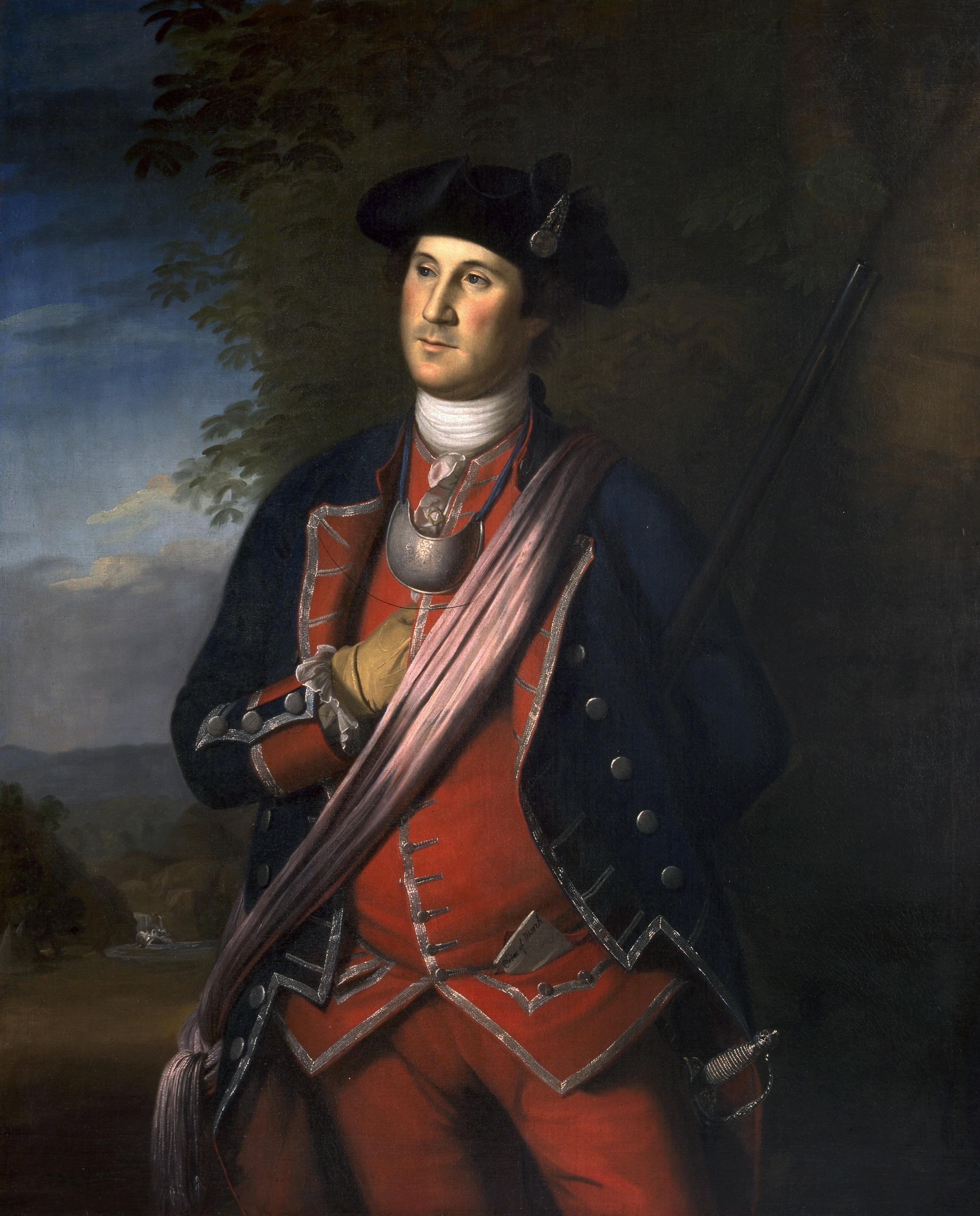
Washington by Peale, 1779
1. The conflicts of Frederick II and Washington form part of the "canon" of modern military thought, and the Military-Civil relationship in our own time. In order to understand that, we need to understand them. 

If you read On War, you will be astonished by the easy familiarity which Clausewitz possesses with the campaigns of Frederick II. To understand the mind which produced On War, we need to understand the conflicts of Frederick II as he did. The debates about the relationship between armies and societies which continue into our own time were happening albeit in a slightly different form, during the eighteenth century. In my observation, there is a gulf today in the United States between many soldiers and many civilians, and neither seem to understand the other, or even have a desire to do so. A reading of Charles Royster's A Revolutionary People at War, will reveal that the exact same debates were occurring in the fledgling United States during the American War of Independence. The army and the society became disconnected from one another during the course of the conflict, and began to actively dislike each other in cases.  In essence, an understanding of eighteenth-century warfare allows for a greater understanding of our own world.

2. Studying Eighteenth-Century Warfare demonstrates that while technology is important, adaptability is more important. 

There were a number of military technological improvements during the Kabinettskriege era,  including the French development of cooper-bottomed pontoon-bridges in the 1670s, the refinement of mortars, the artillery systems of Shuvalov and Gribeauval, the rifles of Isaac de la Chaumette and Patrick Ferguson, to name but a few. However, with the possible exception of the pontoon bridges, none of these technological inventions fundamentally changed the shape of warfare.

In the Seven Years War, Frederick II was faced by enemies with vastly superior artillery systems. The British, not the Americans, experimented with breechloading rifles under Ferguson. Indeed, technological experimentation does not always lead to decisive results. In the 1749, John Muller wrote to the Duke of Cumberland, arguing that
"The French, who are continually aiming at improvements [in their small arms] have succeeded no better than others; One should be surprised to find in their last establishments several things changed which were better before, and Mr. Belidor who takes great pains in making experiments has been very much mistaken in his account of the Chambers in Mortars[.]"[1]
Napoleonic Prussian Generals made much the same observation, after seeing the results of tests which showed that the older Frederician musket was more accurate than their modern replacement.
Though Frederick II was in many ways technologically inferior to his opponents, his willingness to adapt and learn from them proved one of his strengths, as the result of the Battle of Burkersdorf shows. Technology is not always the silver bullet, especially in an era of limited warfare. As the development of light troops shows us during this era, innovation was often more important than invention.

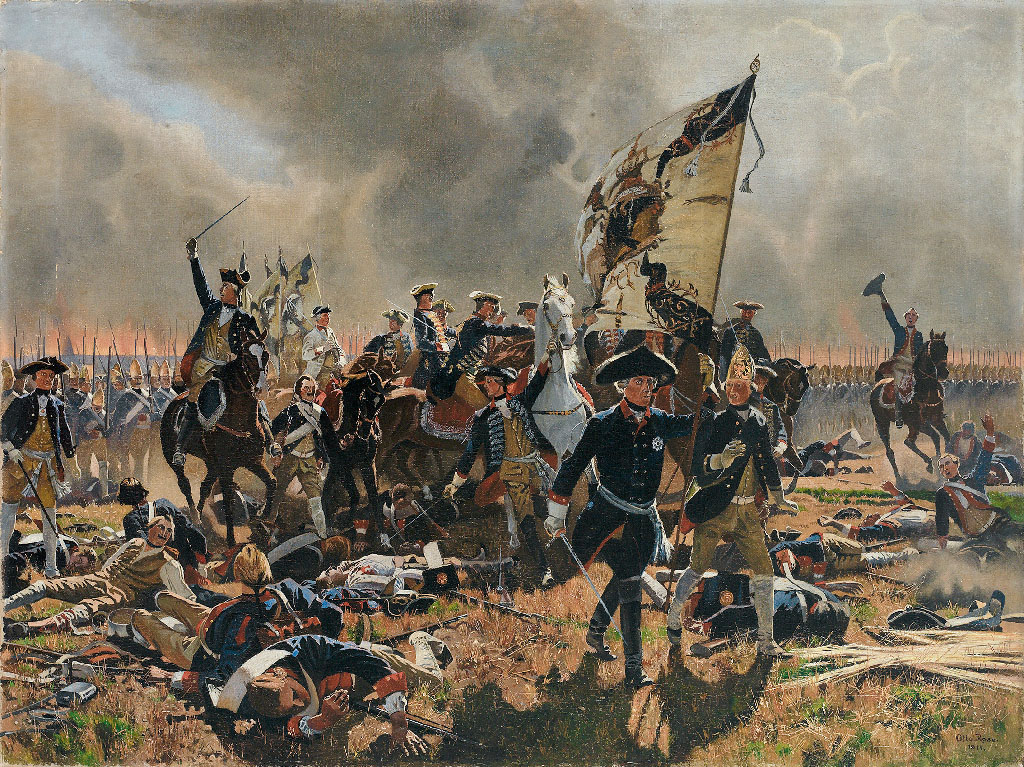
Frederick II, later 18th century, by J.H.C. Franke


3. In both the case of Frederick II and George Washington, greater material and manpower did not necessarily equate victory. 


Both the allies arrayed against Frederick II in the Seven Years War, and the British forces confronting George Washington the early American War of Independence put many more soldiers into the field, and had greater supporting and logistical forces at their disposal. This did not prevent both Frederick and Washington from achieving their political goals in the final outcome of the conflict (though Frederick's success is much more qualified than Washington's.) Both generals marched quickly, unexpectedly took the offensive and initiative from their opponents, knew when to dig in, and when to retreat, and learned from their many mistakes.

This is not a lesson that the American Civil War, or the First and Second World Wars teach particularly well. In these wars, powers with more resources had time to learn from their mistakes and eventually crush their opposition. Obviously, none of this was achieved superior resources alone. Russian operational maneuvering on the Eastern Front was quite good, particularly in the later stages of the Second World War, while the victories achieve by the Union army in the middle-western theater of the American Civil War were fairly consistent throughout the conflict.

Superior resources mattered in the eighteenth century as well, of course, but the successes of George Washington and other American leaders brought powerful allies (the French, Spanish, and Dutch), into the war, not the other way around. Likewise, successes which Frederick II achieved early in the Seven Years War allowed him breathing space to continue the fight as long as he did, until eventually, as a result of chance, the enemy alliance collapsed.


4. Studying an era where the "rules of engagement" were limited compared to the 20th Century encourages thought about the nature of warfare. 


We live in an age where compared with the mid-twentieth century, violence against civilians by regular forces is frowned upon, and at least officially discouraged. Civilians still suffer in war today, obviously, as they did in the eighteenth century, but compared with the mass blood letting of World Wars 1 and 2, and even Vietnam, modern standing armies attempt to cause less civilian casualties, or at the very least, claim that they attempt to cause less casualties. In that way, the eighteenth century may offer a window into our own time.

This point always causes controversy when brought up in the classroom, as many students prefer the thinking of William Tecumseh Sherman ("You cannot qualify war in harsher terms than I will. War is cruelty, and you cannot refine it") and Bomber Harris to the more seemingly more gentle nature of eighteenth-century war. Indeed, compare Sherman's statement above to Austrian Marshall Daun's: "The purpose of war is to push back the unrighteous enemy, not to exterminate the human race."

Frederick II of Prussia, a truly prickly and acidic man at times, delighted in the ransacking of Saxon noblemen's homes during the Seven Years War. Wars with British could turn particularly ugly when rebellion was involved, whether that rebellion was in Scotland in 1745 or in North America in 1775. However, none of the atrocities of the eighteenth century approach the sustained scale and magnitude of the Thirty Years War or the Napoleonic Wars, to say nothing of the industrialized death of the twentieth century.

 In recent years, as a result of the excellent work of historians such as John Childs, John Lynn, Erica Charters, Hannah Smith, Eva Rosenhaft, and others, there has been a vigorous debate about the exact nature of this "limitation" (if it can even be called that), but I would argue that the numbers tell a clear story. Fewer civilians died from conflict related causes during the 150 odd years of the Kabinettskriege era than died in the 50 odd years of the Thirty Years War and Napoleonic Wars. I don't think that we necessarily have a specific answer as to why that was the case. 

Reenactors portray British Forces in the American War of Independence


5. Studying the Eighteenth-Century Warfare is relevant, because, in a popular sense, it is still very badly understood. 


 6. In many ways, the conflicts of the Kabinettskriege era decisively shaped the course of modern history, the history of the era in which we live. 


It is impossible to understand the course of nineteenth and twentieth-century European History without understanding the wars of the eighteenth century. The Kabinettskriege era saw the beginning of so many stories which continued into our own time, or at the very least, continued into the twentieth century. It is impossible to understand the power of Napoleon's Empire without the stories of Vauban and Louis XVI, and the foreign policy disasters which caused the French Revolution.  It is impossible to understand the creation of the nineteenth-century nations of Germany and Italy without the success which Prussia and Savoy enjoyed in the eighteenth century. It is impossible to understand the rise of the British Empire as a global phenomenon without understanding the Seven Years War. It is impossible to understand the modern United States as a global power without the American War of Independence, and equally impossible to understand the story of the Soviet Union and Russian Federation without the reforms of Peter the Great, to say nothing of the generalship of Suvorov. It is impossible to understand the tragic history of Poland and the Polish people in the nineteenth and twentieth centuries without understanding the partitions of the late-eighteenth century. All of these are only reasons related to military history, to say nothing of the enlightenment and industrial revolution.

To some extent, this is true of every era. It is impossible to fully understand the eighteenth century without understanding the seventeenth century, etc. But, I must say, I am prejudiced and conceited enough towards my own field of study to argue that the eighteenth century deserves more of a share of attention than it currently enjoys in the public consciousness as we move into the third decade of the 21st century.

If you enjoyed this post, or any of our other posts, please consider liking us on facebook,  or following us on twitter. Finally, we are dedicated to keeping Kabinettskriege ad-free. In order to assist with this, please consider supporting us via the donate button in the upper right-hand corner of the page. As always:


Thanks for Reading,


Alex Burns


-------------------------------------------------------------------------------------------

[1] Letter from John Muller at Woolrich to His Royal Highness the Duke of Cumberland, June 28th 1749.

Wednesday, July 6, 2016

Valley Forge vs. the Bunzelwitz Position

The view north from Prussian positions at Bunzelwitz towards the modern
village of Czechy
Dear Reader,


In the mythos of Kabinettskriege conflict, the modern mind is drawn to aggressive action. Those alive to a sense of the past might recall Karl XII's Karoliner attacking through ice-strewn fields at Narva or Fraustadt, the daring attacks by George Washington at Trenton and Princeton, Wolfe's men scaling the heights at Quebec, or Frederick II of Prussia's masterpiece at Leuthen. Today, we are going to examine something a bit less glamorous, but no less vital to securing the reputation of these great commanders: positional warfare.

The two positions under comparison are George Washington's 1777/1778 winter encampment and defensive position near Valley Forge, and Frederick II of Prussia's defensive position in the autumn of 1761, near the fortress of Schwiednitz. We will examine the Prussian position in the Seven Years' War first, before moving to the American winter encampment.

Frederick II, King of Prussia
George Washington, (no cool royal title)


Although known for his aggressive attacks, Frederick II was also a master of defensive positional warfare. In 1761, Frederick faced disaster when two larger Austrian and Russian armies combined against him. Six years into the conflict, the Prussian army had only 54,000 men with which to face the Austrian and Russian armies combined total of some 140,000 men. Desperate to retain his position in the Prussian province of Silesia, Frederick assumed a defensive position near Schwiednitz, his vital Silesian fortress.  Frederick knew that his troops were no longer of a superior enough quality to risk open battle against such stacked odds.

Positions: Prussian (Blue) Austrian (White) and Russian (Green)

This position, which centers on the modern town of Jaworzyna Slaska (which did not exist in the eighteenth century) saw  39,000 Prussian infantry in a line some 7 miles/11.5 kilometers in distance. Frederick correctly identified the salient around Wickendorf and Jauernick (present-day Witkow and Stary Jaworow) as vulnerable part of the line. Though the Prussian position was not geographically formidable, (certainly nothing like the Zobtenberg east of Schwiednitz) Frederick was able to use heavy field fortifications combined with gently sloping ground in order to offer a truly daunting defensive perimeter.

Photos of the modern-day position capture some of the ground's tactical usefulness.

The view just West of Stary Jaworow (Jauernick) looking north towards the Prussian Nighttime HQ
Prussian defensive positions in between Stary Jaworow and Czechy (Jauernick and Tschechen)

Approach ground of planned Austrian attack in on the Position


Prussian position opposite the previous image

View towards Austrian positions near the Nonnen-Busch (forest underneath Grochotow on the map)


Prussian Positions across from the Nonnen-Busch
The Prussian position, then, did not take its strength from geographic features, but from the clear, sweeping fields of fire which the position afforded Prussian artillery. Frederick had 182 guns in and around Bunzelwitz, and he positioned most of them into redoubts which crisscrossed the ground with lanes of fire. Indeed, despite his failing health, so often cited by historians who dismiss Frederick as past his prime as a commander in the Seven Years War, Frederick spent every night at Bunzelwitz at the fortifications with his men. Hussar Captain Warnery reported that during the Bunzelwitz days,"Officers and soldiers alike had to live on bread and water. So as to set an example to the soldiers, the king made a point of staying every night in one or other of the batteries, where he had a bale of straw brought up to serve as his chair."[1]

The Austrians developed a plan for a grand attack on the Bunzelwitz encampment, but this attack stalled when Frederick destroyed Russian supply depots in Poland by means of a raid, forcing part of the Russian army to withdraw. Although Frederick was forced to abandon the Bunzelwitz position when the fortress of Schwiednitz was captured, this position bought vital time for Frederick, from August 20th to October 6th. This month and a half could have brought disaster for the Prussian army, with vastly superior forces present in theatre against a smaller Prussian army. Instead, Frederick and his soldiers survived in order to enter winter quarters late in 1761, where they would receive the news that Tsarina Elizabeth Petrovna had died. While this news did not mean an immediate end to the war, it did mean the Russians would switch sides in 1762, bringing the war back into roughly equal terms, and allowing Frederick to seize victory.

National Park Service map of the defenses at Valley Forge
I had the pleasure of visiting Valley Forge National Historical Park for the first time over the last weekend, and I was pleasantly surprised by what I saw there. George Washington utilized excellent defensive terrain in order to winter his army less than twenty miles from substantial British forces. When considering Valley Forge, generally historians gloss over  the defensive nature of the position in order to discuss issues such as the deprivation, sickness, and professionalization of the Continental Army. However, much like the Prussian position at the Bunzelwitz, Valley Forge was chosen with defense in mind. The continental army required a defensible location close enough to continue observation of the British force in Philadelphia. While a winter offensive by British General Howe might not seem likely, it was certainly a possibility, considering Washington's own actions the year before, as well as Frederick II's winter offensive in Silesia in 1757.

The outer line of defenses consisted of a number of infantry brigades occupying a ridge. The fields of fire on this ridge are truly impressive. Behind the initial line, the American position had a further set of defenses on the high ground in between the army's camp and Washington's HQ near Valley Forge. The defensive positions at Valley Forge provided a haven for the army to survive the winter, and allowed for a renewed and retooled Continental Army to prosecute the war successfully against the British in the following years.

 Here are a few photos of the defensive lines at Valley Forge.

The view from just west of the Redan near Muhlenberg's Brigade, facing southwest.
The opposite view, towards the outer line from south of Poor's Brigade, facing northeast.
The southwestern extremity of the outer line, held by Scott's Brigade

From behind the artillery park, facing southeast towards the outer defense line

Now that we have examined both of these positions, some comparison needs to be made. First of all, in my opinion, Valley Forge is much more geographically impressive than position around Bunzelwitz. This is especially apparent terms of the sweeping fields of fire the south of the outer line defenses. The high ground around the inner line at Valley Forge is higher than almost any portion of the Bunzelwitz position, perhaps excepting the Wuerbenburg behind Bunzelwitz.

 Considering the smaller numbers of troops engaged, it should not surprise us that the defenses at Valley Forge are considerably smaller than Bunzelwitz: stretching around 2 miles compared with to Bunzelwitz' 7. However- this is telling. Frederick's infantry were stretched thin at Bunzelwitz, and he had 39,000 men to defend a 7 mile frontage, or around 5,500 per mile. By that calculation, it would seem that the the roughly 7,000 (allowing for desertion and sickness) available to Washington in the early winter would have been inadequate to defend the frontage in the case of an attack. This calculation appears to have even more weight when considering the number of cannon available to both armies. At Monmouth the following year, the Americans seem to have had 16 cannon, but supposing at Valley Forge they had double that number, their position would still have been dangerously short.

Another point worth consideration is the location of the headquarters. The Prussian army manned the Bunzelwitz position in 12 hour shifts, with the night headquarters being much closer to the lines, practically in Jauernick. By contrast, the American headquarters was a mile and a half away from the outer line of defense. While certainly the possibility of attack at Bunzelwitz seemed an imminent reality in a way it did not at Valley Forge. In the advent of a British attack, would valuable time have been lost, making the trek from the headquarters to the outer line?

In the final accounting, Washington's position at Valley Forge was naturally stronger than Frederick's at Bunzelwitz. However, the weakened state of the Continental Army and the smaller number of cannon at the Continental's disposal made the position at Valley Forge tenuous. Both of these eighteenth-century commanders proved their worth, and both of these defensive positions were formidable, and continue to be imposing today.


If you enjoyed this post, or any of our other posts, please consider liking us on facebook,  or following us on twitter. Finally, we are dedicated to keeping Kabinettskriege ad-free. In order to assist with this, please consider supporting us via the donate button in the upper right-hand corner of the page. As always:

Thanks for reading,


Alex Burns


-------------------------------------------------------------------------------------------------------------
[1] Warnery, Campanges de Fredriec II, 1788, 474


Friday, July 1, 2016

Battle Comparison: Hochkirch and Germantown


Battle of Germantown, della Gatta


Dear Reader,

Today, I want to examine the similarities and differences between two Kabinettskriege era battles, the Battle of Hockirch, which occurred in Saxony on October 14th, 1758, and the Battle of Germantown, which occurred outside Philadelphia on October 4th, 1777. In the first battle, Frederick the Great and his Prussian soldiers squared off against the Austrians under FM Daun. In the second battle, British General Howe led a expert force of British soldiers against George Washington's American rebels.  Aside from the obvious similarities in the weapons systems of the combatants, and the time of the year in which they were fought, these battles contain a number of important similarities useful for students of eighteenth century warfare. A brief description of the two battles will help contextualize the analysis.

In early October, 1758, the Prussian army had recently suffered a setback in its invasion of Moravia, and failed at the siege of Olmütz. However, now that they had returned to Prussian occupied territory, they could rightly expect to return to the string of victories which had previously marked Prussian operations under Frederick. After all, in the previous year, a difficult series of defeats in the summer had been replaced by the crowning achievements of Prussian military history: the twin victories at Rossbach and Leuthen.

The Austrians, on the other hand, had fewer reasons to expect success. Although they had defeated the Prussians at the battles of Kolin and Breslau, they had been horrendously defeated by a smaller force at the Battle of Leuthen the previous year, while their victory at Breslau was a result of superior numbers.

The original Prussian positions are in light blue, note the numerous Austrian attacking columns
Noting that the Prussian position around Hochkirch was spread out, and that in the theatre of operations the Prussians had at most 40,000 men with which to defend against his 78,000, Daun decided to attack. The brainchild behind the attack was Austrian Colonel Charles Amadei, who Christopher Duffy asserts was inspired by the multiple Austrian columns used to attack at the Battle of Moys in 1757. A night march on the evening of the 13th-14th of October brought the Austrian attacking columns to within striking distance of the Prussian positions, close enough to hear music and dancing. This decision to attack in separate columns was a novel and almost untried tactic in the 1750s.

At 5am on October 14th, the Austrian attacking columns burst from cover, overwhelming shocked Prussian pickets, and moving to the attack with great speed. The Austrians had achieved complete surprise, through a mixture of false information spread to the Prussian army, and leaving their main camp attended by a few men of each company. Though the Prussians were often only half-dressed, they maintained an effective resistance in the opening stages of the battle, slowly falling back towards the village of Hochkirch.

The fighitng in Hochkirch, as imagined by 19th century artist Karl Roechling

As the Prussians were pushed back on the village, Prussian FM James Keith began feeding fresh units into the desperate fight developing in the midst of the village. Prussian infantry Regiments 13 and 18 led the way, though both were knocked back by canister fire, and FM Keith was killed. By around 8am, the Prussian position was collapsing, and Prussian infantrymen recalled firing over 120 rounds in this furious engagement.[1] Many Prussian positions were only taken after the infantry had fired away all their ammunition. Prussian sources also note the accuracy of the Austrian fire, which wounded a disproportionate number of officers.

The Prussians were driven from the field, and lost some 9,100 men out of a total of 30,000 engaged, and 104 pieces of artillery. The Austrians, by contrast, lost some 8,000 men out of around 60,000 engaged. With the events of the first battle described, let us move to the second.


The Battle of Germantown
During the opening stages of the American War of Independence, the British army soundly defeated the Americans time and again. Throughout many of the battles of 1776, with the notable exception of Trenton and Princeton, British and German forces overcame the American opposition, and seemed to be winning the war. Indeed, the British had defeated the Americans only a month before at the Battle of Brandywine.

However, George Washington's Continental army had been slowly improving, and Washington decided to risk another battlefield encounter with the British forces under General Howe. In his account to congress on October 5th, Washington indicates that Howe's decision to split his army prompted Washington to attack. The numerical advantage lay with Washington's forces, but it was not decisive: the Americans had 8,000 regulars and 3,000 militia with which to confront the 9,000 British and German troops under General Howe.

The American plan of attack called for four columns to make a night march, and then attack simultaneously at 5am. Leaving their camp around 7pm on October 3rd, the American forces were to reach their forward positions two miles from the British lines by 2am. They approached within musket-shot by 4am. Almost immediately, the American reality failed to mesh with the plan. The American columns did not reach the British pickets until 6am, and only two of the four columns made the attack. The British 2nd Battalion of light infantry moved into support the pickets, and the Americans drove them back with great difficulty. General Howe, not realizing the severity of the enemy force to his front, chided the fleeing light infantry streaming past him, until the magnitude of the American attack became apparent.

Cliveden, the house of Loyalist Justice Chew

As the American attack intensified, British Lt. Colonel Thomas Musgrave located a tactically significant structure- the stone house of Loyalist Judge Benjamin Chew.  Musgrave took initiative, placing 120 men of the 40th Regiment inside the house, which they proceed to defend. The main battle-line stabilized a third of a mile south of the Chew house. However, a number of American units remained behind to besiege the structure. Both of the commanders on the American flanks, Armstrong and Smallwood, failed to apply pressure to the British units in their sector of the battlefield.

The American advance was initially effective as a result of the large volume of fire put out by the 1st and 2nd Maryland Brigades, however, as these brigades moved into contact with more British units, the Marylanders ran out of ammunition. With no ready solution presenting itself, individual men began to move towards the rear, showing their officers empty cartridge boxes to demonstrate that it would be idiotic to stay and fight. A thick blanket of fog, smoke, and noise from the fighting back at the Chew house also served to disorient the advancing American line. The British would counterattack the American positions, relieving the defenders of the Chew house, and begina lackluster pursuit of the American army.  The action had lasted barely four hours.

The British and American forces suffered comparable numbers of killed and wounded, 673 Americans to 520 British. In addition to their killed and wounded, the Americans lost some 450 men taken prisoner.  What made the battle so costly for the Americans, as Washington admitted to Congress on October 7th, was the American loss of men.


What can be learned?


In both circumstances, the army on the attack had previously suffered a series of defeats at the hands of their adversary. Both attacking commanders saw an opportunity to strike at a smaller enemy force. Both attacking armies were less experienced than their foe, and becoming more experienced in the course of the conflict. Both attacking armies sought to use a relatively novel way of attacking in order to take their enemy by surprise along a wide frontage.

Both defending armies were taken unaware by this novel system of attack. The British and Prussians fought obstinately to buy time in order for more units to come up and attack the enemy.  Both defending armies saw subordinate commanders utilizing initiative in order to salvage the situation.

When losses are examined as a percentage of total armies involved, the Prussians suffered by far the heaviest, as around 33% of their total force engaged became casualties.  By contrast, the British suffered the least, with rough 5% of their total force becoming casualties. However, the Prussians did inflict a larger loss on their opponents than the British, with 13% of the Austrian army rendered hors d'combat, compared with 10% of the American fighting force. However, these figures fail to show the true nature of the fighting. Assuming 40% of the Prussian casualties were men captured, (sadly, Prussian losses are not broken down) the Prussian army, in terms of killed and wounded, inflicted a 32% greater loss on the Austrians than they suffered. The British, by contrast, inflicted 23% greater number of killed and wounded on the Americans.

So while the fighting at Germantown was costly to the Americans, the fighting at Hochkirch was some of the bloodiest of the eighteenth century, and left its mark on the Prussian army. It is remarkable that both of these battles played out over the course of only 4 hours.

The American rebels failed to launch an organized attack in the same manner of the Austrians. While FM Keith might have played a more decisive role on the battle if he had lived, his piecemeal counterattack wrecked two of the better infantry regiments in the Prussian army, and did nothing to stem the Austrian tide. By contrast, Lt. Colonel Musgrave saw an opportunity to effectively delay the American advance, and his quick thinking my well have saved the British army under General Howe. Both the Americans and the Prussians struggled with ammunition problems as the battle ensued. While the Prussians were able to keep their infantry supplied via ammunition wagons for the majority of the fight, the American infantry appear to have turned back when their initial ammunition load ran empty. However, for both armies, a lack of ammunition effected the overall outcome.

Attacks by disparate columns would continue to play an important role in warfare, and the generals on the defeated sides would learn from these defeats. Oddly enough, Washington does not mention Hochkirch as his inspiration for the plan at Germantown, though many his plans were the same, down to the letter. Frederick II, who mentioned Germantown in several of his letters during the American War of Independence, did not mention any similarities to between these two battles. These battles, though firmly rooted in Kabinettskriege era warfare, show similarities to later styles of army organization, and presage ideas about divisional level systems of army management.

How should wargamers emulate these battles? Is it good to have two different systems for the AWI and SYW? Could/Should one system capture both eras?


For further information, check out By Force of Arms, by Christopher Duffy, and volume two of The Philadelphia Campaign, by Thomas McGuire.


Thanks for Reading,


Alex Burns


[1] Ernst von Barsewisch, Meine Kriegs-Erliebnisse, 77.

Wednesday, March 19, 2014

Dogs in the Kabinettskriege Period


Charles Lee with one of his numerous dogs 
 Dear Reader,

Whether you are a good, loyal, dog loving person, or an evil, faithless, degenerate cat lover, you still want to hear more about animals in the Kabinettskriege period, right?

The fact of the matter is, dogs were loved in this period of history, much like they are today. At the Battle of Germantown, a fierce battle in the 1777 Philadelphia campaign, the American soldiers actually captured one of General William Howe's dogs, a fox terrier, (name, alas, unknown). The dog had followed Howe into battle, and in the confusion, retreated with the Americans instead of the British. Caroline Tiger has written a fascinating study of this incident. 

A recent study of dogs, gentlemanly conduct, and warfare
 Many Americans soldiers advocated taking the dog as a prize of war, or even charging it with being a spy. General Washington soon became aware of what was happening, and returned the pooch to his owner, with a friendly note, stating:

"General Washington's compliments to General Howe. He does himself the pleasure to return him a dog, which accidentally fell into his hands, and by the inscription on the Collar appears to belong to General Howe." [1]

Thus, Washington proved that he was a gentleman, and this incident left a profound effect on General Howe. Howe was far from the only dog lover in the Kabinettskriege period. General Charles Lee, a British and American soldier, was seldom seen without at least six dogs. General Washington had many dogs, and after the war, named one of them Cornwallis after the British general!


Frederick II of Prussia, working with his dogs
Frederick II "the Great" of Prussia also loved his greyhounds and whippets very much. While often spiky and unkind in human relationships, he always had a soft spot in his heart for animals. This might be a result of his childhood, where often pets were his only consolation when dealing with his menacing father. His favorite dog was Biche, a whippet who was given to him early in life. Much like General Howe's dog, she was captured by the Austrians during a battle. At the end of the war, the Austrians returned Biche to Frederick, and he cried tears of joy.

Later, when Biche passed away, Frederick wrote the following:

“I have had a domestic loss which has completely upset my philosophy. I confide all my frailties in you: I have lost Biche, and her death has reawoken in me the loss of all my friends, particularly of him who gave her to me. I was ashamed that a dog could so deeply affect my soul, but the sedentary life I lead and the faithfulness of this poor creature had so strongly attached me to her, her suffering so moved me, that I confess, I am sad and afflicted. Does one have to be hard? Must one be insensitive? I believe that anyone capable of indifference towards a faithful animal is unable to be grateful towards an equal, and that, if one must choose, it is best to be too sensitive than too hard.” 

One of our modern-day "dog's of war"
However, like James Herriot, Frederick believed that it was important to always have animals in his life, and went on to have many other dogs. He loved dogs until the end of his days, as evidenced by his last words, “cover the dog, he is shivering.” Frederick’s love for dogs, (and other animals) shows us another side of his character, often missed by historians. Much like today, dogs were an essential part of life during the Kabinettskriege period.

If you enjoyed the post, feel free to share it.


Thanks for reading,


Alex Burns 


[1] Washington Papers, Washington to Howe, Oct. 6, 1777.