Showing posts with label Catherine the Great. Show all posts

Tuesday, July 7, 2020

Russian Soldiers on American Soil? Catherine the Great, George III, and the American Revolution


Russians troops, 1770s
image graciously provided by Артур Юшкевич
Dear Reader,

Today, we are going to examine a subject which may be familiar to some of you, but I hope to explore the topic with a source base that will be new for many of you. The apocalyptic vision of Russian troops invading the United States became increasingly common during the Cold War, and has carried on into the post-Cold War era through the medium of video games like Call of Duty: Modern Warfare 2. The most famous example of this trend is perhaps the 1984 film, Red Dawn. 
The American fear of invasion by Russian troops existed long before the twentieth century, however. During the American War of Independence, many Americans feared that the Tsarina of Russia, Catherine II "the Great", would send troops to support the British during the War of Independence.

This possibility, both eagerly anticipated by British officers, and feared by the American people, has been addressed by a number of diplomatic historians, going all the way back to Frank A. Golder's 1915 treatment of the subject, "Catherine the Great and the American Revolution" in the American Historical Review. The best book in English on this subject is doubtlessly still Normal Saul's Distant Friends: The United States and Russia, 1763-1867. More recently, Norman Desmarais has covered the topic via published writings by British officers, as well as tracking down newspaper reports of Russian involvement throughout the war. This is a post about an agreement between two countries that was never reached: in the words of Norman Saul, "Russians would not be Hessians." For first making me aware of this incident, and all of his incredible assistance during my MA studies, I would like to thank Prof. Dr. Sergei Zhuk, of Ball State University, who was gracious enough to work with a student who was interested in the Hessians.

A Court Portrait of Sir Robert Gunning
On the 7th of August, 1775, the British Ambassador at the Russian Court, Sir Robert Gunning, received a letter from Henry Howard, the 12th Earl of Suffolk. Suffolk, a highly placed minister in Lord North's government, who eventually secured the use of Hessian and Hanoverian forces for the British Crown, wrote to Gunning, the Ambassador in Russian, confidentially asking him to put out feelers regarding obtaining Russian troops for British use in North America. In his cyphered reply to Suffolk, on the 8th of August, 1775, Gunning spoke of the "delicate and difficult commission" which the government had charged him, namely, obtaining, "a Body of Her Imperial Majesty's Infantry[.]"[1]

Henry Howard, 12th Earl of Suffolk
Almost immediately in this process, Gunning appeared to hedge his bets in his letters back to his handler in London: he carefully explained that he needed to bring this topic of conversation up organically with the Empress herself, or with her minister Nikita Ivanonvich Panin. He planned to wait for the Empress to make one of her "numberless assurances [that] she has formerly given me of Her wishes to have any opportunity of serving the King (George III)."[2] This type of assurance was normally given in the course of diplomatic niceties at court, and can be understood as the equivalent of the modern English nicety, 'let us know if you need anything.' In a difficult situation, Gunning planned to follow-up this nicety with, 'actually, your Imperial Majesty, we need about 20,000 troops for service in North America.'

Nikita Ivanonvich Panin
By the 8th of September, Suffolk had replied to Gunning, indicating that he should be prepared to offer the Russian Empress a subsidy treaty in exchange for use of this "body of troops", but that "it is more profitable," for Gunning to pursue, "the same line of sentiment on which she [Empress Catherine] has thus far proceeded; she may think a treaty unncessary and lend the assistance required without any formal obligation whatever."[3] Acknowledging that this level of generosity seemed unlikely, Suffolk continued, "That you however may be prepared for every possible contingency, His Majesty commands me to inform you that the proposal of a Subsidy is not to frustrate the negotiations."[4]

Helpfully, Suffolk drew up a draft of a subsidy treaty, leaving key areas, such as numbers of troops committed, blank, so that Gunning would have something tangible to present the Russian Empress. This treaty, written in French, contained the following points:

1. George III would secure a body of troops for service, the exact number of troops left blank, they would be officered by Russians.
2. The troops would be picked up by British transports from various seaports on the 25th of March, 1776.
3. The troops would be reviewed before embarkation by an English commissioner, who would administer an oath of loyalty to George III, which the treaty was careful to note, "of course, this will not supersede their oath of Loyalty taken to the Her Majesty the Empress of all the Russians."[5]
4.The British crown would provide two battalion guns (light cannon) to each battalion serving in this manner, and also provide the necessary men for crewing these pieces.
5. Having taken the oath of Loyalty on March 25th, they would for all intents and purposes be British National Troops, receiving pay at the same rate as their British counterparts.
6. Should these battalions be damaged or destroyed while in British service, the British crown would pay for the cost of re-raising the troops, and return them into Russian service in the same condition that they were received.
7. The troops will serve for the duration of the treaty, the British crown would give a three-month warning when the treaty was to be dissolved, and send the troops back to Russian with two months pay for their travel costs.
8. Should hostilities break out in Russia, the troops would be returned immediately with the same arrangement for back pay, and in addition the British government would transport them free of charge.
9. The treaty would last for two years with the possibility of renewal.
10. The Russians have ten weeks from the British signature to ratify the treaty.[6]
Having drafted the treaty, Suffolk felt the need to clarify points in his following letters to Gunning, instructing him, "have it fully understood that the supreme command is to be with General Carlton, or Genl. Howe, or whoever may be the British commander in chief in the District where the Russians are to act[.]"[7] Suffolk continued, "I must again remind you of the great importance of bringing this matter to an immediate Decision so as the Account of it may arrive on or before the 24th of October."[8]

On the September 11th, 1775, Gunning reported to Suffolk a conversation with Catherine II, where she had asked the British Ambassador "whether any progress had been made in settling disputes in America."[9] Before Gunning could reply, the Empress continued, "for God's sake, put an End to it as soon as possible, and do not confine yourself to one Method of accomplishing this desirable End there are various means of doing it, and they ought all to be tried."[10]

Tragically for the British, Gunning was at this particular moment unaware of the drafted subsidy treaty, which had just been written three days earlier by Suffolk, and was still enroute to him. Only on October 1st did Gunning report back that the message had arrived to late, and the empress had departed for another country seat when the subsidy treaty arrived. Notwithstanding this setback, Gunning immediately approached Panin, "the next morning, and on account of the extreme Readiness and good Will which he had shewn in the Business hitherto, I was resolved to treat with him with all possible Openness."[11] Panin initially treated Gunning's request with favor: "Neither the number of troops nor the place of their destination seemed to strike him as exceptionable: he repeated to me that he saw it perfectly in the light I did, as a matter of Friendship between sovereign and sovereign."[12] Panin seemed to wholeheartedly support the plan, but Gunning related that his, "impatience to have the business communicated to the Empress was checked by my knowledge of the persons by whom she was then surrounded, Mons. Potemkin and the Tchernychevs."[13] Panin confirmed Gunning's suspicions that the idea might be shot down in the presence of this hostile party, and "was of the opinion that he ought himself to be the Bearer of His Majesty's Letter to the Empress."[14]

Count Osterman

Gunning next approached Count Ivan Andreyevich Osterman, and received a cooler response. Osterman, "asked me whether such an assistance would not alarm the other powers."[15] Gunning was unable to convince Osterman of the feasibility of the scheme. When Gunning had the opportunity to speak to Panin once again, "the less positive manner in which he expressed his hopes of the success of my application made me very much apprehensive that Count Osterman's ideas of the difficulty of the business had infected him."[16] That was Wednesday. By Friday, at 5pm, Panin relayed to Gunning that the Empress,
"shewed much repugnance to the [idea of] having her troops employed in America, where they could have no communication with this country; and that the number requested was so great that she did not think it was possible to grant them in the present state of her forces, wasted as they were by the length of hte late war; as well as on account of the unsettled state of Poland and the uncertainty of that of Sweden[.]... She had asked whether it was not possible for Her to assisted Us in any other Manner than by sending Her troops out of Europe?"[17]

Panin, in passing, added to Gunning, "could not His Majesty make use of Hanoverians?"[18] At this point, Gunning resorted to begging, pleading, and that most unhelpful of suggestions, 'we could have assisted the Turks in the late war.'  Gunning then attempted to negotiate for a smaller body of troops, reducing his request to 15,000 men. Panin was noncommittal,  and Gunning concluded, "I can scarcely entertain any Hopes at present that Her Imperial Majesty will be prevailed upon to send Troops to America[.]"[19]

Finally, Catherine II sent a lengthy letter to George III via Gunning. Despite a warm and effusive opening, Catherine indicated that, "your minister explains and desires a body of twenty thousand men from my troops be transported to Canada next spring, I cannot hide from your Majesty that such aid with such a destination not only sits ill with me, but also exceeds the limits of my powers to oblige."[] She continued, "Nor can I stop thinking about what should have resulted for Our own dignity, if  two monarchies and two nations had thus joined of our forces simply to calm a rebellion."[20]

In summary, though Gunning and Suffolk worked at some length to obtain a body of Russian subsidy troops, the opinions of Count Osterman and other prominent members of the Russian Court intervened to prevent Russian soldiers from intervening on the British side of the American War of Independence.

Now, we turn to that most dangerous of historical enterprises: the counterfactual hypothesis. What would have occurred if Tsarina and her ministers had been disposed to accept the subsidy treaty with the government of George III?  Obviously, take what follows with a giant helping of salt.

Period drawing of Russian Troops, 18th Century
Unknown artist, oil on canvas, image graciously provided by Артур Юшкевич
Assuming all went well with the inspection and embarkation of troops on March 25th, the Russian force of 20,000 men would have been available for the New York offensive, and could have arrived off Long Island with the rest of Howe's forces by the end of June. Uniformed in their red summer jackets  the Russians would have fit in quite well with the British forces. There is little doubt that they would have performed as effectively as the Hessians did in the late summer and fall campaign across New York in 1776. As the year drew to a close, gaining a similar amount of ground, Howe would likely have dispersed his men into garrisons, and placed 1,500 men under the command of Major General Alexander Suvorov in the area around Trenton. Following established Russian doctrine, Suvorov followed his subordinates' suggestion to place redoubts around key positions at Trenton. When the American attack came on December 26th, 1776, the Russians where still operationally surprised, but doggedly held out in their defensive positions, suffering numerous casualties, but rebuffing Washington's surprise counterattack. With the final failure of this gamble, American resistance continued, but the war ended in a negotiated settlement with most of the thirteenth colonies returning to British rule. Perhaps a bit too, "on the nose," but you get the point.


If you enjoyed this post, or any of our other posts, please consider liking us on facebook, or following us on twitterConsider checking out our exclusive content on Patreon. Finally, we are dedicated to keeping Kabinettskriege ad-free. In order to assist with this, please consider supporting us via the donate button in the upper right-hand corner of the page. As always:

Thanks for Reading, 


Alex Burns
-----------------------------------------------------------------------------------------------------------------
[1] Robert Gunning to Earl of Suffolk, August 8th 1775, TNA UK, SP 91 Russia, Vol 99, 44,46.
[2] Ibid, 45.
[3]Suffolk to Gunning, 8th September 1775, TNA UK, SP 91 Russia, Vol 99, 59-60.
[4] Ibid
[5] Draft of Subsidy Treaty, TNA UK SP 91 Russia, Vol 99, 63.
[6] Ibid, 62-65.
[7] Suffolk to Gunning, 11th September 1775, TNA UK SP 91 Russia, Vol 99, 72.
[8] Ibid
[9]Gunning to Suffolk, 11th September 1775, TNA UK SP 91 Russia, Vol 99, 99-100.
[10]Ibid.
[11] Gunning to Suffolk, 1st October, 1775, TNA UK SP 91 Russia, Vol 99, 109.
[12] Ibid, 110.
[13] Ibid.
[14] Ibid, 111.
[15] Ibid.
[16] Ibid, 112.
[17] Ibid, 113.
[18] Ibid, 114.
[19] Catherine II to George III, 7th October 1775, TNA UK SP 91 Russia, Vol 99, 128.
[20] Ibid, 129.

Friday, November 15, 2019

What HBO's "Catherine the Great" gets Wrong: Paul I

Joseph Quinn as Paul I of Russia, and Kevin McNally as Alexei Orlov

Dear Readers,

Today we are continuing the series of posts discussing "Catherine the Great": HBO's recent period drama on that most excellent of monarchs in eighteenth-century Russia. Our first post discussed the role of Peter III in Russian, history, describing some of the ways that he has been misunderstood by historians. This post discusses a main character in the series, and Catherine's son, Tsar Paul I of Russia.

In the closing scene of the HBO miniseries, Clive Russell, playing the court fool, sings a song which opens: "...History is written by crooks and fools...". The implication is that Paul I controlled the narrative of Catherine's reign, preventing the nature of her love with Prince Potemkin from being common knowledge. This belief both crooked and foolish, as in Russian history, Catherine and Prince Potemkin have always been more beloved than Paul I and his father, Peter III, who are viewed as being traitors to the "Russian soul." In claiming to have unearthed a secret narrative of Catherine's life, the HBO miniseries is really just championing the same nationalist view of the Russian past which was common in 19th and 20th centuries. How then, does the series treat Tsar Paul?

Joseph Quinn's Paul I is a fairly-stock villain for Catherine to square off against. When the series begins, most elements suggest that it is pre-1768 (the Russo-Turkish War has yet to break out, Potemkin is referred to as "Lt. Potemkin", Grigory Orlov is responsible for artillery), but Paul is not portrayed as a 8-12 year-old boy he would have at that point. Rather, he is turning age 19, and obsessed with challenging his mother's power. In the first scene where he has major lines, his attitude towards his mother is encapsulated in the line: "my God, how I hate her." Catherine, on the other hand, develops the antagonism between them through well-crafted lines such as: "Why is my son so unattractive?"

Paul I was eight years old in 1762, when his father was died in suspicious circumstances after his mother's coup d'etat. As boy, Paul was in a difficult position, as an unwanted heir to the Russian throne, and a daily reminder for Catherine of Peter III's existence. During the first ten years of her reign (from 1762-1771) Catherine and Paul had a very difficult relationship, and foreign diplomats commented on the lack of affection the Tsarina seemed to have for her son.[1] Following a serious illness in 1771, Paul and his mother reconciled, to such an extent that Catherine complained regarding the amount of time he was in her presence: "my son no longer wants to be a step away from me and ... I have the honor of amusing so well that he sometimes changes his place at table in order to sit beside me."[2]  This aspect of Paul and Catherine's relationship is left relatively unexplored in the HBO miniseries, as it portray's Paul as scheming to replace his mother for most of the series.


Rory Kinnear's excellent minister Panin,
struggles through a difficult conversation regarding the succession

This reconciliation was cut short by Catherine II's resistance to having Paul II as a co-ruler, and the dismissal and exile of Paul's advocate at court, Caspar von Saldern.  Catherine II initially indicated a willingness to be co-ruler with Paul when he reached the age of 18. Maria Theresa and Joseph II of Austria reached a similar arrangement in 1765. In Paul's case, Catherine was unwilling to share power, and despite the efforts of Nikita Panin to shield Saldern, he was exiled when his support for the idea came to light.[3] The HBO miniseries portrays this rather accurately, although Panin, rather than Saldern, is the character who supports the young Tsar.

After Catherine's ascension to the throne, Paul possessed an unenviable position: his mother viewed him as a remainder of a her hated husband, Peter III. She referred to her son and his wife as, "that difficult baggage".[4] She insinuated that Paul was not Peter III's son in her memoirs, but the fact of the matter is that Sergei Saltykov, her lover in 1752-1754, was not present with her during the timeframe of Paul's conception. Likewise, Peter III wrote to foreign courts that he was pleased at the birth of his son, but acknowledged that Catherine's daughter, Anna, was an illegitimate child of another man.

Paul grew up in an environment where it was common knowledge that his parents hated one another, his mother overthrew and contributed to the death of his father, and then had a series of relationships with other men, who frequently disliked and sometimes humiliated Paul.  Prince Potemkin intercepted mail between two of Paul's supporters, Pavel Bubikov and Alexandr Kurakin, which insinuated that if Prince Potemkin were to be killed, Russia would be better off. Taking this note to Catherine, Potemkin moved against Paul, excluding him from influence at court for the rest of Catherine's reign.[5]

Joseph Quinn as Paul, with his 2nd wife, Sophea Dorothea of Württemberg,
played by Antonia Clarke
The figure of his father, as well as Frederick II of Prussia, remained a powerful force in Paul's life. He admired Frederick, and likely viewed him as a surrogate father figure. Frederick took up a correspondence with the young man, and even went as far as arranging his second marriage. In January of 1774, Paul wrote to Frederick:
"You have been so good to me on different occasions, you express your mark of friendship to me, and you have striven to make me happy by all you have written me and said to others. I unquestionably attribute to you a large part of what makes me happy in life... I could not learn without the greatest sensitivity what part you have taken, Sire, in what my mother-in-law has done to improve the union between my mother and me. Allow me to express my gratitude for this goodness, I will make myself worthy of it by the attachment I devote to you."[6] 
Frederick replied that he would be, "very happy if I contributed in any way to your contentment and satisfaction."[7] After the death of Paul's first wife, Wilhelmina Louisa of Hessen-Darmstadt, Frederick essentially matched Paul with Sophia Dorothea of Württemberg.  Writing to Paul after hearing of his first wife's death, and with the news that he would meet his second while in Berlin Frederick wrote Paul:
"My dear brother, be persuaded that I felt sincere grief at the loss you have suffered. It will be a great satisfaction to me if I can help to repair it. You may count on me to go with all with all zeal and activity. Among the feelings of pain that your situation brought me, I confess that I felt a very great delight in learning that I would have the opportunity of enjoying your presence here."[8]

Christopher Duffy writes this time in Berlin, meeting both his second wife and Frederick the Great, was the most formative experience in Paul's life.[9] Sophia and Paul had a happy marriage, at least in its early years, and had ten children together. The firstborn, Tsar Alexander, figures briefly in the HBO series, as Catherine attempts to separate Alexander from his parents, and turn him against his father by leaving the Russian throne directly to him. Catherine certainly had plans to place Paul's son, Alexander, on the Russian throne, but those plans were not fully realized by the time of her death. If she had lived another few months, Paul I likely would have been entirely excluded from the succession.  She viewed Alexander as her natural heir, and saw Paul as the heir of her hated husband, Peter III.

The HBO series portrays Catherine's death in a horrifying fashion, suffering a stroke, and Helen Mirren is literally left on the floor to die, moaning and attempting to speak, as Paul steps over her and destroys paperwork which would have placed his son, Alexander, on the throne. Largely, this scene is staged to show that the "German"-influenced Paul has no humanity, leading the view to root for his young son Alexander, who witnesses this horrifying spectacle.

In reality, Catherine suffered a massive stroke, on November 5th, 1796, and never regained consciousness. Her attendants moved her to her bedroom where she was ministered to by both doctors and priests. Paul I arrived at the Winter Palace on November 6th, was told that nothing could medically be done for his mother, and ordered her to be given the last rites. He then waited for her death, which came at 9:45pm on November 6th.[10]

Paul I as Emperor by Vladimir Borovikovsky

After his mother's death, Paul did indeed hold an embarrassing funeral procession, where Peter III's body was reburied next to Catherine II. As the last scene of the HBO series depicts, Paul ordered the final member of the cabal which killed his father, Alexei Orlov, to carry his father's crown in the procession. The HBO ends the miniseries on the note that Paul ruled Russia, "unsuccessfully." How true is that claim?

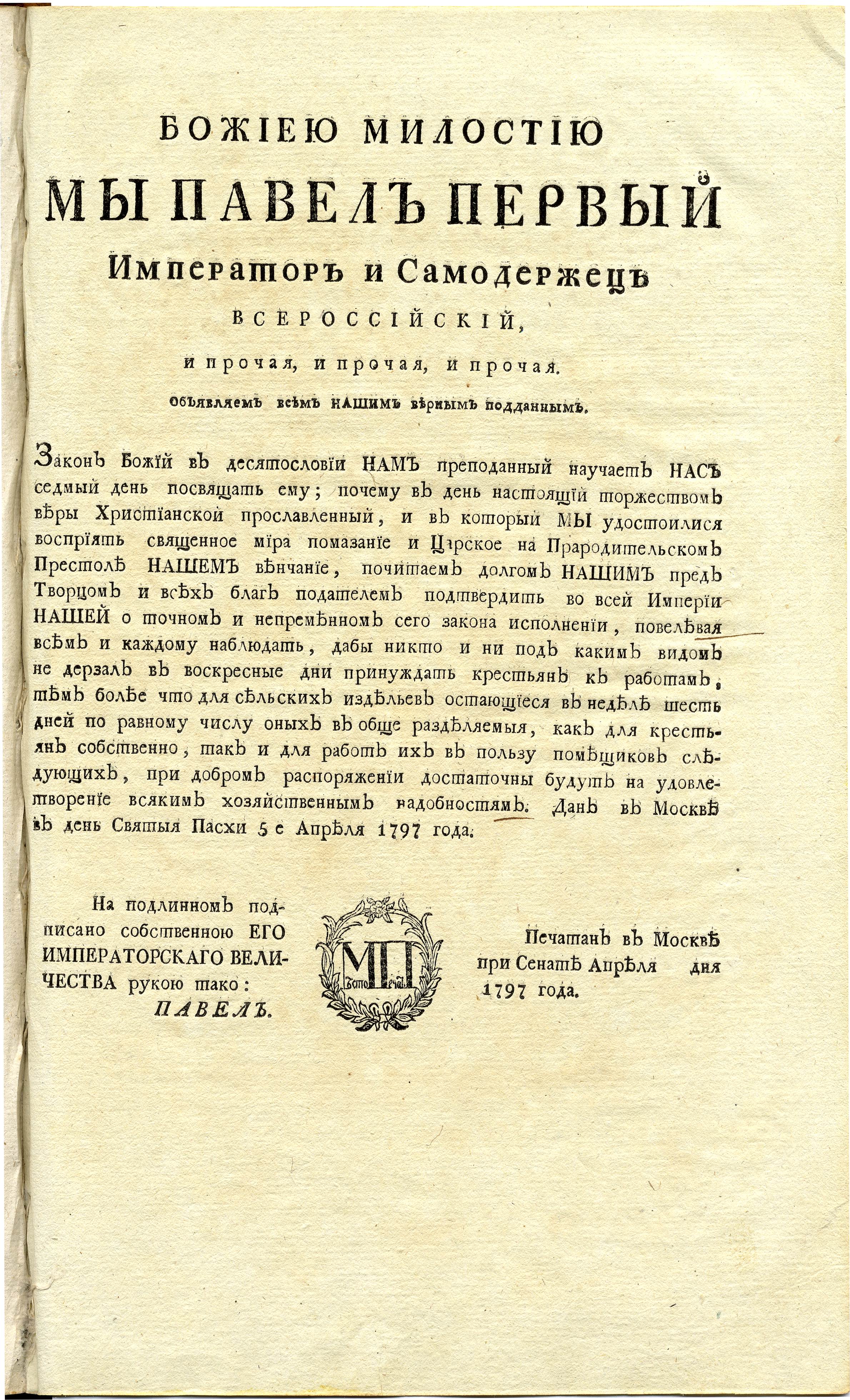
Certainly, Paul's reign was short compared with that of his mother, and he made many enemies among the nobility  as a result of his ambitious reforms.  Tsar Paul, far from being a bitter man obsessed with personal power, followed both his father and Frederick II of Prussia in improving the quality of life for ordinary people in his domain, at the expense of the nobility. Paul I, much like his father, discussed below, firmly believed in using enlightenment principles in order to improve the lives of Russian serfs. Paul I placed limits on the amount of labor landowners could extract from peasants: preventing them from working Sunday, and allowing peasants to work for three days of the week for their own interests/profit.[11] Russian serfs now had Sunday's as a day of religious observance, and could pursued their own labor for an equal amount of time as they work for landlords.  Furthermore, he modified the laws concerning the sale of serfs, mandating that serfs could only be sold with their land. This step ensured that families of serfs in Ukraine could no longer be separated when they were sold by their landowners.[12]  However, for all his enlightenment principles, Paul could not bring himself to liberate the serfs, as he was afraid of the consequences to his power.

In the course of his military reforms, Paul made enemies, and on three occasions, he got into a dispute with army officers heated enough that he beat them with a cane. Christopher Duffy notes that Paul eventually apologized on each occasion, and further states that, "there is much evidence to show that Paul was a man of idealism, honesty, and (we  have to say) sweetness and courtesy."[13] Paul's military reforms likewise showed a humane streak, and wrote in his Tactical Rules of 1797, "The soldier must always be regarded as a human being, for almost anything can be obtained through friendly dealings. Soldiers will do more for an officer who treats them well, and receives their trust, than for one whom they merely fear."[14]

The final note in the HBO series deals with the end of Paul's reign, claiming that he was murdered on the orders of his son, Alexander. It does this to make Tsar Alexander appear as Catherine the Great's avenger. In reality, Alexander was unconnected to the coup which murdered his father. Paul I had alienated large portions of the Russian nobility by means of his liberal reforms, and a group of these noblemen burst into his bedroom March 23rd, 1801. They first attempted to force his abdication, and then brutally murdered him when he resisted. Count Christoph Lieven described the seen in the aftermath of the murder. The former Tsar's younger son, Grand Prince Constantine was, "bathed in tears", while the noblemen around him rejoiced, while the new Tsar, asked for Lieven, and "fell on his shoulder, and sobbed, "My father, my poor father."[15]

Paul I's murder at the hands of drunken noblemen was not a triumph for Catherine the Great, it simply continued a generational story of murder in the Russian Court, and the pain of loss that young Tsars felt at the murder of their fathers.

If you enjoyed this post, or any of our other posts, please consider liking us on facebook, or following us on twitter. Finally, we are dedicated to keeping Kabinettskriege ad-free. In order to assist with this, please consider supporting us via the donate button in the upper right-hand corner of the page. As always: 


Thanks for Reading,


Alex Burns


-------------------------------------------------------------------------------------------------------
[1] Simon Dixon, Catherine the Great, 218.
[2] Sbornik Imperatorskago Russkago Istoricheskago Obshchestava, Vol 13, 265-6. (Translation is Simon Dixon's.)
[3] Dixon, Catherine the Great, 219.
[4] Sbornik Imperatorskago Russkago Istoricheskago Obshchestava, Vol 23, 621.
[5] Sebag Montefoire, Prince of Princes, 240-241.
[6] Politische Correspondenz Friedrich's des Großen, Vol 35, pg. 122
[7] Ibid, 123.
[8] Ibid, Vol. 38, 138.
[9] Christopher Duffy, Russia's Military Way to the West 1700-1800, 200.
[10] Dixon, Catherine the Great, 315.
[11] This manifesto was widely printed, the text can be read here.
[12] See Paul's Decree of October 16th [27th], 1798.
[13] Duffy, Russia's Military Way, 207.
[14] Quoted in Duffy, Ibid
[15] Quoted in Duffy, Ibid, 232. 

Wednesday, November 13, 2019

HBO's "Catherine the Great": The Role of Peter III


Tsar Paul with the remains of Peter III
Dear Readers,

It should come as no surprise that I've been watching HBO's new drama regarding the reign of eighteenth-century Russia's enlightened monarch: Catherine the Great. Catherine was an exceptional woman who led Russia successfully for over thirty years. The length of her reign was nothing short of astounding for eighteenth-century Russia, over 4 times the average length of a Tsar(ina)'s rule after Peter the Great.  This alone is an incredible accomplishment, one which vaulted her rule into the (now defunct) category of "enlightened absolutist" monarchs in the eighteenth century. Though English language historians have often focused on her various sexual affairs and "favorites", Catherine deserves to be recognized as a powerful monarch for her achievements, not her scandals.

After seizing the throne, Catherine waged a number of successful campaigns against the Ottoman Empire, reformed the education system of the Russian Empire, making education to a greater (though still small) number of her subjects. Furthermore, as the HBO briefly mentions, her development of the Smolny Institute allowed select women to receive higher education for the first time in Russian history. She was a patron of the arts, and like Frederick II of Prussia a generation before, had graduated to the position of senior stateswoman of Europe by the time of her death in 1796.

Image result for HBO Catherine the Great
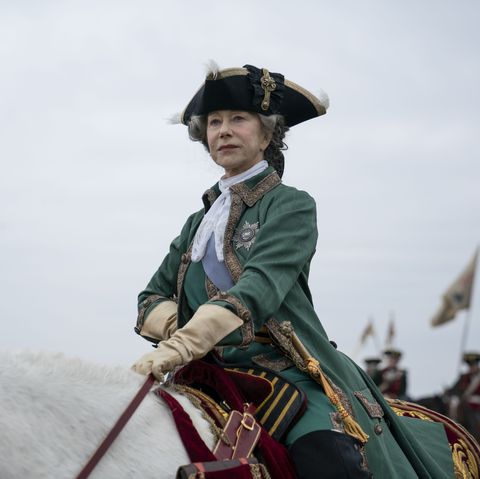
Helen Mirren in her portrayal of Catherine II

The point of this post is not to review the HBO miniseries, but to delve into a specific aspect of it. For all its successes, the HBO miniseries falls dangerously short of the mark when portraying both Peter III of Russia (Catherine's husband) and Paul I of Russia (Catherine's son). Despite portraying Catherine as a complex and challenging historical figure, the miniseries leaves Peter and Paul to fulfill the role of fairly one-dimensional villains. Peter III ruled Russia for barely six months in 1762, before the coup which took him from the throne and his death a week later. Paul I ruled for a bit longer, four and a half years between November of 1796 and March of 1801. Like his father, he was deposed by army officers in favor of another ruler.

Both of these men, but particularly Peter III, have had few friends, both historiographically, and during their lifetimes. Largely, this is a result of their decision to rule as distinctly Germanic enlightenment-era monarchs in Russia. The Napoleonic era, and, of course, the experience of the twentieth century convinced Soviet historians that Peter and Paul were Germanic traitors, besotted with Prussia, who essentially got what they deserved. This language is repeated, largely verbatim, in the HBO miniseries. Catherine is portrayed as a woman who hates "Germany", Germans, and the German language.  This first post will discuss how the HBO series portray's Peter III, who is present in the series, in skeletal form. Grizzly. Subsequent posts will examine the life of Paul I, and other aspects of the show.


Emperor Peter III,, 1762, by Fyodor Rokotov

Over the last forty years, historians have significantly revised our understanding of both Peter III. An older generation of historiography, as well as Franz Szabo's recent English language survey of the Seven Years War, portrays Peter as a, "boorish, obnoxious, obstinate, and capricious young man of arrested development and limited intelligence."[1] These characterizations of  Peter III struggle to mesh with his policy record, which even Szabo notes involved the reduction of taxes, releasing the nobility from permanent military service, and forbidding the sale of serfs to large industries .[2] A further examination of Peter III's reign demonstrates that he was an advocate for religious toleration, allowing for the toleration of the Old Believers in Russia.[3] Peter III promoted educational institutions in Russia, and as noted above his wife would continue this policy during her reign.[4] As an enlightened monarch, Peter III decreed that it was a crime for landlords to kill their serfs, and those who did so would be exiled for life, (small steps, to be sure.)[5]

How can we account for this discrepancy between Peter III the mentally disabled (Szabo implies but fails to use this term) and Peter III the reformer?  

If Peter III was a reformer, and relatively effective ruler, why was he deposed? The answer to this riddle lies in his position as a monarch from German Central Europe who was also the ruler of a larger empire. Historian Peter Wilson has suggested that rather than focusing on Peter III's supposed obsession with Prussia, understanding his role as dual monarch who cared more about his position as Duke of Holstein-Gottorp than his position as Tsar of Russia. [6] Peter III of Russia, like George I of Britain, preferred the familiar politics of the small German state of his birth over the imperial politics of his inherited and adopted empire. George I disliked England, likewise, Peter III of Russia disliked Russia. As such, he ended a relatively successful war with Frederick of Prussia (the Seven Years War) in order to pursue aggressive foreign policy against Denmark. Again, his goals were that of a minor German prince, not the Tsar of Russia. In hindsight, this failure to embrace his role as the Tsar of Russia, rather than mental instability or "weakness" brought down his regime. Catherine II embraced her role as a Russian ruler to the exclusion of her former German identity, and as a result ruled a massive empire quite successfully for over thirty years. In order to achieve this, Catherine deposed and murdered in her husband, and her views on Peter III have dominated the historical memory of Peter's reign.

Both Peter III and his son Paul I allowed Prussian military thinking to dominate their regimes, both conducted drills of their own battalions of soldiers. In this way, they followed the example of Peter I "the Great" of Russia as well. Peter the Great had drilled a small, "toy" army of soldiers during the rule of his half-sister Sophia, and eventually used these soldiers to overthrow her. Like Peter III and Paul I, this earlier "toy army" was drilled by German-speaking instructors.[7] Both Peter III and Paul I were afflicted with a especially bad case of Prussomania, and for Peter, his decision to end the war with Prussia quite literally led to his downfall and death.

Another point of contention between historians: was Peter III murdered? Although there is a possibility that his death was natural, brought about by the stress of Catherine's coup d'état, it is much more likely that Peter III was murdered. At the end of the day, this issue is officially unresolvable, but it begs a question. Which seems more likely: that a 34 year-old man would die of complications from hemorrhoids (the official cause of death), or that a politically inconvenient former ruler would be murdered 8 days after his government was overthrown in a military coup?  In a conversation during the first episode in the HBO series, Paul I and Nikita Panin discuss the likehood of this event. As the HBO series clearly depicts Catherine II also ordered the murder of imprisoned former child-Tsar Ivan VI, when it appeared that he would be freed by disloyal army officers.

Peter's legacy remained contested even in his own time, with the appearance of perhaps as many as 40 "false" Peter III's.[8] Of these, the most famous was the Cossack leader Pugachev, but he was far from alone using Peter III's legacy with the common people of Russia.The greatest legacy of Peter III, however, is the way he was remembered by his son, the future Tsar Paul. Paul attempted to fulfill many of his father's ambitions, particularly in his reforms of serfdom, the nobility, and the military in Russia. Paul also receives much more attention in HBO's miniseries, and will be the subject of the next post on this miniseries.

If you enjoyed this post, or any of our other posts, please consider liking us on facebook, or following us on twitter. Finally, we are dedicated to keeping Kabinettskriege ad-free. In order to assist with this, please consider supporting us via the donate button in the upper right-hand corner of the page. As always: 


Thanks for Reading,


Alex Burns


------------------------------------------------------------------------------------------------------------------
[1] Franz Szabo, The Seven Years War in Europe, 381. 
[2] Ibid, 382. 
[3]Carol S. Leonard, Reform and Regicide, 20. 
[4]Ibid, 21.
[5]Aleksandr Sergeevich Myl'nikov, "Peter III" in The Emperors and Empresses of Russia: Reconsidering the Romanovs, 121-122.  
[6] Peter H. Wilson, German Armies: War and German Politics, 279.
[7]Duffy, Russia's Military Way13-14, 200-201.
[8]нтонова И.В., Ярыкина И.Г. Интегрированный урок по курсу истории России и литературы в 8-м классе "Емельян Пугачёв: кровавый убийца или народный герой" (Chapter 6)