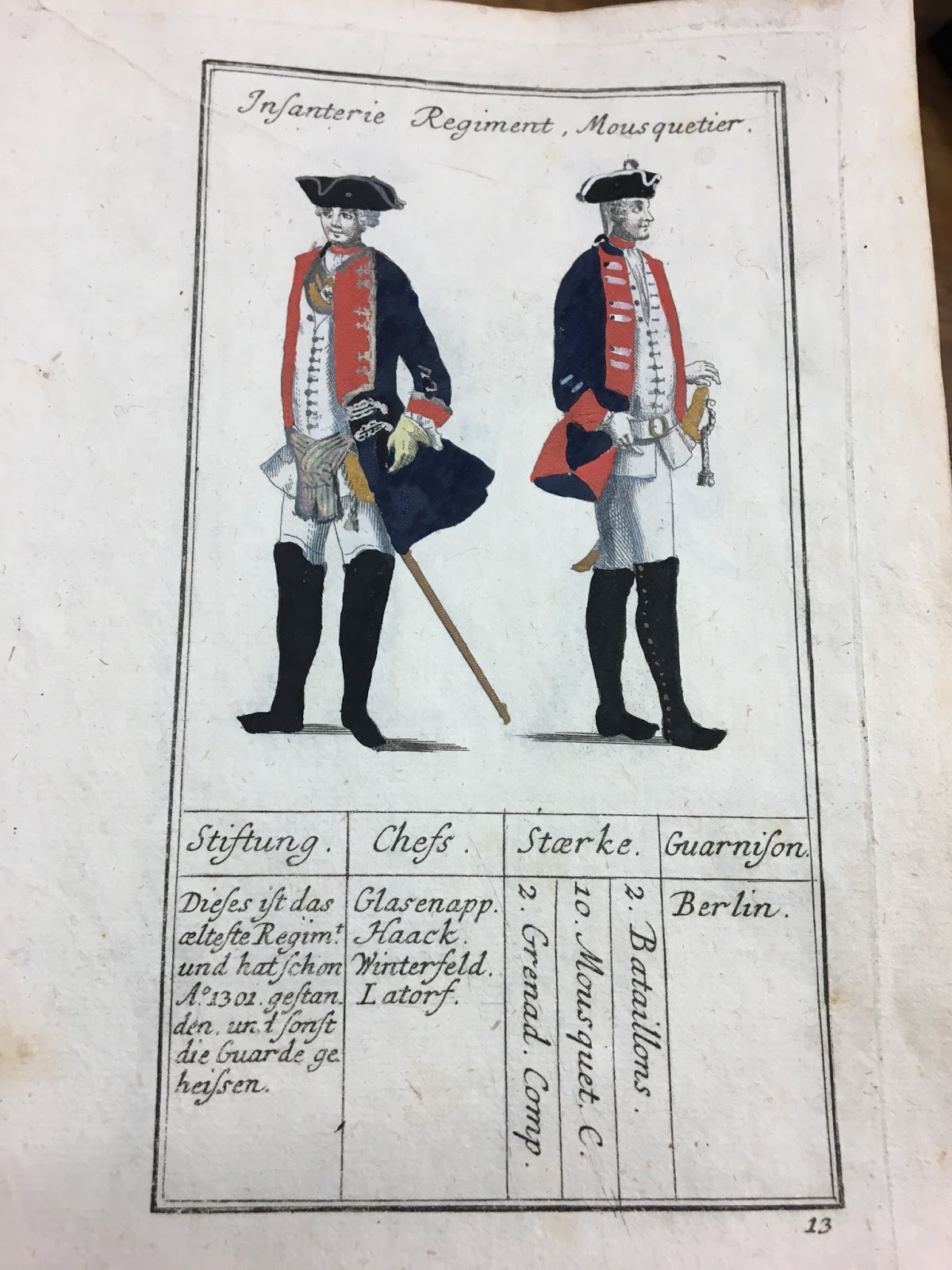
Von Schmalen's interpretation of a Prussian Fahnen-Junker
Dear Reader,
Today, I wanted to share a brief treat with you. In the first week of 2018, I had the privilege of taking a trip to research in Washington, D.C. In the course of my research, I came across a copy of von Schmalen's Accurate Vorstellung der Samtlichen Koeniglich Preussischen Armee, a uniform series published in 1759. Schmalen was an officer in the Prussian Army, and qualified to gather the information required for an accurate series of uniform plates. Although the images are available elsewhere online, I took the liberty of photographing them to share with you all. This copy of Schmalen has a number of unique characteristics, such as the clearly marked gaiter buttons on the Prussian Jäger zu Fuss. In other online copies, I have seen these distinctions are somewhat faded. Regardless of the various errors, this uniform series is one of the visual sources in our understanding of the Prussian army during this era.
Please note: The units are not depicted in standard numerical order, as on websites such as Kronoskaf. I have included the key for identifying which Chef (or colonel-proprietor) is in command of which unit. The page number is located at the lower right-hand corner of each image.
The cover is showing its age
Title Page
The key to plate numeration
Feel free to share this post wherever you think it may be useful. I will follow the post up later this week with cavalry, Jägers, and Freitruppen.
Soldiers of the King's Regiment practice close-order drill at Fort Niagara
Dear Reader,
Whew! What a year it has been. I want to thank you all for reading these posts. Your enjoyment, and the spreading of historical knowledge, is the main reason for this blog. Kabinettskriege started in 2013 as a way for me to continually practice the art of writing, and has grown a lot since that time. This has been Kabinettskriege's second most prolific year, with a total of 45 posts. I want to close this year with two questions for you:
Here at the beginning, I would like to ask you to take a moment and complete the poll in the upper- right-hand corner of the blog. Where should the blog go from here? Feel free to give me more detailed comments below, or contact me via the "about the author" page.
Second, I would ask you to consider writing for Kabinettskriege. Many of you know more about this period of history than I do, and you should consider sharing that knowledge with us! Again, if you are interested in writing for Kabinettskriege, contact me via the "about the author page." Any topic relating to warfare between 1648 and 1789 or its representation will be considered. We had an excellent first guest-post this year, written by Jack Weaver. There is a link to the post below.
Once again, I want to thank all of those who have given feedback and continue to research this era of conflict. The research of individuals such as Christopher Duffy, Don Hagist, Matthew Spring, Will Tatum, Ilya Berkovich, Steve Rayner, and so many others, makes this blog possible. With the remainder of this post, I want to provide a quick way for readers to catch up with posts they might have missed, as well as a way to return to previous posts for reference or enjoyment. To reach these posts, simply click on the links below.
Finally, after some consideration, I have added a donate button to Kabinettskriege. If you enjoy the blog and would like to support the page, I would welcome it. I am dedicated to keeping this page ad-free.
Today, we are going to address one of the primary conceptions of eighteenth-century warfare: that on the battles were conducted at a slow-moving, geometrical pace to the sound of drums. In 1987, Christopher Duffy, asserted that "the time has long since passed since it was fashionable to dismiss [warfare in] the eighteenth century as decorative interval, suspended between the glooms and dooms of the Wars of Religion and the grinding industrialization of the nineteenth century."[1] Yet somehow, this is still the dominant image of warfare in the Kabinettskriege era. The eighteenth century, in the popular imagination, is still a time where English officers doff their hats and say to their chivalrous opponents, "gentlemen of France, fire first!" According to this view, soldiers move to the beat of drums in perfect clockwork precision, and cannot imagine combat occurring outside of a geometric, mechanical framework. To holders of this viewpoint: this century is still a decorative interval, as the clip below indicates.
It goes without saying that some portions of this stereotype are correct. As a result of the principle weapons system of the time, the smoothbore musket, soldiers did usually fight in linear formations. In Europe, these linear formations were usually in close order. However, as I have suggested before, there was a difference in the eighteenth century, as there is today, between the parade ground and the battlefield. These officers and soldiers were not unthinking automata who were incapable of performing any tasks but those learned on the drill square. Rather, under the direction of junior officers, they frequently modified their actions to fit with local conditions. Soldiers often moved quickly on the battlefield as the situation demanded, often moving at a run in moments of crisis.
To students of the British Army in the American War of Independence, this should not come as surprising news. Matthew H. Spring has recently shown that British soldiers fought unconventionally in North America. However: this trend goes beyond North America and the American War of Independence. Eighteenth-century soldiers were often rational actors, and made competent decisions based on the needs of the moment, and battlefield crises. This willingness to respond quickly to developing factors was not a feature of the British or Prussian armies, but common to almost all eighteenth-century militaries. In performing the research for this post, I have been careful to distinguish intentional quick movement on the battlefield from the speedy flight of retreating troops.
Jacques Mercoyrol de Beaulieu, a French veteran of the War of Polish Succession in the 1730s, recalled the types of battlefield movements possible in heat of the moment: "In these battles, (which were all victories) the Picardie Brigade... moved almost as in a race: the most nimble arrived first, their arrival awakened courage and new strength to those already engaged in combat."[2] Moving quickly, perhaps even at the run, was common enough on European battlefield when speed was required.
A nineteenth-century reimagining of the Battle at Leuthen
The Prussian army was famous for its attention drill and parade excellence. It may therefore surprise readers to learn that Prussian soldiers under Frederick the Great occasionally moved with great speed. The official war journal of the Prussian Fusilier Regiment of Jung-Brauschweig makes this clear. In describing the Battle of Prague in 1757, the journal describes two instances of quick movement: both the Prussian regiment and their Austrian opponents moved at speed.
In order to reach the position of advance, we had to pass a long dam, which delayed us. So, in order arrive at the correct time, we had to run past the village of Arhem: the regiment was not in perfect order. The (Austrian) enemy were already advancing on us at the quick step, and we engaged them.[3]
Johann Jakob Dominicus, a musketeer in Frederick II's army, also remembers running at Prague. He wrote, "our left wing had its work cut out for it, and we had to run with energy, in order to get under the enemy guns."[4] In Prussia, speed, and reaching the appointed position at the right time (so as not to leave a gap in the battle line) took precedence over moving in step and keeping good order. Prussian veteran Georg von Berenhorst asserted that commanders who lost time by correcting minor irregularities in dress were punished, as maintaining a healthy and cohesive battle line was more important than keeping in parade appearances.[5]
General Ludwig Matthias von Lossow recalled that as soon as the firing began, "the orderly lines fell by the wayside, as they did whenever troops advanced through terrain, as it is rarely open enough to permit lines of this size. Units only needed to keep in contact with the other parts of the line, that was the main thing, as the experienced army of Frederick II knew well."[6] Keeping in contact with other units, and keeping up the advance, it seems, was more of a priority than keeping in perfect close order. A Dutch officer in Prussian service recalled a nighttime skirmish in 1757:
"Because of the darkness of night, we had difficulty distinguishing our troops from the enemy, so Lt. York received orders to reconnoiter the enemy with two platoons. They fired on him. Captain Rodig, who had been fired upon, rode out to these flanquers[7]... His pickets behaved bravely, and kept up and orderly fire in the manner of platoons. They then rushed forward on the command, "Marsch! Marsch!" The enemy took flight with haste. [8]
"Quick movements, which considerable columns or lines of infantry,[Frederick II] considers as impracticable and ruinous from the hurry and disorder that must thence ensue... but brigades, or smaller divisions of the line, [such as regiments or battalions] occasionally lengthen their step, and move on with rapidty at the moment of attack.[9]
British Soldiers Moving to Attack the Enemy
In delegating more responsibility to junior officers, the British facilitated quick movement even more in North America during the American War of Independence. Matthew H. Spring exhaustively shows that British troops moved at a kind of jog or trot:
"The King's troops, 'briskly marched up to' the enemy at Long Island, 'briskly ascended ' Chatterton's Hill, 'advanced fearlessly and very quickly' at Brandywine, came on at Bemis Heights at a, 'quick step' stormed for Clinton, 'with as much velocity as the ground would admit,' and 'after a very quick march moved up briskly' against the enemy at Monmouth. Likewise, in the South, the redcoats, 'marched forwards briskly, or rather rushed with great shouts,' at Savannah, were observed 'advancing rapidly' at Briar Creek, and 'rushed on with the greatest rapitity' (or 'as fast as the ploughed fields they had to cross would admit') at Spencer's Ordinary. Most expressively of all, one rebel militiman at the battle of Cowpens later recalled, 'the British line advanced at a sort of trot with a loud hallo. It was the most beautiful line I ever saw,' while another reported that the King's troops, 'advanced rapidly as if certain of victory."[10]
All of the quotes in the above paragraph come from observers present at the battles, and Spring provides a detailed footnote for those looking to track them down. Thus, in the American War of Independence, British soldiersmoved quickly as part of usual practice, rather than speeding up when the circumstances demanded it. Roger Lamb recalls that the British moved forward at Guilford Courthouse, "in excellent order, at a smart run, with arms charged."[11] At the same battle, the normally slower Hessians in the Von Bose Regiment joined the British advance with speed:
"After quickly laying aside our tornisters and everything that could impede a soldier, the 71st and von Bose recieved orders to more forward and attack the enemy... We had not advanced more than 300 yards when we found a deep ditch in front of us, with tall banks and full of water. After crossing it with difficulty, we then came to a fenced wheat field; on the other side of this field 1500 continentals and militia were deployed in line... I formed the battalion into line with the greatest of speed and we ran to meet the enemy in tolerable order."[12]
Don Troiani's Study of a Von Bose private
Other German allies of the British, the Brunswickers under Baron Riedesel, appear to have moved at speed during the culmination of a flank attack during the Battle of Freeman's Farm on September 19th, 1777. Hearing the English troops engaged with the rebel Americans, Riedesel moved out, "as quickly as possible," and launched his final attack, "at the quick-step."[13]
It is important that we do not overdraw these examples. In the eighteenth century, most European commanders valued ordered bodies of men, and preferred to attack in an orderly fashion. However, in moments of crisis, European junior officers frequently took it upon themselves to move bodies of men at speed, in order to contain crises or take advantage of conditions. The British took a decidedly different approach in the American War of Independence. In that conflict, speed was instiutionalized in the British Army. Whether in Europe or North America, these soldiers were not automata: they moved at the speed demanded by the situation.
--------------------------------------------------------------------------------------------------------------------------
[1] Christopher Duffy, Military Experience in the Age of Reason, 3.
[2] Mercoyrol de Beaulieu, Campagnes, 184.
[3] Anonymous, Sammlung ungedruckter Nachrichten, Vol 4, 118.
[4] Dominicus, Tagebuch, 16.
[5] Berenhorst, Betrachtungen, Vol 1, 221.
[6] Ludwig von Lossow, Denkwürdigkeiten zu Charakteristik, 242.
[7]Possibly a type of skirmisher, see my publication in the 2014 issue of the Journal of the Seven Years' War Association.
[8] Anonymous, Schreiben eines Hollaendischen Volontairs, 5.
[9] David Dundas, Principles of Military Movement, 9.
[10] Matthew Spring, With Zeal and With Bayonets Only, 146.
[11] Roger Lamb, Journal, 361
[12]Du Buy, Raports vom Oberst Lieut. du Buy Regts v. Bose zu der General Lieutenant v. Knyphausen, Staatsarchiv Marburg, Best. 4h Nr. 3101.
[13] Eelking, Leben und Wirken, Vol 2, 149-50.
Knotel image of a Prussian officer, filled with frustration that he failed to make the cut for this post
Dear Reader,
Today, we are going to do something a little fun. Motivated by a recent article about math and military greatness, I have updated an older series on commanders in the Kabinettskriege era. For those new to the blog, essentially: Who were some of the greatest generals between 1648-1789? In the vein of my earlier post, Who was the Best? on relative efficiency compared between eighteenth-century armies, we will be examining the great captains this age. But how can we define military "Greatness?"In order to get a wider picture of these individuals military capabilities, I will be ranking the 15 men as commanders by 5 criteria:
A) Battle win-loss record.
B) Achievement and sustainment of strategic/political aims
C) Charisma/inspiration of soldiers under their command
D) Scale of operations under their personal command
E) Display of originality/flexibility in thinking
The top fifteen enumerated in the following posts were chosen from this list. In order to make the list, they had to hold an independent command on land (I might consider admirals in a separate post). If your favorite Kabinettskriege-era general didn't make the list, comment below, give some reasons why, and I might just consider updating the post.
Here are the contenders, in order by time period:
Karl X Gustav of Sweden
Jan III Sobieski, King of Poland
Henri, Vicomte de Turenne
Louis de Bourbon, Prince of Conde
William III of England, Prince of Orange
Duc de Villars, Marshall General of France
John Churchill, Duke of Marlborough
Prinz Eugene of Savoy
Peter I of Russia "the Great"
Karl XII of Sweden
Peter von Lacy
Nadir Shah
Maurice de Saxe, Marshall General of France
Leopold von Anhalt Dessau
William Augustus, Duke of Cumberland
Prince Charles Edward Stewart
Frederick II Hohenzollern, "the Great"
Duke Ferdinand of Brunswick
Prinz Henri of Prussia
Leopold Joseph von Daun
Ernst Gideon von Loudon
Franz Moritz von Lacy
Pytor Alexandrovich Rumyantsev
Piotr Semionovitch Saltykov
Sir William Johnson
James Wolfe
John Bradstreet
Robert Clive
Jeffery Amherst
Louis-Joseph de Montcalm
Victor Francois, Duc de Broglie
Obwandiyag (Pontaic)
Sir William Howe
George Washington
Charles Cornwallis
Benedict Arnold
Nathanael Greene
Bernado de Galvez
Banastre Tarleton
Daniel Morgan
Alexander Suvorov
This post will be followed by three others, each containing five individuals who made the top fifteen spots. 15-11 10-6 Top 5
British Reenactors at the Battle of Guilford Courthouse
Dear Readers,
Today, I want to examine two methods of changing front in the eighteenth century. The first method, called wheeling, is quite well known even to individuals with a passing knowledge of military life. Timestamp 00:30 in the following video displays Hessian reenactors demonstrating a wheel in the 2015 Battle of Trenton reenactment. The basic concept is that one end (or the center,) of the line remains relatively stationary, while the rest of the formation pivots around it.
The concept is quite simple, and was widely used in eighteenth-century armies. However, historians and reenactors have identified another way which troops in the eighteenth century also reformed their front. By the 1780s, the British had developed a number of different ways of using this type of motion, with different orders for different situations. Troops would perform tasks such as forming to the right and left, a much faster way of wheeling on the run. Another way of changing the unit frontage in a rapid manner was breaking and reforming. In this method, the troops are dispersed, and then commanded to reform, usually facing a different direction than before.
As opposed to the more stately wheel, troops were expected to reform the company at a much quicker speed. At timestamp 00:34 in the following video, you can see reenactors portraying British troops part of the way through executing this maneuver. In the video, they are reforming their front from a position perpendicular to the camera to one parallel, facing the camera.
Up until this point, the exact origin of this maneuver is unclear. Reenactors have theorized that it came about as a result of British experience during the Seven Years' War in North America. Specifically, the first British source to mention this idea, Townshend's Orders to the Irish Establishment, given on May 15th, 1772, reference the idea as a light infantry exercise. The maneuver is to be carried out by "Light Infantry Companies...marching through a Wood or any Strong Country."
The next British source to describe this idea, Thomas Simes, The Military Instructor, was printed in 1779. Rather than a company, Simes describes the maneuver as something that a battalion to execute in case of dispersal by the enemy. This command is a three-step process. The commanding officer of the battalion gives the order: "Take care to disperse: March." At this point, the officers and colors of the battalion take six paces to the front, and the drummers give a long roll. Upon the command, "to arms," the battalion reforms around the colors.[1] Finally, John Williamson's The Elements of the Military Arrangement, published in 1782, gives a much greater discussion of the various ways a company could use this process in order to reform on the run. Williamson describes this as a new method of wheeling, which is making the old style of wheeling obsolete.[2]
If not for the obvious similarities in these discussions, you could almost believe that they were three separate ideas, independently formulated. Townshend's is clearly a measure designed to change the front of company-sized element of light infantry, Simes is a formalized order for reforming a battalion he does not even mention changing frontage. Williamson's treatise makes it clear that speed, rather than formality, is the purpose of the exercise. However, my submission to you all is that all three of these authors drew on the same idea, and that the originator of the idea was not even an officer of the British army, but rather, this guy:
Frederick II, King of Prussia
The 1743 Prussian infantry regulations, authored by Frederick II, often called, "the Great" contain a passage in which the kernel of all of these elements can be identified.
Like Simes, Frederick identifies dispersal with an enemy attack, or "entstandenen Alarme," (Spontaneous Alarm), and describes the maneuver with a battalion size element in mind. Indeed, Simes seems to lift much of his text directly from the Prussian Reglement. Like Townshend, Frederick intends his officers to use the maneuver to change the frontage of their units. The officers were to swiftly, "change the front via the colors," and that soldiers received commands to, "face to the colors." Finally, like Williamson's treatise, Frederick indicates that the maneuver should be carried out with a high degree of speed. After dispersing, battalions should reform themselves, "with the utmost speed," and that after the order to reform has been given, "rush to reform themselves in their ranks and files."[3]
Prussian Reenactors performing this manuever
Thus, it would seem that Prussian ideas, rather than North American experience, led to the development of reforming fronts. This should not necessarily, surprise us: Williamson is explicitly overt in praising and copying Prussian ideas, while Simes directly copies portions of Faucwitt's translated Prussian regulations. With that being said, the British developed and perfected this idea in North America. As Matthew Spring has shown in With Zeal and Bayonets Only, the British greatly adapted their tactics to a North American environment. By 1785, Charles Cornwallis expressed disgust at the outdated Prussian infantry maneuvers:
"The cavalry is very fine; the infantry exactly like the Hessian, only taller and better set up, but much slower in their movements. Their manoeuvres were such as the worst General in England would be hooted at for practising; two lines coming up within six yards of one another, and firing in one another's faces till they had no ammunition left: nothing could be more ridiculous."[4]
So, while the Prussian infantry may have been at the cutting edge of tactical development in the 1750s, the British had clearly surpassed them in infantry maneuvers by the 1780s. I believe the lessons for reenactors are rather clear, and many reenactors are currently implementing these ideas. But what about wargamers?
Many rulesets make wheeling a more costly affair (in terms of inches available) than simply moving straight. European soldiers appear to have applied inventive solutions to the problem of wheeling, but how often do we see these abilities on the wargame table? I would like to offer the follow solution to the issue of changing front. As opposed to a manner requiring a move, any unit should be able to change front with no penalties following a check. In Dean West's Final Argument of Kings ruleset, this is called a TCT, or tactical competency check. If units fail this check in the movement phase, they should still be allowed to change front, but must fall into disorder. John Williamson is particularly clear that troops could perform this maneuver while under fire, and that it performed well, it would not impede their ability to return fire.[5]
Finally, if anyone has information regarding the use of this maneuver earlier than 1743, please come forward! Frederick II was doubtless influenced by contemporary military thinking. Some have claimed that this practice is found in the Ordonnances du Roi, but I have yet to find a version before 1743 which describes changing front in this way. Has anyone seen this tactic used in the Marlburian era?
If you enjoyed this post, or any of our other posts, please consider liking us on facebook, or following us on twitter. Finally, we are dedicated to keeping Kabinettskriege ad-free. In order to assist with this, please consider supporting us via the donate button in the upper right-hand corner of the page. As always:
Thanks for Reading,
Alex Burns
--------------------------------------------------------------------------------------------------------------------------
[1] Thomas Simes, The Military Instructor, 29.
[2] John Williamson, Elements of Military Arrangement, 50-52.
[3] Reglement vor die Königl. Preussische Infanterie, 1743, 130-132.; Fawcett, Regulations for the Prussian Infantry, 107-108.
[4] Cornwallis, Correspondence, 1859, vol I, 212.
[5] Williamson, Elements of Military Arrangement, 51.
Today, I want to touch on a rather controversial subject.* The subject is the infantry fire effectiveness of mid-eighteenth century European and Euro-American armies. At the outset, "shooting at marks" or target practice, was common in many eighteenth-century armies. Specifically, I am examining the accuracy and limitations of firepower regular soldiers from the British and Prussian armies in the 1740-1783 era. Many people have firm beliefs on this subject and feel that the eighteenth-century musket was a rather poor weapon.
First of all, by modern standards, the smoothbore musket of the mid-eighteenth century was not a terribly accurate weapon. However, we need to judge it by the standards of its own time, not modern standards. In the eighteenth century, more accurate weapons existed, such as the rifles carried by specialized American troops, and Hessian Jägers. However, those weapons also took a significant time to load.
To see the drawbacks of rifles firsthand, examine this pair of videos. The first shows a musketeer and riflemen loading side by side. The second video, below, shows how quickly British soldiers could move in order to attack riflemen with bayonets. The rifleman, offscreen, is portrayed by the director of interpretation at Old Fort Niagara, Davis Tierney. Just before the video begins, Davis has fired a shot, incapacitating one soldier. In the remaining 13 seconds, the British troops quickly cross the 100 yards separating the opposing forces.
When bayonets were not the primary form of attack, how accurate could smoothbore-equipped forces be against one another? The Journal of the American Revolution has featured a number of posts on this topic. The purpose of this post is not to rag on any of the work of these academic, public or amateur historians. In this sense, I use amateur as it is intended to be used: these individuals are interested in the topic for the love of it, and care for it, not simply motivated by the career-orientated goals of a professional historian. As a result of these works, the general public can access information in an easy to digest format suggesting that the soldiers of the eighteenth century fired at marks, and took time to aim. Almost two years ago, living historians at Old Fort Niagara made this video, in order to seriously address this question. Take a few moments to watch the link, or click on the video below.
Firepower was vital to armies of the mid-eighteenth century. A number of authors have amassed evidence regarding the British Army's dedication to accurate fire. In his book, Louisbourg 1758, Hugh Boscawen gives a very detailed description of the British Army honing their accuracy during the Seven Years' War. During the preparations for the attack at Louisbourg, British troops engaged in extensive marksmanship training, mostly consisting of "firing at a marque" or a man sized target. [1] The 60th of Foot, the Royal American Regiment, was praised for taking good aim during the Seven Years' War in North America.[2] In the course of the American War for Independence, despite their reliance on bayonet tactics British troops frequently practiced shooting at marks, and their Germanic allies followed suit.
British Soldiers take aim near Ft. Niagara
Friedrich Adolf, Freiherr von Riedesel, often called Baron Riedesel by English language historians, left an excellent description of this process.
"General Carleton has decreed that that the army is to practice target shooting or shooting at a goal, I am issuing orders so as to adhere to this as well and as successfully as possible. Each squadron or company is to have some rough boards fastened together, on which a ring of black is to be painted proportionately. The target may be either square or round. Have this target placed at a distance of point blank shot."
"NOW WAIT A MINUTE," you say. How helpful could target practice be at point blank range? Well, fortunately, we have an exact idea what "point blank" meant in the eighteenth century. It may surprise you. Lewis Lochee, the author of a military treatise in this era, notes that, "the point blank of our firelocks... is known to be about 300 yards." [3] For more on the subject, check out this website. With that in mind, let us return to Baron Riedesel:
"Each man of the company will shoot eight times... a non-commissioned officer standing some distance from the target will mark on the target the location of the shot... the company officers are to gather together to prove to the men how well they can shoot and aim. When each man has shot eight times, the entire target practice will be completed. In the judgement of the captain, the one who has made the best four shots will receive the following prizes..."[4]
Riedesel goes on to list a monetary reward, and also gives instructions that men who are waiting their turn to shoot should be kept at ease, so as not to think of target shooting as a hard duty, but something necessary for military life. If Germans in North America took to target shooting with such alacrity, we should not be surprised to find that German soldiers in Europe also worried about the accuracy of their shots.
Firepower was also a key feature of Prussian infantry tactics, where Frederick II's infantry had won him the province of Silesia in the War of Austrian Succession via their skill at loading the musket. Wargamers and reenactors debate Frederick's devotion to infantry firepower based on his theoretic military writings, but that his infantry used firepower in both the attack and defense remains clear. Frederick's mind clearly seems to have been made up on the issue by November of 1757, when after witnessing infantry firepower shattering a spontaneous and abortive French assault in columns at the Battle of Rossbach, he famously stated, "If Chevalier Folard had known how it would have turned out, he would have cursed his sacred columns."[5]
Don Troinai's recent interpretation of Freeman's Farm, one of the
few heavy firefights of the American War of Independence
Perhaps unsurprisingly, given their monarch's Enlightenment persuasion, the Prussian's under Frederick undertook a number of studies concerning accuracy of fire during his reign. The first, after the initial battles of the War of Austrian Succession, revealed that Prussian soldiers were firing to low. According to Mauvillon, a military theorist of the time: "According to my sums, the Prussians fired 650,000 rounds of musketry during their advance at Chotusitz, and the enemy lost scarcely 2,500 dead and as many wounded. If you subtract the men who were killed and wounded by the sword, a great number of rounds must have gone astray!"[6]
Frederick himself was concerned with measuring the accuracy of fire, and as a result his general Winterfeldt had two platoons of Grenadiers fire at a target screen in 1755, scoring between 10 and 13% hits at 300 paces, 16.6% at 200 paces, and 46% at 150 paces.[7] It must be said that this target screen was around 30 feet by 30 feet. Finally, Scharnhorst tested the older musket of Frederick's period in 1813, producing the following results:
(Duffy, Military Experience in the Age of Reason, 207)
However, it is important to realize that none of these tests, no matter how hard they might try, simulated the stress of combat. This prevents these studies from truly helping us understand what occurred on mid-eighteenth century battlefields. For an indication of what that combat might have been like, we can only turn to the documentary evidence. The following two excerpts come from Prussian common soldiers' experiences of the Battle of Lobositz, the first engagement of the European Seven Years' War:
“So the battle began at six o’clock in the morning and dragged on amidst thundering and firing until four in the afternoon, and all the while I stood in such danger that I cannot thank God enough for my health. In the very first cannon shots {my friend} Krumpholtz took a cannonball through his head and the half of it was blown away, he was standing just beside me, and the brains and skull of Krumpholtz sprayed into my face and the gun was blown to pieces from my shoulder, but I, praise God, was uninjured. Now, dear wife, I cannot possibly describe what happened, for the shooting on both sides was so great, that no-one could hear a word of what anyone was saying, and we didn’t see and hear just a thousand bullets, but many thousands. But as we got into the afternoon, the enemy took flight and God gave us the victory. And as we came forward into the field, we saw men lying, not just one, but 3 or 4 lying on top of each other, some dead with their heads gone, others short of both legs, or their arms missing, in short, it was a horrifying sight. Now, dear child, just think of how we must have felt, we who had been led meekly to the slaughterhouse without the faintest inkling of what was to come.” [8]
Prussian Soldiers, from a 1730s painting
Another Prussian soldier recalled:
“Now an indescribable slaughter took place, before we could drive the Pandurs out from among the trees. Our advance troops suffered severely, but the rear ranks pressed after them at breakneck speed, until at last all had gained the height. There we had to go stumbling over heaps of dead and wounded. Then the Pandurs went helter-skelter down the hill, jumping down over one wall after another, down to the level ground. Our native Prussians and Brandenburgers sprang upon the Pandurs like Furies. I too was quite beside myself with heat and excitement, and conscious of no fear or repugnance I loosed off nearly all my sixty cartridges without stopping, until my flintlock became almost red-hot and I had to carry it by the sling; yet I do not believe that I hurt any living thing, it all went into thin air. “[9]
With these examples in mind, the chaos of eighteenth-century warfare can begin to seem a bit more real. These passages help explain Mauvillon's discrepancy between shots expended and casualties inflicted. Eighteenth-Century battlefields were truly chaotic places, and acheiving accuracy with a smoothbore weapon was difficult at the best of times. All that the Prussians (or any other European soldier) could hope for was a comparative advantage in firepower which would drive off the enemy force. And, as a result of thorough training, the Prussians and other armies often achieved that comparative advantage.
Infantry firepower decided many of the battles of the eighteenth century, and as a result, helped shape our world. While, "Muzzle-Velocity" military history may be out of favor with academic historians, it remains a portion of lived human experience, and as a result, a topic worthy of historical thought and explanation.
If you enjoyed this post, or any of our other posts, please consider liking us on facebook, or following us on twitter. Finally, we are dedicated to keeping Kabinettskriege ad-free. In order to assist with this, please consider supporting us via the donate button in the upper right-hand corner of the page. As always:
Thanks for Reading,
Alex Burns
--------------------------------------------------------------------------------------------------------------------------
*This is a largely updated version of an older post.
[1] Hugh Boscawen, Louisbourg 1758, 140.
[2] Alexander Campbell, The Royal American Regiment, 110.
[3] Lewis Lochee. Elements of Field Fortification, 1783, 37
[4] Hessian Documents of the American Revolution, Microform, "Riedesel's Order Book", 21.
[5] Quoted in Duffy, Prussia's Glory, 80.
[6] Translation by Christopher Duffy, quoted in Military Experience in the Age of Reason, 209: Mauvillon, Histoire de la derniere guerre de Boheme, Vol. 1, 100-101
[7] Duffy, Army of Frederick the Great, 128.
[8] Bleckwenn, Preussische Soldatenbriefe , 13.
[9] Ulrich Bräker, Lebensgeschichte Und Natürliche Abentheuer Eines Armen Mannes Von Tockenburg (Zurich: Hans Heinrich Füssli, 1789), 150.