Wednesday, July 6, 2016

Valley Forge vs. the Bunzelwitz Position

The view north from Prussian positions at Bunzelwitz towards the modern
village of Czechy
Dear Reader,


In the mythos of Kabinettskriege conflict, the modern mind is drawn to aggressive action. Those alive to a sense of the past might recall Karl XII's Karoliner attacking through ice-strewn fields at Narva or Fraustadt, the daring attacks by George Washington at Trenton and Princeton, Wolfe's men scaling the heights at Quebec, or Frederick II of Prussia's masterpiece at Leuthen. Today, we are going to examine something a bit less glamorous, but no less vital to securing the reputation of these great commanders: positional warfare.

The two positions under comparison are George Washington's 1777/1778 winter encampment and defensive position near Valley Forge, and Frederick II of Prussia's defensive position in the autumn of 1761, near the fortress of Schwiednitz. We will examine the Prussian position in the Seven Years' War first, before moving to the American winter encampment.

Frederick II, King of Prussia
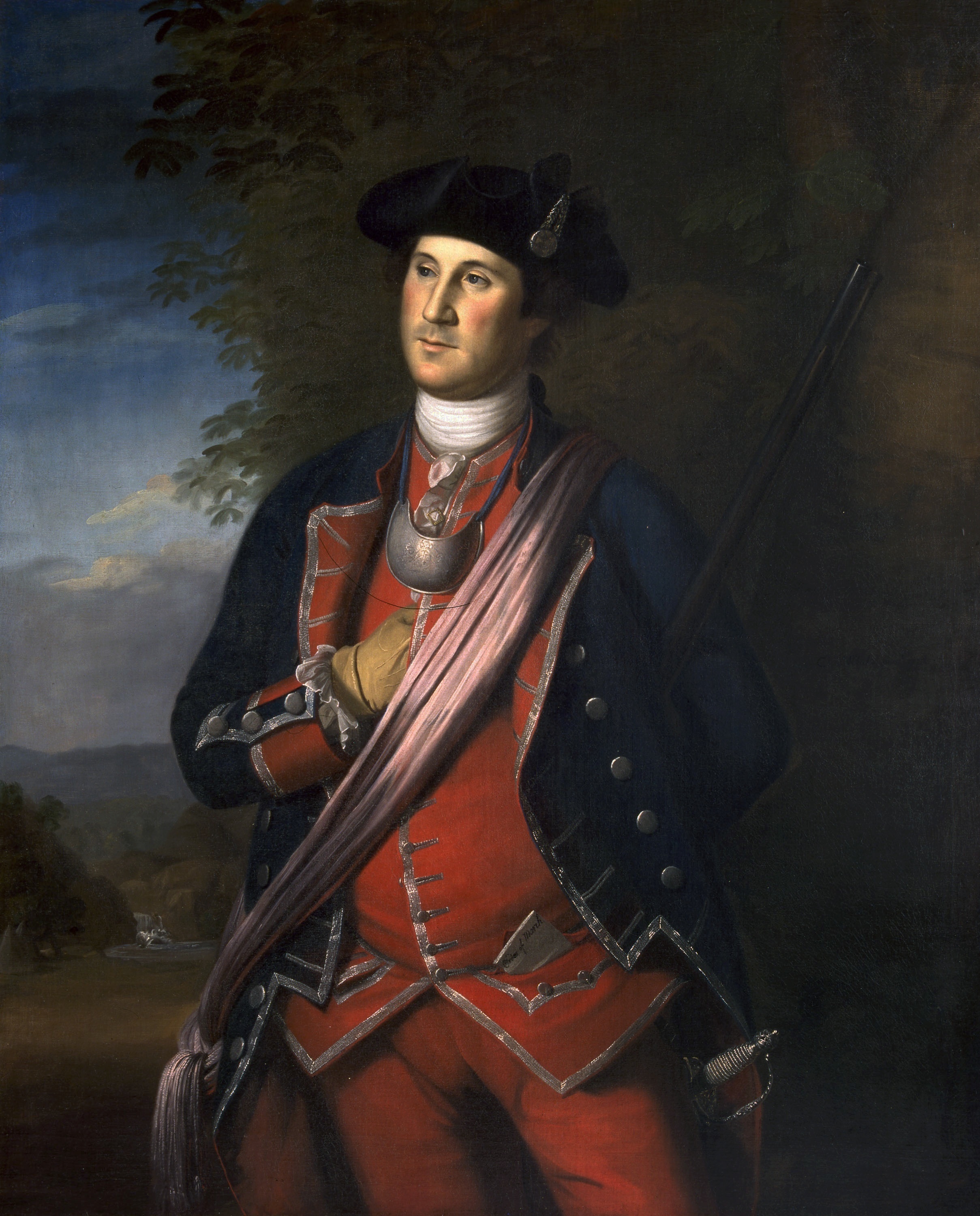
George Washington, (no cool royal title)


Although known for his aggressive attacks, Frederick II was also a master of defensive positional warfare. In 1761, Frederick faced disaster when two larger Austrian and Russian armies combined against him. Six years into the conflict, the Prussian army had only 54,000 men with which to face the Austrian and Russian armies combined total of some 140,000 men. Desperate to retain his position in the Prussian province of Silesia, Frederick assumed a defensive position near Schwiednitz, his vital Silesian fortress.  Frederick knew that his troops were no longer of a superior enough quality to risk open battle against such stacked odds.

Positions: Prussian (Blue) Austrian (White) and Russian (Green)

This position, which centers on the modern town of Jaworzyna Slaska (which did not exist in the eighteenth century) saw  39,000 Prussian infantry in a line some 7 miles/11.5 kilometers in distance. Frederick correctly identified the salient around Wickendorf and Jauernick (present-day Witkow and Stary Jaworow) as vulnerable part of the line. Though the Prussian position was not geographically formidable, (certainly nothing like the Zobtenberg east of Schwiednitz) Frederick was able to use heavy field fortifications combined with gently sloping ground in order to offer a truly daunting defensive perimeter.

Photos of the modern-day position capture some of the ground's tactical usefulness.

The view just West of Stary Jaworow (Jauernick) looking north towards the Prussian Nighttime HQ
Prussian defensive positions in between Stary Jaworow and Czechy (Jauernick and Tschechen)

Approach ground of planned Austrian attack in on the Position


Prussian position opposite the previous image

View towards Austrian positions near the Nonnen-Busch (forest underneath Grochotow on the map)


Prussian Positions across from the Nonnen-Busch
The Prussian position, then, did not take its strength from geographic features, but from the clear, sweeping fields of fire which the position afforded Prussian artillery. Frederick had 182 guns in and around Bunzelwitz, and he positioned most of them into redoubts which crisscrossed the ground with lanes of fire. Indeed, despite his failing health, so often cited by historians who dismiss Frederick as past his prime as a commander in the Seven Years War, Frederick spent every night at Bunzelwitz at the fortifications with his men. Hussar Captain Warnery reported that during the Bunzelwitz days,"Officers and soldiers alike had to live on bread and water. So as to set an example to the soldiers, the king made a point of staying every night in one or other of the batteries, where he had a bale of straw brought up to serve as his chair."[1]

The Austrians developed a plan for a grand attack on the Bunzelwitz encampment, but this attack stalled when Frederick destroyed Russian supply depots in Poland by means of a raid, forcing part of the Russian army to withdraw. Although Frederick was forced to abandon the Bunzelwitz position when the fortress of Schwiednitz was captured, this position bought vital time for Frederick, from August 20th to October 6th. This month and a half could have brought disaster for the Prussian army, with vastly superior forces present in theatre against a smaller Prussian army. Instead, Frederick and his soldiers survived in order to enter winter quarters late in 1761, where they would receive the news that Tsarina Elizabeth Petrovna had died. While this news did not mean an immediate end to the war, it did mean the Russians would switch sides in 1762, bringing the war back into roughly equal terms, and allowing Frederick to seize victory.

National Park Service map of the defenses at Valley Forge
I had the pleasure of visiting Valley Forge National Historical Park for the first time over the last weekend, and I was pleasantly surprised by what I saw there. George Washington utilized excellent defensive terrain in order to winter his army less than twenty miles from substantial British forces. When considering Valley Forge, generally historians gloss over  the defensive nature of the position in order to discuss issues such as the deprivation, sickness, and professionalization of the Continental Army. However, much like the Prussian position at the Bunzelwitz, Valley Forge was chosen with defense in mind. The continental army required a defensible location close enough to continue observation of the British force in Philadelphia. While a winter offensive by British General Howe might not seem likely, it was certainly a possibility, considering Washington's own actions the year before, as well as Frederick II's winter offensive in Silesia in 1757.

The outer line of defenses consisted of a number of infantry brigades occupying a ridge. The fields of fire on this ridge are truly impressive. Behind the initial line, the American position had a further set of defenses on the high ground in between the army's camp and Washington's HQ near Valley Forge. The defensive positions at Valley Forge provided a haven for the army to survive the winter, and allowed for a renewed and retooled Continental Army to prosecute the war successfully against the British in the following years.

 Here are a few photos of the defensive lines at Valley Forge.

The view from just west of the Redan near Muhlenberg's Brigade, facing southwest.
The opposite view, towards the outer line from south of Poor's Brigade, facing northeast.
The southwestern extremity of the outer line, held by Scott's Brigade

From behind the artillery park, facing southeast towards the outer defense line

Now that we have examined both of these positions, some comparison needs to be made. First of all, in my opinion, Valley Forge is much more geographically impressive than position around Bunzelwitz. This is especially apparent terms of the sweeping fields of fire the south of the outer line defenses. The high ground around the inner line at Valley Forge is higher than almost any portion of the Bunzelwitz position, perhaps excepting the Wuerbenburg behind Bunzelwitz.

 Considering the smaller numbers of troops engaged, it should not surprise us that the defenses at Valley Forge are considerably smaller than Bunzelwitz: stretching around 2 miles compared with to Bunzelwitz' 7. However- this is telling. Frederick's infantry were stretched thin at Bunzelwitz, and he had 39,000 men to defend a 7 mile frontage, or around 5,500 per mile. By that calculation, it would seem that the the roughly 7,000 (allowing for desertion and sickness) available to Washington in the early winter would have been inadequate to defend the frontage in the case of an attack. This calculation appears to have even more weight when considering the number of cannon available to both armies. At Monmouth the following year, the Americans seem to have had 16 cannon, but supposing at Valley Forge they had double that number, their position would still have been dangerously short.

Another point worth consideration is the location of the headquarters. The Prussian army manned the Bunzelwitz position in 12 hour shifts, with the night headquarters being much closer to the lines, practically in Jauernick. By contrast, the American headquarters was a mile and a half away from the outer line of defense. While certainly the possibility of attack at Bunzelwitz seemed an imminent reality in a way it did not at Valley Forge. In the advent of a British attack, would valuable time have been lost, making the trek from the headquarters to the outer line?

In the final accounting, Washington's position at Valley Forge was naturally stronger than Frederick's at Bunzelwitz. However, the weakened state of the Continental Army and the smaller number of cannon at the Continental's disposal made the position at Valley Forge tenuous. Both of these eighteenth-century commanders proved their worth, and both of these defensive positions were formidable, and continue to be imposing today.


If you enjoyed this post, or any of our other posts, please consider liking us on facebook,  or following us on twitter. Finally, we are dedicated to keeping Kabinettskriege ad-free. In order to assist with this, please consider supporting us via the donate button in the upper right-hand corner of the page. As always:

Thanks for reading,


Alex Burns


-------------------------------------------------------------------------------------------------------------
[1] Warnery, Campanges de Fredriec II, 1788, 474


Friday, July 1, 2016

Battle Comparison: Hochkirch and Germantown


Battle of Germantown, della Gatta


Dear Reader,

Today, I want to examine the similarities and differences between two Kabinettskriege era battles, the Battle of Hockirch, which occurred in Saxony on October 14th, 1758, and the Battle of Germantown, which occurred outside Philadelphia on October 4th, 1777. In the first battle, Frederick the Great and his Prussian soldiers squared off against the Austrians under FM Daun. In the second battle, British General Howe led a expert force of British soldiers against George Washington's American rebels.  Aside from the obvious similarities in the weapons systems of the combatants, and the time of the year in which they were fought, these battles contain a number of important similarities useful for students of eighteenth century warfare. A brief description of the two battles will help contextualize the analysis.

In early October, 1758, the Prussian army had recently suffered a setback in its invasion of Moravia, and failed at the siege of Olmütz. However, now that they had returned to Prussian occupied territory, they could rightly expect to return to the string of victories which had previously marked Prussian operations under Frederick. After all, in the previous year, a difficult series of defeats in the summer had been replaced by the crowning achievements of Prussian military history: the twin victories at Rossbach and Leuthen.

The Austrians, on the other hand, had fewer reasons to expect success. Although they had defeated the Prussians at the battles of Kolin and Breslau, they had been horrendously defeated by a smaller force at the Battle of Leuthen the previous year, while their victory at Breslau was a result of superior numbers.

The original Prussian positions are in light blue, note the numerous Austrian attacking columns
Noting that the Prussian position around Hochkirch was spread out, and that in the theatre of operations the Prussians had at most 40,000 men with which to defend against his 78,000, Daun decided to attack. The brainchild behind the attack was Austrian Colonel Charles Amadei, who Christopher Duffy asserts was inspired by the multiple Austrian columns used to attack at the Battle of Moys in 1757. A night march on the evening of the 13th-14th of October brought the Austrian attacking columns to within striking distance of the Prussian positions, close enough to hear music and dancing. This decision to attack in separate columns was a novel and almost untried tactic in the 1750s.

At 5am on October 14th, the Austrian attacking columns burst from cover, overwhelming shocked Prussian pickets, and moving to the attack with great speed. The Austrians had achieved complete surprise, through a mixture of false information spread to the Prussian army, and leaving their main camp attended by a few men of each company. Though the Prussians were often only half-dressed, they maintained an effective resistance in the opening stages of the battle, slowly falling back towards the village of Hochkirch.

The fighitng in Hochkirch, as imagined by 19th century artist Karl Roechling

As the Prussians were pushed back on the village, Prussian FM James Keith began feeding fresh units into the desperate fight developing in the midst of the village. Prussian infantry Regiments 13 and 18 led the way, though both were knocked back by canister fire, and FM Keith was killed. By around 8am, the Prussian position was collapsing, and Prussian infantrymen recalled firing over 120 rounds in this furious engagement.[1] Many Prussian positions were only taken after the infantry had fired away all their ammunition. Prussian sources also note the accuracy of the Austrian fire, which wounded a disproportionate number of officers.

The Prussians were driven from the field, and lost some 9,100 men out of a total of 30,000 engaged, and 104 pieces of artillery. The Austrians, by contrast, lost some 8,000 men out of around 60,000 engaged. With the events of the first battle described, let us move to the second.


The Battle of Germantown
During the opening stages of the American War of Independence, the British army soundly defeated the Americans time and again. Throughout many of the battles of 1776, with the notable exception of Trenton and Princeton, British and German forces overcame the American opposition, and seemed to be winning the war. Indeed, the British had defeated the Americans only a month before at the Battle of Brandywine.

However, George Washington's Continental army had been slowly improving, and Washington decided to risk another battlefield encounter with the British forces under General Howe. In his account to congress on October 5th, Washington indicates that Howe's decision to split his army prompted Washington to attack. The numerical advantage lay with Washington's forces, but it was not decisive: the Americans had 8,000 regulars and 3,000 militia with which to confront the 9,000 British and German troops under General Howe.

The American plan of attack called for four columns to make a night march, and then attack simultaneously at 5am. Leaving their camp around 7pm on October 3rd, the American forces were to reach their forward positions two miles from the British lines by 2am. They approached within musket-shot by 4am. Almost immediately, the American reality failed to mesh with the plan. The American columns did not reach the British pickets until 6am, and only two of the four columns made the attack. The British 2nd Battalion of light infantry moved into support the pickets, and the Americans drove them back with great difficulty. General Howe, not realizing the severity of the enemy force to his front, chided the fleeing light infantry streaming past him, until the magnitude of the American attack became apparent.

Cliveden, the house of Loyalist Justice Chew

As the American attack intensified, British Lt. Colonel Thomas Musgrave located a tactically significant structure- the stone house of Loyalist Judge Benjamin Chew.  Musgrave took initiative, placing 120 men of the 40th Regiment inside the house, which they proceed to defend. The main battle-line stabilized a third of a mile south of the Chew house. However, a number of American units remained behind to besiege the structure. Both of the commanders on the American flanks, Armstrong and Smallwood, failed to apply pressure to the British units in their sector of the battlefield.

The American advance was initially effective as a result of the large volume of fire put out by the 1st and 2nd Maryland Brigades, however, as these brigades moved into contact with more British units, the Marylanders ran out of ammunition. With no ready solution presenting itself, individual men began to move towards the rear, showing their officers empty cartridge boxes to demonstrate that it would be idiotic to stay and fight. A thick blanket of fog, smoke, and noise from the fighting back at the Chew house also served to disorient the advancing American line. The British would counterattack the American positions, relieving the defenders of the Chew house, and begina lackluster pursuit of the American army.  The action had lasted barely four hours.

The British and American forces suffered comparable numbers of killed and wounded, 673 Americans to 520 British. In addition to their killed and wounded, the Americans lost some 450 men taken prisoner.  What made the battle so costly for the Americans, as Washington admitted to Congress on October 7th, was the American loss of men.


What can be learned?


In both circumstances, the army on the attack had previously suffered a series of defeats at the hands of their adversary. Both attacking commanders saw an opportunity to strike at a smaller enemy force. Both attacking armies were less experienced than their foe, and becoming more experienced in the course of the conflict. Both attacking armies sought to use a relatively novel way of attacking in order to take their enemy by surprise along a wide frontage.

Both defending armies were taken unaware by this novel system of attack. The British and Prussians fought obstinately to buy time in order for more units to come up and attack the enemy.  Both defending armies saw subordinate commanders utilizing initiative in order to salvage the situation.

When losses are examined as a percentage of total armies involved, the Prussians suffered by far the heaviest, as around 33% of their total force engaged became casualties.  By contrast, the British suffered the least, with rough 5% of their total force becoming casualties. However, the Prussians did inflict a larger loss on their opponents than the British, with 13% of the Austrian army rendered hors d'combat, compared with 10% of the American fighting force. However, these figures fail to show the true nature of the fighting. Assuming 40% of the Prussian casualties were men captured, (sadly, Prussian losses are not broken down) the Prussian army, in terms of killed and wounded, inflicted a 32% greater loss on the Austrians than they suffered. The British, by contrast, inflicted 23% greater number of killed and wounded on the Americans.

So while the fighting at Germantown was costly to the Americans, the fighting at Hochkirch was some of the bloodiest of the eighteenth century, and left its mark on the Prussian army. It is remarkable that both of these battles played out over the course of only 4 hours.

The American rebels failed to launch an organized attack in the same manner of the Austrians. While FM Keith might have played a more decisive role on the battle if he had lived, his piecemeal counterattack wrecked two of the better infantry regiments in the Prussian army, and did nothing to stem the Austrian tide. By contrast, Lt. Colonel Musgrave saw an opportunity to effectively delay the American advance, and his quick thinking my well have saved the British army under General Howe. Both the Americans and the Prussians struggled with ammunition problems as the battle ensued. While the Prussians were able to keep their infantry supplied via ammunition wagons for the majority of the fight, the American infantry appear to have turned back when their initial ammunition load ran empty. However, for both armies, a lack of ammunition effected the overall outcome.

Attacks by disparate columns would continue to play an important role in warfare, and the generals on the defeated sides would learn from these defeats. Oddly enough, Washington does not mention Hochkirch as his inspiration for the plan at Germantown, though many his plans were the same, down to the letter. Frederick II, who mentioned Germantown in several of his letters during the American War of Independence, did not mention any similarities to between these two battles. These battles, though firmly rooted in Kabinettskriege era warfare, show similarities to later styles of army organization, and presage ideas about divisional level systems of army management.

How should wargamers emulate these battles? Is it good to have two different systems for the AWI and SYW? Could/Should one system capture both eras?


For further information, check out By Force of Arms, by Christopher Duffy, and volume two of The Philadelphia Campaign, by Thomas McGuire.


Thanks for Reading,


Alex Burns


[1] Ernst von Barsewisch, Meine Kriegs-Erliebnisse, 77.

Thursday, June 30, 2016

Bunching, Fire Control, and Command on the Pre-Twentieth-Century Battlefield

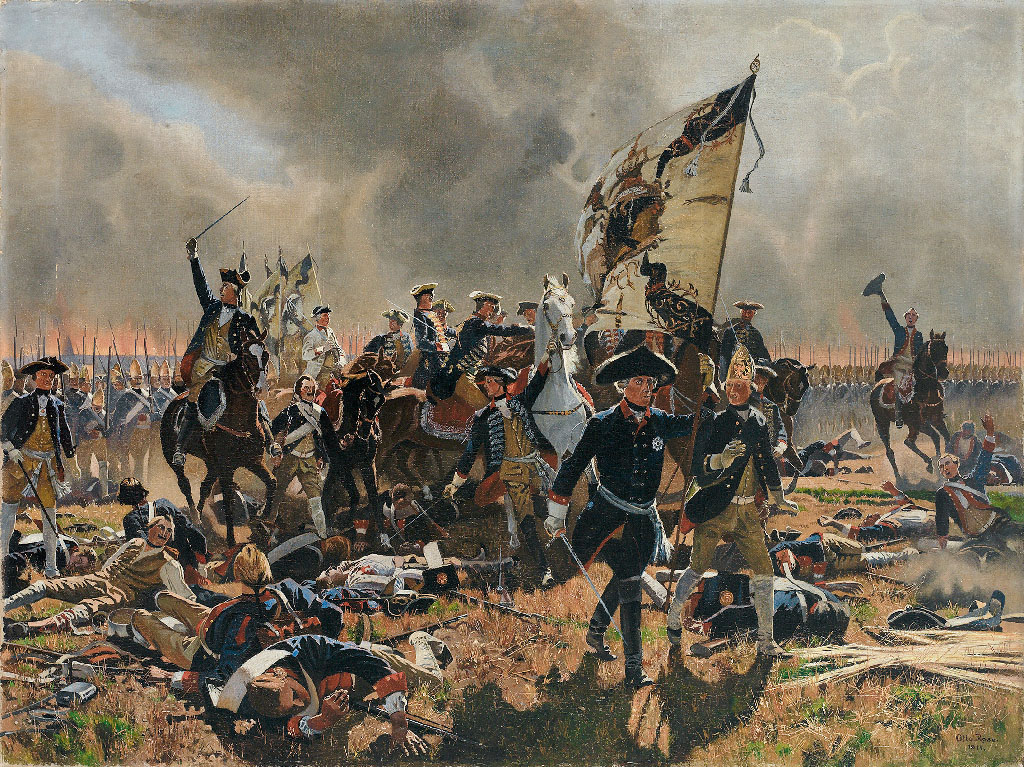
Frederick II at the Battle of Zorndorf


Dear Reader,

This post has been on my mind for a while now, and I hope you will forgive me for my long silence. I am now in the summer between my first and second years of doctoral work, and things are going quite well. One of my articles is being published in the Journal of the Seven Years War Association, so if you are interested in soldierly standards in eighteenth-century North German armies, be sure to check it out! On a related note, I want to examine the issue of bunching and fire control as it applied to eighteenth soldiers.

When I say, "bunching," I am describing the natural instinct to stand closer together in the presence of danger. I began to seriously consider the topic, when a long car-ride conversation with a friend, (and in his own way, military historian), when he expressed incredulity that a professional fighting force such as the Prussians would devolve into an undisciplined mass of men.

The breakdown of command and control on the Kabinettskriege battlefield is well documented. Charles-Joseph, Prince de Ligne, an Austrian officer and military author, recalled, "I cannot recall an action when I did not have to try to break up a multitude of such columns with blows with the flat of my sword, while my corporals were wading in with their canes." (Melanges Militares, vol. 1, 20) "So what," you say- "the Austrians are undisciplined, such things should be expected."  Noted scholars like Christopher Duffy would argue that you are wrong regarding Austrian military capabilities, especially when Ligne would have observed them in the 1770s and 1780s. Rather, this was a European-wide phenomenon.

Frederick II of Prussia's aide in the later stages of the Seven Years' War, Georg H. von Berenhorst, made similar observations regarding Prussian battlefield experience in the Seven Years' War:

"You begin by firing by platoons, and perhaps two or three times get off an ordered volley. But after that follows a general blazing away-- the usual rolling fire when everyone blasted off as soon as he had loaded, when the ranks and files became confused, when the men of first rank could no longer kneel, even if they had wanted to. The commanders, from the lowest officer to the general, could no longer get the mass to perform anything other function: they just had to wait until it finally set itself moving forwards or backwards." (Betractung über die Kriegkunst, vol. 1, 255.)

Berenhorst observations are striking. Even the disciplined Prussian army struggled with command and control. The counter-argument to this is that Berenhorst observed the Prussian army in stages of decline- by 1760, the infantry were of a lesser quality. However, this observation is striking in its similarity to other observers in different armies.

Lt. Colonel Russell, of the British Guards, observed British infantry in action at the Battle of Dettingen, in 1743. Russell wrote in a letter to his wife,

"That the Austrians also behaved well is also true... they all fired as irregular as we did; that the English infantry... were under no command by way of Hide Park firing, but that the whole three ranks made a running fire of their own accord, and at the same time with great judgement and skill, stooping all as low as they could." (Quoted in Blackmore, Destructive and Formidable, 106)

In another letter, Russel indicated, "our men and their regimental officers gained the day; not in the manner of Hyde Park discipline, but our foot almost kneeled down by whole ranks, and so fired upon'em a constant running fire." (Quoted in Blackmore, Destructive and Formidable, 106)

 Ligne, Berenhorst, and Russell all noted the difficulty in translating command and control from peacetime maneuvers to the battlefield. Some may come away thinking that the soldiers of the eighteenth century were not drilled to a high enough standard, but this is the wrong interpretation. Other, non-Kabinettskriege era armies experienced problems in this regard, even those with impeccable credentials.


Peter Connoly's imagining of the Battle of Coronea

To examine this phenomenon at a different level, let us turn to the ancient world. I am sure that many of us are familiar with Thucydides description of the "drift to the right" phenomenon in hoplite battles. According to Strassler's translation, he indicates that, "because fear makes each man do his best to shelter his unarmed side with the shield of the man next to him on the right, thinking that the closer the shields are locked together the better will he be protected."(Strassler, The Landmark Thucydidies, 343.)

But upon closer examination, that doesn't exactly bear out. The second part of that phrase is: καὶ νομίζειν τὴν πυκνότητα τῆς ξυγκλῄσεως εὐσκεπαστότατον εἶναι. (Thuc. 5.71)

Literally, the hoplites "thinking the denser their closeness is, the better protected they are." From a logical standpoint, this is describing bunching. Thucydides language indicates that this phenomenon occurs as a result of fear, and a desire for protection. Thus, even the vaunted Spartiate of the classical age struggled to deal with battlefield bunching. Thucydides shares this anecdote in the context of Spartan King Agis' attempt to minimize the effect of bunching at the Battle of Mantinea in 418.

So, it would seem that keeping soldiers under control on the battlefield was a facet of life in most pre-twentieth century armies, and as some twentieth-century observers, such as Brigadier General Marshall noted in Men against Fire, this problem remains with us today. These problems do not deal dishonor to men from earlier times- command and control had simply not evolved to a sufficient level in order to perfectly manage battle on the scale which it was being waged. Indeed, it must be noted, the highly efficient world of counter-terrorism operations conducted by special forces usually occurs on a small scale. Large armies in battle have been, and continue to be, difficult to manage, and observers should not look for perfection in the military operations.

Thanks for Reading,


Alex Burns

Sunday, March 6, 2016

Film Review: The Witch

Photo Credit: The Witch Theatrical Trailer
Dear Reader,      


Robert Egger's film The Witch, still in theaters, is a powerful and terrifying depiction of life in the American woods of New England during the 1630s. While the film does not portray historical events or claim to, it masterfully captures its setting.   Although the film is slightly outside the purview of this blog, it deserves a mention, for like 12 Years A Slave, the filmmakers worked tirelessly to capture the setting.

The film portrays a Puritan family, who must deal with the inhospitable New England landscape in isolation from the larger plantation. In this course of this journey, they encounter their own fears, as well as threats from supernatural forces. This is not a film for the faint of heart.

Particularly, Ralph Ineson's portrayal of the struggling pater familis strikes at the heart of authentic 17th century fears. Ineson's distinctive voice, but more than that, his mastery of original pronunciation makes the setting come alive. The film's postscript makes it clear that it does not intent to portray historical events, but draws on folktales in order to be true to the period. Indeed, Egger has taken much of the dialogue from period sources.

17th century Christianity is at the heart of this film in almost every way. Fears about female sexuality, interaction with native peoples, and social alienation from other Europeans also play into the film, which made the graduate student part of me quite pleased. Early modern agriculture and family life are dealt with in a believable fashion, and the film's use of Canadian old growth forest captures the look of 1600s New England

I cannot speak to the accuracy of the films material culture in comprehensive detail, however, all clothes appeared to be handsewn, and Wampanoag and European male material culture seemed to fitting the setting in my eyes.

If more directors attempted to pursue films set in the past with less amount of commitment to detail, perhaps historians would view hollywood with less disdain.

Thanks for Reading,

Alex

Wednesday, January 27, 2016

Fight for a Throne: The Jacobite '45 Reconsidered

Front Cover
Dear Reader,

I know it has been some time since I published a post, and I hope to return to work on Kabinettskriege more in the summer months. My first year of doctoral work is going quite well, and I am settling in to my new home at West Virginia University. So, without further ado, let's jump into the matter at hand, the latest book from Dr. Christopher Duffy.

For many students of eighteenth century warfare, the Jacobite rising of 1745-46 (the '45) is old hat. Many books have been published on the subject, including a previous volume from the same author. Dr. Duffy's return to the '45 is a matter of some import, as he is without question the leading scholar of this rebellion, and of mid-eighteenth century warfare as a whole.

Those who have read Duffy's previous volume on the last great Jacobite rebellion, (The '45) will recall the major facets of the rebellion- the initial Jacobite rising, let by Charles Edward Stuart, the "Bonnie Prince Charlie" of 19th century romanticism, and the Scottish Jacobite victory over Hanoverian British forces at Prestonpans. This first success was followed  a Jacobite surge southward into England, eventual retreat to Scotland, and destruction by the Hanoverian forces at Culloden Moor on April 16th, 1746.

Duffy's new study offers something for everyone. Filled with an impressive amount of social and cultural information, Duffy examines the conflict in never before seen detail. Though the book will disappoint readers hoping for a comprehensive examination of Hanoverian fighting forces, Jacobite forces are discussed at extreme length. New appendices provide detailed information about sea conditions, meteorological observations, detailed geography, and a unit by unit evaluation of the highland army.

Duffy spends a great deal of time discussing the Jacobite rising as a modernizing force- as opposed to the traditional historical view of Jacobitism: a backwards movement supporting a bygone dynasty (the Stuarts) and bygone religious movement in England (Catholicism). Rather, Duffy crafts a persuasive argument that the Jacobites were a forward-looking movement, based (via necessity) on Enlightenment ideas of religious toleration, and military innovation. Duffy makes a convincing argument that the Jacobites pioneered a divisional system which gave them an extreme advantage in strategic operations.
The monograph also makes a parallel argument that the Hanoverian system of government was bogged down in pervasive corruption, and that the politicians of the 1740s Britain made poor strategic thinkers in comparison with the Stuart prince and his advisers. In this way, Fight for a Throne turns the traditional interpretation of the '45 on its head.

The book also contains a wealth of new information on the military history of the Jacobite Rising. In Duffy's description of Culloden alone, he provides persuasive evidence that the Highlanders discarded (or perhaps neglected to pick up)  their shields in the hectic assembly to confront rapidly advancing Hanoverian forces. In addition, Fight for a Throne makes it clear that Cumberland's soldiers did NOT adapt a new style of bayonet drill, in which each soldier stabbed the highlander attacking the man next to him.

Rather, according to a eyewitness, the Hanoverian infantry

"...first gave one fire, the fore rank kept [the Jacobites] off with their bayonets till the second rank charged [loaded] again and gave them so close a fire that our fore rank was bespattered with their blood and brains..." (Quoted in Duffy, Fight for a Throne, 466.)

Undeterred by this mauling, the Highlanders pushed into close combat with Barrel's regiment, but were unable to break the British line. The chapter on Culloden alone makes this volume worth the price, but be careful- Duffy will entrance you with his wider social and cultural narrative of this vital event in British history.

Thanks for Reading!

Alex Burns


Wednesday, December 23, 2015

Seven Years' War Convention 2016


Dear Readers,

For those interested, the Seven Years' War Convention is being held this year on April 1st and 2nd, (2016) at the Waterford Estates Lodge in South Bend, Indiana. Dr. Christopher Duffy will be presenting a lively talk on the Battle of Kolin.

The Seven Years' War convention is always a high point of the year for me, as a time to converse with other students of the period, shop for rare books, and listen to famous historians speak on this pivotal conflict.

If you have questions, please direct them to JohannvonHuelsen52@gmail.com


Monday, August 31, 2015

Defining Modern and Early Modern: The Seven Years War.


Dear Readers,

I know it has been a while- too long, in fact. I've been teaching the last year at Indiana Wesleyan University, and applying for Ph.D programs. Good news- I'm currently working on my doctorate at West Virginia University, under the direction of Dr. Tyler Boulware, and Dr. Katherine Aaslestad. 

There isn't much time, so I wanted to run an idea by you. In the historical field, we separate the past five hundred odd years into two fields: early modern, and modern. According to the standard interpretation, the early modern period lasts from about 1500 to somewhere in the eighteenth century, usually the French Revolution, and the modern takes up the story until now. I'd like to propose a new way of looking at this idea. 

The Seven Years War gives us the modern world. This war, so decisive, unlike many eighteenth century conflicts, defines the eighteenth century. Fred Anderson has argued as much in Crucible of War. What if the Seven Years War isn't just the defining moment of the eighteenth century, but also separates the modern and early modern?

This war gives England control of North America (for the moment), puts the pieces of the British Raj in place, begins to define white and Native American as separate races in the minds of people living in Colonial America, increases Russian presence and power projection in eastern Europe, and assures the survival of a strong, Protestant state in Germany. The debts, ideas, and territorial changes of this war are truly revolutionary. Could this war be the defining line of the modern world?

What do you think?

Thanks for reading,

Alex