|
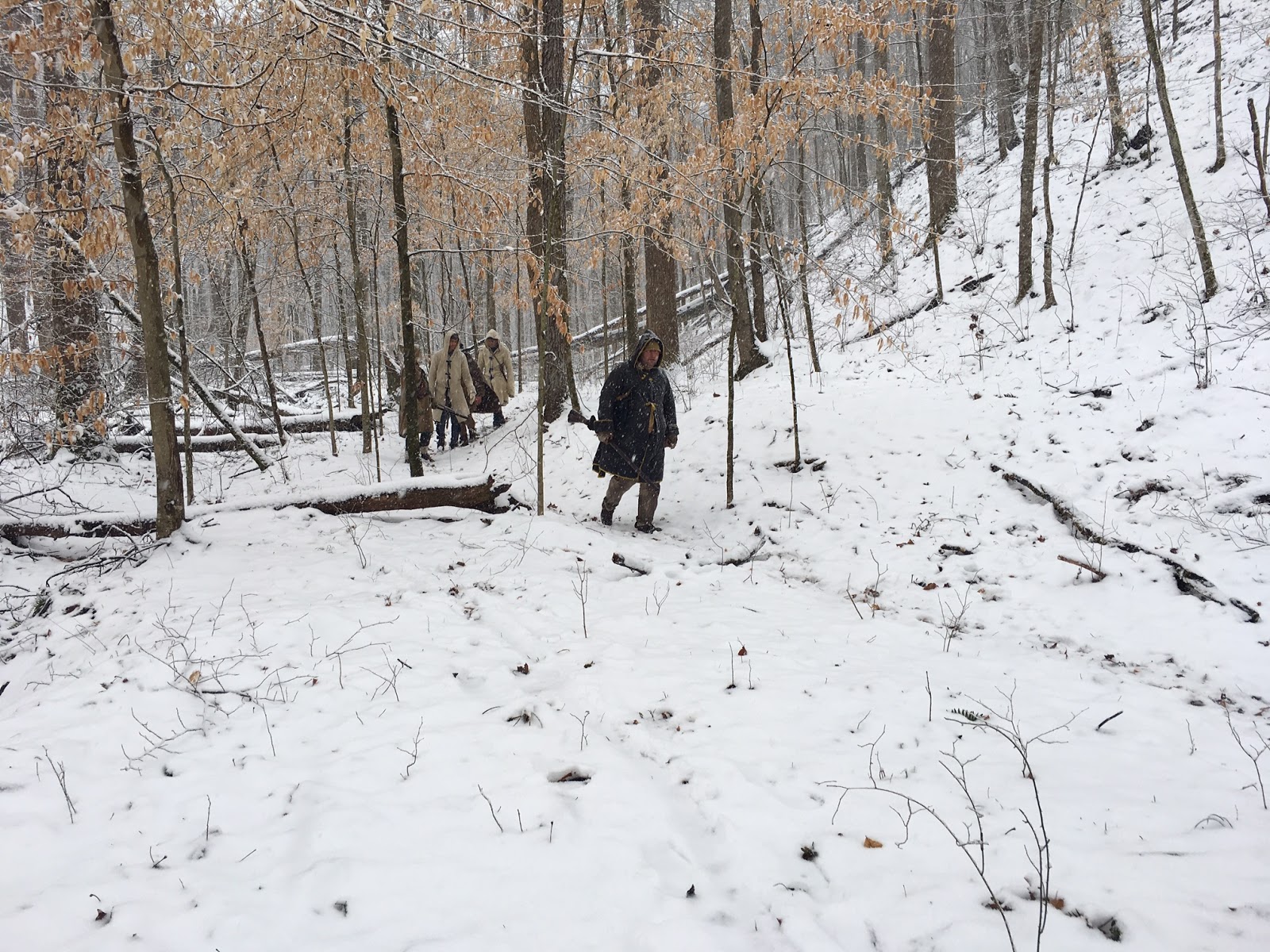
Excellent reenactor Tom Pickerel Portrays a Jaeger
in 1781 North Carolina
|
A previous version of this post used a photograph without permission
based on a misunderstanding of its origin. Kabinettskriege sincerely
apologizes for the confusion. |
|
Dear Reader,
Ahhhh. This topic. Almost nothing I choose to write about will lose me as many friends in so short a span of time, I'll wager. The issue of facial hair among eighteenth-century men is one that sharply divides reenactors of this era, perhaps more than any other issue. So, this post will use period images in an effort to explore the topic in some detail. In this post, I want to briefly track the course of men's facial hair (with particularly reference to military settings) between the middle of the seventeenth century and near the end of the eighteenth century. There has been a lot of excellent work on this subject by both academic historians, such as Dr. Alun Withey, as well as public historians such as Adam Hodges-LeClaire.
Received wisdom is that during the eighteenth-century, only madmen, beggars, cripples, Catholic Priests, and Jewish people wore beards in the Northern Atlantic World. By and large, I would agree with that assertion. Beards were not common, and should only be worn when portraying one of the groups above. However, in order to fully grapple with this fact, we need to examine the entire era.
Beards were quite common, even among soldiers, during the Thirty Years War. This can be observed in the etchings of French artist Jacques Callot, specifically a series entitled, "Les Grandes Misères de la guerre". The etching below, depicting the enrollment of soldiers, shows the veteran commanders in the right foreground, most of them have beards (even if it is just a goatee.)

Indeed, in the middle of the seventeenth century, it was quite common for monarchs to possess neatly trimmed facial hair. Gustav II. Adolph of Sweden, Karl X. Gustav of Sweden, Charles I of England, Charles II of England, Frederick William, the "great" Elector of Brandenburg, Louis XIII of France, and during the early portion of his life, Louis XIV of France. In 1659, Louis XIV still appears to have a "soul patch" in the tradition of his father, by 1673, he is simply sporting a mustache. However, in almost all of these cases, the beard portion of their facial hair is carefully managed, or even shaved completely. We must thank the monarchs of this era for their popularization of the Soul Patch.

As Dr. Alun Withey has written, razors and the act of shaving came to symbolize the Enlightenment, and control over nature. Dr. Withey has also suggested that shaving came to embody a "cult of youth", and indeed, I would argue that it also resulted from a desire to imitated classical norms. By the early eighteenth-century, these factors had combined to make (clean) shaving a necessity across the Northern Atlantic World. Thus, in paintings across Europe between 1650 and 1700, we see a gradual reduction, but not always a complete elimination of facial hair.
Soldiers in the second-half of the seventeenth century began to shave more and more, as can be observed in the paintings of Johan Filip Lemke, a Swedish battle painter active in this era. Lemke's art develops a clear trend: in the early part of his career, mustaches were common among infantry soldiers, and goatees were common among the cavalry.
 |
Musketeers in the mid-seventeenth century,
Sketch by Johan Filip Lemke
|
By the end of Lemke's career, infantrymen were clean-shaven, following the patterns set by late-seventeenth-century monarch Karl XI, and his early-eighteenth-century son, Karl XII.
The situation in the early-eighteenth century can be observed in the paintings of Jean Antoine Watteau, who demonstrates that the fusiliers he encamped with were almost always clean shaven. I have reproduced a number of them below, so that you may have a representative sample. They were executed during the later years of the War of Spanish Succession.
 |
| The Portal of Valenciennes, 1709 |
These paintings clearly show that like their splendid Sun-King, most French infantry soldiers were clean shaven in the early-eighteenth century. This would remain the norm for both military and civilian fashion for around one hundred years, being challenged by the development of prominent facial hair once again in the middle decades of the nineteenth century.
However, unlike beards, mustaches remain a more challenging subject to adequately address in the Kabinettskriege-Era. We cannot simply assert that mustaches were the provenance of the insane, indigent, or specific religious groups. Rather, in both military and civilian settings, mustaches need to be carefully contextualized.
In military settings, the most famous group consistently possessing mustaches are grenadiers. It has been suggested that these men wore mustaches as a result of a desire to imitate Turkish fashion. John Evelyn, commenting on the development of these troops in 1677, had this to say on the subject:
"Now were brought into service a new sort of soldier called Grenadiers, who were dexterous in flinging hand grenadoes, every one having a pouch full; they had furred caps with coped crowns like Janizaries, which made them look very fierce, and some had long hoods hanging down behind, as we picture fools. Their clothing being likewise piebald, yellow and red."[1]
Clearly, this quote is an indication that these uniforms of these troops were designed to resemble Ottoman military fashion. However, I think there are three primary problems asserting that this applied to their mustaches. First and primarily, Evelyn does not mention grenadier mustaches anywhere in his quote, leaving us to infer that he meant that all aspects of their fashion were imitating the Ottoman borderlands. Second, in 1677, the King of England, Charles II, likely wore a mustache, based on his portraits of 1675 and 1685, so it seems odd that wearing mustaches would need a justification lying in Orientalism for this particular type of soldier. Third, as recently as 1650, Evelyn himself wore a mustache, although he did not have one for his 1689 portrait.
 |
David Morier's depiction of Grenadiers from Regiments:
Stammer, Tunderfeld, and Both
|
There is no question that grenadiers were the most famous wearers of mustaches, and even grenadiers who normally went clean shaven could occasionally be ordered to wear them. In 1721, British Army grenadiers were ordered to, "let their whiskers grow for the arrival of the King of Prussia," who was then contemplating a visit to Britain, on the occasion of the christening of his God-son, William Augustus, the Duke of Cumberland.[2] As it turns out, the King of Prussia cancelled his visit, and the mustaches were shaved.
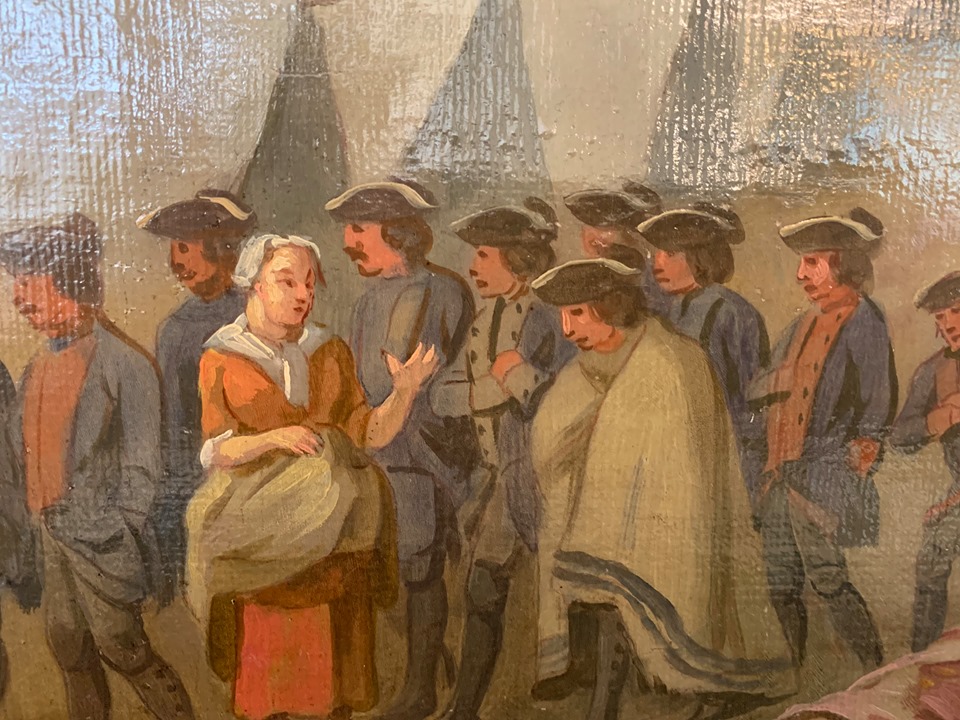
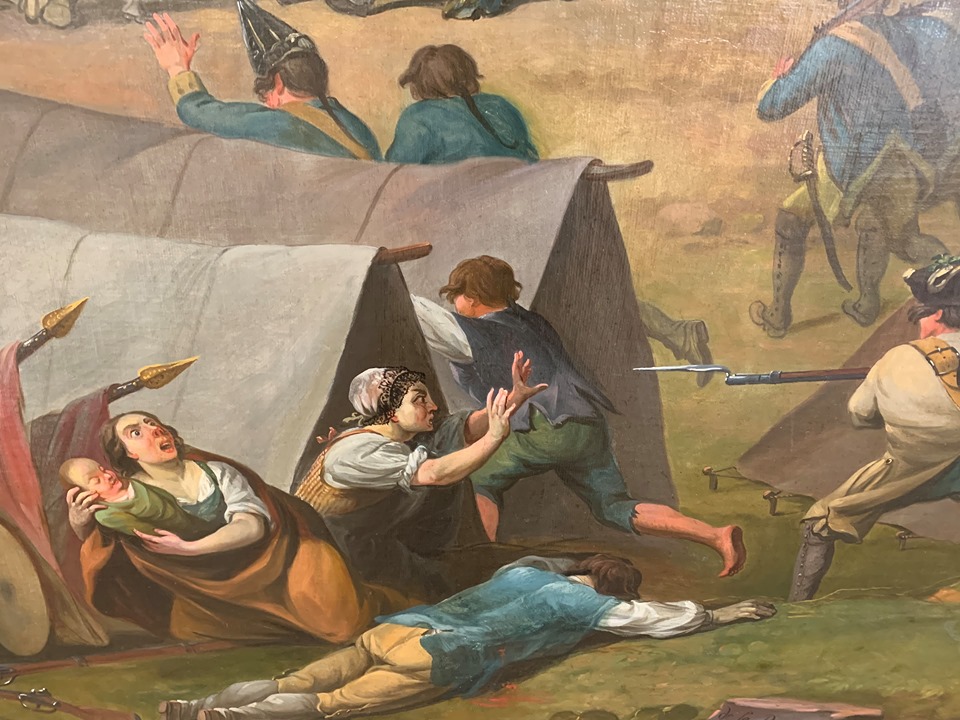
However, the idea that only grenadiers wore mustaches as a result of imitating Ottoman fashion also seems odd in the face of overwhelming evidence that between 1670 and 1760, mustaches were quite common among infantry soldiers across German Central Europe and beyond. I've compiled a few period images below to demonstrate my point.
 |
| Austrian Fusilier in the 1730s |
 |
| Prussian Musketeers, showing both clean shaven and mustaches, 1730s |
 |
| Prussian Musketeers 1750s/60s |
 |
| Prussian Musketeers 1750/60s |
|
|
Austrian Grenadier and two Fusiliers in the 1750/60s
|
 |
| French Soldiers at Assietta, Hyacinth de La Pegna |
|
|
| French soldier, Régiment Royal-Suédois, 1760s |
 |
| Detail from The Siege of Yorktown, Louis Nicholas van Blarenberghe, 1786 |
These images demonstrate that mustaches were rather common among the infantry troops of the larger armies of German Central Europe and perhaps France as well.
Cavalry soldiers wore mustaches with a greater regularity than infantrymen.
If Grenadiers, Musketeers, Jaeger, Hussars, Dragoons, and Cuirassiers all wore mustaches, it does not seem as though we can assign the development of mustache wearing troops in the eighteenth century to a small number of specialists who were deliberately imitating Ottoman fashion. Imitations of Ottoman fashion occurred, there is no doubt, in the way that Bosniaken lancers were uniformed, the way which African musicians were uniformed, but I am not as confident that mustaches can be placed squarely within this realm.
In the early portion of the eighteenth century, mustaches were still common among middle-aged men in the highlands of Scotland, but appear to have died out by the time of the 1745 uprising.
Indeed, in the wonderful Penicuik drawings from the era of the '45 rebellion, the only individuals wearing mustaches are children, "playing at Hessians." Thus, by the 1740s, the mustache had come to be associated with Germanic soldiers in British minds.
If the paintings of Bernardo Bellotto are any measure, it appears that the mustache may survived in civilian fashion in some parts of the Austrian Empire into the 1750s. The men below are wearing peasant clothing common in German Central Europe at this time, especially in the rural southern portions of the Habsburg State.
 |
| Detail from Bellotto, Schloss Schoenbrunn, 1759 |
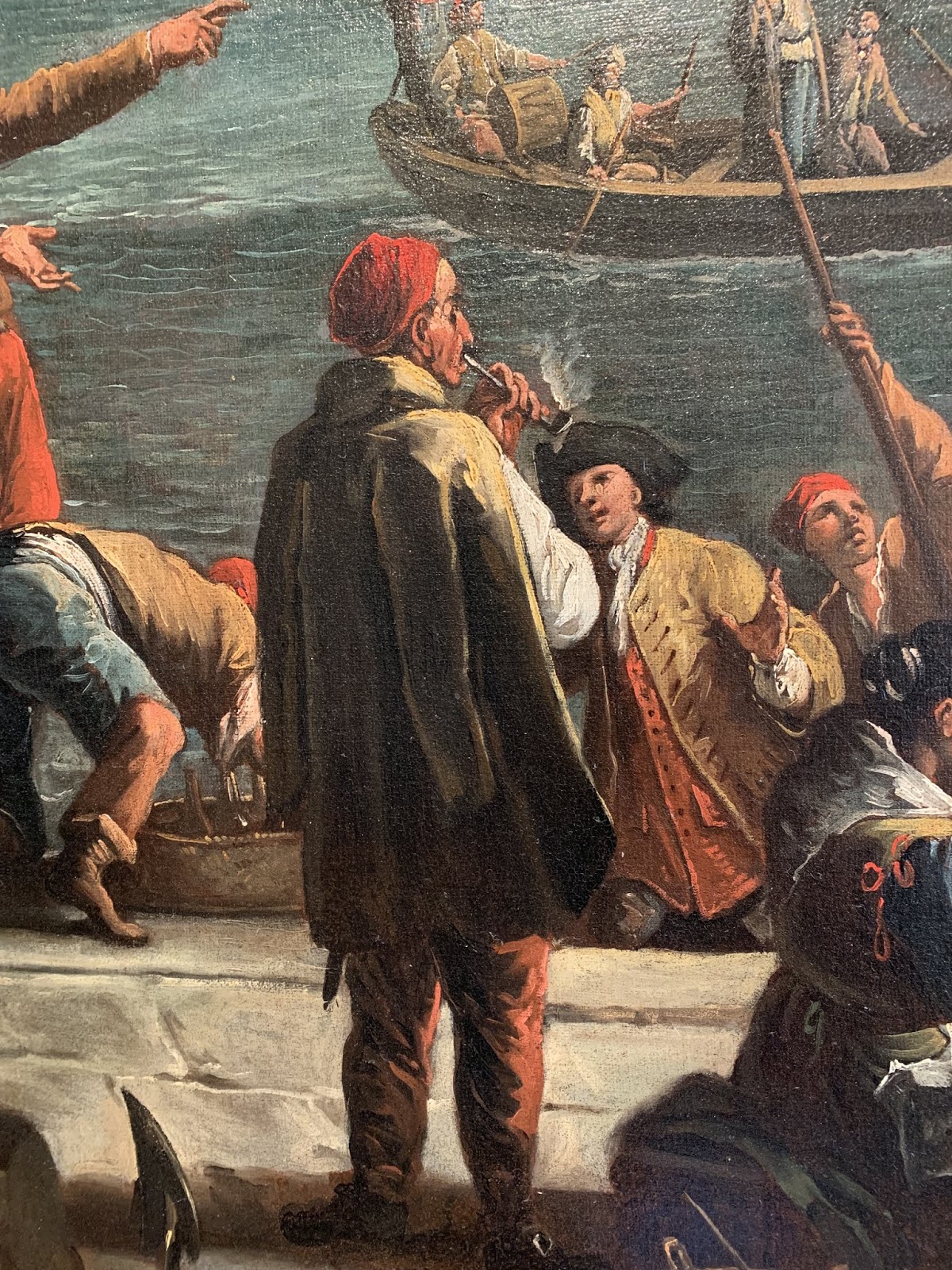
Other groups, of course, continued to wear mustaches as a mark of a specialized trade. Venetian Gondoliers seem to have fit into this mold, at least as depicted by Gaspare Diziani, in the middle of the eighteenth century:
 |
| Detail from La Sagra di Santa Marta |
Russian civilians as well, appear to have ignored the moratorium on facial hair. Here, Giuseppe Moretti depicts merchants from Russia in Venice in the middle of the eighteenth century:
 |
| Detail from Prospettiva con Poritco |
And what about Colonial America? Considering the marked aversion which the British Isles had towards mustaches, it is unsurprising that we almost never find them in Colonial America. Continental Army soldiers may not have always been cleanly shaven, but I would be shocked to find more than a week's growth. Even in the harsh winter at Valley Forge, a continental officer noted that Washington advised the men, "The want of uniformity in the soldiers' clothing, and its deficiency in quality, so far from slovenliness and unsoldierly neglect, ought rather to excite the men to compensate for those bleamishes,-- for instance, the soldier may always shave his beard."[3]
What does all this mean for those most interested in it: reenactors of this era?
It is vital to tailor your facial hair to the specific time, person, and place you are representing. I see almost no evidence that aside from a few week period in 1721, that the British Army ever wore mustaches (much less beards!) in 1700-1789 era. If your heart's desire is to be a redcoat with facial hair, create a first-rate impression of a British Grenadier waiting for the arrival of the King of Prussia in 1721. Mustaches, while still very uncommon, can be found in a number of military impressions in Europe. If you want to wear a mustache in a military impression, develop of first-rate impression of a French or Spanish soldiers, or Hessian Grenadier or Jaeger from the American War of Independence, or attach yourself to one of a number of units who portray the Seven Years War in Central Europe.
If a full-beard is your desire, I would say that there are a number of impressions in the 1648-1789 era which might allow for it. In addition to being various shades of insane and crippled, you could portray a Russian merchant, or if a military impression is your heart's desire, portray a soldier in 17th Century Colonial America, or the era of the late-Thirty Years War in Europe. I understand that shaving is not convenient, and that beards take a long time to grow. However, if the eighteenth century past is worth recreating, it is worth recreating well.
If you enjoyed this post, or any of our other posts, please consider
liking us on facebook, or
following us on twitter.
Consider checking out our exclusive content on Patreon. Finally, we are dedicated to keeping Kabinettskriege ad-free. In order to assist with this, please consider supporting us via the donate button in the upper right-hand corner of the page. As always:
Thanks for Reading,
Alex Burns
--------------------------------------------------------------------------------------------------------
[1] John Evelyn,
The Diary of John Evelyn, 400.
[2]
The Weekly Journal, or British Gazetteer, April 29th, 1721.
[3] National Army Museum, 1991-07-117 (Journal of Captain John Davis)