|
| Richard Knoetel's reimagining of Frederick and a Cuirassier after Kolin. Edited for Richard's apparent lack of understanding how shadows work. |
Dear Reader,
This Sunday is the 260th anniversary of one of the most important battles in the Seven Years' War, the Battle of Kolin. In this battle, fought on June 18th, 1757, Frederick II of Prussia (Frederick the Great) lost for the first time in his military career. From the beginning of his military career as king in 1740, to the Battle of Prague, fought on May 6th, 1757, Frederick had never lost a battle. Without delving too far into the narrative of the battle, this post attempts to establish why this battle was Frederick's first taste of defeat.
 |
| Christopher Duffy's map of the Battle of Kolin |
If you want a narrative of the battle, and don't have any books by Christopher Duffy close at hand, try this site, or this one.
So: What explanations for the defeat have historians advanced in the past?
1) The Lost Cause explanation
According to this line of thinking, it was hopeless to expect the Prussians to win at Kolin. How could 34,000 Prussians ever hope to overcome 52,000 Austrians in a defensive position? Oddly enough, the folks in this camp are often cheering the most when 22,000 Prussians beat 42,000 Frano-Imperials at Rossbach five months later at Rossbach, or when 33,000 Prussians defeat 65,000 Austrians six months later at Leuthen.
2) The Overconfident Frederick explanation
According to this theory, such as advanced version advanced at the second link above, all of the success had gone to Frederick's head, and he did not respect the real threat presented by Daun and the Austrian field army under his command. "Like Lee at Gettysburg," in the words of the blogger above, Frederick believed that his men were invincible and that they could carry any position. If that is true, why didn't Frederick order frontal assaults more often? Why did maneuver and flanking still form such a key part of his strategy?
3) The Exhausted Prussians explanation
For believers in this explanation, the Prussian army was simply pushed to the breaking point by the the Battle of Prague on May 6th, 1757, and had not had sufficient time to recover. Christopher Duffy appears to be in this camp, quoting the following source:
"Never did troops march less willingly than did our men on this occasion - it was as if they were being led to a place of execution. They were shocked by the resistance the Austrians had put up [at Prague], and they feared the worst... our strength and courage seemed to have drained away."[1]This is a hard idea to refute, supported as it is by primary source evidence. With that said, Warnery was writing over thirty years after the events. A quick examination of the service record of Prussian infantry regiments reveals that around 40% of the infantry regiments had not fought at Prague, while 60% had. In addition, as the day wore on, multiple units who had been engaged at Prague were moved from the rear of the Prussian army into the heaviest fighting.
 |
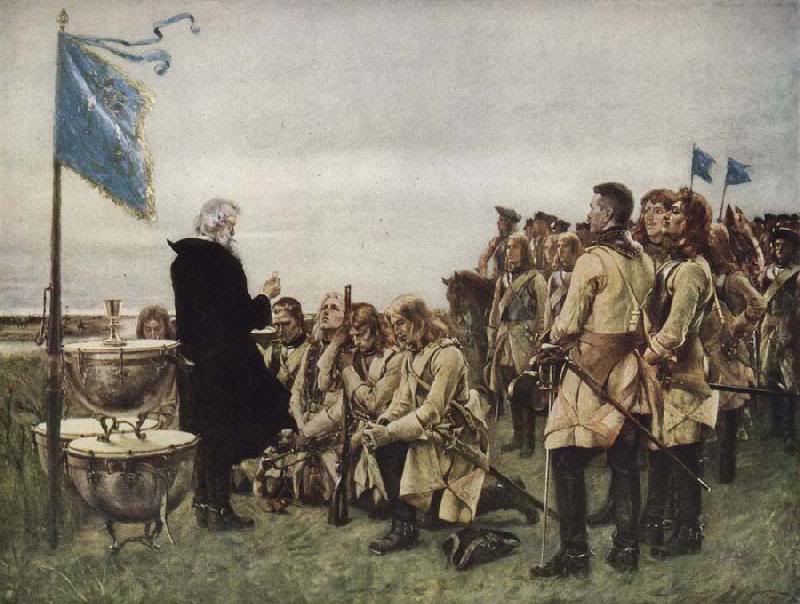
| An artist's re-imagining of the Prussian 2nd Battalion of Guards at Kolin |
4) The Frederick's Tactical Blunders explanation
Frederick II's military reputation has suffered in recent years, as impartial (though incorrect) historians credit him with a 50/50 win-loss record, polemic Frederick-bashers place all blame for Prussian defeats on his shoulders, and even positive biographers note that he was more useful as a campaign planner than as a battlefield commander. Could his plan have been flawed? Absolutely. Frederick would misjudge attacking a defensive position again in the Seven Years' War, at the Battle of Kunersdorf. However, his exact plan at Kolin seems to have made sense and been clearly understood by his generals. According to a Royal Page, Prinz Moritz von Anhalt-Dessau replied after the king's briefing: "No one can misunderstand it: It is so clear that no-one will make a mistake."[2] It is also reasonable to argue that Frederick's micromanagement might have cost him the battle, in that he ordered Prinz Moritz to form the line of battle too quickly during the main approach, preventing the Prussians from reaching the Austrian's flank. Upon forming the line of battle, Prince Moritz became dejected, believing that the battle was lost. [3]
5) The Blundering Subordinates explanation
The previous anecdote may remind readers of the behavior of subordinates who believed that they were doomed to failure in other conflicts. Like the American Civil War lost-causers attempting to blame James Longstreet for what happened at Gettysburg, Frederick's subordinate generals have certainly been accused of failing the Prussian monarch at this critical juncture. In this view, Johann Dietrich von Hülsen, Prinz Moritz von Anhalt-Dessau, or Duke August Wilhelm von Bevern are responsible for the failure of the Prussian attack. By and large, these accusations are unfounded. Hülsen rose to successful independent command later in the Seven Years' War, winning smaller battles such as the Combat at Strehla. Prinz Moritz was also successful, and redeemed his reputation at Leuthen, but died in the course of the war. Bevern had shown great skill in commanding men on the battlefield, and would again, at battles such as Reichenbach in 1762.
6) The Austrian Military Competence explanation
This final explanation put forth by Christopher Duffy over his two-volume examination of the Austrian army in the Seven Years' War, makes the most sense. The Austrians knew Frederick's strategy and planned accordingly. A clever Austrian junior officer, Franz Vettesz, correctly predicted the Prussian plan of attack on the morning of the battle. Daun, the Austrian field marshal, quickly acted on this information. Seeing his path to victory, Daun used delaying forces such as Croats and light artillery to slow the Prussian attack under Hülsen while bringing the weight of his superior numbers to bear on the Prussian force.
With this in mind, the battle looks less like an Austrian Gettysburg and more like an Austrian Antietam. The Austrians correctly divined the Prussian plan, and defeated the Prussian army, but failed to capitalize their victory or, as was common in the eighteenth century, pursue their defeated foe. In addition, the battle was costly for the Austrian force. When the 4,000 Prussian prisoners are removed from the equation, the Austrians and Prussians lost a very similar number of men (approx. 9,000) dead and wounded. Kolin was a hard fought Austrian victory. Rather than always looking for an explanation on the Prussian side of the equation, perhaps some credit is due to the men who earned it.
 |
| Austrian Grenadiers in 1748, David Morier |
At Kolin, the Prussians fought hard and long, following a strategy that had previously been highly successful. They inflicted large losses on the Austrian army and exhausted the Austrians so much that a pursuit of the defeated Prussian army was impossible. Kolin ended a victorious chapter in the history of the Prussian army but did not end the Seven Years' War. It would take five more years of bloody conflict to draw this war to a close.
If you enjoyed this post, or any of our other posts, please consider liking us on facebook, or following us on twitter. Consider checking out our exclusive content on Patreon. Finally, we are dedicated to keeping Kabinettskriege ad-free. In order to assist with this, please consider supporting us via the donate button in the upper right-hand corner of the page. As always:
Thanks for Reading,
Alex Burns
[1] Warnery, Campagnes de Frederic II, 135.
[2] Duncker, Aus der Zeit Friedrichs der Grossen und Friedich Wilhelm III, 90.
[3] Ibid, 76.