|
| British Troops prepare to charge at Guilford Courthouse |
We have charted some interesting territory over the past couple of weeks. It seems that mid-eighteenth-century soldiers frequently fired away their entire ammunition load, engaged in firefights at a much greater distance than is usually assumed, and sometimes fired at will, rather than fire by platoon or division. What does all this mean for eighteenth-century combat? If troops fired quickly, it can help to explain the ammunition usage, and the range of combat can help historians make sense of the large numbers of rounds expended vs. small number of casualties.
What does all this mean for melee (hand to hand, close) combat? Did eighteenth-century soldiers engage in melee combat frequently? If the Swedish Army during the Great Northern War and the British Army during the American War of Independence preferred bayonet attacks, surely there was a good deal of hand-to-hand combat?
Melee combat occurred, but it was perhaps less frequent than might be initially imagined. I am sure we can all think of famous examples: Culloden, Bunker Hill, and Guilford Courthouse all seem like important examples. When fighting against the Ottoman Empire, both Russian and Austrian soldiers reported fierce hand-to-hand struggles. Many military commanders, at some point in their careers, seemed to prefer an armes blanche or cold steel attack. Frederick the Great advocated this idea in the early Seven Years' War, Alexander Vasilyevich Suvorov famously stated that, "the bullet is a mad thing, put your trust in the bayonet." With these ideas spreading, surely hand to hand combat was frequent?
 |
| An artist's reimagining of Prussian Troops at the Battle of Leuthen |
In reality, hand-to-hand, or melee combat was often limited to a select number of places on the battlefield. When enemy troops appeared to make a serious advance into close range with bayonets, defending troops often melted away. That is why the Swedish Karoliner and British redcoats proved so effective on their respective battlefields. It also helps to explain why, when things went wrong for troops making a charge with cold steel, they went very wrong (such as at Poltava in 1709 and Cowpens in 1781.)Troops did experience hand-to-hand combat, but firepower (at range) was the order of the day. In William Dalrymple's 1782 essay on tactics, he asserted (in the case of infantry):
"There is probably not an instance of modern troops being engaged in close combat... the bayonet can be of little utility by way of impulsion in the field... these defects in modern infantry prove the impracticability of two battalions, opposed to each other, being brough in the open field to close encounter: one body must give way before they get into action."[1]Though Dalrymple is exaggerating for effect, we would be wise to take his point. In the open field, when flight was a possibility, it was rare for two battalions of infantry to cross bayonets. Nonetheless, other types of melee combat did occur, and are worth discussing. Even in nations where military theorists preferred bayonets, such as the French, soldiers realized that actual bayonet fighting was rare in this era. French military authority Jacques Antoine de Guibert understood the issue in this way:
"Finally, it seems that the entire exercise of the bayonet consists of fixing bayonets, presenting, and unfixing. I do not wish, as is currently the case, that troops should only use bayonets at parades and reviews. I would like them to be placed, as in combat, or rather in simulated motions which represent it. Soldiers have become familiar with bayonets, and view them as an unnecessary arm. They consider it to be a weapon without a use. Soldiers, and French soldiers above all, believed, "Well, I am out of ammunition, so only bayonets are left."... According to the method of the German infantry, our troops always march with fixed bayonets, in a unique way, a weapon that is always ready but never used."[2]In short, during cavalry action, attacks on defensive works, and surprise attacks, troops often engaged in melee combat. These were the places for bayonets, not in the open field against other infantry.
 |
| Prussian Cavalry on the Charge |
“Colonel Washington, observing their maneuvering, made a charge upon them, in which charge he (Francisco) was wounded in the thigh by a bayonet, from the knee to the socket of the hip, and in the presence of many, he was seen to kill two men, besides making many other panes which were doubtless fatal to others.”[4]At the Battle of Hohenfriedberg. the Bayreuth Dragooner swept away a large portion of the Austrian army.[5] Lt. Francois de Chasot, a friend of Frederick "the Great" of Prussia, gave his recollection of the attack:
At the start we moved at a walk. We crossed several ditches one rank at a time, and on each occasion I made the leading rank halt of the far side so as to give the reward two ranks time to catch up. Then we broke into a trot, and finally into a full gallop, putting our heads down and running into the Austrian grenadiers. At first they stood bravely, and fired a salvo at twenty paces. After that, they were overthrown and cut down.[6]
 |
| Unlike dragoons and cuirassiers, Prussian Hussars had curved swords |
When fighting other cavalry, it appears that the horses would seek intervals through the enemy formation, leading to brief moments of intense combat followed by maneuvering. In moments of true melee combat, all order was lost, and horses and men swirled around in an individual combat. Even here, however, cavalry melee was perhaps less effective than frequently believed. In the 1780s, military theorists studying the Prussian army recorded, "We heard from some cavalry officers that when troops undertake a charge, almost always, one troop flees before melee is joined, and the other gives pursuit."[7] Georg Tempelhof, a veteran of the Seven Years' War, reported,
"The strength of cavalry consists in its movement: it must have the ability to maneuver with speed. The shock or charge has no effect unless it happens in this way. Forgive me if I do not consider the cavalry's shock to be so decisive as it seems. In 1762 I observed Prussian cavalry charging superior Austrian horsemen. The result was that on both sides there were a few hundred wounded and prisoners. Not a single death was recorded."[8]It is possible that Tempelhof, as an artillerist, underestimated the potency of cavalry. Horsemen, then, particularly in Europe, preferred to engage in hand to hand combat. Cavalry officers endlessly debated whether or not it was more effective to cut or thrust against the enemy, or whether straight or curved swords were more effective. Frederick II of Prussia was once pressed on this issue:
Speaking one day with his Majesty the King of Prussia, of this diversity of opinions, with regard to the edge or the point, he answered, " Kill your enemy with the one or the other, I will never bring you to an account with which you did it."[9]Having addressed cavalry, we will now turn to another example of troops in melee combat: combat over defended positions.
 |
| Reenactors in the processes of assaulting a Redoubt |
When defending soldiers held fortified or prepared positions, melee combat could be fierce. Soldiers attached great pyschological important to their defensive works, and often tangled with enemy troops in melee combat in order to defend them. In discussing this issue, Christopher Duffy presents evidence that soldiers actually had difficulty understanding that they needed to use their bayonets in these type of assaults.[10] Even insignificant defensive positions could motivate defending troops to stand, such as the rail fence which the North Carolina troops sheltered behind at Guilford Courthouse in 1781. An advancing Hessian soldier, recalling the fighting over this obsticale, only commented, "Colonel Du Buy at once ordered, "Fix bayonets! March! Before the enemy could reload, we changed against them with our bayonets. Everyone was bayoneted."[11]
Obviously, this type of melee action includes siege warfare. During the Siege of Schweidnitz in 1762, Austrian 1st Lt. Waldhütter and thirty men of the Erzherzog Carl regiment spearheaded a successful sortie against the besieging Prussian forces. Franz Guasco, the fortress commandant, left this description of the sortie:
"Waldhütter and his troops jumped inside without hesitation and found the Prussians on their guard.Some of the opened fire, while some knelt on the floor and raised their muskets, the bayonets fixed to the muzzles. Our men flung themselves blindly among them, sabre in hand; some of them were skewered on the bayonets, but the rest set about the enemy and hacked them to pieces."[12]Alexander Hamilton was briefly involved in bayonet fighting during the storming of redoubts 9 and 10 at the siege of Yorktown. Joseph Plumb Martin is silent on the exact nature of the fighting inside the redoubts.[13] Hamilton reported that men under his command suffered a number of "bayonet wounds," in the course of the fighting.[14]
 |
| Xavier della Gatta's impression of the Battle of Paoli |
The American War of Independence produced a number of famous night-attacks which led to bayonet fighting, both of these, at Paoli in 1777 and Tappan in 1778 were extremely violent affairs, with many soldiers being killed both in and out of combat. At both Paoli and Tappan, British troops bayoneted Americans, and there is indeed evidence that Americans fought back with bayonets. This type of fighting was quite intense from a psychological perspective, and you often find descriptions of men, who like Captain Sir James Baird, killed large numbers of enemy troops singlehandedly. In addition to fighting with bayonets, troops at Paoli and Tappan burned to death, and were killed by firepower. Lt. Martin Hunter described the scene: "the camp was immediately set on fire; the Light Infantry bayonetted every man they came up with... this, with the cries of the wounded, formed altogether the most dreadful scene I ever beheld. Every man that fired was immediately put to death."[15]
 |
| The Attack at Hochkirch by Hyacinthe de La Pegna |
"It was dark, and confusion reigned supreme. What a sight for these warriors, almost like a night terror. The Austrians seemed to emerge from the earth, in the midst of the Prussian flags at the center of camp! Several hundred men were killed before they could open their eyes, and others ran half-naked to their weapons. Only a few could reach them. Others laid ahold of whatever was closest to hand, and began to fight."[16]Here we have an example of true melee, with thousands of soldiers fighting and dying in close combat. However, even here, it is important to note the ways in which this melee is unique. The Prussian army was surprised in camp, and fought a battle of desperation because of the impossibility of escape. In the open, troops would have fled long before this point.
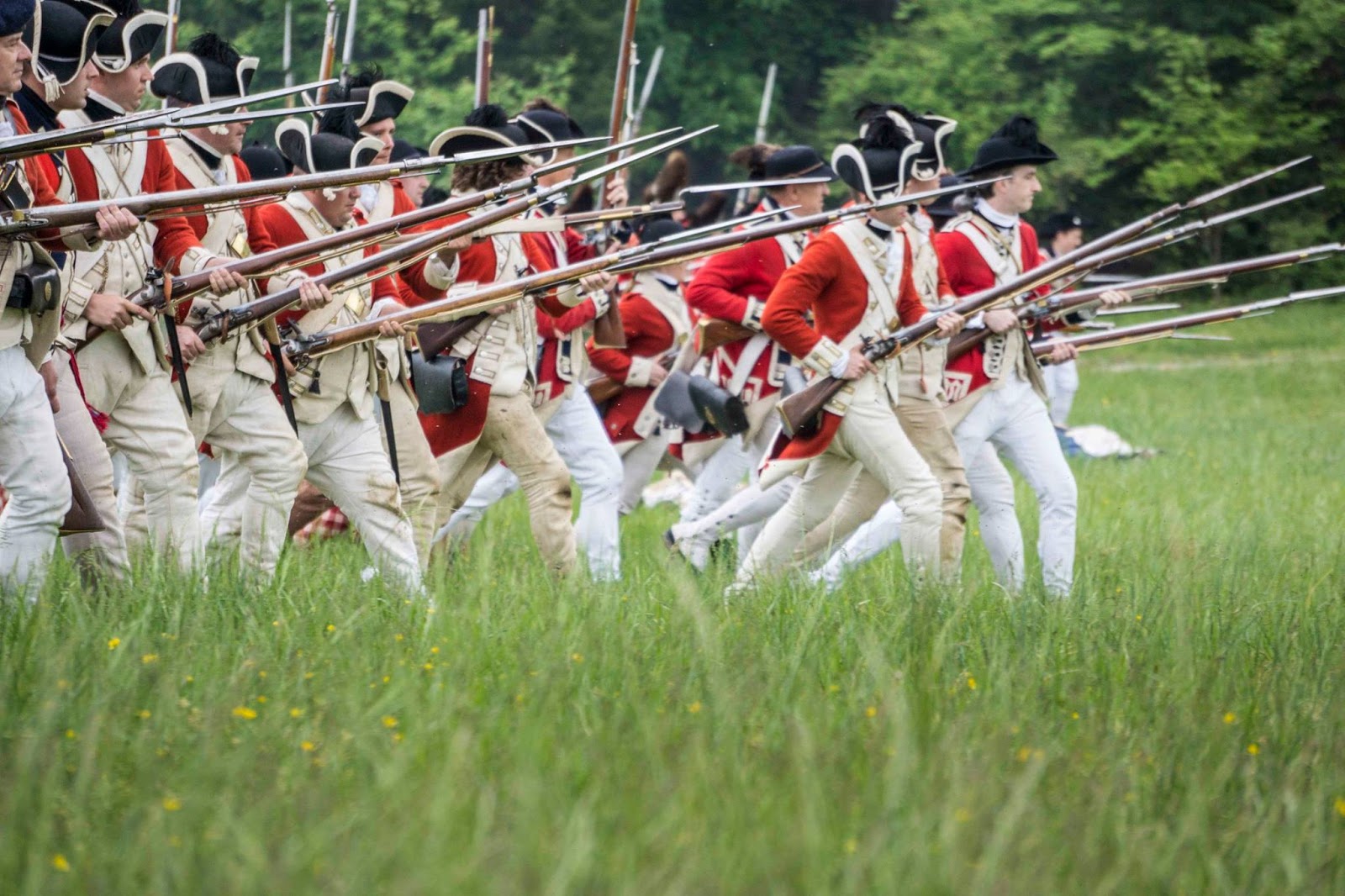 |
| British Troops with charged bayonets |
So, did troops in the open really not cross bayonets? Outside of the above-mentioned categories, infantry forces actually crossing bayonets when one force had the option to flee seems to have been quite rare. Again, there are instances such as Culloden and Guilford Courthouse, but those remained more the exception than the rule. According to one French report, 68.8% percent of troops were wounded by small arms fire, 14.7% were wounded by artillery fire, and approximately 15% were wounded by swords and bayonets.[17] When we consider that swords were the cavalry's main form of engaging the enemy, these figures are impressive. J. F. Puysegur argued that,
"firearms are the most desctructive category of weapon, and now more than ever. If you need convinving, just go to the hospital and you will see how few men have been wounded by cold steel as opposed to firearms. My argument is not advanced lightly. It is founded on knowledge.[18]Because Puysegur was writing in the 1740s, before the Seven Years' War, his experience is even more telling. Other military theorists, such as David Dundas, recalled, "... infantry seldom mix with bayonets."[19] These eighteenth-century military observations match well with those from the twentieth century:
"The vast majority of soldiers who do approach bayonet range with the enemy use the butt of the weapon or any other available means to incapacitate the enemy rather than skewer him... when the bayonet is used, the close range results in a situation with enormous potential for psychological trauma... The resistance to killing with the bayonet is equal only to the enemy's horro at having this done to him. Thus in bayonet charges one side or the other inveriably flees before the actual crossing of bayonets occurs."[20]
 |
| Reenactors at Guilford Courthouse |
"they were, particularly, trained to attack a supposed enemy, posted behind railing, the common position of the rebels; they were instructed not to fire, but to charge their bayonets with their muskets loaded, and, upon their arrival at the fence, each soldier to take his aim at their opponents, who were then supposed to have been driven from it; they were taught that, in the position of running, their bodies afforded a less and more uncertain mark to their antagonists, whose minds also must be perturbed by the rapidity of their approach..."[22]Here, we can see that when driving enemy from a position, infantry were trained to fire at fleeing men, rather than attempt to chase them down with bayonets. Obviously, melee occurred in the eighteenth century. However, it was not a common occurence, and seems to have become less prevelant over the course of the era.
If you enjoyed this post, or any of our other posts, please consider liking us on facebook, or following us on twitter. Consider checking out our exclusive content on Patreon. Finally, we are dedicated to keeping Kabinettskriege ad-free. In order to assist with this, please consider supporting us via the donate button in the upper right-hand corner of the page. As always:
Alex Burns
--------------------------------------------------------------------------------------------------------------------------
[1] William Dalrymple, Tacticks, 113.
[2] Guibert, Essai général de tactique, 81.
[3] Lawrence Babits and Joshua Howard, Long Obstinate and Bloody, 160.
[4]Letter of Peter Francisco, William and Mary College Quarterly, (1905) Vol 10, 219.
[5] Christopher Duffy, Military Life of Frederick the Great, 64.
[6] Matthias Kröger, Friedrich der Große und General Chasot, 38.
[7] Mirabeau and Mauvillon, Systeme militaire de Prusse, 104.
[8] Georg F. Tempelhof, Geschichte des Siebenjährigen Krieges in Deutschland, 68.
[9] Charles Immanuel de Warnery, Remarks on Cavalry, 17.
[10] Christopher Duffy, Military Experience in the Age of Reason, 204-5.
[11] Bertold Koch, The Battle of Guilford Courthouse, 7.
[12] Kriegs Archiv, Vienna, HKR Memoires 1762 880/12, Guasco, Relation du Siege de Schweidnitz, 31 October, 1762.
[13] Joseph Plumb Martin, Private Yankee Doodle, 237.
[14] Alexander Hamilton, The Works of Alexander Hamilton, Vol 8, 47.
[15] Martin Hunter, Journal, 31.
[16] Johann Wilhelm von Archenholz, Geschichte des Siebenjährigen Krieges, Vol 2, 279.
[17] Andre Corvisier, L'Armee Francaise, 64.
[18] Puysegur, Art de guerre par pricipes et par regles, Vol 1, 227. (Translation is Christopher Duffy's.)
[19] David Dundas, Principles of Military Movement, 51.
[20] David Grossman, On Killing, 120.
[21] Babits and Howard, Long Obstinate and Bloody, 159.
[22] John Simcoe, Simcoe's Military Journal, 98.