Showing posts with label Stony Point. Show all posts

Monday, February 25, 2019

Book Review: Men Who Are Determined to be Free


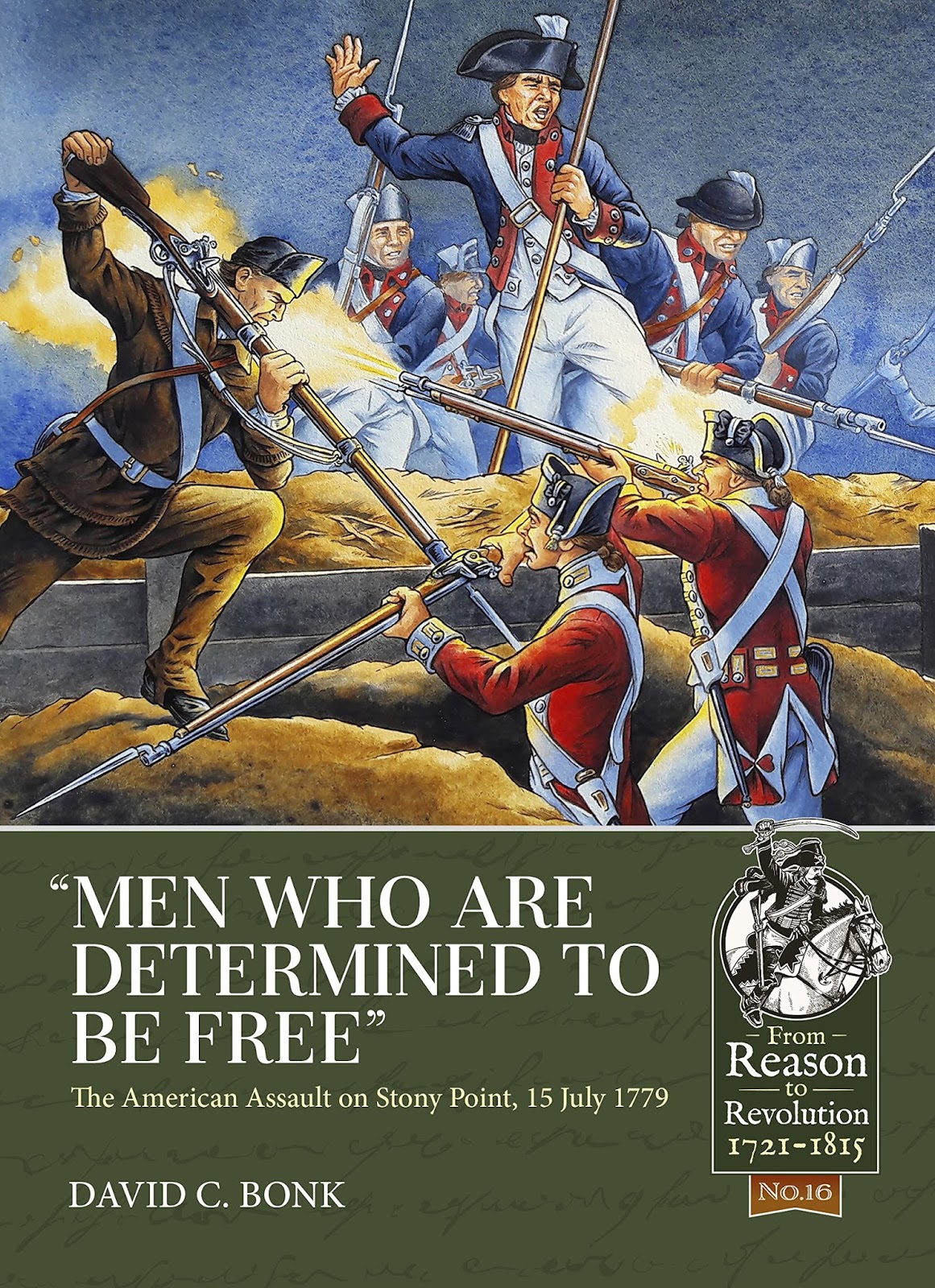
Cover Art
 Dear Reader,

Today we have a book review from Ben Olex. Ben reviews David C. Bonk's Men Who Are Determined To Be Free, a recent  title from Helion and Company. Without further introduction, here is Ben's review: 


          The Battle of Stony Point is certainly one of the more exciting and unorthodox battles of the American War for Independence. While it was rather famous in its time, it has become one of the lesser known battles of the war. In the early hours of July 16, 1779, the American Corps of Light Infantry assaulted the British position at Stony Point on the Hudson River. In twenty-five minutes American forces captured over 500 British troops, including the entirety of the His Majesty’s 17th Regiment of Foot, fifteen artillery pieces, and over 100,000 continental dollars’ worth of goods.[1] David C. Bonk covers this unique battle in this new book, Men Who Are Determined to be Free.”

         In Determined to be Free Bonk argues that Corps of Light Infantry played an important in the Battle of Stony Point, and that the battle played in the larger strategic role in the context of the War for Independence. The book is roughly 120 pages in length and contains a good number of photos and maps to help the reader in visualizing the events of the 15th of July. It is part of the “From Reason to Revolution” Series published by Helion and Company. It is good to see that Bonk draws from two of the most important secondary sources relating to the battle of Stony Point: Don Loprieno’s The Enterprise in Contemplation: The Midnight Assault on Stony Point, and Henry P. Johnston’s The Storming of Stony Point on the Hudson. Enterprise in Contemplation was written by the former site supervisor of Stony Point Battlefield and Lighthouse State Historic Site, and includes the full transcripts for the Court Martial of Lieutenant Colonel Johnson, the fort’s commander. Though published over one hundred years ago, Johnston’s Storming of Stony Point remains a reliable resources for those researching the battle as well.

      Bonk begins his coverage of the Battle of Stony Point by describing the strategic situation in 1778, delving as far back as 1777. To the reader who may be looking to learn more about the battle itself than the larger strategic situation, this may feel somewhat unnecessary. Bonk goes into a large amount of detail about these events, that while related to the battle, do not play a direct role in its outcome.[2]  However, Bonk does give a great deal of context for those looking to better understand the larger strategy at hand from 1777 to 1779.It is in the third and fourth chapters that the reader begins to get a clearer sense of how Stony Point fit strategically in the campaign of 1779. Chapters five through seven outline the defenses erected at Stony Point, the history of Anthony Wayne and the Corps of Light Infantry, and the American plan for attacking the fort. In the final two chapters the reader learns about the battle itself and the events that unfolded after the conclusion of the fighting.

Determined to be Free has a good amount of pictures, including many of the battlefield. Throughout the book the reader can find a number of maps that detail the movements of Washington and Clinton as they maneuver through the Hudson Highlands that are clearly marked and easy to understand. The middle of the book includes a section with several images and maps, including the map of Stony Point drawn by William Faden, and a modern map showing the movement of the battle. This last map has some small flaws, such as the positions of the pickets that are placed too far from the fort, or the position of the HMS Vulture which was more likely more to the South-East of its current position. However, the map is generally representative of the battle. 

The book falls prey to some small flaws, such as the idea that Lt. Col. Johnson was captured by Lt. Col. de Fluery[3]. There is one photograph which is mislabeled. That is the photograph labeled “Captured three-inch mortar deployed by the British at Stony Point”[4] The artillery piece pictured is actually an eight-inch howitzer, though the manner in which it is displayed (with the barrel almost vertical) may cause some people to mistake it for a mortar. There are two mistakes that should be addressed. The first involves the eight-inch mortar again. Towards the end of chapter eight Bonk discussed the eight-inch mortar and how the garrison was unable to utilize it.[5] It is clear from the details Bonk gives that he is actually referring to the eight-inch howitzer pictured in the book.[6] It seems that this is simply a typing error, because the events that Bonk describes are correct. His second mistake involves His Majesty's Galley Cornwallis, and the role that vessel played at Stony Point. Bonk writes that “On the south side the row-galley Cornwallis could bring fire from one 24lb and four 4lb guns to bear in defense of the lower abatis near the Hudson River.”[7] For many years it was thought that the ‘gunboat’ that is referred to in Lt. Col. Johnson’s court martial might be the galley Cornwallis, which was indeed in the area at the time of the battle. This is unlikely given that throughout the proceedings, the gunboat in question is consistently referred to as a gunboat by many different parties. Furthermore Captain Mercer, engineer at the time of the battle, testified that General Clinton ordered the two gunboats that had advanced with Collier’s fleet from New York to guard Stony Point and Verplanks’ Point.[8]

Despite these small flaws, Bonk’s research is generally correct, and readers will gain a good understanding of the battle, its key players, and important points. He is to be commended for adding to the relatively lightly trod history of the Battle of Stony Point. Determined to be Free offers the reader a great amount of information about not only the battle, but the strategy and people surrounding the Battle of Stony Point. We look forward to more titles from Helion addressing the American War of Independence.

 If you enjoyed this post, or any of our other posts, please consider liking us on facebook,  or following us on twitter. Finally, we are dedicated to keeping Kabinettskriege ad-free. In order to assist with this, please consider supporting us via the donate button in the upper right-hand corner of the page. As always:


Thanks for Reading,


Ben Olex 


[1] Don Loprieno, The Enterprise in Contemplation: The Midnight Assault of Stony Point, (New York: Heritage Books, 2009), 47.
[2] It is worth noting, as Bonk does, that the campaigns provided valuable experience for the Corps of Light Infantry.
[3] Henry P. Johnston, The Storming of Stony Point, (New York: James T. White & Company, 1900), 83
[4] David C. Bonk, “Men Who are Determined to be Free”: The American Assault on Stony Point, 15 July 1779, (Warwick, England: Helion & Company Limited: 2018), 54
[5] Bonk, 54
[6] For description of events around the howitzer battery see Testimony of Corporal Newton in Loprieno, 241-245.
[7] Bonk, 54
[8] Testimony of Captain Alexander Mercer in Loprieno, 259

Monday, October 22, 2018

Young Historian Spotlight: Ben Olex


Ben Olex, giving a presentation to visitors at the Stony Point Battlefield and Lighthouse

Today, we are continuing with the second of a series of interviews with a number of young historians. By the time this series concludes in early November, we will have heard from Jack Weaver, Andrew Warren, Ben Olex, Casey Hill, Samantha Sproviero, and Davis Tierney. All of these individuals are broadly interested in the Kabinettskriege era, and have been selected as a result of recent promotion, impending graduate school applications, or work recently begun in graduate school or at a historic site. Today's young historian Ben Olex, a gifted young historian interested in naval affairs. Ben has worked as an historic interpreter at Stony Point, is currently in the process of applying to graduate programs, and has a forthcoming article on the American War of Independence in coastal areas.  

Alexander Burns : What drew you to study the history in this era? In 2018, much of popular memory of military history in the United States is focused on World War 1, World War 2, and the Vietnam War. What about the history of the 1688-1815 era do you find so compelling?

Ben Olex[1]: I have always had a fascination with ships.  When I was younger it was more challenging to understand the maritime world of the eighteenth and nineteenth century, since it is so different from our own, so I stuck to landborn military topics for a while.  When I reached the age that I could begin really comprehending naval history, I found it totally engrossing. With regards to why 20th century conflicts are so interesting,  I believe that modern wars are more easily understood by modern people.  Many people alive today grew up with grandparents or great grandparents that fought in a world war.  For those who did not, photographs and videos are available, which makes it easier to connect with the experiences of those wars. As for the eighteenth-century, it is hard to say why I am so drawn to this period.  Something about it just fascinates me.  

AB: Is there a particular person, conflict, event, or geographical setting which draws you to this era?

BO:  I am really torn between the American War for Independence and the French Revolutionary and Napoleonic Wars (if I’m allowed to lump them all together).  Since I work at a Revolutionary War battlefield it really brings home that connection for me.  When it comes to the Revolutionary and Napoleonic Wars I am much more interested in the naval aspects of the war.  These wars represented over twenty years of almost incessant fighting around the world and it was the navy that brought that war to the Cape of Good Hope or the Caribbean, for example.  It is also arguably the golden age of the Royal Navy.  The Royal Navy was one of the largest institutions in Britain, if you take into account the dockyards etc.  I think the effect that the Navy had upon the war and Britain itself is very intriguing.

AB: How do you plan to continue your research into this era? Many of you have been employed in public history settings, or are currently applying to graduate programs. Why have you chosen your particular path?


Ben as a historical interpreter at Stony Point
BO:  I am currently in the process of applying to graduate school.  At the same time I’m trying to  research a little into some of the events on the Hudson River surrounding the Battle of Stony Point, where I currently work as a public historian.  I originally went to college to be a highschool-level history teacher.  After completing my  my student teaching,  I realized that I would prefer to teach at a higher level, so I am returning to my education, in order to hopefully teach at the university level.

AB: Ben, you have a forthcoming article about floating batteries, tell us a bit about more about your interest in the conflict along the Hudson during the American War of Independence. How did the combatants try to control the river?

BO:  Absolutely!  So one of the main interests I’ve had while working at Stony Point concerns sa type  of gunboat that guarded the left flank of the fort.  If you look up a map of the battle you can see that Stony Point is a sort of peninsula that juts out into the Hudson River.  The American plan for the battle consisted of two columns attacking both flanks of the fort with bayonets only at night.  So the American right column would have come into contact with this gunboat, and presumably the ensuing fight would have alerted the fort sooner to the American attack or at the very least have slowed the American attack.  The problem was that the gunboat just wasn’t there.  We know that it was absent from its post very often, but no one knows why or where it went. So the more I looked into this as an interpreter at Stony Point, the more I realized that there wasn’t really a satisfactory answer for it.  Therefore, the goal of my article is to try to bring as much information as is available about this gunboat and put it in one place and use it to try to answer as many questions as possible.  For example, I try to look at other examples of gunboats during the war, most notably on Lake Champlain in 1776 and try to see if they might have been similar to the vessel at Stony Point.  My other goal is to dispel the idea that the gunboat was actually the British row-galley Cornwallis.  I’ve just about finished the article now. This is only an article length treatment, and there is much work left to do, but hopefully it can clear up some of the confusion around this critical part of the battle.  With regard to your second question, I would say yes.  In researching this topic I was able to see a lot of how the relationship between land and naval forces works, (or sometimes doesn’t work!)

AB: What have you been reading, recently? Could you recommend one book on your topic of interest, or any recent work on the era?

BO:  At this moment I am reading a biography of King George III, appropriately titled King George III by John Brooke.  I always wanted to read more about him since he is frequently portrayed as the enemy of the Revolution.  I’m very interested to see to what extent he was involved in the war and the lead up to it.  Before that I was reading a book exploring warfare from the 1600’s to 1815 called The Age of Battles: The Quest for Decisive Warfare from Breitenfeld to Waterloo by Russell F. Weigley.  If I had to recommend a book about naval history I think I would recommend Jack Tar: Life in Nelson’s Navy by Roy and Lesley Adkins.  It explores the life of regular sailors in the Royal Navy, a topic which can be hard to find information on.  To understand the how the navy functions I think it is imperative to understand the common sailors.

AB: What do you think of Russ Weigley’s book? It is an older work, but an ambitious attempt to synthesize a wide period of European military history. Have you ever looked at N.A.M. Rodger’s The Wooden World?

BO:   I would definitely agree Weigley’s book is rather ambitious.  I found the premise rather interesting, and he makes some interesting points.  I think at some times he jumps to conclusions with certain leaders or battles.  Nonetheless I thought it was a good book, one that takes a wide look at this era of military history.  I am currently in possession of a copy of The Wooden World.  I was planning on reading it this summer, but unfortunately time got away from me.

AB: That sounds good! Thanks so much for taking the time for this interview! I look forward to talking with you more in the future.

---------------------------------------------------------------------------------------------------------
[1] Ben Olex is a recent graduate of Ramapo College of New Jersey where he received a bachelor's degree in history and a secondary education certification. He is currently an interpreter at Stony Point Battlefield and Lighthouse in Stony Point, New York. Ben is currently in the process of applying for graduate school, and eventually plans to earn his Ph.D in History. His current research interests include the experience of war in coastal areas, British naval history in the 18th and 19th centuries, the American Revolution and Civil War.